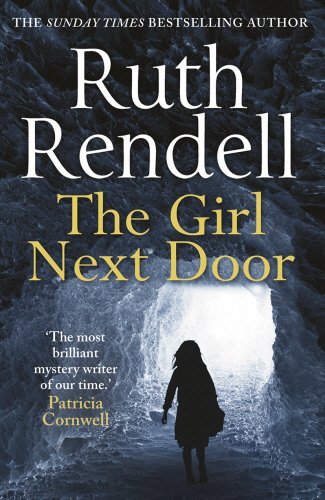
The Girl Next Door by Ruth Rendell

Rating: 5 out of 5.

Ruth Rendell, Lady Rendell of Babergh, also known as Barbara Vine, who died aged 85 in 2015, was a literary phenomenon. From 1964, when Inspector Reginald Wexford first appeared in From Doon With Death, she wrote more than sixty novels, including police procedurals, standalone and psychological mysteries plus numerous books of short stories. Many of them were adapted for television or made into feature films.

The Girl Next Door by Ruth Rendell, is one of my TBRs, a book that’s been sitting on my bookshelves since 2016. It’s one of her later novels, a stand-alone book, first published in 2014, a year before her death.

Description from Amazon UK

Beneath the green meadows of Loughton, Essex, a dark network of tunnels has been dug. A group of children discover them. They play there. It becomes their place.

Seventy years on, the world has changed. Developers have altered the rural landscape. Friends from a half-remembered world have married, died, grown sick, moved – or disappeared.

Work on a new house called Warlock uncovers a long buried grisly secret: the bones of two severed hands are discovered in a box, and an investigation into a long-buried crime of passion begins.

The friends, who played together as children, begin to question their past. And a weary detective, more concerned with current crimes, must investigate a case of murder.

The book begins just before the second world war when Woody killed his wife and her lover when he discovered they were having an affair. He then cut off their hands, a right hand and a left that they had held together, and put them in a biscuit tin, which he buried in a tunnel, where the local children played.

Time moves on to 1944. Ruth Rendell describes a garden where the neighbourhood children play:

The garden was not beautiful. It had no flowering trees, no roses, no perfumed herbs. Tunnels they called it at first. The word ‘qanat’, an impossible word, was found by Daphne Jones and adopted by the rest of them. It meant, apparently, a subterranean passage for carrying water, in some oriental language. They liked it because it started with a q without a u. Their schoolteachers had taught them that no word could ever start with q unless followed by u, so Daphne’s idea appealed to them and the tunnels became qanats. (pages 13 – 14)

Time moves on again and we meet up with the children as adults in their seventies, when the skeletal hands have been discovered. The qanats were actually the foundations of a house called Warlock in Loughton, twelve miles north of London and most of the children, are now still living in the area. When they read the newspaper report about the discovery of the hands they get together and reminisce about their childhood and playing in the tunnels, wondering whose hands had been buried.

This is when the book expands into a study of ageing as well as murder mystery:

As you get older, you forget names: those you studied with, lived next door to, the people who came to your wedding, your doctor, your accountant and those who cleaned your house. Of these people’s names you forget perhaps half, perhaps three quarters. Then whose names do you never forget, because they are incised on the rock of your memory? Your lovers (unless you have been promiscuous and there are too many) and the children you went to your first school with. You remember their names unless senility steps in to scrape them off the rock face. (page 17)

It’s quite a long book, nearly 350 pages in a small font in my copy and Ruth Rendell takes time to describe these old friends’ lives and reveals their relationships, their loves and losses and those of their own children and grandchildren as well as their regrets, and bereavements. I felt I really got to know them as real people. Long buried secrets rise to the surface, and old passions are reignited.

From the beginning we know the identity of the murderer, Woody and that of his wife Anita, but not that of the man, whose hand had held Anita’s. At times I thought I’d worked out who it was but when his identity was revealed it wasn’t who I thought it was – it was more complicated than I’d realised. And who is ‘the girl next door‘? I did work that out correctly. It is in some places a bleak novel, and all the characters’ lives have changed by the end of the book. It’s a book that really gripped me and drew me on to find out more. And I really enjoyed how it shows the changes that have taken place in society from the 1930s onward.

I’ve read several of Ruth Rendell’s standalone books and I think this is one of her best. I’ve also read some of her Inspector Wexford books and those she wrote under the name of Barbara Vine.

The Tree of Hands by Ruth Rendell

Rating: 5 out of 5.

Description from Amazon UK

When Benet was about fourteen, she and her mother had been alone in a train carriage – and Mopsa had tried to stab her with a carving knife. It has been some time since Benet had seen her psychologically disturbed mother. So when Mopsa arrives at the airport looking drab and colourless in a dowdy grey suit, Benet tries not to hate her. But when the tragic death of a child begins a chain of deception, kidnap and murder in which three women are pushed to psychological extremes, family ties are strained to the absolute limit…

The Tree of Hands by Ruth Rendell is one of my TBRs. It’s a book I bought nine years ago from Barter Books in Alnwick. I don’t know why I haven’t read it before now as it is really good – one of the best books I’ve read this year, and one of her best standalone books. I read it this year as one of my 20 Books of Summer.

Why I enjoyed it so much is that it thoroughly gripped me and made me want to read on and on. It’s a psychological thriller, full of suspense, with several twists and turns that made me unsure how it would end. I was delighted by the final twist!

Benet’s son, James aged four dies from croup whilst in hospital soon after Mopsa, her mother with a history of mental illness, comes to visit. Meanwhile Carol, a young widow with three kids, two of them in care, is living nearby with Barry, her younger boyfriend. He adores her but she doesn’t want to marry him, content for him to do all the housework and look after Jason her two year old son when he is not being looked after by babysitters. The trouble starts when Mopsa kidnaps Jason and brings him back to Benet as a replacement for James.

The tree of hands in the title is taken from the collage on the hospital playroom wall:

On the white paper base sheet had been drawn a tree with a straight brown trunk and branches and twigs, and all over the tree, on the branches, nestling among the twigs, protruding like fungus from the trunk, were paper hands. All were exactly the same shape, presumably cut out by individual children using a template of an open hand with the fingers spread slightly apart. (page 46)

Benet found them horrible, as though the hands were begging for relief, or freedom, or oblivion. She thought there was a mad quality about them, ‘all the hands upraised, supplicating, praying.’ And she fell forward in a faint when the doctor told her James had died.

This is a dark and disturbing book about what happens to Jason, Benet, Carol and Barry. It’s well written and I could easily visualise the characters and the setting. It’s emotionally challenging and it both fascinated and horrified me in equal measure. It won the CWA Silver Dagger Award in 1984, an award given annually by the Crime Writers’ Association of the United Kingdom since 1960 for the best crime novel of the year. 

NB I’m currently reading Rendell’s The Girl Next Door because I enjoyed The Tree of Hands so much.

Unnatural Death by Dorothy L Sayers

From the back cover:

‘No sign of foul play,’ says Dr Carr after the post-mortem on Agatha Dawson. The case is closed. But Lord Peter Wimsey is not satisfied.

With no clues to work on, he begins is own investigation. No clues, that is, until the sudden, senseless murder of Agatha’s maid.

What is going on in the mysterious Mrs Forrest’s Mayfair flat? And can Wimsey catch a desperate murderer before he himself becomes one of the victims?

This is the third book in the Lord Peter Wimsey series by Dorothy L Sayers, first published in 1927. My copy was reprinted in 2016 and I bought it secondhand five years ago. I’ve been reading this series totally out of order – I’ve already read the first two and several of the later books too. I think they each read well on their own.

Miss Climpson makes her first appearance in Unnatural Death, helping Lord Peter, working undercover. She is an elderly spinster, who runs what Wimsey calls ‘My Cattery’, ostensibly a typing bureau, but actually an amateur detective/enquiry agency. As in the first two books he works with his friend, Inspector Charles Parker, who is a Scotland Yard detective. Bunter, his manservant, only has a very minor role in this book. I think it’s an interesting mystery, not so much about discovering who killed Agatha Dawson and her maid, Bertha, but more about how the murders were committed.

Uncertain Death is most definitely a book of its time – that is the early 20th century. There is much banter, wit and humour, and plenty of snobbery of all types, clearly showing the class distinctions between the working and upper classes. Racism is prevalent and also lesbianism, although that is not directly stated. It is a clever story, well told, with colourful characters. There is a biographical note at the end of the book that reveals much about Lord Peter’s background, about his early years, school and university, and his experiences during the First World War.

The Classics Club Spin Result

The spin number in The Classics Club Spin is number …

17

which for me is How Green Was My Valley by Richard Llewellyn. The rules of the Spin are that this is the book for me to read by 22 September 2024.

Synopsis from Goodreads

A poignant coming-of-age novel set in a Welsh mining town, Richard Llewellyn’s How Green Was My Valley is a paean to a more innocent age, published in Penguin Modern Classics

Growing up in a mining community in rural South Wales, Huw Morgan is taught many harsh lessons – at the kitchen table, at Chapel and around the pit-head. Looking back on the hardships of his early life, where difficult days are faced with courage but the valleys swell with the sound of Welsh voices, it becomes clear that there is nowhere so green as the landscape of his own memory. An immediate bestseller on publication in 1939, How Green Was My Valley quickly became one of the best-loved novels of the twentieth century. Poetic and nostalgic, it is an elegy to a lost world.


This is good as How Green Was My Valley is also on my 20 Books of Summer list. I’m looking forward to reading it. It’s been on my To Be Read list for so long!

Did you take part in the Classics Spin? What will you be reading?

Daisy Darker by Alice Feeney

I’ve read Alice Feeney’s debut novel, Sometimes I Lie and His and Hers and loved them. So I had high hopes for Daisy Darker, her fifth book.  Sadly, I was disappointed and I have to say that I didn’t enjoy it. I’ll even go as far as admitting, which I really don’t want to say because I don’t like being negative about a book, I think it is dire. But there are plenty of other readers who enjoyed it, even loved it, so I’m in the minority here. Don’t let me put you off reading it, if it appeals to you. This is just my opinion.

Description (Goodreads)

After years of avoiding each other, Daisy Darker’s entire family is assembling for Nana’s 80th birthday party in Nana’s crumbling gothic house on a tiny tidal island. Finally back together one last time, when the tide comes in, they will be cut off from the rest of the world for eight hours.
The family arrives, each of them harboring secrets. Then at the stroke of midnight, as a storm rages, Nana is found dead. And an hour later, the next family member follows… Trapped on an island where someone is killing them one by one, the Darkers must reckon with their present mystery as well as their past secrets, before the tide comes in and all is revealed.

With a wicked wink to Agatha Christie’s And Then There Were NoneDaisy Darker’s unforgettable twists will leave readers reeling.

My thoughts:

I’m going to be brief. The beginning, was promising and made me interested enough to read on as the Darker family reunited for their Nana’s 80th birthday party at Halloween. They all arrive, Daisy, her father Frank, her mother Nancy, her siblings Rose and Lily and her niece, Trixie. Nana lives on a tidal island, which means that when the tide was in they couldn’t leave, making this a variation on the ‘locked room murder’ mystery, which I generally like. So, I read on, as hour by hour, one by one they’re all found dead. There’s a poem written in chalk on the back wall of the kitchen about the Darker family. As each death occurs the lines about each person are struck through. The poem is pure doggerel and painful to read.

The story quickly began to drag for me and I got fed up with the repetition of how many hours were left until low tide. I got tired of the unlikable characters in this dysfunctional family, the platitudes scattered throughout the book and the increasingly stupid plot, culminating in a surreal supernatural conclusion. I was glad to get to the end.

Hamlet, Revenge! by Michael Innes

A Golden Age Mystery

Hamlet, Revenge! by Michael Innes has been languishing on my TBR shelves for 9 years, mainly because it is in such a small font making it difficult for me to read. It was first published in 1937. My copy was published in 1961 in paperback with the cover shown in the photo above.

Synopsis:

A Scotland Yard detective probes a high-society house party for someone rotten when a government official is murdered in this classic British mystery.

Preparations are underway for a grand party at Scamnum Court, the sweeping English country estate of the fabulously wealthy Duke of Horton. Some of the nation’s elite are invited for dinner, and some are even set to star in a semi-amateur production of Hamlet on an authentic Elizabethan stage in the banqueting hall. No expense is spared, but one guest soon pays with his life. Before the play ends, a shot is fired, and the actor playing Polonius―Lord Auldearn, the Lord Chancellor of England―is dead.

With war looming on the horizon, suspicions arise over the possibility of espionage. Therefore, the prime minister sends Insp. John Appleby not only to investigate, but to also find a confidential government document. Appleby is lucky there’s a mystery novelist eager to lend a hand with the extensive guest list at Scamnum Court. He will need all the help he can get if he hopes to prevent the killer from making an encore performance . . .

My thoughts

This is the second Inspector John Appleby book. And like the first, Death at the President’s Lodging (my review) it is a most complex mystery. When Lord Auldearn, Lord Chancellor of England is murdered on stage during an amateur production of Hamlet at Scamnum Court the Prime Minister asks Appleby to investigate. Because there’s a possibility that espionage is involved, the PM tells Appleby not to trust anybody. It’s all very vague. The PM tells him there’s a document concerning

… the organization of large industrial interests on an international basis, in the event of a certain international situation. The general drift towards the matter such a document embodies cannot, you realize, well be secret; nothing big can be secret. But the details may be. And this document might be useful in two ways: the detailed information might be useful to one powerful interest or another: and accurate possession of the details, as circumstantial evidence of something already known in general terms, might be useful to an unfriendly government.

…War? said Appleby … (pages 83,84)

The book begins with a Prologue.which is is longer than most prologues. It sets the scene, describing Scamnum Court in detail. It’s the family seat of the Crispin family, described as ‘a big place: two counties away it has a sort of little brother in Blenheim Palace.’ All the characters are introduced, including Giles Gott, who was also in Death at the President’s Lodging. An eminent Elizabethan scholar, he is the director of the play. The other characters are also introduced; Lord Auldearn, the Lord Chancellor of England, who plays Polonius, and numerous other family members, guests and members of the Scamnum Court staff.

There are thirty people involved in the play, actors and those behind the scenes, plus twenty seven in the audience. I found this section too long (74 pages in my copy) and it took me more than a while to identify who was who! My attention was drooping as I read pages of long meandering, descriptive paragraphs and I wondered when there would be a murder. And there is a lot of information about the staging of the play and numerous Shakespearean references. Before the performance the murderer delivered a number of warning messages about revenge, so everybody is on edge.

Appleby doesn’t appear until the second section and then the pace picks up considerably as he and Gott question the suspects. It gets more complicated when a second murder, that of Mr Bose, the prompter who was on stage and who could possibly have seen who shot Lord Auldearn. I was puzzled for much of the time as I read – it’s a book that you can’t read quickly and it requires concentration. I had no idea who the culprit was as Appleby and Gott tried to eliminate the suspects and answer numerous questions, such as why was Lord Auldearn shot and not stabbed as Polonius the character he played was, why did the murderer come onto the stage to shoot him and risk being seen by Bose, why did he send the mysterious messages about revenge – what revenge was being sought, and was the possible espionage plot the reason behind the shooting? Or was the reason a personal one?

From being confused and overwhelmed by the puzzle I became thoroughly absorbed by the mystery and was eagerly turning the pages to find out all the answers. It’s a book I really need to re-read to get to grips with it – I’m sure I missed so much. My post falls far short of doing justice to the book!