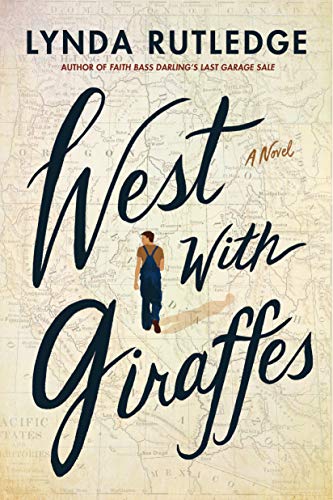
West with Giraffes by Lynda Rutledge

Lake Union Publishing| 2001| 346 pages| e-book| I bought it| 5*

Description on Amazon:

An emotional, rousing novel inspired by the incredible true story of two giraffes who made headlines and won the hearts of Depression-era America.

“Few true friends have I known and two were giraffes…”

Woodrow Wilson Nickel, age 105, feels his life ebbing away. But when he learns giraffes are going extinct, he finds himself recalling the unforgettable experience he cannot take to his grave.

It’s 1938. The Great Depression lingers. Hitler is threatening Europe, and world-weary Americans long for wonder. They find it in two giraffes who miraculously survive a hurricane while crossing the Atlantic. What follows is a twelve-day road trip in a custom truck to deliver Southern California’s first giraffes to the San Diego Zoo. Behind the wheel is the young Dust Bowl rowdy Woodrow. Inspired by true events, the tale weaves real-life figures with fictional ones, including the world’s first female zoo director, a crusty old man with a past, a young female photographer with a secret, and assorted reprobates as spotty as the giraffes.

Part adventure, part historical saga, and part coming-of-age love story, West with Giraffes explores what it means to be changed by the grace of animals, the kindness of strangers, the passing of time, and a story told before it’s too late.

My thoughts:

I read West with Giraffes by Lynda Rutledge in September this year but didn’t get round to writing about it then. I don’t think I need to add anything to the description shown above other than to say that I loved this story. I didn’t really expect to like it as much as I did – that took me by surprise. It has a colourful cast of characters, all fictional apart from the owner of the San Diego Zoo, Mrs Belle Benchley, a remarkable woman. In the Historical Notes at the end of the book she’s described as ‘an early glass-ceiling breaker‘. She began working at the zoo in 1925 as a civil servant bookkeeper, and working her way through a number of different roles eventually becoming known in the late 1930s as ‘the only female zoo director in the world‘. She believed that the only way people would care about wild animals was to meet them.

Not knowing much about American history I found the Historical Notes very helpful, particularly those about the Great Hurricane of 1938, the most destructive storm to strike New England in recorded history until 2012’s Hurricane Sandy. The journey the giraffes took was primarily the Lee Highway, the more southern, of the transcontinental routes at the time, designed to be a southern counterpart to the northern Lincoln Highway. The author’s website is fascinating giving lots of information about the book, photos from newspaper articles and details about her writing process.

It conjures up a vivid picture of America in 1938 during the Great Depression, the Dust Bowl, hobo cards, nomadic workers taking jobs where they could, desperate Hooverville dwellers in shanty towns, sundown town racism, and circus animal cruelty. But of course, it is the giraffes that are the two main characters. It is a remarkable book and if you like historical fiction based on fact, books about travel and an exciting story I think you’d enjoy it too.

Travels with a Donkey in the Cévennes by Robert Louis Stevenson – Short Nonfiction

Travels with a Donkey in the Cévennes: A Journey of Solitude and Reflection  by Robert Louis Stevenson, first published 1879

Namaskar Books| 2022| 124 pages| e-book| my own copy| 4*

The wild Cévennes region of France forms the backdrop for the pioneering travelogue Travels with a Donkey, written by a young Robert Louis Stevenson. Ever hopeful of encountering the adventure he yearned for and raising much needed finance at the start of his writing career, Stevenson embarked on the 120-mile, 12-day trek and recorded his experiences in this journal. His only companion for the trip was a predictably stubborn donkey called Modestine. Travels with a Donkey gives the reader a rare glimpse of the character of the author, and the journalistic and often comical style of writing is in refreshing contrast to Stevenson’s more famous works. (Goodreads)

This is a short nonfiction book, just right for both Nonfiction November and Novellas in November. It’s a book I’ve had since 2011 and I’m glad to say that it was well worth the wait. I enjoyed it on several levels, as travel writing, history of the Cévennes region, descriptive writing of the French countryside in 1878, observations of the local people and Stevenson’s thoughts on religion.

He began his journey through the Cévennes, a range of mountains in south-central France, at Le Monastier, a highland valley fifteen miles from Le Puy, where he spent a month preparing for his excursion southward to Alais (modern name, Alès) a distance of 120 miles.

I was struck by what he took with him – a sleeping sack, because he didn’t intend to rely on the hospitality of a village inn, and a tent was troublesome to pitch and then strike. Whereas, a sleeping sack was always ready to get into. His was extraordinary, made of green waterproof cart-cloth lined with blue ‘sheep’s fur’, nearly six feet square plus two triangular flaps to make a pillow at night and the top and bottom of the sack by day. It was a huge sort of long roll or sausage, large enough for two at a pinch. And that was why he bought a donkey from an old man. He called her Modestine because she was

a diminutive she-ass, not much bigger than a dog, the colour of a mouse, with a kindly eye and a determined under-jaw. There was something neat and high-bred, a quakerish elegance, about the rogue that hit my fancy on the spot.

But he soon discovered that unless he beat Modestine with a staff, which he didn’t want to do; it sickened him – and me too. He had to let her go at her own pace and patiently follow her and there were times when she just stopped and wouldn’t go any further. This was extremely slow and in the end he resorted to a goad, which was a plain wand with an eighth of an inch of pin which worked wonders on poor Modestine, who carried most of his equipment.

As well as his clothing, he also took his travelling wear of country velveteen, pilot coat and knitted spencer (a short waist-length, double-breasted, man’s jacket, originally named after George Spencer, 2nd Earl Spencer), some books, a railway rug, food, and a variety of other things including a revolver, a spirit lamp, lantern, candles, a jack-knife and large leather flask, a bottle of Beaujolais, a leg of cold mutton and a considerable quantity of black bread and white for himself and the donkey and of all things an eggbeater, which he later abandoned. He wasn’t travelling light!

The book is full of Stevenson’s descriptions of the countryside, such as this one of the landscape as he approached the Trappist Monastery of Our Lady of Sorrows:

The sun had come out as I left the shelter of a pine-wood, and I beheld suddenly a fine wild landscape to the south. High rocky hills, as blue as sapphires, closed the view, and between these lay ridge upon ridge, heathery, craggy, the sun glittering on veins of rock, the underwood clambering in the hollows, as rude as God made them at first.

Modestine had to stop at St Jean du Gard, as she just couldn’t travel any further and needed to rest. He sold her and continued on to Alais by diligence (a public stagecoach). He missed her after she was gone.

For twelve days we were fast companions; we had travelled upwards of a hundred and twelve miles, crossed several respectable ridges, and jogged along with our six legs by many a rocky and many a boggy road. After the first day, although sometimes I was hurt and distant in manner, I still kept my patience; and as for her, poor soul! she had come to regard me as a god. She loved to eat out of my hand. She was patient, elegant in form, the colour of an ideal mouse, and inimitably small.

And he wept!

I was rather surprised by how much I enjoyed this book, mainly because I didn’t know anything about it other than its title and thought it was perhaps fiction. Of course it isn’t and it’s full of detail of his hike that I haven’t mentioned in this review. I shouldn’t have been surprised as I’ve enjoyed other books by Stevenson – Treasure Island, Kidnapped and Catriona.

I read in Wikipedia that Stevenson’s purpose in making his journey ‘was designed to provide material for publication while allowing him to distance himself from a love affair with an American woman of which his friends and family did not approve and who had returned to her husband in California’, but without giving a source for this information. In his book Stevenson does say when talking to a monk he met at the Trappist Monastery that he was not a pedlar (as the monk thought), but a ‘literary man, who drew landscapes and was going to write a book’.

The Boy With No Shoes: a Memoir by William Horwood

Headline Book Publishing| 2004| Hardback edition| 440 pages| 5*

Five-year-old Jimmy Rova is the unwanted child of a mother who rejects him, and whose other children bully him. The one thing he can call his own is a pair of shoes, a present from the only person he feels has ever loved him. When they are cruelly taken away, Jimmy spirals down into a state of loneliness and terrible loss from which there seems no recovery.

This triumphant story of a boy’s struggle with early trauma and his remarkable journey into adulthood is based on William Horwood’s own remarkable childhood in south-east England after the Second World War. Using all the skills that went into the creation of his modern classics, Horwood has written an inspiring story of a journey from a past too painful to imagine to the future every child deserves. (Amazon)

William Horwood is an English novelist. He grew up on the East Kent coast, primarily in Deal. His first novel, Duncton Wood, an allegorical tale about a community of moles, was published in 1980. It was followed by two sequels, forming The Duncton Chronicles, and also a second trilogy, The Book of Silence. William Horwood has also written two stand-alone novels intertwining the lives of humans and of eagles, The Stonor Eagles and Callanish , and The Wolves of Time duology. Skallagrigg, his 1987 novel about disability, love, and trust, was made into a BBC film in 1994. In addition, he has written a number of sequels to The Wind in the Willows by Kenneth Grahame.

When I saw The Boy With No Shoes on the secondhand bookshelves in my local village hall I thought I’d like to read it. It was a great choice as I think it’s one of the best books I’ve read this year. It’s important to read the Author’s Note carefully before you read the book, and not dive straight into it. I had to re-read it after I’d read a few chapters as I was beginning to wonder if this was really fictional. I also wasted time searching on maps to find where he lived growing up.

In his Author’s Note at the front of the book he explained why he wrote about himself as Jimmy Rova:

When I was thirty-four and had been iller than I knew for two long years, my recovery began in the strangest and most magical dream of ways. |I woke one day from dreaming and saw myself when very young, as clearly as in a black and white Kodak photograph. I saw how desperately the little boy I once was had needed someone to talk to in a world where no one wanted to listen. I decided there and then to travel back in time and let myself as adult be listener to the child. This book and my final healing is the result of that imaginative listening, over very many years.

Because the boy seemed other than himself he gave him a different name and changed the name of his home town. By so doing he was able to fill in gaps, paper over the cracks and visit distant places of emotion that he would never have reached.

It is a long and detailed book that took me nearly a month to read. It is beautifully written and as he tells the story of his very early life there are many times when it moved me to tears. His writing is so clear that the places and people he describes spring to life as you read. All the characters have depth and are believable as people.

He is just as good at portraying Jimmy’s feelings and emotions. I could feel his depth of despair, fear and confusion as he describes his first memory about the man in a time long ago who bought him a pair of shoes. That day entered his heart and stayed there forever. He called him The Man Who Was, the man who left him standing in the rain, holding his Ma’s hand, full of fear that he would not be there to keep him safe from Ma, who treated him appallingly, and he would be all alone. All that was left to him were the shoes. So, imagine how awful it was when the shoes disappeared, cruelly taken from him.

But life for Jimmy did eventually get better, especially when Granny came to live with them, but even she could not protect completely from his abusive Ma. I loved all the details of Granny’s time in Africa with ‘The African Gentleman’, who wore a funny hat on his grey and grizzled hair, and his clothes were striped black and yellow. In his hand he carried a wand like a magician. Also unforgettable is his first love, Harriet, and how his mother ended their affair.

There were others too who were kind to him. I loved his description of a new English teacher at the Grammar School, who in contrast to the Head and other teachers believed in the boys. He inspired Jimmy and transformed his life by showing him how to believe he could succeed and how to prepare for his O levels.

There were others too, His Uncle Max who took him hiking in Snowdonia. Moel Saibod was the first mountain he climbed and then others, including Snowdon, the tallest mountain in Wales and England. Then, Mr Boys who taught him to read, Mr Bubbles, a fisherman and his wife, who lived along the shore and taught him all about fishing. I could go on and on, but really if this interests you the best thing is to read the book for yourself. It is a wonderful book, that captures what life was like in the 1950s and even though my childhood was nothing like his, it brought back memories of growing up. I too, as a young woman) climbed Snowdon – Welsh name, Yr Wyddfa (I did not take the Snowdon Mountain Railway either up or down) and also Moel Saibod.

Gulliver’s Travels by Jonathan Swift

The summary on Goodreads:

A wickedly clever satire uses comic inversions to offer telling insights into the nature of man and society. Nominated as one of America’s best-loved novels by PBS’s The Great American Read.

Gulliver’s Travels describes the four voyages of Lemuel Gulliver, a ship’s surgeon. In Lilliput he discovers a world in miniature; towering over the people and their city, he is able to view their society from the viewpoint of a god. However, in Brobdingnag, a land of giants, tiny Gulliver himself comes under observation, exhibited as a curiosity at markets and fairs. In Laputa, a flying island, he encounters a society of speculators and projectors who have lost all grip on everyday reality; while they plan and calculate, their country lies in ruins. Gulliver’s final voyage takes him to the land of the Houyhnhnms, gentle horses whom he quickly comes to admire – in contrast to the Yahoos, filthy bestial creatures who bear a disturbing resemblance to humans.

I think Gulliver’s Travels is such a strange book, definitely not a children’s book as I had thought. There are very many editions of this book. The edition I read is the e-book edition based on the text of Swift’s 1726 original, with the 1899 illustrations of Arthur Rackham. It’s a satire on human nature and the imaginary travellers’ tale literary subgenre about Lemuel Gulliver, a ship’s surgeon who travels to four strange and distant lands.

This is one of those books that I’ve known of since childhood and have known bits of the story, but have never read. I did see a TV cartoon version several years ago and I’ve been meaning to read it for years. It’s a book, which operates on several levels, as the Introduction in one of my copies (an Odhams Press Limited publication) states:

An embittered, middle-aged man sat down to write a book that would scourge the vices and follies of mankind. That book, with its sting mellowed during the passage of two hundred years, has become – of all things – a children’s classic. ‘Gulliver’s Travels’ was the splenetic outburst of a passionate mind, whose genius gave immortality to so transient a thing as satire; but that immortality had a permanent basis – a child-like delight in marvels, a freshness of invention, a limpid style and a selective perception that created images of giants, dwarfs and fabled races with a vivid pulsating life of their own.

I don’t think I’d have liked it very much if I’d read it as a child as there are many passages that would have bored me stiff and which even now I found tedious and heavy going in parts. It satirises the political situation during Swift’s lifetime, and is full of political and social allusions, a lot of which, interesting as it is, passed over my head.

But it is a fantastical fantasy set in such different places, the ones I found most interesting are Lilliput inhabited by tiny people Brobdignag, the land of giants, and the country of the Houyhnhms, where a race of talking horses, rule the Yahoos, strange, filthy humanoid animals that Gulliver viewed with contempt and disgust. Gulliver became a part of one of the horse’s households and grew to admire and wanted to emulate the Houyhnhms’ way of life, which left him horrified with humanity. Less interesting is his visit to Laputa, a flying island and it’s rebellious cities.

It was not really what I expected, and whilst I think a lot of it is absurd and amusing, it’s certainly not a book I can say that I enjoyed, I think it was worth reading and I’m glad I finally got round to reading it.

Completely Unexpected Tales by Roald Dahl

I’m taking part in Short Story September hosted by Lisa at ANZ LitLovers LitBlog She asks us to read a collection and then choose just one story to review, defining a short story as one that can be read in under an hour. It’s fine to mention the titles of other stories in the collection that you also enjoyed, of course. Aim for a review that’s less than 800 words, but this is not a hard-and-fast rule because some stories need less and others need more.

Roald Dahl is well known for his children’s books. He was a poet, screenwriter and a wartime fighter ace, a military pilot who had officially shot down a minimum number of enemy aircraft, typically five or more, during aerial combat.

He also wrote numerous short stories for adults. There are several collections of these. I have just one – Completely Unexpected Tales by Roald Dahl, which is made up of two collections: Tales of the Unexpected and More Tales of the Unexpected. I first came across Roald Dahl back in 1979 when I used to enjoy watching these tales in the TV series, Tales of the Unexpected. There are 25 short stories in total in this book, some of them are very short, but I prefer the longer stories. As the title suggests these short stories all end with an unexpected twist, some are more predictable than others, but others did take me by surprise with a sting in the tail.

Roald Dahl was born n Llandaff, Glamorgan. His parents were Norwegian. I bought this book at The Roald Dahl Museum and Story Centre in the village of Great Missenden, Buckinghamshire where Dahl lived until his death in 1990. Previously I’ve read and enjoyed some of his children’s books.

On the back cover Completely Unexpected Tales is described as a superb compendium of vengeance, surprise and dark delight. I haven’t read all the stories yet but a couple stand out for me.The first is William and Mary, which was originally published in 1959 and included in his 1960 collection Kiss Kiss, a sinister story about the darker side of human nature.

After William Pearl died his wife, Mary received a letter which both surprised and shocked her. It wasn’t at all what she had expected. A domineering, unpleasant man he began in usual bossy way by telling her to:

continue to observe those precepts which have guided you so well daring our partnership together. Be diligent and dignified in all things. Be thrifty with your money. Be very careful that you do not . . . et cetera, et cetera.

She had hoped he might have written her something beautiful, that maybe he’d thank her for giving him thirty years of her life and for ironing a million shirts and cooking a million meals and making a million beds, something that she could read over and over again, once a day at least.

But, no this was a letter describing a scientific experiment that Doctor Landy, an Oxford University colleague wanted to do on his brain immediately after his death from cancer. She was shocked and appalled as he proceeded to tell her in great detail what it entailed.

He ended his letter with a postscript reminding her not to drink cocktails… waste money… smoke cigarettes… buy a television apparatus.

After she read it all, she reached for a cigarette, lit it, inhaling the smoke deeply and blowing it out in clouds all over the room. Through the smoke she could see her lovely television set, brand new, lustrous, huge, crouching defiantly but also a little self-consciously on top of what used to be William’s worktable. What would he say, she wondered, if he could see that now?

He disapproved of smoking and also of children and they’d never had any. But after thirty years of doing what he told her, she felt she had to follow his instructions and rang Landy to see whether the experiment had gone ahead. It had and Dahl describes it in disgusting and repulsive detail.

This is a story about control, revenge and the dark side of human relationships and as I read it I wonder how Mary would react. She’d already gone against his ban on smoking and watching television. But would she really break free of his control and could she indeed take revenge on him?

The other story features a couple with a very different marriage – Mrs Bixby and the Colonel’s Coat. Mrs Bixby has been having a secret affair for years with an extremely wealthy man known as the Colonel. When he gives her a beautiful mink coat she wonders what to tell her husband about where she got it. In the end she decides to pawn the coat and tell him she found the pawn ticket in a taxi and then she can retrieve the coat. But will this plan work? Is her dentist husband really as ignorant of her affair as she thinks. I was pleased with the ending of this story of betrayal and deception.

Short Story September 2025

Lisa at ANZ LitLovers will be hosting a new reading event – Short Story September, running from September 1 to 30. On September 1st Lisa will set up a post where all contributions can be posted so that they form a valuable resource that is easy to find.

To participate, please keep it simple.  We all know that it’s hard to review short story collections, so all you are asked to do is to read a collection and then choose just one story from that collection to review.  To sidestep all the yada-yada about how many words a short story can be, just choose a story that can be read in under an hour.

Contributions should include the name of the short story and its author, and the title of the collection that you found it in, and its editor is there is one.  Please #NameTheTranslator for all translations.  It’s fine to mention the titles of other stories in the collection that you also enjoyed, of course.

Aim for a review that’s less than 800 words, but this is not a hard-and-fast rule because some stories need less and others need more.

I’ve four collections of Agatha Christie’s short stories I’ve been meaning to read for ages. So, I got them down from the bookshelves:

Poirot’s Early Cases – Captain Hastings recounts 18 of Poirot’s early cases from the days before he was famous from theft and robbery to kidnapping and murder – were all guaranteed to test Poirot’s soon-to-be-famous ‘little grey cells’ to their absolute limit.

The Golden Ball and Other Stories – bizarre romantic entanglements, supernatural visitations and classic murders.

Miss Marple and Mystery: the Complete Short Stories, an omnibus of 55 short stories, presented in chronological order 1923 -1958.

The Complete Parker Pyne, Private Eye – this edition brings together all 14 stories featuring the rather fat and unconventional Mr Parker Pyne.