R.I.P. VII wrap-up

R.I.P. VII, hosted by Carl, has come to its end – the time has just flown by.

I chose Peril the First – ‘˜Read four books, any length, that you feel fit (the very broad definitions) of R.I.P. literature. It could be King or Conan Doyle, Penny or Poe, Chandler or Collins, Lovecraft or Leroux’¦or anyone in between.’

Mystery.
Suspense.
Thriller.
Dark Fantasy.
Gothic.
Horror.
Supernatural.
Or anything sufficiently moody that shares a kinship with the above.

I completed the challenge as many of the books I read in September and October fitted into these categories. I read:

  1. Death of a Red Heroine by Qiu Xialong
  2. Dark Matter: a Ghost Story by Michelle Paver
  3. The Sixth Lamentation by William Brodrick
  4. Maigret and the Ghost by Georges Simenon
  5. The War of the Worlds by H G Wells
  6. The Four Last Things by Andrew  Taylor
  7. The Judgement of Strangers by Andrew Taylor
  8. Fear in the Sunlight by Nicola Upson
  9. The Chalk Circle Man by Fred Vargas
  10. The House of Silk by Anthony Horowitz
  11. Hickory Dickory Dock by Agatha Christie
  12. The Expats by Chris Pavone

The ones that stand out as the scariest are The Four Last Things by Andrew Taylor and Dark Matter by Michelle Paver. Sometimes life gets in the way of blogging  so I haven’t had time to write about The War of the Worlds or The House of Silk, but those are good books too and I am aiming to write about The House of Silk – the new Sherlock Holmes Novel!

The Judgement of Strangers by Andrew Taylor

The Judgement of Strangers is the second in Andrew Taylor’s Roth Trilogy, an ideal choice for  R.I.P.VII. This second book fills in some of the back story of the first, The Four Last Things, which I wrote about earlier. It covers events that took place in 1970 and although there is an atmosphere of suspense and mystery it is by no means as chilling and scary as The Four Last Things.

It’s narrated in the first person by David Byfield, who is a sexually frustrated, widowed parish priest with a mysterious past. When he marries Vanessa, his beautiful teenage daughter, Rosie, seems to accept her. But, it’s obvious that David is unaware of Rosie’s psychological troubles and is beset with problems – his own passions, the attentions of the menopausal spinster churchwarden, Audrey Oliphant, as well as his obsession with Joanna, the new young owner of Roth Park.

And then the murders begin and it seems that the influence of Francis Youlgreave, a 19th century opium addict, poet and priest who committed suicide at Roth Park is still prevalent. Vanessa is fascinated by him. The sole surviving member of the family, Lady Youlgreave, now  senile lives in the Old Manor House with her equally senile dogs, Beauty and Beast. She allows Vanessa to study Francis Youlgreave’s journals. The pressure and suspense build, with the climax at the village fete, which ends in disaster. 

 In some ways this book is a bit like an Agatha Christie mystery – set in a village (there’s a helpful map), with a mix of characters, locals, gentry and newcomers. The plot is complex and although it can be read as a self-contained novel, it really is best to read the trilogy in order, because there are answers in this book to some of the questions posed in the first and I think it could spoil the suspense if you read them the out of order. There are also intriguing glimpses into the past. I’m keen to read the third book – The Office of the Dead – as soon as possible. And I’d like then to re-read them in reverse order, just to see the difference.

Crime Fiction Alphabet: T is for …

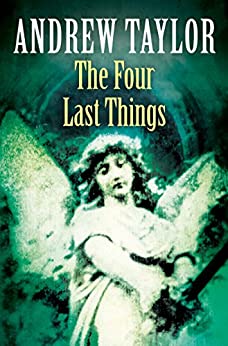
The Four Last Things by Andrew Taylor.

This is the first in the Roth trilogy, a tense and scary opening book. So chilling that I nearly stopped reading it and only continued because I couldn’t get the story out of my head and I wanted to know how it ended.

The complete trilogy is about the linked histories of the Appleyards and the Byfields. The books work backwards in time, with this first book being the last chronologically, set in the 1990s, and each book works as a stand-alone, self-contained story. Andrew Taylor states they are designed to work together, but they can be read in any order. The second novel, The Judgement of Strangers, describes events that took place during the summer of 1970, with the third, The Office of the Dead, ten years earlier again. But, having read the first book and the second, I think it is best to read them in that order, because there are people and things that happen that have roots in the second (and I suspect because I haven’t read it yet) the last book and it would spoil the story to know these in advance.

The Four Last Things tells the story of Lucy Appleyard, aged four, who is snatched from her child minder’s one cold winter afternoon. Her parents, Sally, a deacon in the church of England and Michael, a police sergeant, are distraught. Their fears mount as grisly body parts are discovered first in a graveyard and then in a church. A sense of evil and menace permeates the book, told from varying viewpoints conveying Sally’s and Michael’s terror and powerlessness. The characterisation is strong, so much so that I feared for Lucy’s safety and even sympathised with one of the kidnappers.

It’s not just the characters and the mysteries that kept me captivated reading The Four Last Things, because the settings are so well described and so atmospheric, so vivid that I could easily see them in my mind – the dingy London streets and alleyways, the old churches and graveyards, and the overgrown back garden of 29 Rosington Road.

The reason I found this book is so compelling to read is that, although there are horrific elements to it (although not in gratuitous detail) and it’s about the kidnapping of a little girl (which always horrifies me), it’s also a puzzle, posing questions such as why and how these events came about. And the answers aren’t all in this first book. There are tantalising glimpses of the kidnappers’ backgrounds and their psychological make-up, which in themselves are so disturbing. There are questions too about the parents – Sally wonders if there is a religious motivation behind the kidnapping, particularly after the incident in church where she is cursed by an old woman. And what is so troubling in Michael’s background, why is he so reliant on his ‘Uncle David’, an Anglo-Catholic known as Father Byfield? Where do the Reverend Francis Youlgreave and the parish of Roth fit in ? What had happened there when David was the vicar? It was these questions that made me pick up the next book as soon as I’d finished the first. I have just finished it this morning and have some of the answers, but also more questions. I’ll be writing more in another post on The Judgement of Strangers some time soon.

The title is a reference to a painting of the Last Judgement showing the ‘four last things’ identified in a passage in the Apocrypha as ‘Death and Judgement and Heaven and Hell.’ Sally comes to realise that ‘where hell is, there is Lucy.’

vaguely remembered watching a TV version of this with Emilia Fox and Charles Dance as two of the characters. Looking it up, I see that this was in 2007 under the title Fallen Angel. Fallen Angel is also the title of the HarperCollins paperback omnibus of the trilogy (formerly published as Requiem For an Angel). I think the books will stick in my mind longer than the TV version did. For me reading is almost always better than watching a film or TV drama.

A Crime Fiction Alphabet post for the letter T.

This book also fits very nicely into the R.I.P. VII Challenge.

  • Paperback: 368 pages
  • Publisher: HarperCollins; (Reissue) edition (5 Feb 2001)
  • Language: English
  • ISBN-10: 0007105118
  • ISBN-13: 978-0007105113
  • Source: my own copy
  • My rating: 4/5
  • Author’s website: Andrew Taylor

Dark Matter: a Ghost Story by Michelle Paver

Dark Matter

My first book for the R.I.P. VII Challenge is a chilling book, very chilling, both in the setting in the High Arctic and in atmosphere. I was glad I wasn’t reading Dark Matter by Michelle Paver in the dead of winter, snowbound and alone, because then it would have been terrifying. The isolation of the long, dark Arctic winter is oppressive and unrelenting.

It’s a ghost story in the form of a diary – that of Jack Miller who in 1937 was part of an expedition to the High Arctic to study its biology, geology and ice dynamics and to carry out a meteorological survey. Jack’s role is as radio operator, transmitting observations three times a day to the Government forecasting system.

From the start Jack is very reluctant to go, put off by the other members of the expedition, four ex-public schoolboys. But he’s stuck in a boring job, after giving up his plans to be a scientist and realises this is the only chance he’ll ever get to change his life. Right from the start things begin to go wrong, but Jack remains enthusiastic. Later when they meet Skipper Eriksson, the part owner and captain of the ship taking them to Gruhuken, a remote uninhabited bay where they’re setting up camp, Jack begins to feel increasingly uneasy. Eriksson is reluctant to take them to Gruhuken, but he doesn’t explain why merely saying he doesn’t think it’s ‘right’ for a camp.

Not long after they have set up camp Jack feels oppressed by the isolation brought on by the thought of the men who had been there before them:

Suddenly, I felt desolate. It’s hard to describe. An oppression. A wild plummeting of the spirits. The romance of trapping peeled away, and what remained was this. Squalor. Loneliness. It’s as if the desperation of those poor men had soaked into the very timber, like the smell of blubber on the Isbjørn. (page 65)

The trappers had left behind a ruined mine, a hut ‘crouched among the boulders  in a blizzard of bones‘ and in front of the hut a ‘bear post’ for luring bears to the trappers’ gun. It all makes Jack’s spirits sink. As the ship is leaving the camp, Jack sees a man standing in front of the cabin by the bear post and is relieved when he leaves. Now the members of the expedition are alone with the huskies and Jack’s unease grows. He is disturbed by the change in the weather, the increasingly shorter days and irritated by the other members, in particular by Algie and his insensitivity and cruelty towards the dogs.

Jack’s unease turns into dread as he realises that Gruhuken may be haunted, but his rational mind explains his feeling as an echo:

An echo from the past. … it’s called ‘place memory’, a well-known idea, been around since the Victorians. If something happens in a place – something intensely emotional or violent – it imprints itself on that place; maybe by altering the atmosphere, like radio waves, or by affecting matter, so that rocks, for example, become in some way charged with what occurred. Then if a receptive person comes along, the place plays back the event, or snatches of it. … What I saw was only an echo. (pages 111-2)

As the darkness descends, Jack is left alone at the camp and his nightmare really begins. The book is well-paced, the tension mounts, and paranoia sets in … or is it real, even the dogs are scared. It really is a page-turner and a good old-fashioned ghost story. The relationships between the characters are well drawn, and especially Jack’s relationship with Isaak, one of the huskies. I was most concerned about Isaak!

Jack describes ‘dark matter‘ of the title, as that part of the universe that cannot be seen or detected, but is there. He finds this idea

‘… unsettling. Or rather, not the idea itself, that’s merely an odd notion about outer space. What I don’t like is the feeling I sometimes get that other things might exist around us, of which we know nothing.’ (pages 94-5)

I don’t like that either. It’s scary.

  • Hardcover: 256 pages
  • Publisher: Orion; First Edition edition (21 Oct 2010)
  • Language: English
  • ISBN-10: 1409123782
  • ISBN-13: 978-1409123781
  • Source: I bought the book
  • My Rating: 4/5

R.I.P. VI Challenge Completed

Carl’s R.I.P. VI  challenge ended on 31 October and I’m pleased that I completed Peril the First, which was :

Read four books, any length, that you feel fit (my very broad definitions) of R.I.P. literature. It could be Stephen King or Sir Arthur Conan Doyle, Ian Fleming or Edgar Allan Poe’¦or anyone in between.

I read the following books (linked to my reviews):

These are all books that were on my to-be-read list. I think Blood Harvest has to be my favourite of the four and I thoroughly enjoyed it – a dark, scary book, disturbing, and completely gripping.  I was particularly pleased that I finally read The Turn of the Screw as I first started to read it some years ago. It’s an ideal book for the RIP Challenge. Thanks go to Carl for hosting.

The Turn of the Screw by Henry James: a Book Review

I first started to read The Turn of the Screw by Henry James a few years ago soon after I bought it. I stopped reading, mainly, I think, because it seemed so slow to get going with long, convoluted sentences that seem to drag the story down. So, it was with low expectations that I began once more to read it. I was surprised. This time the story didn’t drag, the sentence structure didn’t bother me and I became engrossed in the tale. It’s an ideal book for the RIP Challenge.

The Turn of the Screw

But is it a ghost story or a psychological study? Either way there are creepy, disturbing things going on. It’s a story within a story, told as a ghost story to a group of people as they sit gathered round a fire in an old house. It tells of two children and their governess. She has been employed by their uncle who wants nothing to do with them. Their previous governess had died under mysterious circumstances (was it in childbirth?).  The older child, Miles, was away at school and soon after the new governess arrives Miles returns home, expelled from school for some terrible unexplained offence.

The children seem to the governess to be beautiful, little angels, but are they as innocent as they seem? And can they see the ghosts or not? Is the governess imagining them, peering in menacingly through the windows, standing silently and staring from the top of a tower, or gazing intently across a lake. Are they the ghosts of Miss Jessel, the previous governess and Peter Quint, also a previous employer? What relationship did they have with the children? Do they still have a hold over the children? These questions are never fully answered and the governess, aided (or not?) by the housekeeper, Mrs Grose, becomes increasingly unhinged by all the events. I think it’s all the better for the ambiguity.

The story is dark and melodramatic, about good and evil and with hints of sexual relations, reflecting the Victorian society of the time. The Turn of the Screw is based on a ghost story told to James by the Archbishop of Canterbury, Edward White Benson. It was first published in 12 instalments in Collier’s Weekly, a popular,  illustrated New York magazine in 1898.  By that time his wrist was too painful to actually write the story and he dictated  it to his secretary, William MacAlpine, who typed as James spoke.

My copy of the book  is in the Case Studies in Contemporary Criticism series, edited by Peter G Beidler. It contains not just the text, but critical essays from four contemporary critical perspectives, plus explanations of the biographical, historical and cultural contexts. I haven’t yet read much of the additional material as I wanted to see what I made of it myself. Just scanning the essays I think they show the widely different interpretations and controversies this book has aroused and should prove very interesting reading.