Ten Little Niggers by Agatha Christie

I wondered when I began to write this post whether to use the current title, And Then There Were None, for this book, but chose to use its original title, Ten Little Niggers as that is the title of my copy, a 1968 reprint of its first publication in the UK in 1939. Because of its offensive title it was first published in the US a few months later in 1940 as And Then There Were None.
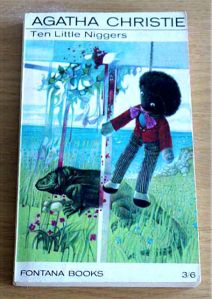
Ten Little Niggers

Description from the back cover:

10 people are invited to a fabulous mansion on Nigger Island off the coast of Devon. Though they all have something to hide, they arrive hopefully on a glorious summer evening… But soon a series of extraordinary events take place: the island is suddenly bathed in a most sinister light .. panic grips the visitors one, by one … by one… by one…

Eight people are invited to the island (based on a real island – Burgh Island off the south west coast of Devon). They are met by the butler and housekeeper/cook who explain that the owner, Mr Owen (U.N.Owen) has been delayed but has left instructions for their reception. In each of their rooms is a framed copy of the rhyme about the ten little nigger boys who all met their death. On their first evening they sit down to dinner in good spirits until, without any warning they hear a Voice accusing each of them (including the butler and housekeeper) of having caused the deaths or murdered a number of people. From that point onwards, one by one they are found dead, corresponding to the deaths in the rhyme and one by one a china figurine on the dining room table mysteriously disappears.

As the weather worsens they are stranded on the island and unable to leave or to get help from the mainland. Agatha Christie has created not only a ‘locked room’ type of mystery but also a mystery full of suspense, as the guests try to identify Mr U N Owen and become increasingly suspicious of each other. Their fear is further amplified by the house itself, which surprisingly is not an old Gothic house full of creaking wood and dark shadows –

But this house was the essence of modernity. There were no dark corners – no possible sliding panels – it was flooded with electric light – everything was new and bright and shining. There was nothing hidden in this house, nothing concealed. It had no atmosphere about it.

Somehow, that was the most frightening thing of all …

They exchanged good-nights on the upper landing. Each of them went into his or her own room, and each of them automatically, almost without conscious thought, locked the door … (page 52)

Despite their precautions the deaths continue, and each time no one sees or hears anything. I’d marked the page with the rhyme and kept flipping back to it to check how the next victim was going to meet with death, as I tried to work out who the murderer was and how he/she was able to carry out the murders unobserved. What makes it more tense for the reader (or at least for me) is the technique Agatha Christie makes of revealing the thoughts of the remaining characters, but without letting on who the thinker is.

In 1943 Agatha Christie adapted the book into a play, changing the ending, and there have been several film versions, none of which I’ve seen, so I didn’t know who the murderer was, although I knew the outline of the plot. Part way through the book I thought – ah, there is only one person who could be the murderer and I was right. I must re-read the book sometime to see if there were any clues, because if there were I missed them. My idea was based on the probability of that character being the murderer rather than any specific clues.

It is an ingenious mystery, revolving around the concepts of guilt and justice. There was no doubt that each of the victims had committed murder or caused/influenced the death of another person. But did the punishment fit the crime and could it ever be justified? As the murderer explains in an epilogue there were varying degrees of guilt among the victims and those whose guilt was lightest were killed off first!

This is possibly the most famous of Agatha Christie’s books. In her Autobiography Agatha Christie wrote that she had written the book because it was so difficult to do and the idea fascinated her. I found it fascinating too, but as an exercise and a puzzle rather than as a novel. Writing about the play and the book she stated:

I don’t say it is the play or the book of mine I like best, or even that I think it is my best, but I do think in some ways that it is a better piece of craftsmanship than anything else I have written. (page 489 of An Autobiography)

I agree.
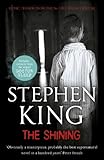
The Shining by Stephen King

Years ago I read a few of Stephen King’s books, including Carrie and Christine but I didn’t read The Shining. I saw the film with Jack Nicolson, which is terrifying. I remember his crazed face as he rampaged through the hotel, the sense of evil and terror, and I decided that was enough – I wouldn’t read the book.

Recently I changed my mind and bought a copy on Kindle and began reading – it’s an ideal book to read for Carl’s R.I.P. challenge. It has a fascinating introduction by Stephen King, in which he writes about writing horror stories and how he came to write The Shining, which was a ‘crossroads novel’ for him. He wanted to go deeper than he had in his earlier books (The Shining was his third novel) and make his characters more realistic and therefore more frightening. In my opinion he succeeded.

The Shining tells the story of Jack Torrance and his family as they move into the Overlook Hotel in the Colorada Rockies. The Overlook is closed for the winter and Jack, a recovering alcoholic is the caretaker. Just what impels him towards murder is horrifyingly revealed as the winter weather closes in on the hotel and they are cut off from the rest of the world. For terrible things had taken place at the hotel and as psychic forces gather strength ghosts begin to surface and both Jack and his five year old son, Danny are their targets. There are hints right from the start that the Overlook is not a good place to be and Jack is told that there have been scandals and suspicious deaths, and he soon discovers from records down in the basement just what has been going on. Also down in the basement is the boiler – that seems to have a life of its own – Jack has to control it, release the pressure to let off its steam.

Danny too, who has the gift of ‘shining’ was warned by Dick Hallorann, the hotel’s cook, as he was leaving, that bad things had happened in the hotel and if he should see something he should just look the other way and it would be gone. ‘Shining’ is a psychic ability – both Danny and Hallorann can hear people’s thoughts, and see visions of the past and of the future. He tells Danny to ‘call’ him if there’s trouble and he’ll come to help. Danny tries looking the other way, but it doesn’t work and he desperately needs Hallorann’s help. I didn’t remember this part in the film and as the tension built, just as the pressure in the boiler inexorably rose, I just couldn’t foresee how the book would end.

In fact there’s an awful lot of the film I don’t remember. I didn’t remember the hedge animals. These are blood-chilling as they come to life and move when you’re not looking – like the stone angels in Doctor Who! Truly terrifying. And the carpet in the hotel corridor with its deep jungle of blue and black woven vines and creepers, the light blue silk wallpaper with the embossed pattern of wavy lines and the wasps crawling and stinging again and again. Oh, no I probably couldn’t have watched that – and I couldn’t stand to watch the film again to see if these scenes were in it!

The characters are so well-drawn and so distinct. Their vulnerability, coupled with the way King gets inside each person’s head, increases the element of fear. There’s the horror of the father who has monsters inside his head, who still loves his son, but demands he should ‘take his medicine’; the evil is palpable. Then, the powerlessness of the mother to help either her husband or son makes it even more frightening. Even when it seems to have ended there is a further twist in the tale and it’s not the end. I read on breathless, almost.

It was only when I’d nearly finished read The Shining that I discovered that Stephen King has written a sequel, Doctor Sleep – I just have to read that!

Not the End of the World by Christopher Brookmyre

Not the End of the World

Not the End of the World by Christopher Brookmyre is a crime thriller set in Los Angeles at the end of the last century when people were in the grip of ‘1999 Syndrome’:

1999 Syndrome took plain old Things Are Getting Worse and changed it into Things Are Getting Worse Because The End Is Nigh. Crime used to be seen as instances of anti-social behaviour, sins against society. But now there was this resigned attitude at large that it was indicative of a greater, inexorable process of decay. Each crime now had to Mean Something, each new atrocity held up as the next marker on our descent into uncharted depths of stygia. (page 37)

Synopsis (from Christopher Brookmyre’s website):

The crew of an oceanic research vessel goes missing in the Pacific along with their mini-submarine.

An evangelical media star holds a rally next door to a convention in LA devoted to ‘nubile’ cinematic entertainment.

The cops know there’s going to be trouble and they are not disappointed. What they didn’t foresee was the presence in their state of a Glaswegian photographer with an indecipherable accent and a strong dislike of hypocrisy or of a terrorist who seems to have access to plutonium as well as Semtex.

My View

I became absorbed in this book as I read it. The plot is tightly constructed but the novel is interspersed with details of the main characters’ backgrounds and how they came to have their beliefs and personality traits, which slows down the action somewhat. However, this does flesh out the characters – the tension and drama slowly comes up to boiling point.

Larry Freeman of the LAPD is overseeing security at the Pacific Vista Hotel where the American Feature Film Market is being held. Just over the road the Evangelical Festival of Light is being held, including the Mission of Purity and the American Legion of Decency, led by the TV evangelist and ex-Presidential candidate Luther St John. St John has predicted that time is running out, the countdown has begun and a tidal wave is going to hit LA as God’s punishment for all the evil man has committed. St John’s wrath is also aimed at the ‘Whore of Babylon’, the porn actress Madeleine Witherson, whose father is a Republican Senator. Steff Kennedy is a Scottish photographer who falls in love with Maddy and gets mixed up in the whole scene and the result is chaos. Add into this mix diatribes against fundamental religion and this is the book in a nutshell.

I enjoyed it, but could have done with less detail about the characters’ backgrounds. Brookmyre’s style is snappy, cynical and wise-cracking, although in places I thought it was too wordy. I really liked the ancient history references to the Minoan eruption of Thera (Santorini), one of the largest volcanic eruptions of all time, a ‘devastating caldera eruption’, resulting in one of the largest seismic waves in history. I’d like to find out more about that!

Not the End of the World is Christopher Brookmyre’s third book. He is a Scottish novelist whose novels mix politics, social comment and action with a strong narrative. He has been referred to as a Tartan Noir author.

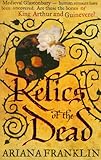
Relics of the Dead by Ariana Franklin

As soon as I’d finished reading The Death Maze I began Ariana Franklin’s third book in her Mistress of the Art of Death series, Relics of the Dead. Now this one was more to my liking and I enjoyed it very much.

The date is 1176, the setting is Glastonbury where the monks, after a fire had destroyed their monastery, discovered two skeletons buried in their graveyard. The question is  – are these the remains of King Arthur and Queen Guinevere? The problem is that Henry II needs evidence that they are not – that the legendary Arthur is indeed dead and not the ‘Once and Future King’, sleeping but waiting for the right time to lead the belligerent Welsh against him. Henry’s solution is to send Adelia Aguilar, the anatomist, to examine the bones for evidence, preferably to establish that no one can say that the bones are not that of Arthur and his queen. Given that this is the 12th century and the technology wasn’t there to prove the age and identity of the bones, Adelia assisted by Mansur, does a pretty good job in her investigation, despite attempts on her life.

Where Relics of the Dead stands out is in the depiction of Glastonbury, a mysterious, spiritual place, ‘one of the world’s sacred centres, a place where the division between man and God was thinner than anywhere else‘, a place where ‘there was a special magnetism that pulled people to worship a presence her long before Christ had set foot on his native heath.’ But Adelia, that down-to-earth, practical woman couldn’t feel it – for her all mysteries had to have an explanation. And she was determined to find it.

I’ve always liked the stories about King Arthur and the beliefs about his life and death, about Excalibur (which does feature in this book), about Guinevere’s affair with Lancelot,  and the Holy Grail (which do not). As well as a strong sense of place and atmosphere the characters are well-drawn and believable, even if some aspects of the plot required quite a hefty suspension of disbelief (which I managed easily enough).

Similarly I wasn’t bothered by Franklin’s use of modern language – in her Author’s Note, she had noted that she was sometimes criticised for making her characters use modern language and explained that ‘in 12th century England the common people spoke a form of English even less comprehensible than Chaucer’s in the 14th, the nobility spoke Norman French and the clergy Latin. Since people then sounded contemporary to each other, and since I hate the use of what I call ‘Gadzooks’ in historical novels to denote a past age, I insist on making them sound contemporary to us.’ If she had used such ‘gadzooks’ language I don’t think I’d have got very far into the book. And, it didn’t occur to me that her dialogue was anachronistic.

Franklin also used a lot of terms common to the age, such as ‘Mort d’Ancestor’, which she did explain within the text, so that that too did not bother me. In fact I liked it, I think it added to the atmosphere and I did enjoy looking up such terms for more information in a book I used to use a lot when I worked in a local archive repository – The Local Historian’s Encyclopedia by John Richardson, a fascinating book.

Ariana Franklin was the pseudonym of Diana Norman. She died in 2011. The last book in the series is The Assassin’s Prayer (published as Murderous Procession in the US), continuing Adelia’s story.

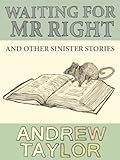
Waiting For Mr Right by Andrew Taylor

The full title of this collection of three short stories is Waiting For Mr Right & Other Sinister Stories and it is an ideal book to read for Carl’s R.I.P Challenge – reading books of a macabre and fantastical nature .

Andrew Taylor writes in his introduction to this collection that ‘short stories permit concentration, the ability to focus on a single idea,’ I like the good ones for just that reason, but more often than not when I read some short stories I’m left feeling ‘oh, so what’ – they can be trivial and unsatisfying. Not so with this collection, because these are very good stories. Taylor also writes:

Unfortunately, good short stories are also incredibly difficult to write. Each word counts for more than a word in a full-length novel; each word costs more to write. Short stories may be short but they make a author sweat blood.

He has succeeded in my opinion. These cleverly written stories work on two levels – they are works of fantasy that made me both amused and chilled; they present a different form of ‘reality’.

The first story, Waiting For Mr Right,  is set in the cemetery of Kensal Vale where a remarkably well-educated creature lives and is the narrator, telling the tale of Jack and Tracy. Jack is in hiding in the vault of the Makepiece family, which has a Bateson’s Belfry – a Victorian invention that enabled you to summon help if you’d been buried alive. The ending is both horrific and well, amusingly satisfying.

The second slightly less sinister story is perhaps not quite as good as the first one. It is Nibble-Nibble, but it is still an entertaining story about a little boy and his imaginary friend, John – or is he really a ghost? The little boy lives with his Aunt and Uncle. Then his Granny comes to stay and she doesn’t believe in ghosts, but ghosts are like people, or so John says – there are some you like and some you don’t. The little boy realises:

Normally grannies were meant to be nice and ghosts were meant to be scary. Why did it have to be the other way round for me? Why couldn’t I be like everyone else?

I think the final story is the best. It’s called Keeping My Head. It was written for an anthology celebrating the eightieth birthday of the late H R F Keating, a former president of the Detection Club.

The narrator is an old lady looking back over the events of her life – and her death. I can’t write much about it or I’ll be giving away too much. I’ll just say that her husband was having an affair and she decided to kill him, but it all went wrong. When she was fifteen a tinker told her fortune and warned her that although she was going to have a long life and would be known around the world she must always ‘beware of keeping her head‘. She was a heedless girl and soon forgot the tinker.

R.I.P. VIII

September is nearly here – time for Carl’s R.I.P. Challenge – this is the 8th year welcoming September with a time of coming together to share our favourite mysteries, detective stories, horror stories, dark fantasies, and everything in between.

These are the categories:

Mystery.
Suspense.
Thriller.
Dark Fantasy.
Gothic.
Horror.
Supernatural.
Or anything sufficiently moody that shares a kinship with the above. I’m attempting


Peril the First:

which is to read four books, any length, that you feel fit (the very broad definitions) of R.I.P. literature.  R.I.P. VIII officially runs from September 1st through October 31st. But  you can start today!!!

I haven’t decided definitely which books I’ll be reading. I’m thinking of these at the moment and will probably start with The Death Maze:

  • The Death Maze aka The Serpent’s Tale by Ariana Franklin – I’ve had this for years so it would be good to read it. I read the first book – The Mistress of the Art of Death ages ago and loved it.
  • Her Fearful Symmetry by Audrey Niffenegger – not sure about this one, a ghost story.
  • The Brimstone Wedding by Barbara Vine – described as ‘a masterful mystery about love and madness’.
  • Waiting for Mr Right and Other Sinister Stories by Andrew Taylor – three sinister and slightly surreal short stories.
  • The Shining by Stephen King – a scary book!
  • Northanger Abbey by Jane Austen – I read this so many years ago that it will be like reading it for the first time. It was one of the set books at school and I don’t think I appreciated it then.