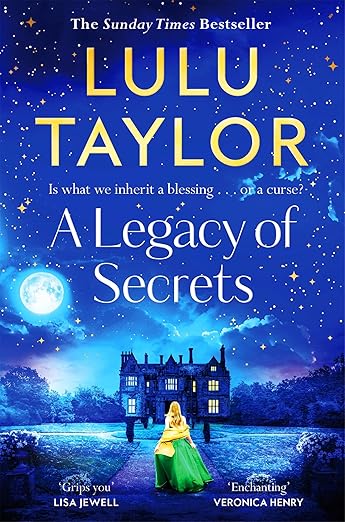
A Legacy of Secrets by Lulu Taylor

Pan Macmillan| 4 December 2025| 445 pages| e-book| Review copy| 3*

Description:

Is the truth a legacy worth inheriting?

Flick Templeton seems to have it all: money, a renowned family name, brains and talent. But her wealth and status seem an obstacle to the real love she longs for. Guided by passion, she seeks her soulmate while finding her own path – but will the legendary family curse of tragedy and loss always thwart her?

Etta, Flick’s daughter, inherits her own share of the family blessings along with its darkness. Growing up, she is pulled between caring for her mother and finding her own identity. As Etta unravels the threads of Flick’s secrets, she starts to learn the truth about who she really is . . .

But can Flick and Etta ever break truly free from the shadows of a painful past, and the curse that seems to hang over every generation of their family?

This is the first book I’ve read by Lulu Taylor, so I wasn’t sure I would enjoy it. But when I had an invitation from Pan Macmillan to read this book I thought I’d read it, based on the blurb.

Once I’d started reading it I found it gripping and compelling, but I also found that it’s full of emotion, from ecstasy to the depths of despair about a dysfunctional family, with some truly awful characters.They believe their family is cursed. It’s a dramatic family saga, verging on melodrama, high on romance, intermingled with mystery and intrigue. It’s also very long encompassing three generations, over different time lines. I did find the structure of the plot rather muddled, so it’s definitely a book you have to read carefully to keep track of the characters over the years from 1952 to 1992.

The main character is ‘little girl lost‘ Flick (Felicity) Templeton, the daughter of the fabulously rich and glamorous, Gloria, who is so unbelievably selfish, self-centred, and controlling, a perfectly horrible person. The novel begins in 1952 with Brinsley and Flick’s eighteenth birthday party to celebrate their coming-of-age, when Brinsley would take possession of Caundle Court. This puzzled me as in 1952 the date when a young person became an adult was 21 and it was not until 1969 that it was lowered to 18. I know this book is fiction, but this is so incorrect that it made me wonder if I wanted to carry on reading. Nevertheless I did because a mystery always intrigues me. However, as I read on it soon became clear what the secret was and it wasn’t too hard to work it out well before it was revealed, over 400 pages later. I had been tempted to jump to the end to see if I was right but because I received this book via NetGalley to review I thought it was only fair to read the whole book.

Despite my misgivings I did find enough that I liked to give A Legacy of Secrets 3 stars. I enjoyed the details of life in the 1950s when Flick went to a finishing school in Oxford and her brother went to Magdalen College to read history. I liked Flick’s daughter a lot, and determination to uncover the family’s secrets. I also liked the descriptions of all the locations and the interaction between the characters showing how misunderstandings arise and the difficulties of mother/daughter relationships. I could feel the heartbreak and sadness as the characters experience all the setbacks that are thrown at them. It’s a complex and emotional book, one that I liked rather than loved.

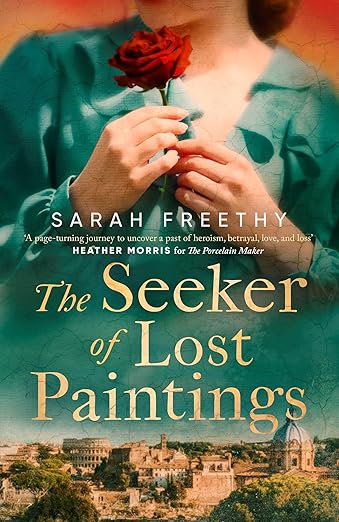
The Seeker of Lost Paintings by Sarah Freethy

Simon & Schuster UK| 11 September 2025| 400 pages| e-book| Review copy| 5*

Blurb:

Rome 1939
Arriving in Rome to work for the wealthy Montefalco family, Maddalena is homesick and alone. She finds solace – and love – in the beauty of the city, but as the war in Nazi-occupied Italy rages, she must make a devastating choice.

London, 1997
After her mother Maddalena’s death, Beatrice Fremont discovers a fragment of a painting and a letter that sends her on a hunt to Rome. Helping her is art dealer Jude Adler, who’s convinced they are looking for a lost Caravaggio. For Jude, this could be the find of a lifetime; but for Beatrice their search uncovers a shocking secret and the answer to a mystery kept hidden for years.

I’ve not read Sarah Freethy’s first novel, so I wasn’t sure what to expect from her latest book, The Seeker of Lost Paintings. I am delighted to say I loved it. It’s historical fiction set in two timelines, one in the 1940s in Italy and the other in 1997 in London and Italy. It appealed to me because of the mystery surrounding a lost Carravagio and I really enjoyed that aspect. I’ve read quite a lot of historical fiction set during the Second World War, but I don’t think I’ve read any set in Italy during the Nazi occupation before and it was this part of the story that I enjoyed the most.

The book begins with a Prologue set in Naples in 1610 with an unnamed artist as he starts a painting. Who he is and what he is painting only becomes clear later in the book. The narrative then flies forward to July 1997 and a hot day in London when Beatrice Fremont, yearning to be in Italy where both of her parents were born, is waiting for Jude Adler to arrive to value her late father’s art and photography collections. Her mother, Maddalena is seriously ill and they need to sell his collections to secure the family home.

When Jude spots a small painting, hanging on Maddalena’s bedroom wall, he is convinced he’d seen the image somewhere before. It reminds him of Caravaggio’s painting of St John the Baptist in Youth with a Ram. Caravaggio’s followers had made many copies of that painting and Jude is convinced that if it is one of those it could be worth tens of thousands. But Maddalena wants Beatrice to reunite the painting with its rightful owner. And so after Maddalena’s death, the search to find out more about the painting begins, taking Beatrice and Jude to Italy.

Back in 1939, Maddalena was working as a cook at the home of Conte Luca Montefalco, at the Villa Velare in Rome. Luca’s older brother Roberto had renounced his title and taken up Holy Orders, and is working at the Vatican where he is responsible for an art collection that must be preserved and removed from the Vatican in preparation for the impending war. It was a remarkably tense and difficult time in Italy, under Mussolini and the Fascists, and the local people suffered immensely under the Nazi occupation.

Sarah Freethy’s beautiful descriptive writing and characterisation transported me back to that period, almost as though I was there witnessing what life was like for the ordinary Italians during the war years – the dangers and privations they faced. It really is a remarkable book, drawing together the two strands of the story, both in the past and the present and ending in a satisfying conclusion.

Many thanks to the publishers, via Netgalley for my review copy and I’d love to read more of Sarah Freethy’s books.

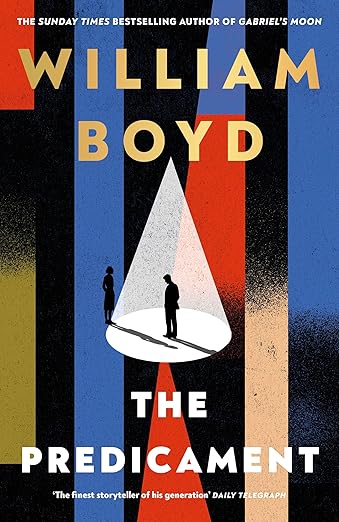
The Predicament by William Boyd

Viking| 4 September 2025| 272 pages| e-book| Review copy| 3*

Gabriel Dax, travel writer and accidental spy, is back in the shadows. Unable to resist the allure of his MI6 handler, Faith Green, he has returned to a life of secrets and subterfuge. Dax is sent to Guatemala under the guise of covering a tinderbox presidential election, where the ruthless decisions of the Mafia provoke pitch-black warfare in collusion with the CIA.

As political turmoil erupts, Gabriel’s reluctant involvement deepens. His escape plan leads him to West Berlin, where he uncovers a chilling realisation: there is a plot to assassinate magnetic young President John F. Kennedy. In a race against time, Gabriel must navigate deceit and danger, knowing that the stakes have never been higher . . .

My thoughts

I was really keen to read The Predicament William Boyd’s second book in his espionage trilogy about Gabriel Drax because I loved, the first book Gabriel Moon. A major strand in that book was the story of the tragedy surrounding his mother’s death when he was a young child. His subsequent separation from his older brother added to Gabriel’s disturbed state of mind and contributed to his reluctance to become a spy. In fact he was accidentally drawn into the world of espionage without making a conscious decision.

The Predicament begins in 1963, a few months after the events related in Gabriel’s Moon. However, I didn’t enjoy it as much as I thought I would because the novelty of a spy who doesn’t want to be a spy is no longer a novelty. Now, Gabriel knows he is being drawn back into the dangerous and shadowy world of espionage by his fascination/obsession with Faith Green, his MI6 handler, who effortlessly manipulates him. But is Faith beginning to show her true feelings for him, is it possible that she may even be in love with him, or is she just using sex to keep stringing him along?

It all seems a bit shallow and the characters are rather stereotypical, although it’s fast paced and easily readable. Gabriel is assigned to a joint MI6/CIA operation in Guatemala to interview Pedro Tiago an ex-priest thought to be the next elected President. When Tiago is assassinated Gabriel realises he has once again been manipulated and is in danger of losing his life. Then he is sent to Berlin to assist the CIA prevent the assassination of President Kennedy, an interesting episode that lacks tension as we know Kennedy wasn’t assassinated in Berlin.

The action does jump about, as in between these events he has meetings with Russian spies and realises he’s become a double agent and he is still having sessions with the psychoanalyst as in Gabriel’s Moon. In addition he is a successful travel writer and he continues to use his spying assignments as locations for his books, but his research seems rather superficial and he is accused of plagiarism. I felt it was all too much tongue in cheek. There are several loose ends, which I hope will be resolved in the final book.

My thanks to the publishers for a review copy via NetGalley.

The Spy in the Archive by Gordon Corera

William Collins| 5 Jun 2025| 298 pages| e-book| Review copy| 4*

Description:

The Spy in the Archive tells the remarkable story of how Vasili Mitrokhin – an introverted archivist who loved nothing more than dusty files – ended up changing the world. As the in-house archivist for the KGB, the secrets he was exposed to inside its walls turned him first into a dissident and then a spy, a traitor to his country but a man determined to expose the truth about the dark forces that had subverted Russia, forces still at work in the country today.

Bestselling writer and historian Gordon Corera tells of the operation to extract this prized asset from Russia for the first time. It is an edge-of-the-seat thriller, with vivid flashbacks to Mitrokhin’s earlier time as a KGB idealist prepared to do what it took to serve the Soviet Union and his growing realisation that the communist state was imprisoning its own people. It is the story of what it was like to live in the Soviet Union, to raise a family and then of one man’s journey from the heart of the Soviet state to disillusion, betrayal freand defection. At its heart is Mitrokhin’s determination to take on the most powerful institution in the world by revealing its darkest secrets. This is narrative non-fiction at its absolute best.

I was intrigued by the title of The Spy in the Archive: How One Man Tried to Kill the KGB by Gordon Corera, a former BBC correspondent. It’s about Vasili Mitrokhin, a KGB archivist who defected to Britain in 1992. Mitrokhin, a quiet, introverted and determined man, was a reluctant defector, because whilst he loved Russia he came to hate the KGB and the Soviet system.

Working in the archives gave him access to top-secret documents and he decided to copy the files on slips of paper written in his own personal code, a type of shorthand. He wasn’t searched when he left work, although his bags were, so he hid the slips of paper in his clothing and typed them up in full at home. They included details about the Soviet secret service and the ‘illegals’, deep-cover operatives who penetrated Western society. These ‘illegals’ had been used to recruit and run the Cambridge spies, including Kim Philby in MI6 as well as atomic spies in America who had stolen the secrets of the Manhattan project and the bomb, and spies in other countries. He also noted the names of hundreds of agents in the west who had collaborated with the KGB. He wanted the documents he had copied to be made public, not just to the world but to open the Russians’ eyes to the corruption, torture and terror that was prevalent.

So, in 1992 he decided to take a sample of his notes first to the US embassy in Riga and Vilnius, but he was not taken seriously, He then went to the British embassy in Vilnius, where he was believed and eventually and handed over his secret archive.

It is a remarkable book about a remarkable man. It’s an in-depth account, that took me weeks to read as it’s not a book to read quickly. It’s fascinating and informative, as I know very little about Russian history post the 1917 Revolution (and not much before that either). It includes a glimpse of a young Vladimir Putin, aged sixteen, who already walked with a swagger as he announced to a KGB official that he wanted to get a job, on his way to becoming a Chekist. I think it’s worthy of note that in 2000 he was the first President to attend the Chekist day celebrations personally. Corera wrote that ‘only a few could understand what his [Putin’s] rise really signified. Mitrokhin, in his exile, was one of those. He understood the Chekist roots from which Putin had sprung and he understood what his rise meant.’

I’d never heard of Chekism before so that was particularly interesting for me. The word derives from Lenin’s creation in 1917 of the ‘All Russian Extraordinary Committee to combat Counter-Revolution and Sabotage’, known by its initials as the Cheka. It was more than a secret police force, it was ‘a revolutionary terrorist organisation’. The Lubyanka building in Moscow was its headquarters. It was formally dissolved in 1922 (the year Mitrokhin was born). But it was renamed several times and eventually emerged as the KGB. As Corera explains ‘the Cheka never died. It simply passed from the land of the living to the land of the dead, an otherworldly beast whose outward form would change but whose dark heart kept beating. … those who served the beast would always refer to themselves as the same thing: Chekists.’ Mitrokhin became a Chekist and that was what he came to hate and want to defeat by exposing to the Russian people and the world. He made it a condition of his defection that the documents he had copied should be made public

The final section concerning his exfiltration from Russia via Lithuania and Sweden reads like fiction. It was hard to believe that it is all true, as I began to wonder whether Mitrokhin and his family would make it to London, even though I knew that he did. Sadly, despite his determination that his work would reach the Russian people, that has not proved possible. He died from pneumonia in January 2004.

Many thanks to the publishers for a review copy via NetGalley. I enjoyed this fascinating and enlightening book.

The Death of Shame by Ambrose Parry

Canongate Books| 5 Jun. 2025| 427 pages| e-book| Review copy| 5*

Description:

1854, Edinburgh.
Respectable public faces hide sordid private sins.

Apprentice Sarah Fisher is helping to fund Dr Will Raven’s emerging medical practice in exchange for being secretly trained as a medic, should the rules barring women ever change. Sarah needs no instruction in the inequalities that beset her gender, but even she has her eyes opened to a darker reality when a relative seeks her help in searching for her missing daughter. Annabelle Banks was promised a situation in a prestigious household, but there has been no word from her since she left home, and the agency that arranged her position says she never appeared.

Sarah’s inquiries lead her to reforming campaigners trying to publicise the plight of the hundreds of girls ensnared in Edinburgh’s houses of assignation. Sarah learns how young women are lured, deceived, trafficked and raped, leaving them ruined in the eyes of a society obsessed with moral purity, and where virginity is prized as a lucrative commodity.
Drawing upon real historical events, The Death of Shame takes Raven and Sarah into a treacherous labyrinth of exploitation, corruption, high-level complicity and Victorian-style revenge porn.

Ambrose Parry is the pseudonym of crime fiction author, Chris Brookmyre and Marisa Haetzman, a consultant anaesthetist. The combination of a crime fiction writer and an anaesthetist works excellently in Ambrose Parry’s novels. The research into the history of medicine is extensive, making this book a combination of historical fact and fiction, a tale of murder and medical matters, with the social scene, historical and medical facts slotting perfectly into an intricate murder mystery. 

The Death of Shame by Ambrose Parry is the 5th and final Raven and Fisher book. Dr Will Raven is no longer working with Dr Simpson (a real historical person, renowned for his discovery of chloroform) but is setting up his own medical practice with the financial assistance of Sarah Fisher. Sarah, who began working as a housemaid for Dr Simpson, then as a nurse, has ambitions to train as a doctor, something rarely possible for women in her position. So secretly Will is training her as his apprentice to become a doctor.

It’s set in 1854, when Will and his wife, Eugenie have two children, as she is struggling to bond with her children suffering from postnatal depression. The book begins with the death of her father, himself an eminent doctor with a wealthy practice. It appears he committed suicide but Eugenie can’t accept that and asks Will to investigate. Meanwhile Sarah has also been asked to investigate the disappearance of her young niece who has disappeared after leaving home to start a job in Edinburgh.

The plot is complicated and although you could read this as a standalone book as there is some background to what has happened in the earlier books, I really think it’s better to have read them – and they are well worth reading. Will and Sarah’s separate investigations take them into dark and desperate places dealing with blackmail, murder, suicide, abortion, rape, female exploitation, and prostitution. The position of women and girls in society and the dangers they faced are centre stage.

I always enjoy reading the Historical Notes at the end of the Raven and Fisher books and this one is no exception. It gives the factual background and sources that Ambrose Parry used and information about the real life people who are included in the book as well as Dr Simpson, such as Henry Littlejohn, Edinburgh’s police surgeon who served as Medical Officer for Health and medical advisor to the Crown, and Emily Blackwell, one of the pioneers of women in medicine.

This is a great ending to the series but I’d like to think this is not the end of their stories – I’d love to read more about them! In the meantime there is a short story, The Apple Falls Not Far by Ambrose Parry, a digital exclusive short story from the world of Raven and Fisher to read – more about that in a later post.

One Dark Night by Hannah Richell

Simon & Schuster UK| 3 July 2025| 432 pages| e-book| Review copy| 5*

ELLIE
When the body of a young woman is discovered in the woods the morning after Halloween, arranged with ritualistic precision, teenager Ellie has more reason than most to be afraid …

RACHEL
 As both Ellie’s mum and the local school counsellor, Rachel, must grapple with the terror gripping the community, a tough job that’s made even harder when she realises her daughter is keeping secrets …

BEN
Police detective Ben Chase is desperate to solve the murder, but with his daughter Ellie struggling and the noose circling ever tighter, can he catch the killer before they strike again?

My thoughts:

I requested One Dark Night by Hannah Richell from NetGalley because I thought I’d like it when I read the blurb. And I was right! I haven’t read any of Richell’s books before but I’m certainly going to try some of her six earlier novels, all of them stand-alone stories. On her website she describes her work as suspenseful novels about families and friends tangled in secrets and lies. I’m drawn to buildings that creak with stories, to landscapes that shape the characters moving through them, and to the rich and often complex relationships between mothers, daughters and sisters.

One Dark Night is her sixth book, which she says is inspired by a real-life stretch of woodland and an old stone folly near where I currently live, supposedly one of the most haunted spots in England. Yes, it is very creepy.

I loved the spooky, tense atmosphere and as soon as I started reading it I knew I was going to enjoy this book. The settings are vividly described, the characters come across as real people, and the plot is amazing, multi- layered, with plenty of suspects for the murder and numerous twists and turns to throw me off the scent. For quite a while you don’t even know the name of the victim, who was found in the woods, called ‘Sally in the Wood’. It’s a police procedural centred on Ellie, a pupil at the private school, where her mother Rachel works as the school counsellor and her father, Ben, a detective sergeant who is on the investigation team. Ellie is struggling, having just started at the school and also because her parents are newly divorced.

In the Acknowledgements the author explains that the novel is loosely inspired by the place and stories of Sally in the Wood and the nearby stone folly, but the surroundings are drawn purely from her imagination. She had the idea for the novel after her daughter took part in a Girl Guides night hike to the stone folly above the spooky wood.

I found more information about the origins of the road, Sally in the Wood, on the Wiltshire & Swindon History Centre. The road forms a curved section of the A363 road on the Somerset-Wiltshire border that cuts through dense woodland near Bath – a perfect place to set a murder mystery. There are a few explanations for the name – one being that a girl called Sally was murdered in the woods or imprisoned in nearby Brown’s Folly, or that she was an actual road accident victim. It has a reputation of being an eerie place, where ‘no birds sing’, so you never know…

I loved it, one of the best books I’ve read so far this year!