Two Novellas in Now and Forever by Ray Bradbury:#NovNov22

HarperVoyager| 25 June 2012| 240 page| e-book| 4*

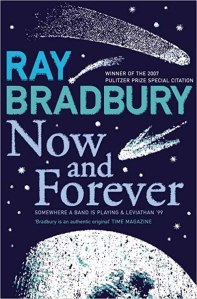
Now and Forever is the first book by Ray Bradbury that I’ve read. It contains two novellas – Somewhere a Band is Playing, in which a young writer discovers that all is not as it seems in a nostalgic community, and Leviathan ’99, a retelling of Moby Dick set in space. Two very different stories, each one fascinating, and both with a long history, as Bradbury wrote each one over several decades. They contrast both in style and content. I enjoyed both, but Leviathan ’99 is my favourite.

In the first, Somewhere a Band is Playing, (102 pages) a reporter James Cardiff arrives in Summerton, a small town in the middle of Arizona, a town which seems perfect, a quiet peaceful place. He can hear in the air the quiet sound of a band playing. But the more he explores the more mysterious Summerton becomes. For one thing there are no children and no hospitals or doctors because no one gets ill and even stranger the graves in the cemetery are empty. The story has a nostalgic feel, a sense of melancholy and myth as James, under the guidance of a beautiful young woman, Nefertiti, discovers the truth about Summerton.

Bradbury’s introduction to Somewhere a Band is Playing explains that he begun writing a screenplay and short story about a small town somewhere in the desert and how he had kept encountering Katharine Hepburn either in person or on the screen and was attracted by the fact that she remained youthful throughout the years. Then in 1956 she had made the film Summertime and this had led him to put her at the centre of a story and so Somewhere a Band is Playing slowly evolved. Another element of the story came when he saw the film, The Wind and the Lion and was so taken with the score that he wrote a long poem based on the enchanting music. He then put these elements together to produce this novella, which he dedicated to Anne Hardin, who had encouraged his work and to Katharine Hepburn.

Leviathan ’99’ (101 pages) is dedicated to Herman Melville because after spending a year writing the screenplay for John Huston’s Moby Dick he’d fallen under the spell of Melville and his ‘leviathan whale’. Bradbury then wrote his first script of Leviathan ’99’, which was eventually produced by BBC Radio in London, then as a longer version as a play in 1972. Finally thirty years later he finished writing it as a novella as his ‘final effort to focus and revitalize what began as a radio dream.’

I haven’t read Moby Dick, but I enjoyed this story about spaceships instead of sailing ships, mad astronaut captains instead of seafaring captains and the blind white comet instead of the great white whale. It’s set in 2099 and begins as Ishmael, an astronaut joins the Cetus 7, the largest interstellar ship ever built. The spaceship is on a mission, travelling beyond the stars. His cubicle roommate is Quell, a seven feet tall, green spider who is a telepath. The captain is mad, obsessed with finding the comet, Leviathan, the largest comet in history that had blinded him thirty years earlier. As Quell described it ‘the universe set off a light-year of immensity of photographic flash. God blinked and bleached the captain to this colour of sleeplessness and terror.’

It is an incredible achievement transposing Melville’s 19th century epic into a hundred page novella set in the future.


Two Novellas by Claire Keegan #NovNov22

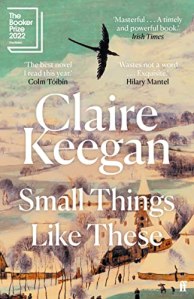
Week 4 in Novellas in November is Contemporary novellas (post 1980). It was only this year that I ‘discovered’ Claire Keegan’s work when her novella, Small Things Like These was shortlisted for the 2022 Booker Prize. I liked the description, so I was eager to read it and I thoroughly enjoyed it. So wanting to read more of her books I read Foster, another novella, which is the buddy read during the Novellas in November event.

Small Things Like These by Claire Keegan (73 pages) 5*

It is 1985, in an Irish town. During the weeks leading up to Christmas, Bill Furlong, a coal and timber merchant, faces into his busiest season. As he does the rounds, he feels the past rising up to meet him – and encounters the complicit silences of a people controlled by the Church.

It won the 2022 Orwell Prize for Political Fiction, an award for outstanding novels and collections of short stories, first published in the UK or Ireland, that illuminate major social and political themes, present or past, through the art of narrative. It also won the Kerry Group Irish Novel of the Year 2022.

Claire Keegan’s style of writing is a refreshing change from so many of the long and complicated books I so often read. It is precise, focused, and beautifully written bringing her characters to life – these are real, ordinary people, living ordinary lives in 1980s Ireland. And the detail is there too in all the particulars of everyday life – it packs a lot into its pages. Bill Furlong is happily married with five young daughters, but he still remembers his own childhood. He never knew who his father was, brought up by his mother and the widow for whom she worked. Life was hard then and his own childhood Christmases were not like his daughters’, and it is this, I think, that makes him such a kind and compassionate man. As he does his rounds delivering coal and wood, he goes to the local convent and is confronted with the cruelty meted out to the young girls living there.

Set in the weeks leading up to Christmas it contrasts the season of hope and joy at the birth of a child with the treatment of unmarried mothers received in the homes known as the Magdalen laundries – and at the end of the story Claire Keegan explains the history of those institutions that were run by the Roman Catholic Church and the Irish State until they were closed down in 1996. Small Things Like These demonstrates the courage and compassion needed to stand up to the power of the church and state.

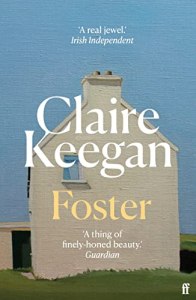
Foster by Claire Keegan (101 pages) 5*

A small girl is sent to live with foster parents on a farm in rural Ireland, without knowing when she will return home. In the strangers’ house, she finds a warmth and affection she has not known before and slowly begins to blossom in their care. And then a secret is revealed and suddenly, she realizes how fragile her idyll is.

I was amazed at the emotional depth Claire Keegan has instilled into such a few pages. She writes such clear sentences filled with poetic beauty. She shows how a young girl from an overcrowded and poverty stricken family blossomed whilst living with relatives of her mother, the Kinsellas, as her mother is about to give birth to yet another baby.

Yet it is not that straight forward. There is an undercurrent that hints of something that is not right, something that has happened that is never put into words. There is a sadness that pervades the story, along with kindness, caring and compassion. The girl knows she’ll return to her family, but she doesn’t know when, so the story is always told as it is happening. It’s in the present tense, which I never realised until I came to the ending. This is one of the rare instances for me that the use of the present tense seemed just right. The ending too could only happen the way it does. I absolutely loved Foster.

The Black Mountain by Kate Mosse #NovNov22

Week 4 in Novellas in November is Contemporary novellas (post 1980)

The Black Mountain by Kate Mosse (136 pages) 3*

This is a Quick Reads publication – a series of short books by bestselling authors and celebrities. They are designed to encourage adults who do not read often, or find reading difficult, to discover the joy of books. I like the long novels Kate Mosse writes, so I wondered what this short novel would be like.

It is historical fiction set in May 1706 on the northern part of the island of Tenerife, where Ana and her family live in the shadow of a volcano, known locally as the Black Mountain. It’s also a murder mystery – Ana’s father Tomas had apparently committed suicide, but Anna just can’t accept that and reading the letter he’d left she is convinced it was murder. She is determined to find out the truth.

Legend says the mountain has the devil living inside it and when the devil was angry he sent fire and rocks up into the sky. However, there has been no eruption for thousands of years and no one believes it is a threat. Sometimes the earth trembled and shook but the sky never turned red. Until, that is two days after Tomas’ death. He had seen the signs that the mountain was about to erupt and had tried to warn people – but they didn’t want to know. When more tremors occur, and grey ash starts falling Ana realises the danger signs are increasing and she needs to warn people that they must flee before the volcano erupts and destroys their world.

I enjoyed this novella, reading it quickly, feeling almost as though I was also in danger as the Black Mountain threatens to erupt and wondering if Ana would discover the truth about her father’s death in time for her to escape.

The Black Mountain is based on a real historical event. The town of Garachio erupted from May 4 to 5, 1706, which was disastrous not only for the town but also for the entire archipelago. Its port concentrated a large part of the international trade that linked the island with Europe, Africa and America.

~~~

I’ve read a few of the Quick Reads. Here’s a list of all the available titles.

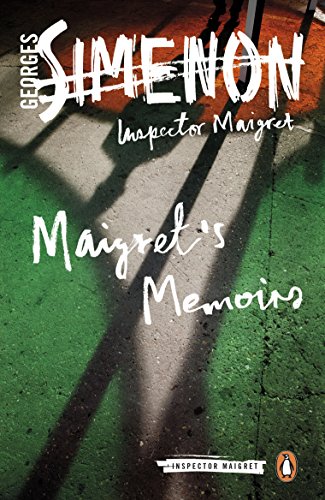
Maigret’s Memoirs by Georges Simenon Translated by Howard Curtis

Week 2 in Novellas in November is Novellas in translation and a Maigret book is an obvious choice for me. But Maigret’s Memoirs is not your usual Maigret mystery. This a memoir written by Simenon writing as his fictional character, Maigret.

Penguin Classics| 2016| 160 pages| My Own Copy| 4*

I can still see Simenon coming into my office the next day, pleased with himself, displaying even more self-confidence, if possible, than before, but nevertheless with a touch of anxiety in his eyes.’

Maigret sets the record straight and tells the story of his own life, giving a rare glimpse into the mind of the great inspector – and the writer who would immortalise him.

‘One of the greatest writers of the twentieth century . . . Simenon was unequalled at making us look inside, though the ability was masked by his brilliance at absorbing us obsessively in his stories’ Guardian

‘A supreme writer . . . unforgettable vividness’ Independent

The original French version of Maigret’s MemoirsLes Mémoires de Maigret, was first published in 1950. An English translation was later published in Great Britain in 1963. It is unlike any of the other Maigret novels. It’s a fictional autobiography by Georges Simenon writing as Maigret, beginning in 1927 or 1928 when Maigret and Simenon, calling himself Georges Sim, first ‘met’. I don’t recommend reading if you haven’t read some of the Maigret mysteries.

I enjoyed it – it’s a quick entertaining read as Maigret looks back to his first ‘meeting’ with Sim. He fills in some of the background of his early life and talks about his father and how he first met his wife, Louise. Simenon had written 34 Maigret novels before this one and Maigret took this opportunity to correct some of Simenon’s inaccuracies. I recognised some of the books – I’ve read 11 of his first 34 books.

One of the things that irritated Maigret the most was Simenon’s habit of mixing up dates, of putting at the beginning of his career investigations that had taken place later and vice versa. He’d kept press cuttings that his wife had collected and he had thought of using them to make a chronology of the main cases in which he’d been involved. And he also considered some details his wife had noted – concerning their apartment on Boulevard Richard Lenoir, pointing out that in several books Simenon had them living on Place des Vosges without explaining why. There were also times when he retired Maigret even though he was still several years away from retirement. Madame Maigret was also bothered by inaccuracies concerning other characters in the books and by Simenon’s description of a bottle of sloe gin that was always on the dresser in their apartment – that was in actual fact not sloe gin but raspberry liqueur given to them every year by her sister-in-law from Alsace.

Simenon drops facts and information piecemeal in his Maigret books and one thing I particularly like in Maigret’s Memoirs is that it is all about Maigret, but I did miss not having a mystery to solve.

Lord of the Flies by William Golding: a Mini Review of a Short Classic

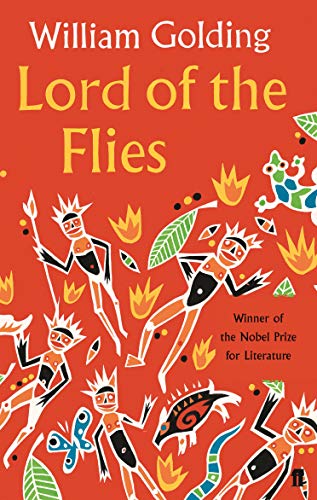
The first weekly theme for Novellas in November is short classics and I read Lord of the Flies, William Golding’s 1954 novel about a group of boys stranded on a desert island. It was his first novel and it certainly packs a punch. It was described as ‘A post-apocalyptic, dystopian survivor-fantasy … [A novel] for all time … A cult classic.’ Guardian. It’s a quick read of just 183 pages.

What are we? Humans? Or animals? Or savages? What’s grown-ups going to think? Going off-hunting pigs-letting fires out-and now!

A plane crashes on a desert island. The only survivors are a group of schoolboys. By day, they explore the dazzling beaches, gorging fruit, seeking shelter, and ripping off their uniforms to swim in the lagoon. At night, in the darkness of the jungle, they are haunted by nightmares of a primitive beast. Orphaned by society, they must forge their own; but it isn’t long before their innocent games devolve into a murderous hunt …

I thought I’d read this book years ago. But as soon as I began reading I realised I hadn’t read it – it’s one of those books you think you’ve read because you know the basic outline of what happens.

It is frighteningly believable. What at first seemed to the boys as a great adventure – stranded on a desert island, leaving them free to play all day without any annoying interference from adults, soon descended into a sinister nightmare scenario. They elected a leader, Ralph who initially made friends with Jack, the leader of a group of choirboys. But soon the two fell out as Jack, disappointed at not being chosen as leader, tried to take over – and a battle for power followed.

Ralph wanted to make sure they were seen if a ship passed the island and organised the boys to keep a fire going as a smoke signal. But when one of the younger boys thought he saw a beast in the jungle panic set in. Jack made himself the leader of the hunters, promising to hunt and kill the beast band the boys let the fire go out as they joined the hunt. Things got completely out of hand ending in chaos. It is absolutely gripping and very dark, showing the savage side of human nature.

Another Part of the Wood by Beryl Bainbridge

Rating: 4 out of 5.

Synopsis from Amazon:

Joseph decides to take his mistress and son, together with a few friends, to stay in a cabin in deepest Wales for the weekend – with absolutely disastrous results. Beryl Bainbridge’s gift for deadpan dialogue and spare narrative, and her darkly comic vision of the world, are all in evidence in this early novel.

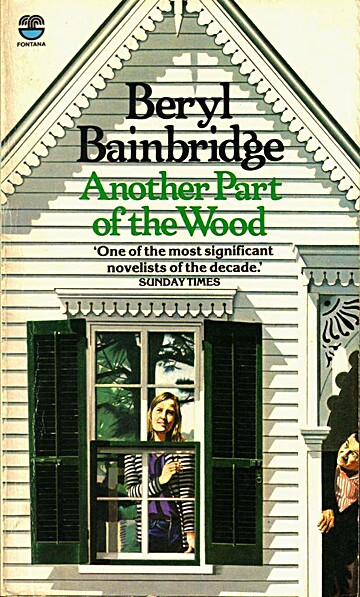
I read Another Part of the Wood because I’ve enjoyed other books by Beryl Bainbridge. It’s a novella, really, as it’s only 159 pages. I love her style, dark humour with clear, concise prose, and fully realised characters. It was her second book, first published in 1968. She revised the book and reissued it in 1979. My copy is a Fontana edition published in 1980. I read it at this time because it’s the novel that came up for me to read for the latest Classics Club Spin. It’s also one of my TBRs, a book that I’ve owned since 2016.

Like all of Beryl Bainbridge’s books that I’ve read it is well written and makes compulsive reading, with individual, mainly unlikable, characters who are mostly at odds with each other. I enjoyed the oddness, never really knowing what would happen next. The title has a theatrical feeling, pointing out the different scenes in the book as the action switches from one part of the wood to another, with one or more of the characters taking centre stage.

It’s set in Flintshire, Wales, in a holiday camp, which consists of huts in a wood at the foot of a mountain. There is George, the owner of the land, and Balfour who works in a factory during the week and helps him at the weekends. George, is obsessed with the Holocaust and Balfour, a shy, quiet man suffers from some sort of illness – he gets sick very suddenly with a high temperature and the shivers as though he’s turned to ice. All he can do is hide away and sleep it off.

The book begins as George’s friend, Joseph, a selfish, insensitive man, arrives for the weekend from London, with his young son, Roland, his girlfriend Dotty, and Kidney, a fat teenager who apparently has learning disabilities and a health problem (never explained), dependent on his pills. In addition Joseph has invited another couple to join them, Lionel and his wife, May, an unhappy couple with a dysfunctional and argumentative relationship. They are all townies, like fish out of water in the countryside and find the huts claustrophobic and too basic – May refuses to use either the chemical toilet or the bushes.

The atmosphere is tense right from the start and rises throughout the book as their relationships become increasingly fractious. Having promised Roland that he would take him for a walk up the mountain, Joseph leaves him to his own devices. He withholds Kidney’s pills and argues with Dotty. Dotty and Balfour walk off to the village where she buys a coat of many colours and Balfour falls ill. The wood, as in fairy tales, is not a safe place.

The world was a deep deceptive forest, full of promises and little glades and clearings, and in the dark depths roamed the wolves, savage, snapping their great teeth, waiting to spring on those who wandered from the path. (page 73)

There’s a sense of foreboding, the sense that something terrible is about to happen … but what, and who is in danger? I felt that more than one of these characters could come to a sticky end. And I was unsure, fearing the worst for one particular character – and sadly I was right. It was inevitable.