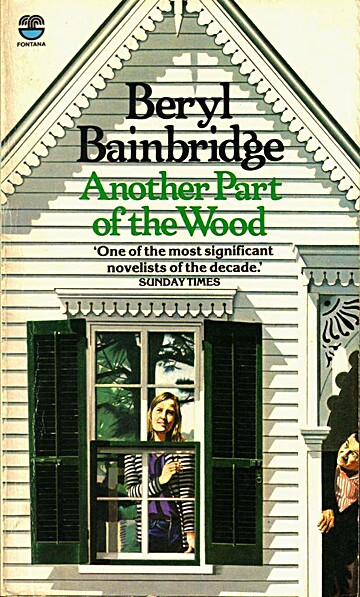
Another Part of the Wood by Beryl Bainbridge

Rating: 4 out of 5.

Synopsis from Amazon:

Joseph decides to take his mistress and son, together with a few friends, to stay in a cabin in deepest Wales for the weekend – with absolutely disastrous results. Beryl Bainbridge’s gift for deadpan dialogue and spare narrative, and her darkly comic vision of the world, are all in evidence in this early novel.

I read Another Part of the Wood because I’ve enjoyed other books by Beryl Bainbridge. It’s a novella, really, as it’s only 159 pages. I love her style, dark humour with clear, concise prose, and fully realised characters. It was her second book, first published in 1968. She revised the book and reissued it in 1979. My copy is a Fontana edition published in 1980. I read it at this time because it’s the novel that came up for me to read for the latest Classics Club Spin. It’s also one of my TBRs, a book that I’ve owned since 2016.

Like all of Beryl Bainbridge’s books that I’ve read it is well written and makes compulsive reading, with individual, mainly unlikable, characters who are mostly at odds with each other. I enjoyed the oddness, never really knowing what would happen next. The title has a theatrical feeling, pointing out the different scenes in the book as the action switches from one part of the wood to another, with one or more of the characters taking centre stage.

It’s set in Flintshire, Wales, in a holiday camp, which consists of huts in a wood at the foot of a mountain. There is George, the owner of the land, and Balfour who works in a factory during the week and helps him at the weekends. George, is obsessed with the Holocaust and Balfour, a shy, quiet man suffers from some sort of illness – he gets sick very suddenly with a high temperature and the shivers as though he’s turned to ice. All he can do is hide away and sleep it off.

The book begins as George’s friend, Joseph, a selfish, insensitive man, arrives for the weekend from London, with his young son, Roland, his girlfriend Dotty, and Kidney, a fat teenager who apparently has learning disabilities and a health problem (never explained), dependent on his pills. In addition Joseph has invited another couple to join them, Lionel and his wife, May, an unhappy couple with a dysfunctional and argumentative relationship. They are all townies, like fish out of water in the countryside and find the huts claustrophobic and too basic – May refuses to use either the chemical toilet or the bushes.

The atmosphere is tense right from the start and rises throughout the book as their relationships become increasingly fractious. Having promised Roland that he would take him for a walk up the mountain, Joseph leaves him to his own devices. He withholds Kidney’s pills and argues with Dotty. Dotty and Balfour walk off to the village where she buys a coat of many colours and Balfour falls ill. The wood, as in fairy tales, is not a safe place.

The world was a deep deceptive forest, full of promises and little glades and clearings, and in the dark depths roamed the wolves, savage, snapping their great teeth, waiting to spring on those who wandered from the path. (page 73)

There’s a sense of foreboding, the sense that something terrible is about to happen … but what, and who is in danger? I felt that more than one of these characters could come to a sticky end. And I was unsure, fearing the worst for one particular character – and sadly I was right. It was inevitable.

Novellas in November 2022

Novellas in November is being hosted once more by Cathy of 746 Books and Rebecca of Bookish Beck, running from 1-30 November 2022. They suggest 150–200 pages as the upper limit for a novella.

Here’s the schedule:

1–7 November: Short classics (pre 1980) (Rebecca)

8–14 November: Novellas in translation (Cathy)

15–21 November: Short nonfiction (Rebecca)

22–28 November: Contemporary novellas (post 1980) (Cathy)

29–30 November: You might like to post a “New to my TBR” or “My NovNov Month” roundup.

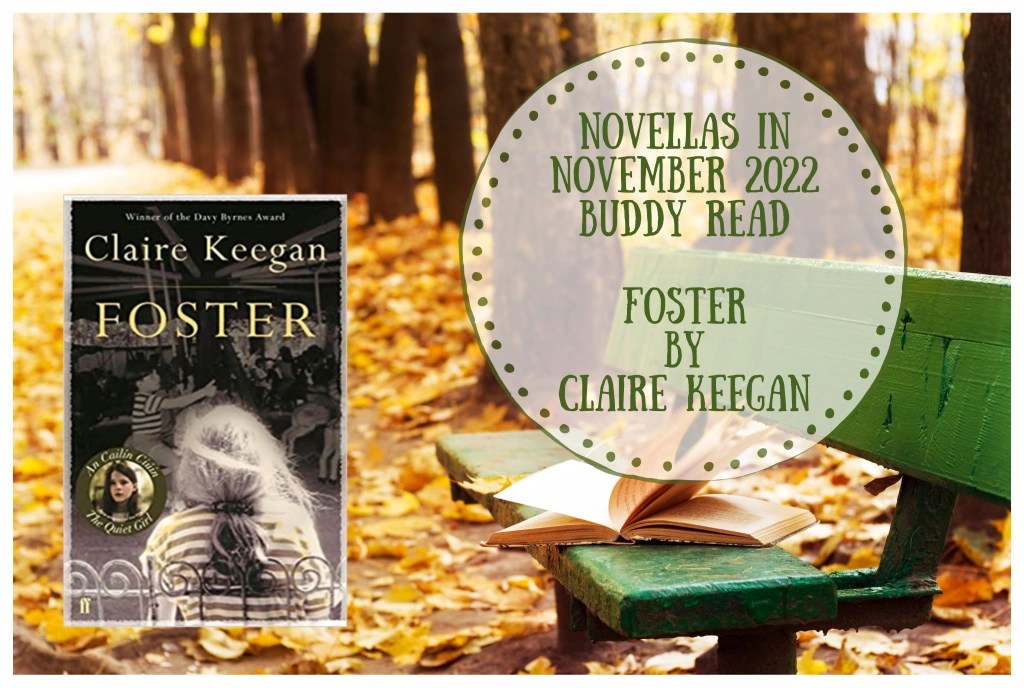
There is also one overall buddy read. Claire Keegan has experienced a resurgence of attention thanks to the Booker Prize shortlisting of Small Things Like These (which I have read – review to follow). Foster is a modern Irish classic that comes in at under 90 pages, and, in its original version, is free to read on the New Yorker website. You can find that here. (Or whet your appetite with Cathy’s review.)

Keegan describes Foster as a “long short story” rather than a novella, but it was published as a standalone volume by Faber in 2010. A new edition will be released by Grove Press in the USA on November 1st, and the book is widely available for Kindle. It is also the source material for the recent record-breaking Irish-language film The Quiet Girl, so there are several ways for you to encounter this story.

I’m aiming to read Foster during November.

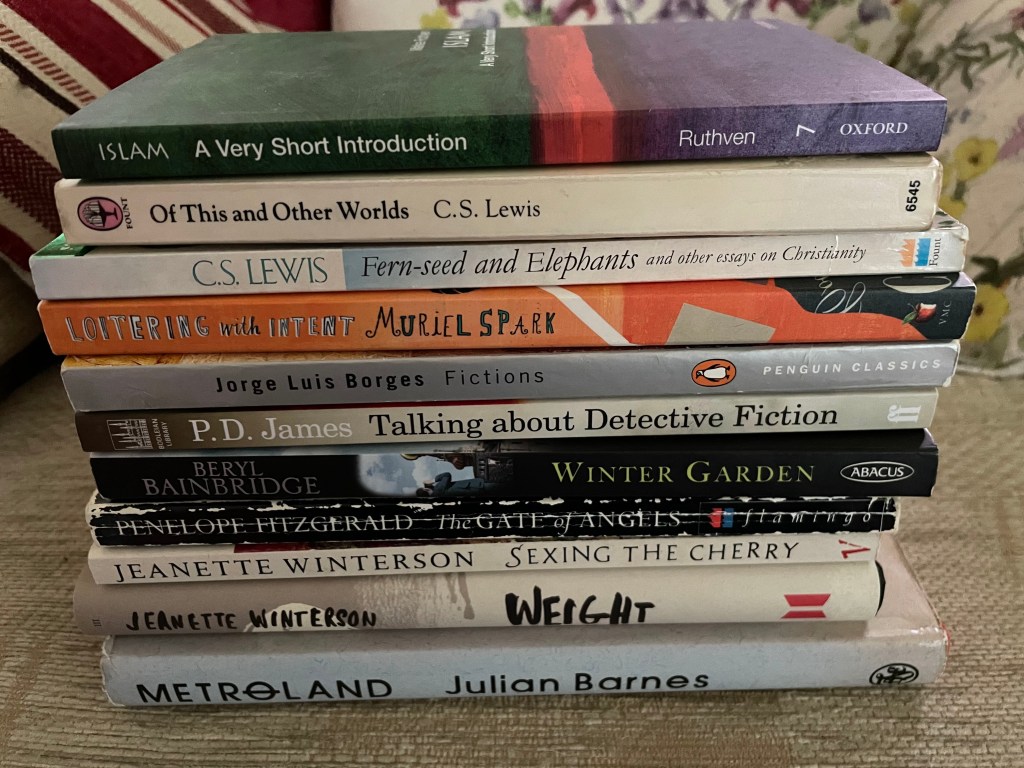
I won’t be taking part every week, as there are other books I want to read. But I’m going to pick a few novellas from this pile. They are a mix of fiction and nonfiction.

And I’ll choose one or more from this selection of novellas on my Kindle:

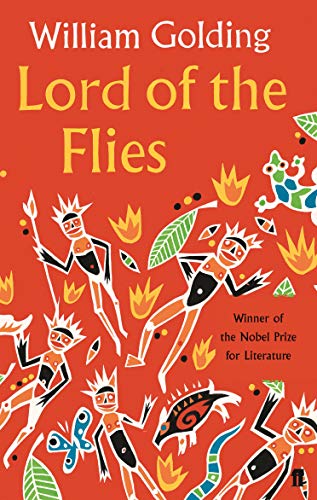
Lord of the Flies by William Golding
Signal Moon by Kate Quinn
North to Paradise by Ousman Umar
Bill Bailey’s Remarkable Guide to Happiness
The Ardent Swarm by Yamen Manai
Silent Kill by Jane Casey

Country Dance by Margiad Evans: a short review

Country Dance by Margiad Evans, a novella, is set in the the border country between Wales and England in the late 19th century. It’s the story of Ann Goodman, the daughter of an English shepherd and a Welsh mother. It’s told in diary form, telling how she left her cousin’s farm, Twelve Poplars in Wales, for her parents’ home in England to look after her mother. She had promised Gabriel, an English shepherd working on her cousin’s farm that she would keep a diary of her visit to England.

Whilst in England her father’s employer, a Welsh landowner, Evan ap Evans, takes a fancy to her. When Gabriel visits her he is infuriated by Evan’s attentions to her, especially as they talk together in Welsh. And it is this relationship that sets in motion the conflict between the two men.

I was confused when I began reading, trying to work out these relationships and I wondered why Ann was living in Wales away from her parents – I don’t think that was ever explained. But anyway as she rejects both men this turns the book into a tragedy, with the English and the Welsh at each others’ throats, divided by language and profound misunderstandings. Ann, herself is equally torn between her dual heritage.

Whilst I didn’t love this book, I did enjoy reading it and would like to read more of Margiad Evans’ work.

Artist and writer Margiad Evans (Peggy Whistler) was born in Uxbridge in 1909. Her work includes Country Dance (1932); The Wooden Doctor (1933); Turf or Stone (1934), and Creed (1936), as well as non-fiction, short stories, autobiography and two collections of poetry, Poems from Obscurity (1947) and A Candle Ahead (1956). 

  • Publisher ‏ : ‎ Parthian Books (1 Dec. 2012)
  • Language ‏ : ‎ English
  • Print length ‏ : ‎ 110 pages
  • My Rating: 3*

The Quiet American by Graham Greene

Vintage Digital| Oct 2010| 210 pages| my own copy| 4*

I heard of Graham Greene’s The Quiet American years ago. So when it was on offer for 99p at Amazon three years ago I bought the e-book version, with an Introduction by Zadie Smith. It’s one of the BBC’s 100 Novels That Shaped Our World. The nudge to read it now came from FictionFan’s Wanderlust Bingo as it fits nicely into the Southeast Asia Square as it is set in Vietnam * (see below). I don’t think I’ve read anything set in Vietnam before so I enjoyed it for its setting in Saigon and a glimpse of the situation in Vietnam under French colonialism in the early 1950s.

There are many natural storytellers in English literature, but what was rare about Greene was the control he wielded over his abundant material. Certainly one can imagine nobody who could better weave the complicated threads of war-torn Indochina into a novel as linear, as thematically compact and as enjoyable as The Quiet American. (Extract from Zadie Smith’s Introduction)

The Quiet American was first published in 1955 and is about America’s early involvement in Vietnam. It’s only the second book of Greene’s that I’ve read. The main characters are a cynical British journalist, Thomas Fowler, Phuong, a beautiful, young Vietnamese woman who lives with him, and Alden Pyle, a young and idealistic American – the ‘Quiet American,’ of the title. Phuong’s sister is keen for her and Fowler to marry, but he has a wife in England, who won’t agree to a divorce. Matters between all three characters come to a head when Pyle falls in love with Phuong and wants to marry her.

The book begins with a death and then goes back to the events that led up to that death. Although there is plenty of action the book revolves around these three characters and their relationships. Fowler is tired and jaded, addicted to opium and the thought of losing Phuong forces him to face the possibility of a lonely and bleak future. She meets his needs and prepares his opium pipes for him. Pyle, on the other hand is bright, confident and optimistic, certain that he can offer Phuong a better future.

The Americans at this time were not actively involved in the war against the Vietminh and Pyle has been sent to promote democracy and combat communism through a mysterious ‘Third Force’. However he is naive and gets involved in violent action causing injury and death to many innocent people. At that point Fowler realises he has to intervene.

*I know very little about Vietnam and its history, before the Vietnam War in the 1960s and 1970s and was a little confused about what was happening during the period in which this book is set and the references to the Vietminh. So, I had to look it up – In the late 19th century Vietnam was controlled by the French. In September 1945 the Nationalist leader Ho Chi Minh proclaimed its independence. From 1946 to 1954, the French opposed independence, and Ho Chi Minh led guerrilla warfare against them in the first Indochina War that ended in the Vietnamese victory at Dien Bien Phu on May 7, 1954. (see Britannica)

Picnic at Hanging Rock by Joan Lindsay

Picnic at Hanging Rock is one of the best books I’ve read this year. It was first published in 1967 and has since been republished a few times. The copy I read was published by Vintage in 1998. It’s a novella of 189 pages, with a list of characters at the beginning followed by a note, that indicates the truth of the story it tells is in question:

Whether Picnic at Hanging Rock is fact or fiction the readers must decide for themselves. As the fateful picnic took place in the year nineteen hundred, and all the characters who appear in this book are long since dead, it hardly seems important.

On St Valentine’s Day in 1900, a party of nineteen girls accompanied by two schoolmistresses sets off from the elite Appleyard College for Young Ladies, for a day’s outing at the spectacular volcanic mass called Hanging Rock. The picnic, which begins innocently and happily, ends in explicable terror, and some of the party never returned. What happened to them remains a mystery.

I enjoyed it immensely. I love the detailed descriptions of the Australian countryside and the picture it paints of society in 1900, with the snobbery and class divisions of the period. It’s a hot day, the picnic at the base of Hanging Rock shaded from the heat by two or three spreading gums was going well, and while some of the party dozed in the sunshine four of the girls walked to the Rock to get a closer view. As they walked up to the pinnacles and crags the plain below came into sight, but infinitely vague and distant and a rather curious sound was coming up from the plain, like the beating of far off drums. They neared a monolith rising up in front of them and:

Suddenly overcome by an overpowering lassitude, all four girls flung themselves down on the gently sloping rock in the shelter of the monolith, and there fell into a sleep so deep that a horned lizard emerged from a crack to lie without fear in the hollow of Miranda’s outflung arm.

Nobody had noticed that one of the teacher had also left the picnic. The day ended dramatically when one of the girls ran screaming down to the plain, back to the picnic grounds. She had left the other three girls ‘somewhere up there’, but she had no idea where that was. Despite lengthy searches only one girl was found and she couldn’t remember what had happened. It was all very strange. There’s an eerie feeling hanging over the whole event – during the picnic two of the adults found that their watches had stopped at twelve o’clock and they had no idea of the time. It was as though time had been suspended.

It’s a deceptively simple story, but with so many layers and undercurrents, making this mysteriously compelling reading. All the characters are believable people, each with their own backstories, and all their lives are affected and changed by the events of that one day. There’s a dreamlike quality to the mystery and a suspicion of the supernatural surrounding it. I loved the ambiguity of it all.

This is a Novella in November contribution and also qualifies as an entry for AusReading Month 2021.

Short Classics: The Old Man and the Sea by Ernest Hemingway

It’s the last week of Novellas in November hosted by Cathy and Rebecca, and the final theme is short classics. The buddy read this week is Ethan Frome by Edith Wharton and I’ll post my thoughts later this week. Today my short classic is The Old Man and the Sea by Ernest Hemingway, which won the 1953 Pulitzer Prize for Fiction.In 1954 Hemingway was awarded the Nobel Prize in Literature 1954 for his mastery of the art of narrative and for the influence that he had exerted on contemporary style.

Synopsis – This is the story of an old Cuban fisherman and his supreme ordeal: a relentless, agonizing battle with a giant marlin far out in the Gulf Stream. Using the simple, powerful language of a fable, Hemingway takes the timeless themes of courage in the face of defeat and personal triumph won from loss and transforms them into a magnificent twentieth-century classic.

My thoughts:

A simple story on the surface, told in a few pages, yet full of depth. Hemingway’s language is direct and deceptively simple too, but I was drawn into his descriptive writing, almost a stream of consciousness in placea. I felt the exhaustion of the old man as he struggled to catch the enormous marlin and then to return to the shore with his catch.

It’s one of those books that I find so difficult to write about, a well known story that has received much praise and also a lot of criticism as some people find it boring.. There’s this old man alone on the sea pondering about life and death, what he has achieved and also his failures. He is at the end of his strength and yet he endures. He has perseverance and determination and pride. Pride in his ability and in his way of life. The matter of sin occupies his mind and he thinks it was a sin to kill the fish, even though he did it to keep himself alive and feed many people. Then he thought he was born to be a fisherman:

You did not kill the fish only to keep alive and to sell for food, he thought. You killed him for pride and because you are a fisherman. You loved him when he was alive and you loved him after. If you love him, it is not a sin to kill him. Or is it more?

So, yes this is a simple tale and well told – it is more than just a fishing story and it gave me much to ponder.