Teaser Tuesday – After the Victorians by A N Wilson

Teaser Tuesday is hosted by MizB at Should Be Reading.

Grab your current read.
Let the book fall open to a random page.
Share with us two (2) ‘teaser’ sentences from that page.

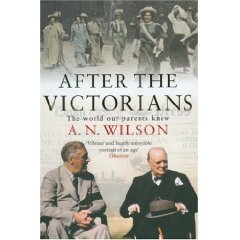
At long last I’ve finished reading After the Victorians: the World Our Parents Knew by A N Wilson.after-the-victorians

It’s a remarkable book and I’ve learnt so much from it. I began reading it in April when I wrote that it would probably take me until September to read it all – I finished it this morning.

This passage is from page 512 writing about Aneurin Bevan and the setting up of the National Health Service:

Apart from his eloquence, and his wit, which inspired so many who heard his oratory both on the hustings and in the House of Commons, he was that very, very rare thing in the history of politics, a man whose decisions on behalf of those he served brought about human betterment. This book has been a catalogue of mistakes by politicians, moral and practical disasters which led to wars, enslavement and human wretchedness on a scale which no previous age could have dreaded or dreamed of.  The National Health Service, which inspired so many other countries in the world to imitate it, did what it set out to do, and with all its many mistakes and short-comings, it still does so: it provides free medicine, free advice, free surgery, free nursing to everyone, regardless of their income.

I shall write in more detail about this book in a later post.

Griff Rhys Jones – “Rivers”

I’ve been watching Griff’s TV series Rivers, so I was thrilled to read on the Mostly Books blog that he was giving a talk in Abingdon. Of course, by the time I read about it all the tickets were sold out, but I had a phone call yesterday morning – some tickets had been returned and did I still want to go!

griff1My thanks go to the person who returned the tickets – it was a great evening. Griff was up and running as soon as he was on stage – entertaining, funny and oh, so knowledgeable. So many facts spilled out of him with boundless enthusiasm and all without any notes. Griff explained how he came to do the TV series and how the producers like him to be “in jeopardy” – if you’ve seen any of his TV programmes, you’ll know what he means, from dangling on a cradle whilst cleaning windows of a New York skyscraper (his hairiest moment) to swimming the River Mersey, in danger of getting Weil’s disease when he fell straight in the sewage going underground with the team maintaining Manchester’s waterways, and kayaking in a canoe slalom on the River Derwent.

Griff is passionate about rivers and opening them up for people to use. He wanted to make a series about the landscape and how it is used – the waterways of Britain are the ancient transport routes only superceded by road and rail relatively recently. The rivers are there to be used, navigation rights that have been extinguished should be reinstated so that we can all use them. He also wanted it to be about the history of rivers – telling how the monks were the first people to use the rivers, creating the water meadows to irrigate the land, how people settled near rivers, how the towns grew up, how they were above all working rivers, and how we have lost our ancient connection with rivers.

griff21I bought his book – Rivers: a Voyage into the Heart of Britain, which he explained is not just about the TV series but is full of stories. I  joined the long queue waiting for him to sign it. I was almost the last person in the queue, but he was still cheerfully smiling and signing! I asked him how long it had taken him to write the book. He paused and screwed his eyes up whilst he thought back, “Well I started it in November … and had to have it finished by … February”, he said. “And then it was edited down, it was much longer than it is now.”

Well, that wasn’t very long to write such a detailed, hefty book, which looks  fascinating, complete with line drawings, maps and colour illustrations. I’ve only dipped into it so far, but here is an extract conveying the beauty of our rivers:

Down beyond Sudbury the River Stour closes in. It slinks through a perfect English landscape: Essex to the south, the much more mythically rural Suffolk to the north. “Suffolk” sounds eggy, buccolic, lost and lazy. Essex is equally as good, just not so equally named. I glimpsed wool merchants’ ochre or pink half-timbered hall houses. I slid into great mill ponds. There were plenty of startling grand churches, some paid for out of the profits of the local weaving industry, some like Stoke-by-Nayland, by rich medieval aristocrats. But mostly, despite the hard-won navigation rights, I was alone, hemmed in by tall banks of reeds, picking my way through over-hanging willows, negotiating passage rights with arrogant swans.

Frequently a stretch would open out with bullrushes standing up on either side, below whispering aspens. The way was clogged with waterlilies in full bloom: buttercup-coloured buds the size of small fists, and open petals like dishes, lying on flat floating leaves. The water itself was clear and waving with green cabbage-like undergrowth that ceaselessly, yearningly, writhed in the current. I could see right down to a river bottom reflecting sunlight off mother-of-pearl freshwater mussel shells. (page 277-8)

As well as meeting Griff I also met Annabel from Gaskella, who was on the stall selling books – she has the good fortune of having Mostly Books as her local bookshop. She’s also written about the event – see here.

The Sunday Salon – After the Victorians

tssbadge1

In my last Sunday Salon post I mentioned I was reading about the 1920s in A N Wilson’s After the Victorians. This week I’ve moved on to the 1930s – today’s chapter is called “Puzzles and Pastorals” and I enjoyed it immensely.

after-the-victoriansI like word puzzles and most days do one or more  Alphapuzzles, also known as Codewords. I also like doing crosswords, although I’m not very good at the cryptic puzzles. The Times Crossword became a regular feature dating from 1930. It soon became competitive with letters to the editor boasting of how quickly the writers could solve the puzzle, culminating in the account of M R James, the Provost of Eton and ghost-story writer who could complete the crossword in the time it took to boil an egg ‘and he hates a hard-boiled egg.’ The editorial crowed about the evidence that ‘the best brains in the country’ were viying with each other to complete the puzzle whilst Britain was lagging behind in solving the unemployment crisis or reviving British Industry.

From crosswords Wilson then moves on to discussing the ‘whodunnit mystery story’, another product involving solving a puzzle. Amongst others, he mentions Ellery Queen, Agatha Christie, and Ronald Knox who wrote six detective stories between 1926 and 1937. The appeal of the mystery genre during the 1930s is not simple to explain as it falls into many different categories – the ‘locked room’ mysteries, books based on deductive reasoning, mysteries that rely more on their settings than on plots and the enclosed world of the country house. Wilson sums up the Thirties in this little paragraph:

The 1930s turn into a murder story on a grand scale. Old scores will be settled. Old injustices avenged, new resentments expressed in murder. Of the dominant figures who cross the pages in the early years – Hitler, Laval, Mussolini, Ribbentrop – very many, like characters in Cluedo were headed for violent ends.

In writers of the 1930s a sense of  ‘Englishness’ developed – such as in the mysteries of John Dickson Carr, ‘Michael Innes’, Somerset Maugham and John Cowper Powys. Reading about these writers makes me want to read their books, particularly the four Wessex novels of Powys – Wolf Solent, A Glastonbury Romance, Maiden Castle, Weymouth Sands and his Autobiography .

Wilson ends this chapter by describing the work of Stanley Spencer, whose return to his childhood village of Cookham, is emblematic of Britain’s retreat into itself after the First World  War. Wilson writes:

British Elegy, and most specifically English Elegy, is the overriding note of serious art and literature for the next twenty years. So much had been lost and destroyed in the war that it is as though the creative intelligences in Britain wanted to recover Eden, not to chart new lands.

I’ve passed the Stanley Spencer Gallery in Cookham many times but I’ve never gone in; I’ve only seen reproductions of his work. Stanley Spencer’s paintings are according to Wilson ‘stylishly executed landscapes of a highly traditional style’. There are religious pictures – the villagers of Cookham experiencing a General Resurrection in Cookham Churchyard, scenes of life and death during the war, and his lowlife paintings of ‘overweight women and randy, bewildered little men like himself.’  Maybe next time I’m in Cookham I’ll stop and have a look for myself.

Wilson concludes that in all this Britain turned its back on the rest of the world and pulled up the shutters:

The troops had come back from the war. The politicians and the businessmen had conned everyone into thinking that life would be different. It wasn’t a land fit for heroes. It was still as unfair and as class-riven and silly as before, simply less rich, and less certain of itself.

There is so much in this book – more than a history of the period, encompassing literature, politics, economics and culture, ranging from ephemera to character sketches and anecdotes. It’s entertaining –  popular history rather than the standard historical account of events.
Jane Austen: a Life by Claire Tomalin

Jane Austen: A Life

It’s been a few weeks since I finished reading Jane Austen: a Life by Claire Tomalin. I listed this book as one I hadn’t reviewed in a Weekly Geeks post  – the idea being to spur me on to writing the outstanding reviews and invite questions about the books from other book bloggers.

Dorothy, who sent me the book and who writes Of Books and Bicycles asked Were there things you learned in the book that surprised you? And Eva who writes A Striped Armchair’s questions are – Are you a big Austen fan? Did reading her biography enhance her fiction for you, or take something away? Is Tomalin a relatively objective biographer?

My outstanding impression of the book is how amazingly detailed it is given the fact that few records of her life have survived. It did surprise me a little that Claire Tomalin admits that it was not an easy story to investigate, but explained that Jane Austen wrote no autobiographical notes and if she kept any diaries they did not survive her. Most of her letters to her sister Cassandra were destroyed by Cassandra and a niece destroyed those she had written to one of her brothers. However, 160 letters remain and there is a biographical note of just a few pages written by her brother, Henry after her death. He explained that her life “was not by any means a life of event.” But as Tomalin discovered her life was “full of events, of distress and even trauma, which left marks upon her as permanent as any blacking factory.”

As I’d previously read Carol Shields’s biography of Austen there was really very little I learned reading this book that surprised me – I already knew the outline of her life, that she was considered rather unrefined by her relatives and of her love for Tom Lefroy who eventually married an heiress.

In answer to Eva’s questions I have loved Jane Austen’s books for years – since reading Pride and Prejudice as a young teenager. I’ve also enjoyed and been impressed by Claire Tomalin’s biographies. Reading her biography of Austen has enhanced my reading of her fiction, setting them in the context of her world. Jane Austen was not remote from the events of her day, with brothers in the navy, and England at war with France.  Tomalin is a relatively objective biographer although every now and then she voices opinions based on her impressions, such as this one concerning Jane’s lack of vanity and efforts to be concerned with fashion and dress design:

In her letters she may comment on the fact that ladies are wearing fruit on their hats, and that it seems more natural to have flowers growing out of the head, and be precise about the colour she requires for dress material; but the impression we get is that, had she lived two hundred years later, she would have rejoiced in the freedom of an old pair of trousers, with a tweed skirt for church, and one decent dress kept for evening. (pages 112 – 113)

But mainly she sticks to the facts, gleaned from the documentary material and concludes that Jane Austen

 …  is as elusive as a cloud in the night sky.

She has a way of sending biographers away feeling that as Lord David Cecil put it, she remains “as no doubt she would have wished – not an intimate but an acquaintance. ”  Her sharpness and refusal to suffer fools, makes you fearful of intruding, misinterpreting, crassly misreading the evidence. (page 285)

I thoroughly enjoyed reading this book and particularly liked the quotations from Austen’s letters and the details about her family and friends.

map-of-steventon

 I always like maps and thought this map at the front of the book showing Steventon and the Austens’  Hampshire Neighbours was a useful feature – I consulted it regularly. The End Notes are good, giving information on the sources and there is also a helpful index.

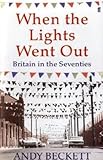
When the Lights Went Out by Andy Beckett: Book Review

I saw When the Lights Went Out: Britain in the Seventies by Andy Beckett on LibraryThing’s Early Reviewer Programme and the publishers’ description made me think maybe it would be interesting:

Over five years in the making, this book is not an academic history but something for the general reader, written with the vividness of a novel or the best works of American New Journalism. No such treatment of the seventies has been previously attempted. Hopefully the book will bring the decade back to life in its all its drama and complexity.

And it did bring that decade back to life. It’s a very detailed book, using original material such as diaries, letters, personal memoirs as well as books written about the period. I particularly liked the personal, face-to-face interviews with some of the key figures such as Ted Heath,  and his assessments of politicians such as this one of Margaret Thatcher in 1975 when she was a contender for the leadership of the Conservative Party:

 She was a fast learner, a holder of fierce convictions and a highly distinctive speaker and political presence. (page 261)

Margaret Thatcher was, essentially not easy to be around: ‘Thatcher was always tiresome,’ remembers the political journalist Michael White who spent a lot of time with her in the seventies. ‘There was no romance, no self-analysis, no self-consciously epic qaulity like you would have got with Churchill. (page 262)

When Beckett describes the strikes of the decade, and there were so many, the changes in the balance of power, the three-day week and the Winter of Discontent, I was back there living it all over again. My only criticism is a personal one – when he writes about the economic and financial situations with all the statistics he quotes I was a bit bored and have to admit that I skim read those sections. It was the personalities, the personal touches and the cultural and social scenes that I liked – for example during his interview with Denis Healey, who was Harold Wilson’s Chancellor of the Exchequer in the seventies Healey talked about Wilson’s lack of ambition:

‘In his second term he told many people that he planned only to stay a few months. He told me in the lavatory at No. 10 just before a Cabinet meeting.’ Healey giggled, characteristically delighting in the black comedy. Then, equally characteristically, he looked out of the window of his Sussex study and kicked Wilson’s reputation in the shins. ‘I thought, “About bloody time!” He was a terrible prime minister, actually.’ (page 162)

 Andy Beckett is a journalist and this book is very readable. As well as the personalities I also liked his descriptions of places, comparing how they are today with how they were in the seventies and his comparisons of the crises that faced Britain then with those facing us today:

At the least, a very seventies dread has seeped back into how people in Britain and other rich countries see the world. Economic crises, floods, food shortages, terrorism, the destruction of the environment: these spectres, so looming in the seventies did not go away during the eighties and nineties; yet they faded – they were often quite easy to forget about. Now that they have returned to haunt newspaper front pages almost daily, it is possible to wonder how many of Britain’s seventies problems were ever really solved. (page 522)

Sunday Salon

tssbadge1Today I started reading The Birthday Present by Barbara Vine. but I’m not sure that I really want to finish it. Maybe I’ve read too much crime fiction recently because this one just seems rather silly.

Ivor Tesham, MP decides to give his married girl friend a birthday present, one with a difference.  He arranges to have her “kidnapped” and delivered to him bound and gagged. Not my idea of fun and I nearly stopped reading at that point, but thought I’d go on a bit longer with it before giving up. I can’t say any of the characters are likeable, in fact they’re rather more stereotypes than real people – a sleazy politician, a plain single woman with no hope of romance, a beautiful young woman with no morals stuck in a boring marriage etc. And despite Ivor’s fears that he’s going to be found out and his name splashed across the newspapers ruining his chances of a dazzling political career it’s sadly lacking in tension.

Much more interesting are my current non-fiction reads:

after-the-victoriansAfter the Victorians by A N Wilson. This is not an academic study of the period 1900 – 1952 and Wilson interjects history with his own opinions and it’s full of references to art and literature as well as being an account of the political events of the times:

 … artists … hold up mirrors to what is going on in societies, they take soundings of a society’s cohesion, moral wellbeing, strength or lack of it. That is why totalitarian regimes persecute poets and composers with just as much rigour as they do to silencing overtly political opposition. Stalin and Hitler both had violently strong views about art and music. (p.156)

When the Lights Went Out by Andy Beckett. I’m enjoying this much more than I expected when-the-lights-went-outand surprising myself by wanting to read about the politics of the 1970s. But again this book is not solely a political history and there are plenty of personal touches. Beckett had interviewed many of the personalities and his accounts are compelling reading. Here he is on meeting Ted Heath:

Heath came slowly into the room, supported by a walking stick and another of his staff. His clothes – a baggy cream short-sleeved shirt with half the buttons undone, and the casual grey chinos – came as a small shock after watching hours of his pinstriped and uncomfortable early seventies political broadcasts. But his face was much the same: small determined eyes, the proud dagger nose, big plump cheeks barely lined despite his lingering yactsman’s tan – a usefully aspirational political signal back in the pre-easy Jet Britain of his premiership. (p. 28)

Part of its attraction is that it reminds me of many things I’d forgotten  – like the three-day week, the Winter of Discontent, and the TV programmes The Good Life and Fawlty Towers.