When the Lights Went Out by Andy Beckett: Book Review

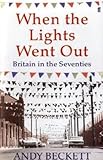
I saw When the Lights Went Out: Britain in the Seventies by Andy Beckett on LibraryThing’s Early Reviewer Programme and the publishers’ description made me think maybe it would be interesting:

Over five years in the making, this book is not an academic history but something for the general reader, written with the vividness of a novel or the best works of American New Journalism. No such treatment of the seventies has been previously attempted. Hopefully the book will bring the decade back to life in its all its drama and complexity.

And it did bring that decade back to life. It’s a very detailed book, using original material such as diaries, letters, personal memoirs as well as books written about the period. I particularly liked the personal, face-to-face interviews with some of the key figures such as Ted Heath,  and his assessments of politicians such as this one of Margaret Thatcher in 1975 when she was a contender for the leadership of the Conservative Party:

 She was a fast learner, a holder of fierce convictions and a highly distinctive speaker and political presence. (page 261)

Margaret Thatcher was, essentially not easy to be around: ‘Thatcher was always tiresome,’ remembers the political journalist Michael White who spent a lot of time with her in the seventies. ‘There was no romance, no self-analysis, no self-consciously epic qaulity like you would have got with Churchill. (page 262)

When Beckett describes the strikes of the decade, and there were so many, the changes in the balance of power, the three-day week and the Winter of Discontent, I was back there living it all over again. My only criticism is a personal one – when he writes about the economic and financial situations with all the statistics he quotes I was a bit bored and have to admit that I skim read those sections. It was the personalities, the personal touches and the cultural and social scenes that I liked – for example during his interview with Denis Healey, who was Harold Wilson’s Chancellor of the Exchequer in the seventies Healey talked about Wilson’s lack of ambition:

‘In his second term he told many people that he planned only to stay a few months. He told me in the lavatory at No. 10 just before a Cabinet meeting.’ Healey giggled, characteristically delighting in the black comedy. Then, equally characteristically, he looked out of the window of his Sussex study and kicked Wilson’s reputation in the shins. ‘I thought, “About bloody time!” He was a terrible prime minister, actually.’ (page 162)

 Andy Beckett is a journalist and this book is very readable. As well as the personalities I also liked his descriptions of places, comparing how they are today with how they were in the seventies and his comparisons of the crises that faced Britain then with those facing us today:

At the least, a very seventies dread has seeped back into how people in Britain and other rich countries see the world. Economic crises, floods, food shortages, terrorism, the destruction of the environment: these spectres, so looming in the seventies did not go away during the eighties and nineties; yet they faded – they were often quite easy to forget about. Now that they have returned to haunt newspaper front pages almost daily, it is possible to wonder how many of Britain’s seventies problems were ever really solved. (page 522)

Sunday Salon

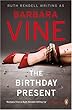
tssbadge1Today I started reading The Birthday Present by Barbara Vine. but I’m not sure that I really want to finish it. Maybe I’ve read too much crime fiction recently because this one just seems rather silly.

Ivor Tesham, MP decides to give his married girl friend a birthday present, one with a difference.  He arranges to have her “kidnapped” and delivered to him bound and gagged. Not my idea of fun and I nearly stopped reading at that point, but thought I’d go on a bit longer with it before giving up. I can’t say any of the characters are likeable, in fact they’re rather more stereotypes than real people – a sleazy politician, a plain single woman with no hope of romance, a beautiful young woman with no morals stuck in a boring marriage etc. And despite Ivor’s fears that he’s going to be found out and his name splashed across the newspapers ruining his chances of a dazzling political career it’s sadly lacking in tension.

Much more interesting are my current non-fiction reads:

after-the-victoriansAfter the Victorians by A N Wilson. This is not an academic study of the period 1900 – 1952 and Wilson interjects history with his own opinions and it’s full of references to art and literature as well as being an account of the political events of the times:

 … artists … hold up mirrors to what is going on in societies, they take soundings of a society’s cohesion, moral wellbeing, strength or lack of it. That is why totalitarian regimes persecute poets and composers with just as much rigour as they do to silencing overtly political opposition. Stalin and Hitler both had violently strong views about art and music. (p.156)

When the Lights Went Out by Andy Beckett. I’m enjoying this much more than I expected when-the-lights-went-outand surprising myself by wanting to read about the politics of the 1970s. But again this book is not solely a political history and there are plenty of personal touches. Beckett had interviewed many of the personalities and his accounts are compelling reading. Here he is on meeting Ted Heath:

Heath came slowly into the room, supported by a walking stick and another of his staff. His clothes – a baggy cream short-sleeved shirt with half the buttons undone, and the casual grey chinos – came as a small shock after watching hours of his pinstriped and uncomfortable early seventies political broadcasts. But his face was much the same: small determined eyes, the proud dagger nose, big plump cheeks barely lined despite his lingering yactsman’s tan – a usefully aspirational political signal back in the pre-easy Jet Britain of his premiership. (p. 28)

Part of its attraction is that it reminds me of many things I’d forgotten  – like the three-day week, the Winter of Discontent, and the TV programmes The Good Life and Fawlty Towers.

Teaser Tuesdays

teaser-tuesdayShould Be Reading – Miz B – hosts this weekly event – quoting a couple of sentences from our current read (without spoilers, of course) to entice you to read the book.

I’n currently reading three books – all non-fiction: a biography of Jane Austen, a popular history of Britain 1900 -1952 and a political history of Britain in the 1970s. I couldn’t decide which one to choose – so here are quotes from all three.

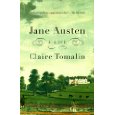
jane-austen-tomalinFirst Jane Austen: A Life by Claire Tomalin:

Jane Austen was a tough and unsentimental child, drawn to rude, anarchic imaginings and black jokes. She found a good source for this ferocious style of humour in the talk she heard, and sometimes joined in, among her parents’ pupils, bursting out of childhood into young manhood. (page 33)

after-the-victoriansThen After the Victorians: the World Our Parents Knew by A N Wilson:

One of the scientists who worked on the bomb dropped on Hiroshima, Leo Szilard, said that the idea of nuclear chain reaction first came to him when reading Wells’s The World Set Free (1914), in which atom bombs falling on world cities during the 1950s kill millions of people. These things were not possible when Wells wrote about them. We know that the twentieth century would see them happen. (page 67)

when-the-lights-went-outAnd finally When the Lights Went Out: Britian in the Seventies by Andy Beckett:

Declinism was an established British state of mind, but during the mid-seventies it truly began to pervade the national consciousness. It filled doomy books aimed at the general reader. It became a melodramatic staple for newspapers, magazines and television programmes. (page 181)

Two of those programmes were the comedy series Fawlty Towers and The Rise and Fall of Reginald Perrin – both about  middle-aged men “trapped in a decrepit England and filled with rage or dreams of escape”. Interestingly, we’re now watching a new Reggie Perrin (Martin Clunes); is it a sign of the times?

Non-Fiction Five Challenge

nonfictionsmall

Another Challenge! This is the Non-Fiction Five Challenge, starting on Friday 1 May. For more information on this challenge hosted by Trish at Trish’s Reading Nook click on the Rules below.

The Rules

1. Read 5 non-fiction books during the months of May – September, 2009

2. Read at least one non-fiction book that is different from your other choices (i.e.: 4 memoirs and 1 self-help)

You don’t have to post a list of the books you intend to read and can change them at any time, but I decided to do it anyway. So for the time being I’m planning to read:

  • After the Victorians by A N Wilson. I have started reading this one already and it will probably take me until September to finish it.
  • Russia by Jonathan Dimbleby
  • 1599: A Year in the Life of William Shakespeare by James Shapiro
  • Eden’s Outcasts by John Matteson
  • The Snow Geese by William Fiennes

Book Review: The Private Lives of the Impressionists by Sue Roe

Non-fiction books often take me a while to read and Sue Roe’s The Private Lives of the Impressionists is no exception; not however, because it’s difficult to read or boring, but simply because I decided to read it slowly. The Impressionists were a mixed bunch, including Manet, Monet, Pissarro, Cezanne, Renoir, Degas, Sisley, Berthe Morisot, Mary Cassatt, and Caillebotte. I feel I got to know some of them more than others and have only just skimmed the surface of their lives, which is understandable in a book covering so many people.

The Private Lives of the Impressionists tells how the early leaders of the group met when students in the studios of Paris. There was Monet, from an affluent family background originally from Normandy, Pissarro a Portuguese Jew from a very different background, born in the Dutch West Indies, Cezanne, a strange and intense student from Aix-en-Provence. The group widened with the addition of Renoir, from a working family (his father was a tailor from Limoges), Sisley the son of an English merchant and a Frenchwoman, and Bazille the son of a wealthy Montpellier wine-grower. They rebelled against the Salon and were pilloried and criticised for their work. They struggled to make a living, although now their paintings sell for millions.

Manet, whose father was a judge and mother the god-daughter of  the King of Sweden, was not really a part of their group , although over the years he supported them but never exhibited at the Impressionists exhibitions. To say that Manet was a complex character is an understatement and I’m going to read a biography devoted to him alone at some point. I’d also like to know more about Pissarro, Berthe Morisot and Renoir in particular.

This book follows their lives and loves and how their art developed over 26 years between 1860 when they first met and the introduction of their work to America in 1886. The Epilogue summarised what happened to each artist as the end of the century approached and the Paris art scene changed completely.

I now feel rather sad to have come to the end but there is a bibliography, essential for non-fiction books in my view, listing other books on the artists. If I’m being picky I’d criticise the bibliography because it’s arranged a-z by author – I’d prefer it to be arranged the individual artists. I’d also have liked more illustrations, but there are plenty of books on Impressionism.  I’d also love to travel the world to see their paintings – in London, Paris, and the US – well maybe I’ll manage the London galleries.

These are some of my favourite paintings, some of which are in this book.

Bar at the Folies Bergere by Manet
Red Roofs, 1877
La Loge by Renoir

This is the  eleventh library book I’ve read this year – still on target to complete the Support Your Local Library Challenge.

This Week’s Library Books

I don’t need to borrow any more books, but I had to go to the library to return The Gargoyle (see here) and of course then I couldn’t leave without at least looking at the books. This  week I concentrated on non-fiction as I already have a few novels on the go. I  read non-fiction much more slowly than fiction, so I don’t read many.

The photo below shows part of my local library’s non-fiction section. It’s not large but it has a good selection of books and I always find something of interest there.

non-fiction
Non Fiction Books

I came home with three books (I was very restrained remembering all my unread books):

library-loot-non-fiction

  • I don’t read much poetry but The Poems of Thomas Hardy, selected and introduced by Claire Tomalin caught my attention as I’ve read several of Hardy’s novels, but none of his poetry. Hardy wrote over a thousand poems and this selection traces his experiences of life and love. This reminded me that over a year ago I started to read her biography of Hardy, which I’d put down for a while to read more of Hardy’s own works before finishing it. Time to get back to it soon.
  • Impressionism by Paul Smith. I’ve become very interested in the Impressionists since taking a short course recently. The course concentrated on the sites they painted rather than their lives. To supplement that I’m already reading Sue Roe’s The Private Lives of the Impressionists. This book looks at the social, political and intellectual contexts in which Impressionism came about. Plus it has many colour illustrations of their paintings.
  • Lost For Words by John Humphrys. I like John Humphry’s style – this book is about the “mangling and manipulation of the English Language”. He thinks language should be “simple, clear and honest” and provides examples of cliches, meaningless jargon and evasive language (which I detest).