The Day Gone By: an Autobiography by Richard Adams

This book has been sat waiting patiently for me to read it for some years now. I can’t remember when I bought it, but I bought it because I loved the other books by Richard Adams that I’d read – Watership Down, the story he originally told to his children to while a way a long car journey, Shardik, The Plague Dogs, and The Girl in a Swing.
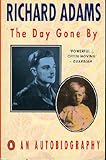
The Day Gone By is his memoir of his early life from his 1920s childhood at home with his parents in Newbury, Berkshire, to his time at boarding school, then life at university in Oxford and his service in World War Two, up to his return home in 1946 and his first meeting with the girl who became his wife.

He was born in 1920, the youngest child of George and Lilian Adams. The early chapters are about his earliest memories, full of wonder at the natural world around him. It was his father, a doctor, who taught him to recognise and love birds and the countryside. These chapters convey vividly his family’s idyllic post-Victorian pastoral lifestyle. His talent for storytelling came out when he went away to pep school at Horris Hill at the age of 8:

To Horris Hill’s lack of electric light I owe more than I can tell. Indeed, it may very well have been the greatest blessing of my life, for it was this that made me a dormitory story-teller. The shadowy, candle-lit dormitories of winter; or those same dormitories in the fading twilight after sunset; these were the settings for a story-teller such as no electrically lit room could ever provide. (page 138)

At first the stories he told were from those he’d read, but when he had no more to tell he was forced to make them up. During the day he began thinking about what he was going to tell the other boys at night.

The Day Gone By is a detailed account of his early life throwing light on the society in which he lived, the class structure and attitudes and above all the changes that were brought about by the Second World War. His experiences during the war are equally as detailed, conveying the effect it had on his life:

To anyone at all who lived through it, in whatever capacity, the Second World War was an enormous, shattering experience. It was – and I say this in all seriousness – difficult to believe it was really over; one could not remember what things had been like before. Anyway, that no longer mattered much: they weren’t ever going to be the same again. (page 379)

His style of writing changed in the section on his wartime experiences, almost as though he was using the language he spoke at the time. I liked his reflections on life; his opinions on the terrible suffering and cruelties of the war years are especially moving.

The Day Gone By: an Autobiography by Richard Adams. Penguin Books. 1991. 399 pages.

This is the last book completing the What’s In a Name? 5 Challenge – a book with something you’d find on a calendar in the title.
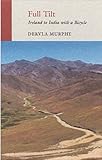
Full Tilt by Dervla Murphy

Dervla Murphy was born in County Waterford, Ireland. In a Book Beginnings post I wrote about how when she was ten she decided she wanted to cycle to India. And that is what she did 21 years later.

Full Tilt: Dunkirk to Delhi on a Bicycle, first published in 1965  is an account of her journey in 1963, which took her through Europe, Persia (Iran), Afghanistan, over the Himalayas to Pakistan and into India. She travelled on her own, with a revolver in her saddle bag. I’m full of admiration for her courage and determination.

Reading this book made me wonder about the countries she cycled through and how they’ve changed since the early 1960s. It would certainly be a different experience if anyone tried to do the same these days! T

Here are a few quotes to give a taste of the book:

The border between Persia and Afghanistan

The only indication of the Persian-Afghan frontier is a seven-foot stone pillar, conspicuous from far across the desert, which lucidly announces ‘Afghanistan’.  Here I stopped to photograph Roz [her bicycle]. Three miles further on a long branch served as Customs barrier and beside it lay a very young soldier in a very ragged uniform, sound asleep with one hand on his rifle. I quietly raised the barrier for myself and continued towards the Customs and Passport Office two hundred yards ahead.

There, no one took the slightest notice of either my kit or my passport, no uniformed officials appeared and no series of dingy, uncomfortable offices had to be visited. (page 47)

The concept of time:

… people here have no concept of time as we understand it. The majority wear watches as ornaments and I was diverted to discover that they can’t read the time and don’t see why they should learn! Yesterday is over, today is something to be enjoyed without fuss, and tomorrow – well, it’s sinful to plan anything for the future because that’s Allah’s department and humans have no business to meddle with it. (page 58)

Dervla Murphy loved the Afghan way of life and deplored the modernisation of countries:

The more I see of life in these ‘undeveloped countries’ and of the methods adopted to ‘improve’ them, the more depressed I become. It seems criminal that the backwardness of a country like Afghanistan should be used as an excuse for America and Russia to have a tug-of-war for possession. (page 69)

Her thoughts on the attitude of Westerners:

… what an artificial life is led by the foreign colonies in these Asian cities! The sense of their isolation from the world around them is quite stifling. At a dinner party tonight I met a European couple who have been in Kabul for eighteen months without once entering the home of an ordinary Afghan – and they are not exceptions. The attitude is that the ‘natives’ are people to be observed from  a discreet distance and photographed as often as possible, but not lived among. The result is boredom and an obsessional longing for home leave, (page 101)

This was not her attitude as she stayed with local people wherever she could, accepting their food and lodgings which was given freely – they would not let her pay for anything and would have been offended if she had insisted.

Her essentials for a five-month trip – she needed less than I would want!

… the further you travel the less you find you need and I see no sense in frolicking around the Himalayas with a load of inessentials. So, I’m down to two pens, writing paper, Blake’s poems, map, passport, compass, comb, toothbrush, one spare pare of nylon pants and nylon shirt – and there’s plenty of room left over for food as required from day to day. It’s a good life that teaches you how little you need to be healthy and happy, if not particularly clean! (page 105)

Her views on ‘Progress’:

The more I see of unmechanized places and people the more convinced  I become that machines have done incalculable damage by unbalancing the relationship between Man and Nature.

people now use less than half their potential forces because ‘Progress’ has deprived them of the incentive to live fully. (page 149)

… I don’t know what the end result of all this ‘progress’ will be – something pretty dire, I should think. We remain part of Nature, however startling our scientific advances, and the more successfully we forget or ignore this fact, the less we can be proud of being men. (pages 149 – 150)

I enjoyed Full Tilt, as much for her descriptions of the places she visited as for her thoughts along the way. I’m not sure that I would find her easy company though!

Weekend Cooking: Cakes Please!

Yesterday was CatsPlease on my blog and today it’s CakesPlease! I used to bake cakes every week, but haven’t done so for years.

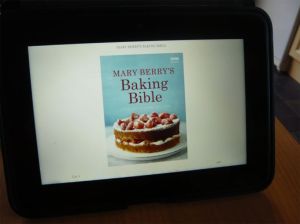
Mary Berry's Baking Bible P1080218Earlier this year I got the baking bug after watching The Great British Bake Off, and I was so taken with Mary Berry that I bought one of her books – Mary Berry’s Baking Bible. For the first time I bought a cookery book to read on my new Kindle Fire, partly because I have lots of cookery books and there’s no room for any more and also because the Kindle Fire has colour and the cover has a built-in stand so I can stand it up on the kitchen table to refer to it easily whilst cooking.

This contains a huge range of cakes, biscuits, traybakes, breads, buns, scones, hot puddings and pies, souffles and meringues and cheesecakes! Over 250 classic recipes.

Mary Berry writes:

Cakes are made to be shared so, once you have mastered a recipe, invite your friends and family to enjoy the fruits of your labour with a good pot of tea – happy baking!

So, I’m sharing the recipe for the Banana Loaf, which I made earlier this week and as I can’t physically share it here are my photos. First the ingredients:

  1. Preheat the oven to 180°C/ Fan 160°C/Gas 4. Lightly grease a 900g loaf tine then line sides and base with baking parchment.
  2. Put all ingredients into a mixing bowl and beat for 2 minutes until well blended. Spoon mixture into the loaf tine and level the surface.
  3. Bake for about 1 hour, until well risen and golden brown. Leave in the tin to cool for a few minutes then turn out, peel off the parchment and finish cooling on a wire rack.

This is what mine looked like:

It tasted delicious!

For more Weekend Cooking posts see Beth Fish Reads.

Scottish History

Ever since we moved to live just south of the border with Scotland I’ve been interested in learning more about its history. My knowledge was limited to the basics and mainly related to the monarchy – Robert the Bruce, Mary Queen of Scots, James VI of Scotland and I of England, the Jacobite Rebellions, and Bonnie Prince Charlie and so on.

Many books have been written on Scottish history and when I saw this little book some years ago I thought it could be a good place to start to find out more:

A Short History of Scotland by Richard Killeen is by its very nature a summary account and a basic introduction. There are 31 short chapters covering the period from Prehistoric Scotland up to the Twentieth Century – all in 69 pages, including coloured illustrations of people and places.

I found the early chapters the most interesting (maybe because it was mainly new information for me) covering the early periods – Iron Age Celts, Roman Scotland and later invaders – Anglo-Saxons, raiders from Dalriada in Ireland (Irish Celts), Picts and Vikings.

Much of the book is the history of the monarchy. Kenneth MacAlpin was the first King of Scotland (9th century) but not of all modern Scotland – he never established himself in the Borders, which was held by the Anglo-Saxon Northumbrians. Northumbria had formerly extended from the Humber right up to the Forth, and it was not until Malcolm II (1005-34) won the battle of Carham in 1018 that the land north of the Tweed became part of his kingdom.

The book traces the history of Scotland through the various battles for power and control – the Norman settlement of the lowlands founding abbeys and cathedrals, the contest for the crown between John Balliol and Robert Bruce (both members of the Norman aristocracy) and the intervention of Edward I of England in choosing John Balliol as king in 1292 and claiming formal overlordship for himself and his successors.

Scottish kings had paid feudal homage to English kings before the 1290s. As far back as 1174, William the Lion had acknowledged himself the formal vassal of Henry II. Such acts did not imply that Scotland was a dependency of England. In the first place, England and Scotland hardly existed in the modern sense. The age of centralised states with uniform laws, secure boundaries with centralised administration – all things we take completely for granted – lay well in the future. (page 28)

Edward’s actions triggered Scottish resistance, with William Wallace winning victory over the English at Stirling Bridge in 1297. Wallace was then defeated within a year at the Battle of Falkirk. Robert the Bruce gained the crown, and in 1314 defeated Edward II at the Battle of Bannockburn: ‘the battle which confirmed Scotland as an independent kingdom.’ (page 31)

Moving forward in time, Killeen describes the history of Scotland until the Reformation as ‘a guignol of intrigue, faction and murder mixed with solid achievement.’ The rest of the book includes chapters on the Stewarts, Mary Queen of Scots, the Union of Crowns (1603), the Civil War, Glencoe, the Act of Union (1707), Scottish Enlightenment, the Clearances and the Industrial Revolution.

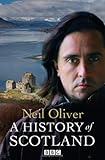
Reading this little book has spurred me on to read more detailed histories and I’ve started with Neil Oliver’s A History of Scotland. More about that another time.

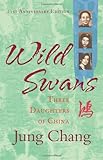
Book Beginnings: Wild Swans by Jung Chang

I’m currently reading Wild Swans by Jung Chang.

It begins:

At the age of fifteen my grandmother became the concubine of a warlord general, the police chief of a tenuous national government of China. The year was 1924 and China was in chaos. Much of it, including Manchuria, where my grandmother lived, was ruled by warlords. the liaison was arranged by her father, a police official in the provincial town of Xixian in southwest Manchuria, about a hundred miles north of the Great Wall and 250 miles northeast of Peking.

Wild Swans is a family memoir – the story of three generations of woman in Jung Chang’s family – her grandmother, mother and herself. This is the 2003 edition with an introduction by Jung Chang explaining how she came to write the book. She had always dreamed of being a writer, but growing up in Mao’s China it seemed out of the question, with most writers suffering in endless police persecutions. It was only after she had been allowed to come to Britain in 1978 to study that she had the freedom to write and to write what she wanted.

So far, I’m finding it fascinating, reading about her grandmother, who was one of the last generation of Chinese woman to suffer the practice of binding feet. I knew of this practice, but hadn’t realised just how much the little girls suffered and continued to suffer throughout their lives.

As this book is so long (over 600 pages in a small font) it’s going to take me quite a while to read it. I’l probably write a few posts on my progress.

First Chapter, First Paragraph is hosted by Diane at Bibliophile by the Sea.

Adventures of a One-Breasted Woman by Susan Cummings

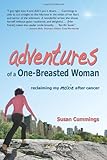
I received Susan Cumming’s book Adventures of a One-Breasted Woman: Reclaiming My Moxie After Cancer from the publisher via LibraryThing‘s Early Reviewer programme.

About the author from Goodreads:

Susan Cummings is a writer, an actress and now a 20-year breast cancer survivor. Once a newspaper reporter, she has since been published in a number of literary journals and written songs and plays. Feeling alone and vulnerable after her mastectomy for early-stage breast cancer, she looked, in vain, for a memoir of another woman’s experiences after cancer treatment. Eventually she wrote the book she had sought. She lived in New York City for many years, but is now settled in western Massachusets.

The fact that I’ve read this book shows how I’ve become more adjusted to reading about cancer than I was a few years ago. At that time I had grave misgivings about reading about breast cancer because my mother had died from it many years ago. But I was diagnosed with breast cancer a year last August and was so encouraged by how treatment has improved over the years that I’m now able to face reading about it. I haven’t had a mastectomy as Susan Cummings had but I was able to identity with some of the feelings she describes. Even so, I hesitated about reading the book as everyone has their own ways of coping and everybody’s experience is different.

Susan Cummings was diagnosed with cancer in 1992 and she chose to have a mastectomy rather than a lumpectomy followed by radiation because her surgeon said it would be a more assured cure. She didn’t move on after the operation and struggled with fear that the cancer would recur and with shame about her disfigured body.

Her book follows her thoughts and feelings over the six years after her surgery with openness. At times she was depressed, at others more optimistic and cheerful, accepting her body for what it is. I thought it was very good, easy to read and encouraging to read about someone who had not only survived but had managed to overcome her problems and face up to life with courage. Throughout the book I thought she looked realistically at the options open to her. It’s also an account of relationships and how they change, about her childhood and about different and alternative methods of healing.  I’m glad to have received and read it.