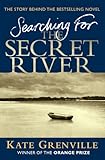
Searching for The Secret River by Kate Grenville

Searching for the Secret River is Kate Grenville’s account of how she came to write The Secret River. Her interest began with her great-great-great grandfather, Solomon Wiseman,who was the original ferryman at Wiseman’s Ferry. Her mother had told her stories about him, but she wanted to know more about what he was like and what he might have done when he first encountered Aboriginal people.

It is a fascinating book detailing how she went about her research into family history and how she imagined his life from facts gleaned from the records and the places he had lived.

She writes about reading. As a short-sighted child reading was her whole life:

I read in the bath, I read on the toilet, I read under the desk at school, I read up in my tree house, feeling the branches of the jacaranda swell and subside under me.

I can identify so well with this. I was a short-sighted child and read everywhere too, walking round the house, in bed under the covers with a torch when I should have been asleep, all the places Kate Grenville read, although not in a tree house – I would have loved a tree house!

She writes about writing. As a writer she couldn’t help examining how other writers went about their writing – seeing how books had been made. One book that helped her with writing The Secret River is Anil’s Ghost by Michael Ondaatje, a novel based on historical events in which some of the characters are apparently versions of real people. She had come to the point in her book where she had written lots of notes, forty-seven folders of notes!! So she made lists to try to organise her writing and then began just writing scenes and descriptions of various aspects – about London and Sydney, the convict system, and what she called ‘elements of memoir.’ But she thought that lots of her writing was dry and dead.

Reading Anil’s Ghost, however she realised that she had to take herself out of the book and find a character to carry out the search for the story of Wiseman and his dealings with the Aboriginal people. To do this she had to see the scenes before she could write them:

The hard part of the writing wasn’t finding the words – they seemed to come reasonably easily. If they started to come reluctantly, I stopped writing and began with something else. The hard part was finding the picture. Once I could see and hear the moment, I could write it.

In her first draft some parts were in the first person, some in the third person, but always from Wiseman’s point of view. The first-person point of view seemed right but then she decided that that didn’t match Wiseman’s character and there were things she wanted the book to say that Wiseman couldn’t say – about the Aboriginal culture for one thing. So, it had to be in the third person, but the ‘third person subjective’ – ‘from Wiseman’s point of view but only partly in his voice.’

There is so much in this book – the research, the notes, the descriptive passage, the numerous drafts, finding the right voices, the characters, identifying the central drama of the novel, the right eighteenth century names, developing Wiseman into a character, renaming him William Thornhill and building a picture of the Thornhill family. Then the dialogue had to be right, to be convincing. She listened to a recording of Robert Browning, went through transcripts of Old Bailey trials, looked at how Dickens, Defoe and other writers put words into their characters’ mouths.She remembered her mother’s and grandfather’s sayings, phrases and idioms. In the end she decided that she wouldn’t try

to reconstruct the authentic sound of nineteenth century vernacular. My job was to produce something that sounded authentic. … I read all the dialogue aloud. If anything hit a false note, it was obvious straight away. This was a bad one for example: ‘That bit of land, he said. Remember, I told you. We’ll lose it if we don’t move soon.’

This sounded terribly drawing-room. I muddied it up: ‘that bit of land, he said. Remember he telled you. We’ll miss out if we don’t grab it.’

She deleted large sections of dialogue.

The whole book is compelling reading, not just because it’s about how she wrote the book and the enormous amount of work she put into research, but also because in itself it paints a picture of life in London in the late eighteenth century and Australia in the early years of settlement in the early nineteenth century. I was captivated from start to finish.

Searching for The Secret River: a Book Beginnings Post

Book Beginnings ButtonGilion at Rose City Reader hosts Book Beginnings on Friday in which you share the first sentence (or so) of the book you are reading, along with your initial thoughts about the sentence, impressions of the book, or anything else the opener inspires.

I’m currently reading Searching for The Secret River by Kate Grenville. It begins:

In the puritan Australia of my childhood, you could only get a drink on a Sunday if you were a ‘bona fide traveller’. That meant you had to have travelled fifty miles or more. Around Sydney a ring of townships at exactly the fifty-mile mark filled with cheerful people every Sunday. One of them was a little place called Wiseman’s Ferry.

I loved Kate Grenville’s book The Secret River, so when I discovered that she had written a book about how she came to write it I just had to get a copy. Her interest began with her great-great-great grandfather, Solomon Wiseman,the original ferryman at Wiseman’s Ferry. Her mother had told her stories about him, but she wanted to know more about, what he was like and what he might have done when he first encountered Aboriginal people … she needed to know.

I haven’t finished the book yet, but it is fascinating – seeing how she went about her research into family history and how she imagined his life from facts gleaned from the records and the places he had lived.

A Time of Gifts by Patrick Leigh Fermor

I read A Time of Gifts by Patrick Leigh Fermor a few weeks ago and have been mulling it over ever since. It began so well and I thought it was one of those books I was going to love. And then there are later passages which are so tedious and hard work to read, so full of dry facts and arcane words that I began to wonder why I was reading any further. But I did and then the writing swept me away and I became engrossed in the book again.

My reaction, I think, is to the two sides of this book, in which Patrick Leigh Fermor describes his travels on foot in 1933 from the Hook of Holland through Germany, to Austria, Slovakia and Hungary, on his way to Constantinople. (He continued his journey in Between the Woods and the Water, which describes his experiences up to the Iron Gates border between Rumania and Bulgaria.) The two sides are because he wrote this book in later life so his direct experiences and reactions are intermingled with the results of his later research and with the benefit of hindsight. I prefer the immediacy of his earlier writings taken from the diaries he kept along the way, bringing the countryside to life and recounting his encounters with the local people.

There are passages like the one below where he linked his journey to painting:

When no buildings were in sight, I was back in the Dark Ages. But the moment a farmhouse, or a village impinged, I was in the world of Peter Brueghel. The white flakes falling beside the Waal – or the Rhine or the Neckar or the Danube – and the zigzag gables and the muffled roofs, were all his. The icicles, too, and the trampled snow, the logs piled on the sledges and the peasants stooped double under loads of faggots. … When the wintry light crept dimly from slits close to the horizon or an orange sun was setting through the branches of a frozen osier-bed, the identity was complete.

In the end I scan read page after page of detailed descriptions of churches, of sociological, political or historical people and places.  I was too impatient to read all those details and I was reading the book too quickly. It’s a book to take your time with, to read a section, put the book down and come back to it later – and I didn’t do that, I swallowed it down with the result that parts were indigestible.

In a way his journey was a gilded experience as he had introductions to people in different places – people who gave him a bed for the night, or longer stays. There were also people who didn’t know him who welcomed him into their homes as a guest – as the title says it was a time of gifts. It was the period when Hitler came to power in Germany:

Appalling things had happened since Hitler had come into power ten months earlier: but the range of horror was not yet fully unfolded. In the country the prevailing mood was a bewildered acquiescence. Occasionally it rose to fanaticism.

But whereas not everyone liked the English there were some who did:

I answered many earnest questions about England: how lucky and enviable I was, they said, to belong to that fortunate kingdom where all was so just and sensible. The allied occupation of the Rhineland had come to an end less than ten years before, and the British, she said, had left an excellent impression.

Overall, I did enjoy this book. There are many passages so vividly described that I can remember them now weeks later – the vision of this young man, nearly nineteen years old striding through the German countryside reciting Shakespeare, in a loud voice and accompanied with gestures, sword thrusts, a staggering gait and with his arms upflung, looking as though he was drunk, or a lunatic. Then there was the time in Vienna when the money he was expecting hadn’t arrived and Konrad, a Don Quixote type character, took him round to a block of flats and encouraged him to knock on doors asking if the occupants wanted to pay him for a sketch of themselves.

In fact even with the dull passages, I liked this book well enough to buy the second book by Fermor Leigh, Between the Woods and the Water and I see that a third book is to be published later this year – The Broken Road, completing the account of his journey to Constantinople.

Following his walk across Europe, Patrick Leigh Fermor (1915-2011) lived and travelled in the Balkans and Greek Archipelago. He joined the Irish Guards and during the occupation of Crete led the party that captured the German commander. He was awarded the DSO and OBE.

Saturday Snapshot

This is the Flodden Visitor Centre. It’s in a former telephone box in the village of Branxton in Northumberland. Flodden Visitor Centre P1080503It claims to be the smallest visitor centre in the world:

Flodden Visitor Centre P1080499

It’s part of the commemoration of the Battle of Flodden which took place 500 years ago in September between the English and Scottish armies in the fields near Branxton.

Flodden Visitor Centre P1080501Inside there is a map showing the routes of the two armies and indicating several sites related to the battle. There are leaflets and even a button to press the hear about the battle.

If you are in London on 14 May you can get tickets for a lunchtime lecture on the Battle of Flodden 1513 by historian Clive Hallam Baker at the Tower of London. He is the author of The Battle of Flodden: Why and How.

Other books about Flodden, with links to my reviews:

Fiction:

Non fiction:

  •  Flodden: the Scottish Invasion of Henry VIII’s England by Nigel Barr
  • New Light on Floddon (sic) by Gerard F T Leather – I have not written about this short book published in 1938, which Leather, a member of the Berwickshire Naturalists’ Club had written after studying the battle for a talk. As he explained there were actually four distinct fights going on a more or less the same time and the old name of the battle was that of Branxton Moor, a more correct title, in his opinion, as the battle scene was a mile and a half from Flodden.

For more Saturday Snapshots see Alyce’s blog At Home With Books.

Weekend Cooking: Ultimate Chocolate Brownies

Slender Frenchwomen often told the co-founder of Green & Black’s chocolate that ‘they kept a bar of Green & Black’s in their desk drawer, to have a square at 4 pm which would keep them going till dinner …’ Could I be so disciplined and just eat one square?

Well, I can restrict myself to eating just one Ultimate Chocolate Brownie and whilst that can never really be thought to help keep anyone slender, eating one at 4 pm will certainly keep anyone going until dinner time!

Chocolate Brownie

I made a batch recently using the recipe from Green & Black’s Organic Ultimate Chocolate Recipes: the New Collection. This is a book mainly about baking, and it makes my mouth water just looking at it, full of recipes for cakes, cookies, cupcakes, cheesecakes, tarts  soufflés, puddings, pies, and sweets such as truffles and chocolate marshmallows. They are all decadently chocolatey and scrumptious.

To make 24 chocolate brownies you need:

  • 300g unsalted butter
  • 300g dark (70% cocoa solids) chocolate broken into pieces
  • 5 large free-range eggs
  • 450g granulated sugar
  • 1 tablespoon vanilla extract
  • 200g plain flour
  • 1 teaspoon salt
  • Preheat oven to 180°C/gas mark 4
  • Melt butter and sugar together in a bowl over a pan of barely simmering water
  • Beat eggs, sugar and vanilla extract together until the mixture is thick and creamy and when chocolate and sugar have melted together beat in the egg mixture
  • Add flour and salted (sifted together first) and beat until smooth
  • Bake in a tin 30x24x6cm, lined with greaseproof or baking parchment for about 20-25 minutes until the top has formed a crust just starting to crack.
  • The brownie will not wobble but will be gooey inside
  • Leave in the tin for 20 minutes and then cut into 24 squares and remove from the tin

Eat and enjoy!

N.B. I wrote about Green & Black’s first cookbook in an earlier Weekend Cooking post where I described making chocolate mousse – Dark with Coffee.

weekend cookingWeekend Cooking is hosted by Beth Fish ReadsIt’s open to anyone who has any kind of food-related post to share: Book (novel, nonfiction) reviews, cookbook reviews, movie reviews, recipes, random thoughts, gadgets, fabulous quotations, photographs.  For more information, see the welcome post.

BooksPlease is 6: A Celebration of Books

Today my blog is six years old. Reading has always been a great pleasure and I began my blog to try and capture some of that pleasure. So, I thought that for today’s anniversary post I’d look back at some of the books I’ve read over the last six years that stand out in my mind as being most enjoyable.

It’s difficult with so many books to choose from and there are plenty more I could highlight, but here are six of the best fiction books and six of the best non fiction. I think the books I’ve chosen show the range of books that I enjoy – historical fiction, crime fiction, contemporary fiction, autobiography, history, poetry (just a few poets) and philosophy/psychology.

Over these last six years I’ve seen blogs come and go and there have been times when I’ve considered giving up blogging, but somehow I’ve hung on and looking back over my blog to do this post has proved to me the value of keeping it – it’s not just a record of what I’ve read but also a reminder of what I thought of the books too. And I hope my posts do convey the pleasure reading gives me.

Fiction (one from each year)

2007 – 

Mistress of the Art of Death by Ariana Franklin. This is historical crime fiction set  in Cambridge in 1170 during the reign of Henry II. A child has been murdered and others have disappeared.The Jews are suspected and Henry is keen to find the culprit as the Jewish community in Cambridge are major contributors to his Exchequer. He enlists the help of Simon of Naples, who is accompanied by Adelia, a female doctor who specialises in studying corpses. I loved this book, reminiscent of The Canterbury Tales. The medieval world is vividly brought to life and it’s a fascinating murder mystery.

2008 – 

Atonement by Ian McEwan – a book that moved me to tears. It begins on a hot day in the summer of 1935 when Briony, then aged thirteen witnesses an event between her older sister Cecelia and her childhood friend Robbie that changed all three of their lives. It’s a captivating story of the use of imagination, shame and forgiveness, love, war and class-consciousness in England in the twentieth century.

From 2009 – 

Fire in the Blood by Irène Némirovsky – a gem of a book, this is  set in a small village based on Issy-l’Eveque between the two world wars. The narrator is Silvio looking back on his life and gradually secrets that have long been hidden rise to the surface, disrupting the lives of the small community.  It is an intense story of life and death, love and burning passion. It’s about families and their relationships €“ husbands and wives, young women married to old men,  lovers, mothers, daughters and stepdaughters.

From 2010 – 

Wolf Hall coverWolf Hall by Hilary Mantel – this is my favourite, so far, of Mantel’s trilogy about the story of Thomas Cromwell, the son of a blacksmith, and his political rise, set against the background of Henry VIII’s England.This first book in the trilogy is about his struggle with the King over his desire to marry Anne Boleyn. It transported me back to that time, with Mantel’s descriptions of the pageantry, the people, the places and the beliefs and attitudes of the protagonists. A wonderful book.

From 2011 – 

Blood HarvestBlood Harvest by S J Bolton. Crime fiction set in the fictional town of Heptonclough in Lancashire where the Fletcher family have just moved into a new house built on land right next to the boundary wall of the churchyard.  I was completely convinced not only by the setting but also by the characterisation that the place and the people in this book were real. It’s full of tension, terror and suspense and I was in several minds before the end as to what it was all about. I had an inkling but I hadn’t realised the full and shocking truth.

From 2012 – 

The Secret River 001The Secret River by Kate Grenville €“ this book completely captivated me and I could hardly wait to get back to it each time I had to put it down. It’s historical fiction, straight-forward story-telling following William Thornhill from his childhood in the slums of London to his new life in Australia in the early 19th century. Dramatic, vivid and thought-provoking, this novel raises several issues €“ about crime and punishment, about landownership, defence of property, power, class and colonisation.

Non Fiction:

2007 –

On Trying to Keep Still by Jenny Diski  about her travels during a year when she visited New Zealand, spent three months in a cottage in Somerset and went to sample the life of the Sami people of Swedish Lapland. This is also a personal memoir, and is about being still, being alone, wanting to be alone, phobias and the problems of coping with life and especially with aging.  I can indentify with her feelings such as not wanting to make a noise in case people notice that I’m there, not wanting others to worry about me, and worrying that others are worrying about me; feeling the need to do something such as going out for a walk €“ not the desire to do it for itself but the feeling that I should want to. It’s a moving, amusing, thought-provoking and original book.

2008 –

Our Longest Days  by the writers of Mass Observation, edited by Sandra Koa Wing. In August 1939, with war approaching, the Mass Observation Organisation asked its panel to keep diaries to record their daily lives and selections from fifteen of these diaries are included in Our Longest Days. Because they are personal accounts there is that sense of being actually there during the air raids, hearing Churchill’s speeches, reading the newspaper reports, experiencing the grief at the number of casualties and deaths and the terrible devastation of the war, the food and clothes rationing and the excitement of D-Day.

also from 2008:

Robert Frost (The Illustrated Poets series) – a slim little book with a selection of Frost’s verse illustrated by American, English and French painters of the nineteenth and twentieth centuries. Frost’s poems are written in deceptively simple language but they convey great depth of meaning. They are compact and powerful. And the illustrations are beautiful.

2009 – 

The Perfect Summer by Juliet Nicolson, a fascinating look at life in Britain during the summer of George V’s Coronation year, 1911.  It was one of the hottest years of the twentieth century and also a summer of discontent as the country was almost brought to a standstill by industrial strikes and the enormous gap between the privileged and the poor was becoming more and more obvious. It covers a wide spectrum €“ from King George’s accession to the throne to débutantes  politicians, poets, factory workers, writers, and women trade unionists. There is little about the suffragettes €“ they agreed a summer truce for the Coronation.

 2010 –

Agatha Christie: an Autobiography As well as being a record of her life as she remembered it and wanted to relate it, it’s also full of  her thoughts and reflections on life and writing. She wrote about her childhood, teenage years, friends and family, and her marriage to Archibald Christie; but although she wrote about their divorce she didn’t write about her disappearance in 1926. She wrote about her travels around the world, the two world wars, her interest and involvement with archaeology and her marriage to Max Mallowan.  I read it in short sections and felt quite sad when I came to the end. It was like having a daily chat with Agatha.

2011 –

Operation Mincemeat by Ben Macintyre – this is about the Allies’ deception plan code-named Operation Mincemeat in 1943, which underpinned the invasion of Sicily. It was framed around a man who never was. The plan was to take a dead body, equipped with false documents, deposit it on a beach in Spain, so that it would be passed over to the Germans and divert them from the real target. Totally outside my usual range of reading this was so far-fetched as to be almost like reading a fictional spy story. I marvelled at the ingenuity of the minds of the plans’ originators and the daring it took to carry it out.

PS – I’ve enjoyed compiling this post so much that I’m thinking of doing something similar for the paintings and places I’ve written about.