First Chapter, First Paragraph: The Girl in the Cellar

First chapterEvery Tuesday Diane at Bibliophile by the Sea hosts First Chapter First Paragraph Tuesday Intros to share the first paragraph sometimes two, of a book that she’s reading or planning to read soon.

I didn’t read any of my books for the 20 Books of Summer Challenge in July, so I’ve got some catching up to do. One of the shorter books on my list is The Girl in the Cellar by Patricia Wentworth, in which Miss Silver helps Anne, who has lost her memory, but who thinks she has witnessed a murder.

It begins:

She looked into the dead unbroken dark and had neither memory nor thought. She was not conscious of where she was, or of how she had come there. She was not conscious of anything except the darkness. She did not know if time had passed. There seemed to be no sense that it went by, but it must have done, because the moment when she knew nothing but darkness had changed into a moment in which she knew that her feet were on stone, and that she must not move from where she stood.

Blurb:

A young woman regains consciousness and finds herself on some cellar steps. At the bottom of the steps there is the corpse of a dead girl. She cannot remember who she is, what has happened or why she is there. Terrified and confused she manages to find a way out and as she flees she runs into Miss Silver, who offers to help her.

A letter in her bag is the only clue to her identity. But by investigating what has happened to her will she find herself in danger? Can she trust the letter writer? And who is the girl in the cellar?

This is a Miss Silver Mystery (there are 32 in the series), first published in 1961, the year that Patricia Wentworth died. She was born in India in 1878 and wrote dozens of best-selling mysteries being recognised as one of the ‘mistresses of classic crime.’She died in 1961 and was as popular in the 1940s as Agatha Christie and Dorothy L Sayers. Miss Silver, a contemporary of Miss Marple ‘was her finest creation‘.

What do you think? Would you keep reading? I think this opening paragraph sets the scene well, with the sense of danger and mystery to make me want to know more.
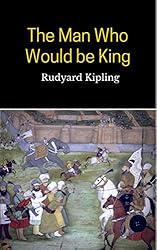
The Man Who Would Be King by Rudyard Kipling

For me the book chosen for the current Classics Club Spin is The Man Who Would Be King by Rudyard Kipling. It’s a novella, just 60 pages, which first appeared in The Phantom Rickshaw and other Eerie Tales, published in 1888.
Set in India and narrated by a journalist this is a story of two ruffianly-looking adventurers, wanderers and vagabonds, Daniel Dravot and Peachey Carnehan, who announce that they are off to Kafiristan in the mountains of Afghanistan to make themselves Kings. They tell the journalist that when they have got their kingdom ‘in going order’ they will let him know and that he can then come and help them govern it.

But some two years later, on a hot summer’s night, what was left of Carnehan crept into the journalist’s office,

He was bent into a circle, his head was sunk between his shoulders, and he moved his feet one over the other like a bear. I could hardly see whether he walked or crawled- this rag-wrapped, whining cripple who addressed me by name, crying that he was come back. (page 24)

And he had a sorry tale to tell.

I was a bit disappointed with it, mainly because for a novella it took such a long time to set the scene and the opening section was confusing, with references I didn’t understand. After the slow beginning the story picks up when it gets to relating what happened to Dravot and Carnehan. The Kipling Society website (where you can read the story, which is also free on Amazon) has some notes that helped me understand more – Masonic, Biblical and other references and details about the places and people mentioned.

The Kipling Society also gives details of the background to the story and some critical responses to it. Overall the responses are good – that it is a memorable, fantastic tale, some believing it to be a masterpiece, but Kingley Amis stated it was a ‘grossly overrated long tale‘. I was also interested that Edmund Wilson is quoted as stating that the story is “…surely a parable of what might happen to the English if they should forfeit their moral authority.”[Edmund Wilson ‘The Kipling that Nobody Read’, in Kipling’s Mind and Art ed. Andrew Rutherford, Oliver & Boyd, 1964.]

There was a film adaptation in 1975, starring Sean Connery as Dravot and Michael Caine as Carnehan with Christopher Plummer as Kipling, which according to some is much better than the story itself.

Rudyard Kipling was born in Bombay in 1865 and lived there until he was five when he was taken to live in England, returning to India in 1882, where he worked as a journalist. As well as short stories he also wrote poems, including If, and novels, and was awarded the Nobel Prize in Literature in 1907.

My copy is an e-book, which I’ve had for several years, so it counts towards my Mount TBR Reading Challenge.

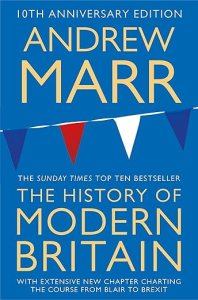
The History of Modern Britain by Andrew Marr

I’ve taken quite a long time (nearly two months) to read Andrew Marr’s The History of Modern Britain, which covers the post World War II period up to 2006, with an added introduction in the paperback edition written in 2008. This is a brief review of a very long and detailed book – too long and detailed for me to sum up meaningfully in a few paragraphs.
So, here is the blurb from the back cover:

This is an account of great political visions – and how they were defeated – and of the resilience, humour and stroppiness of the British public. From the Second World War onwards, Britain has been a country on edge: first of invasion, then of bankruptcy, then on the vulnerable front line of the Cold War, and later in the forefront of the great opening up of capital and migration now reshaping the world. This history follows all the political and economic stories, but deals too with comedy, cars, the war against homosexuals, Sixties anarchists, oil-men and punks, Margaret Thatcher’s wonderful good luck, the true heroes of British theatre, and the victory of shopping over politics.

I wanted to read this book after watching Andrew Marr’s BBC 2 series, History of Modern Britain, which was first shown in 5 episodes in 2007 –  but it was the EU Referendum that nudged me into reading it this year. Like many others, I’ve now become addicted to news and comment programmes, but my knowledge of modern history, even though, or maybe because, I’ve lived through a lot of it, is sketchy, so it was fascinating, if somewhat scary, to read about events I remembered or had half-forgotten.

It’s an obvious statement, but still true, that Britain has changed since 1945 to be almost unrecognisable today and inevitably it is still changing. This book shows how we were then and how we got to where we are today. It’s mainly a political and economic history, with short sections on social and cultural events thrown into the mix.

Despite its length and complexities it is a readable book, which doesn’t surprise me as Andrew Marr is a journalist, TV presenter and political commentator. He was born in Glasgow in 1959. He studied English at the University of Cambridge and has since enjoyed a long career in political journalism, working for the Scotsman, the Independent, the Daily Express and the Observer. From 2000 to 2005 he was the BBC’s Political Editor. He has written and presented TV documentaries on history, science and politics, and presents the weekly Andrew Marr Show on Sunday mornings on BBC1 and Start the Week on Radio 4.

  • Paperback: 672 pages
  • Publisher: Pan; Reprints edition (6 Mar. 2009)
  • Language: English
  • ISBN-10: 0330511475
  • ISBN-13: 978-0330511476
  • Source: my own copy

Reading challenges: Mount TBR Reading Challenge and Read Scotland.

Mount TBR Mountaineering Checkpoint #2

Mount TBR 2016
Now it’s July and the year is half-way over so Bev, our mountaineering guide, is calling for a second quarterly check-in post and asking how we are getting on.

1. Tell us how many miles you’ve made it up your mountain (# of books read).  

I’m on my way up Mt Vancouver , having read 28 books. I’m well on target to reach Mt Ararat (48 books) this year and hoping to get a fair way up Mt Kilimanjaro (60 books).

2. Which book (read so far) has been on your TBR mountain the longest? Was it worth the wait? Or is it possible you should have tackled it back when you first put it on the pile? Or tossed it off the edge without reading it all?

The Voyage Out by Virginia Woolf has been on my TBR mountain the longest. I’m not sure when I bought it, but it was one of the books I listed when I first joined LibraryThing in 2007.  I do wish I’d read it before this year but I enjoyed it so it was worth the wait.

My Life According to Books 

Use titles from your list to complete as many of the following sentences below as you can.  Feel free to add or change words (such as “a” or “the” or others that clarify) as needed.

1. My Ex is/was [reduced to] Bones and Silence (by Reginald Hill)

2. My best friend is Doctor Thorne (by Anthony Trollope)
3. Lately, at work [I’ve been] Talking to the Dead (by Harry Bingham)
4. If I won the lottery, [I’d be on] The Voyage Out (by Virginia Woolf) [cruising around the world]
5. My fashion sense [is because of the] Heat Wave (by Penelope Lively)
6. My next ride [will take me to a]  Destination Unknown (by Agatha Christie)
7. The one I love is [in] The Glass Room by Simon Mawer
8. If I ruled the world, everyone would [know] The Secret of Chimneys (by Agatha Christie)
9. When I look out my window, I see The Mill on the Floss (by George Eliot)
10. The best things in life are [found during] A Month in the Country (by J L Carr)

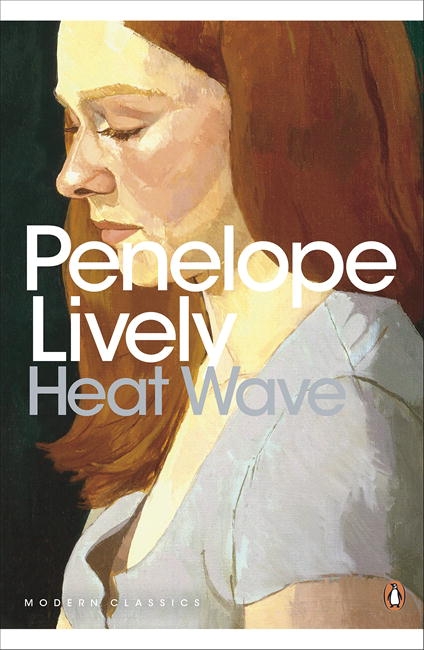
Heat Wave by Penelope Lively

I’ve read quite a lot of Penelope Lively’s books and have found them full of interest, easily readable, peopled with believable characters and covering various philosophical and moral issues that make me think. Heat Wave (first published in 1996) is no different in that it is about relationships, the connections between the past and the present, love, marriage and adultery, jealousy, anger, grief and loss.

However, I groaned when I began reading it because it is in the present tense and I’m not that keen on that. But as I read on, my irritation with the tense began to fade away as I became engrossed in the story. It’s quite a simple one really, the strength of the book, I think, coming from the characterisation, the increasing tension and the oppressive atmosphere of a blazing hot summer.
Pauline, a freelance copy-editor, is spending the summer at her cottage, somewhere in the middle of England. Her daughter, Teresa, grandson, Luke and son-in-law Maurice are next door in the adjoining cottage, whilst Maurice concentrates on finishing the book he is writing. They are visited by James and Carol, who accompany them on visits to tourist attractions to help with the research for his book. As Pauline sees the relationship between Teresa and Maurice change, apparently following the same pattern of her own failed marriage, she becomes increasingly anxious and angry, unable to intervene.

In just 184 pages, Penelope Lively builds an in depth study of angst, frustration and conflict, set against the changing landscape of the countryside, the effect of the heat on the land, the crops and the people. Interspersed are her trips to London, her long-standing and now platonic friendship with Hugh, her conversations with one of the authors whose book she is editing and who is also struggling with his marriage, and the family’s visits to tourist attractions as part of Maurice’s research for his book. So alongside the personal relationships Heat Wave also looks at the countryside, how it is changing, our relationship to nature and how farming has changed because of industrialisation and tourism.

I love the descriptions of the countryside that Pauline sees through her window, just one example:

A light wind ruffles the field – shadows course across the young wheat. The whole place is an exercise in colour, as it races into growth. The trees are green flames and the hedges billow brilliantly across the landscape. The old hedgerow at the bottom of the garden has a palette that runs from cream through lemon yellow and all the greens to apricot, russet and a vivid crimson. Each burst of new leaf adds some subtle difference to the range. For a couple of weeks the whole world glows. (page 24)

But this is not just an idealised view of the countryside; she also notes the unnatural discordant sight of fields of dead grass as a result of the policy of set-aside, the industrialisation of agriculture, and the nasty, glaring yellow of oil-seed rape seen by some as an intrusive blight.

What irritated me when I began reading the book, paled into insignificance as the tension between the characters grew, culminating in an inevitable climax as the hot weather ended and a violent thunder storm broke over the cottages. I ended up loving this book.

Heat Wave is my 28th book for Bev’s Mount TBR 2016 challenge and the 6th book for the  20 Books of Summer Challenge.

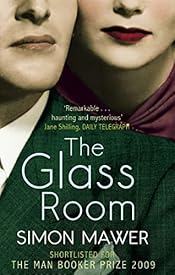
The Glass Room by Simon Mawer

The Glass Room by Simon Mawer 

Synopsis from Amazon:

Cool. Balanced. Modern. The precisions of science, the wild variance of lust, the catharsis of confession and the fear of failure – these are things that happen in The Glass Room.

High on a Czechoslovak hill, the Landauer House shines as a wonder of steel and glass and onyx built specially for newlyweds Viktor and Liesel Landauer, a Jew married to a gentile. But the radiant honesty of 1930 that the house, with its unique Glass Room, seems to engender quickly tarnishes as the storm clouds of WW2 gather, and eventually the family must flee, accompanied by Viktor’s lover and her child.

But the house’s story is far from over, and as it passes from hand to hand, from Czech to Russian, both the best and the worst of the history of Eastern Europe becomes somehow embodied and perhaps emboldened within the beautiful and austere surfaces and planes so carefully designed, until events become full-circle.

The house and its setting are not fictional, but are based on the Tugendhat House, Brno in the Czech Republic. A few of the characters are non-fictional but the rest are imaginary and their story has no basis in fact. In his introduction to the Abacus edition of the book, published in 2013, Simon Mawer describes his first visit to the house, which was then a museum. He hadn’t planned to write a novel centred on the house. To him is not a museum, but ‘vibrant and alive’, and the novel was born.

I found it a gripping novel that had me on tenterhooks as I was reading. It is, as the synopsis relates, the story of a house, the Landauer House, and specifically of a room within that house called the ‘Glass Room’.

Liesel and Viktor stood and marvelled at it [the Glass Room]. It had become a palace of light, light bouncing off the chrome pillars, light refulgent on the walls, light glistening on the dew in the gardens, light reverberating from the glass. It was as though they stood inside a crystal of salt. Isn’t it wonderful,’ she exclaimed, looking round with an expression of amazement. ‘You feel so free, so unconstrained. The sensation of space, of all things being possible. Don’t you think it is wonderful, Viktor? Don’t you think that Rainer has created a masterpiece for us?’ (pages 64-5)

The whole wall of the lower ground floor is plate glass. The room is a huge space, white walls, furnished with little decoration beyond a piano, specially designed chairs in the sitting area in front of an onyx wall veined with amber and honey, polished to a mirror-like gloss, reflecting the light, and a circular dining table in the dining area enclosed in a semicircle partition of Macassar wood.

But it was the story of the people who lived/worked in the house that captivated me and made me so anxious for them and about what would happen to them as the events of the Second World War and beyond overtook their lives. It’s not only a gripping novel, but also a beautifully written book with interesting and likeable characters, set in a Europe at war and its aftermath; and a book about architecture, ideas, about love and loss, about prejudice and persecution. A deeply moving and haunting book.

I’ve read two of Simon Mawer’s earlier books, The Gospel of Judas (2000) and The Fall (2003), both of which I also thoroughly enjoyed. He has also written:

Chimera (1989)
The Bitter Cross (1992)
A Place in Italy (1992)
A Jealous God (1996)
Mendel’s Dwarf (1997)
Swimming to Ithaca (2006)
The Girl Who Fell From the Sky (2012)
aka Trapeze
Tightrope (2015)

For more details see his website.

The Glass Room is my 27th book for Bev’s Mount TBR 2016 challenge and the 5th book I’ve read in the 20 Books of Summer Challenge.