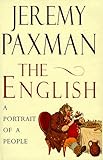
 The English: a Portrait of a People by Jeremy Paxman (an English journalist, broadcaster and author) is a very interesting book, described as:
A book on what constitutes Englishness, and what are considered the essential characteristics and values. Using literary sources and interviews, Jeremy Paxman attempts to define how “Englishness” has changed over this century, and what it is now both in our own and outsider’s views.
It is full of historical information, but is a bit rambling, but even so it is very entertaining. He begins with ‘Being English used to be so easy‘ and goes on to say ‘It’s all so much more complicated now.’ And then proceeds to prove his point.
This makes it difficult to write about it, but easy to read. I like Paxman’s style of writing, I could almost hear him speaking as I read. He’s a person who has grown on me over the years and lately I’ve enjoyed his TV documentaries too. It’s always been entertaining to watch his interviews, even if I didn’t agree with his views – or his aggressive approach. It’s toned down in this book, but every now and then his acerbic nature comes across.
The easiest way to describe the book is to look at the chapter headings. There are chapters on ‘Funny Foreigners’, ‘The English Empire’, and ‘There Always Was An England’ – in which he concludes ‘the chasm between the imaginative England and the real England won’t do any longer because it fails to reflect the lives of the majority.‘ Other chapters are about the ‘Ideal Englishman’, the ‘True Born Englishman and Other Lies’ and so on. But it’s the index that shows the full breadth of the topics he covers, from the ‘Abbey National Bank’ to ‘Zadok the Priest (Handel)’.
He writes about food, sport, football hooligans, language, individualism, education, religion, ‘John Bull’, cities and the countryside – the English idyllic village, class structure and social tone, attitudes to women, business and trade to name but a few topics. It’s well researched and very readable, with a bibliography listing all the books he mentions plus others that presumably he has used.
It was published in 1998, so things have moved on a lot since then, but I still think it’s a valid book. I’ve had it for about four years and was prompted to read it now by all the discussion about Scottish Independence, if only to see if he could clarify what it means to be ‘English’. He points out the thoughtless way people have of muddling up ‘England’ with ‘Britain’, as if the Scots and Welsh do not exist (it annoys me too).
But I don’t really feel any clearer about what is is to be ‘English’. It seems there really is no such thing as ‘the English’ – we’re a mixture of all sorts, or as Paxman puts it, The English are a mongrel race‘. (page 59) It’s hard to do justice to this book in one short post and there is so much more that I could write about – but it would be far better to read the book itself.
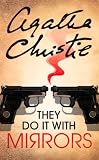 I don’t think it’s one of her best, but I did like it. It begins with Miss Marple reminiscing with an old friend, Mrs Ruth Van Rydock, an American. Miss Marple has known her and her sister, Carrie Louise since they had been together at a pensionnat in Florence. Ruth is worried about Carrie Louise, who is now living in a country house in the south of England with her husband, Lewis Serrocold, which he has turned into a home for delinquent boys. She can’t put her finger on what is wrong, she just felt the atmosphere wasn’t right, whether it was the boys’ home – ‘those dreadful young delinquents‘ or something else and she asks Miss Marple to visit Carrie Louise to see if her fears are justified.
 patriarch who, although generous and well-respected in the community, is repressive and fanatically religious at home. Escape and the discovery of a new way of life come when Nigeria is shaken by a military coup, forcing Kambili and her brother to live in their aunt’s home, a noisy place full of laughter. The visit will lift the silence from her world and, in time, unlock a terrible, bruising secret at the heart of her family life.
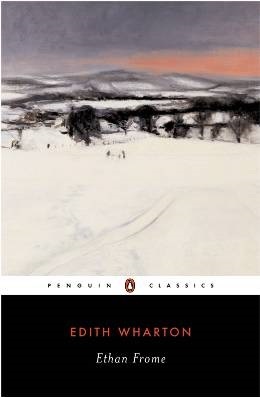 What a fantastic book. Ethan Frome is a beautifully told tale – a tragedy, signalled right from the beginning of the book, when the unnamed narrator first saw Ethan Frome and was told he had been disfigured and crippled in a ‘smash up’, twenty four years earlier. Life had not been good to him:
 BooksPlease