New-To-Me Books

Just eleven days left to go before the end of March and the end of the TBR Triple Dog DareThe basic idea of the Triple Dog Dare is to spend the first three months of the year cleaning house by reading only books in your TBR stack as of midnight, Dec. 31 and with a few allowed exceptions I’m still on track. But I’ve downloaded books onto Kindle and got some books from Barter Books over these last three months and I’m really looking forward to reading them from April onwards. I wrote about some of them in an earlier post.

Here are some more of the ‘physical’ books I have waiting not-so-patiently to be read:

Sweet Thursday P1090384

  •  Sweet Thursday by John Steinbeck – because I loved Cannery Row and this is the follow-up story. ‘Set in Monterey, on the California Coast, Sweet Thursday is what they call the day after Lousy Wednesday, which is one of those days that’s just naturally bad.’ I was really pleased to find this on the shelves at Barter Books – it just jumped out at me.
  • The Last Girl by Jane Casey – because I’ve read good things about her books, crime fiction of the thrilling kind. It’ll probably be a while before I read this book as I haven’t read the first in the Maeve Kerrigan series and this one is the third.
  • A Medal for a Murderer by Frances Brody – because I enjoyed the first Kate Shackleton mystery, Dying in the Wool. This is the second in the series, set in the 1920s in Harrogate where the leading lady in a play at the theatre is found dead in a doorway.
  • The Day of the Lie by William Brodrick – because I’ve read two of the earlier Father Anselm books and enjoyed them. In this one Anselm investigates events in Eastern Europe in the grip of the Cold War.

The books on Kindle include these:

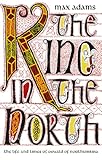
Books on Kindle P1090385The one I’m most interested in is The King in the North: the Life and Times of Oswald of Northumbria by Max Adams – because it’s history of the area where I live, set in the 7th century about Oswald, a prince of the Northumbrian royal house. He reigned briefly, from 634 – 642, but during that time he re-united and re-Christianized the North-East; forged a hybrid culture of Briton, Irish, Scot and Anglo-Saxon; and founded a monastery on Lindisfarne. He was the first British king to die a Christian martyr. Max Adams is a biographer, archaeologist,  traveller and writing coach who lives in North-east England.

I think I’ll be reading this book very soon!
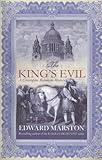
The King's Evil by Edward Marston

I’m still reading from my own unread books and turned to The King’s Evil for some historical crime fiction. It’s the first in Edward Marston’s Restoration series, featuring Christopher Redmayne, an architect and Jonathan Bale, a parish constable.
The King’s Evil is set in London in September 1666, just as the Great Fire of London has begun, eventually devastating a large part of the old medieval City of London. I liked Marston’s description of the fire, conjuring up the sights and sounds, the fear and panic it caused and the efforts to stop its spread – although I’m sure they didn’t use ‘dynamite’ to blow up houses to create a fire break. Anyway this anachronism didn’t spoil my enjoyment of this book.

Redmayne, a Royalist – a supporter of the Court and King Charles II – has designed a new house for Sir Ambrose Northcott and Bale is a Puritan who views Charles with great disapproval and is wondering if the fire is a consequence of the corruption in society as a result of the Restoration of the Crown:

England was once more ruled by a Stuart king. A monarchy which Jonathan had been pleased to see ended was now emphatically restored. As a result, London was indeed a wicked city and nobody was better placed to see the extent of its depravity than someone who patrolled the streets in the office of constable. Jonathan was a God-fearing man who always sought guidance from above and he was bound to wonder if the conflagration really was a sign of divine anger. There were Biblical precedents of cities being punished for their corruption. (page 26)

The two men are brought together with the discovery of Sir Ambrose’s dead body in the cellars of his partly built new house. It’s a good story with some interesting characters, including Jesus-Died-To-Save-Me Thorpe and Redmayne’s older brother Henry, elegant, fashionable and a dissipated rake, who had introduced Christopher to Sir Ambrose. But it’s the setting in time and place that interested me most – the period when Christopher Wren was the leading architect in rebuilding London – the bustle and energy of the times and the lingering conflict between Royalists and Parliamentarians.

The mystery of who killed Sir Ambrose moves along swiftly, with a few surprises along the way, as you would expect, but nothing too surprising. Redmayne travels to Sir Ambrose’s country house, Priestfield Place in Shipbourne, Kent and crosses the Chanel to Paris following the trail of the killer. It’s the ending of the book that let it down somewhat for me – it’s all a bit rushed and abrupt, but overall I enjoyed it and will read more in the series.

Edward Marston, who also writes under the name of Keith Miles, is a prolific author. He is a former chairman of the Crime Writers’ Association. He has several series of books, listed on his website and also on Fantastic Fiction.

The King’s Evil fits into several challenges I’m doing – The Mount TBR Reading Challenge, TBR Triple Dog Dare,the Historical Fiction Challenge, My Kind of Mystery Challenge and What’s in a Name (royalty category).

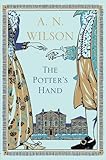
Book Beginnings: The Potter's Hand by A N Wilson

Whilst I’ve been reading from my own book shelves this year so far, I’ve accumulated a pile of library books that are tempting me away from them. One of these books is The Potter’s Hand by A N Wilson.

It begins:

The unoiled hinge joined its melancholy whine to the opium-dosed whimper of the patient who st gagged in his chair, and to the swift rasping of the saw. The door creaked ajar in the very moment that the doctor sawed off the leg of Sukey’s pa.

Such a dramatic opening that immediately grabbed my attention, conjuring up such a vivid picture complete with sound effects! The year is 1768. Sukey (Susannah), who later became the mother of Charles Darwin, was the daughter of Josiah Wedgwood,  an English potter and founder of the Wedgwood company.

The Potter’s Hand is a novel about Josiah Wedgwood and his family. Wilson explains in an Afterword that the broad outlines of the story and most of the details are true, but he has altered dates and rearranged historical events and nearly all the letters are invented. It is ‘meant to be read as fiction, even thought it is intended in part, as an act of homage to one of the great men of our history.’

I’ve read the first two chapters and think I’ll have to read on soon, after I’ve finished Death Under Sail by C P Snow, a crime fiction novel, if not sooner.

Every Friday Gilion at Rose City Reader hosts Book Beginnings on Friday, where you can share the first sentence (or so) of the book you are reading, along with your initial thoughts about the sentence, impressions of the book, or anything else the opener inspires.

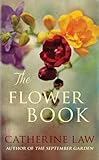
Book Beginnings – The Flower Book

Yesterday I finished reading Purple Hibiscus by Chimamanda Ngozi Adichie, which I thought was an amazing book that kept me captivated even though it’s a challenging book to read because of its subject matter. I’ll write more about that in a later post.

It has left me with the usual problem of deciding what to read next and I’ve picked up and started so many books, none of which seem good enough after Purple Hibiscus. I’ve been reading from my own bookshelves this year, but I’m thinking of having a little break from that and reading a library book. It’s one I picked off the mobile library van, not knowing anything about it or about the author, Catherine Law – The Flower Book. It’s set in 1914 and also in 1936.

It begins in Cornwall in March 1914:

On certain nights if the wind was right, you could hear the sea from Old Trellick. So the legend has it, although Violet had never heard the waves and her parents would not try, due to the fact, she decided, that they had no imagination.

As a child she’d stand at the French windows and implore them to be quiet, to stop what they were doing and to concentrate with her, to catch this magical and elusive sound.

Every Friday Gilion at Rose City Reader hosts Book Beginnings on Friday, where you can share the first sentence (or so) of the book you are reading, along with your initial thoughts about the sentence, impressions of the book, or anything else the opener inspires.

I like the images the beginning of this book conjures and also the sounds. I always like the sight and sound of the waves breaking on the shore; to me too that has a certain magic. So this appealed to me straight away. Couple that with a story set against the backdrop of World War I as Aster Fairling searches for the truth behind her parents’ tragic love through the pages of her mother journal and I want to know more.

The Flower Book is Catherine Law’s third book.

Crucible by S G MacLean

Once again I was transported back to 17th century Scotland with Crucible by S G Maclean, the third of her Alexander Seaton books. I read the first, The Redemption of Alexander Seaton in February 2013 and now a year later I’ve been just as engrossed in Crucible. I think her style of writing suits me perfectly, the characters are just right, credible well-rounded people, the plot moves along swiftly with no unnecessary digressions and it’s just full of atmosphere. I loved it.

It’s set in 1631 in Aberdeen, where Alexander is now a Master at Marischal College. On Midsummer’s eve he stumbles across the body of his friend, Robert Sim, the college librarian, a few feet from the library steps, with his throat cut, blood congealing around the wound. Dr Dun, the college principal asks Alexander to investigate the matter, to look into Robert’s private life, hoping he’ll find nothing to reflect badly on the college.

I found it absolutely compelling reading. Robert had been cataloguing a new acquisition to the library before he was killed and Alexander is convinced that Robert was troubled by what he found there, amongst the books of history, alchemy  and hermetics – the quest for ‘a secret, unifying knowledge, known to the ancients’ since lost to us. There are many twists and turns and another man is killed before he finally arrives at the truth.

This is the third book in the series, but although I haven’t read the second book, I don’t think that matters as I think Crucible stands well on its own. The fourth book in the series is The Devil’s Recruit – the hardback and Kindle versions are available now, whilst the paperback will be available on 14 May. Now I’ve lifted my book buying ban I think I may just have to get the Kindle version soon.

Crucible qualifies for four of the challenges I’m doing this year – the Mount TBR challenge, the Historical Fiction Challenge, My Kind of Mystery Challenge and the Read Scotland Challenge.

Dying in the Wool by Frances Brody

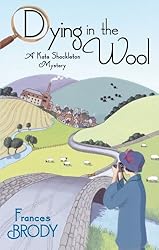
After I finished reading The Grass is Singing (see my previous post) I felt I needed to read something lighter and easier, so I turned to Dying in the Wool by Frances Brody and it turned out to be just the right book – not too taxing on either the brain or the emotions and a rather interesting mystery too.

It’s the first of Frances Brody’s Kate Shackleton Mysteries set in Yorkshire in 1922, with flashbacks to 1916. Bridgestead is a peaceful mill village, until the day in 1916 when mill owner Joshua Braithwaite went missing after apparently trying to commit suicide. Seven years later his daughter, Tabitha, who is getting married, still can’t believe her father is dead and she asks her friend Kate Shackleton to find out what really happened to him.

This is another post World War 1 crime novel, along the lines of Jacqueline Winspear’s Maisie Dobbs and Carola Dunn’s Daisy Dalrymple books, with an independent female amateur detective. Kate is a widow, her husband was missing in action during the war, presumed dead, her father is a police superintendent and she is a keen amateur photographer. On her father’s recommendation she hires Jim Sykes, an ex-policeman to help her. Once they start asking questions things start to happen with disastrous effects.

I liked the characters, Kate and Jim in particular, and the setting is lovely. The novel is well grounded historically in the aftermath of the First World War. I also liked the way the chapter headings were textile related with an explanation of the terms used and relevant to the events described in the chapters – very skilfully done, I thought. And just like woven cloth this mystery has many separate strands that Kate and Jim have to bring together to reveal what had happened in 1916.

This book fits well into several challenges – see the categories listed above.

Other books in the Kate Shackleton series are:

2. A Medal For Murder (2010)
3. Murder in the Afternoon (2011)
4. A Woman Unknown (2012)
5. Murder on a Summer’s Day (2013)
6. Death of an Avid Reader (2014)