The Black Friar by S G MacLean

The Black Friar by S G MacLean is one of those books that has the power to transport me to another time and place. I was totally absorbed, convinced I was back in England in the 17th century.
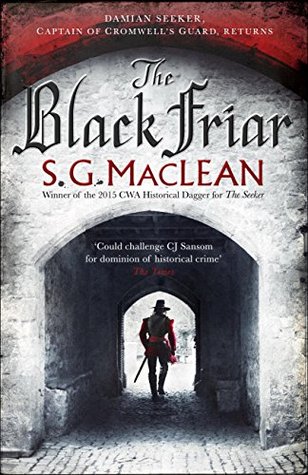
The Black Friar (Damian Seeker, #2)

It is the second book in the Damian Seeker series, historical crime fiction set in 1655 during the Interregnum under Oliver Cromwell, the Lord Protector. Damian Seeker, Captain of Cromwell’s Guard, works for Thurloe, Cromwell’s Chief Secretary and spy master, in charge of the security of the regime. It’s a complex mystery, particularly as there are various factions and religious sects plotting rebellion against Cromwell.

A body, presumed by his black robe to be that of a Dominican friar, is found bricked up in a wall in Blackfriars, once a monastery and now a derelict building gradually falling into the River Fleet. But this was no friar, as Seeker recognised him as Carter Blyth one of Thurloe’s undercover agents, who had been working in the Netherlands, observing the Royalists colluding with foreign powers. As far as Seeker knew he had been killed in Delft three months earlier. Seeker’s task is to find why he had been killed and who killed him. He discovers that Blyth under Thurloe’s orders had in fact infiltrated a group of Fifth Monarchists who wanted to overthrow Cromwell and had been living with the Crowe family, members of the group, under the name of Gideon Fell.

It’s a complicated and intricate tale as Seeker, helped by Nathaniel Crowe, tries to discover what Blyth had been doing, and what trail he was following. There are missing children, whose whereabouts Blyth had been investigating, and plots to overthrow Cromwell as well as plots to reinstate Charles Stuart as King.

Although The Black Friar is the second book in the series, (the first is The Seeker, which I haven’t read) I think it works well as a stand-alone book. The characterisation is strong and I particularly like Damian Seeker, a man both respected and feared, and a man to trust.

I also like the way S G MacLean has based her book on solid historical research (she has an M.A. and Ph.D. in History from the University of Aberdeen) and weaves real historical figures into the story, such as the poet John Milton, now an old blind man, the Secretary of Foreign Tongues and the diarist Samuel Pepys, an Exchequer clerk, who though very personable was ‘prone to drink and some lewdness.’ It all brings to life the atmosphere and tenor of the 1650s. I loved it.

My thanks to Netgalley and Quercus books for my copy of this book. It is due to be published on 6 October.

Recent Additions at BooksPlease

books-sept-2016

From top to bottom: the first seven in the pile are from Barter Books in Alnwick, my favourite bookshop where you can either swap or buy books. I took seven books in and came home with another seven. I love browsing at Barter Books and always find books I want to read.

  • Absent in the Spring by Mary Westmacott – I had to search round the various places fiction is shelved in Barter Books before I found this book in the Romance section. It’s by Agatha Christie, writing as Mary Westmacott. The books she wrote under this pseudonym are a complete change from her crime fiction – she was such a versatile writer. Her daughter, Rosalind, called them ‘bitter-sweet stories about love’. It was first published in 1944.
  • Arms and the Women by Reginald Hill – I’ve been collecting his books in an attempt to read them in chronological order. This is the 18th Dalziel and Pascoe mystery in which Ellie, Pascoe’s wife is in danger at a decaying seacoast mansion.
  • An April Shroud by Reginald Hill – the 4th Dalziel and Pascoe mystery, set in a solitary mansion in the Lake District where Pascoe is spending his honeymoon.
  • The House by the Churchyard by Sheridan Le Fanu – the Horror section is right next to Crime Fiction and I don’t usually look there but as I walked past this book caught my eye as it was displayed in one of the holders on the side of the bookcase, maybe because I’m taking part in the R.I.P. event at the moment. Le Fanu was described by Henry James as in the ‘first rank of ghost writers‘. Set in the 1760s in Ireland, it begins with the accidental disinterment of an old skull and an eerie late-night funeral.
  • A Game of Sorrows by Shona MacLean – the second book in the Alexander Seaton series. I’ve read the first and the third so I was pleased to find this one. It’s set in 1628 in Ulster as Seaton investigates a family curse – a family divided by secrets and bitter resentments.
  • The Collector by John Fowles – another author whose books I’ve enjoyed in the past. This could also be a choice for the R.I.P. event. It’s described as a thriller with psychological and social overtones, the story of a kidnapping.
  • A Walk Along the Wall by Hunter Davies – I was really pleased to find this book Hadrian’s Wall is the most important Roman monument in Britain. Hunter Davies grew up at one end of the wall and was inevitably drawn to walk its length. It’s part history, part guidebook and part personal experience and gives readers a taste of what life was like in this remote part of Britain 2000 years ago.

The bottom two books in the pile aren’t from Barter Books:

  • The Black Caravel by Harry Nicholson is a book the author sent to me for review. It’s his second novel, a sequel to ‘Tom Fleck‘ which I reviewed in 2011. It begins and ends at Hartlepool in 1536, the year of The Pilgrimage of Grace, as Barbary corsairs are raiding northwards.

and finally a birthday present (in August):

  • Rowan’s Well by C J Harter – a psychological thriller (another one for  R.I.P. maybe). Rowan’s Well is a remote house on the north-east coast of England, home to the charismatic Brooke family, the scene of murder and betrayal.

I want to start reading them all – now!

Favourite Books: September 2007 – 2010

Each month I’ve been looking back at some of my favourite books I read during the years 2007 – 2010. These are some of my favourite books I read in September in each of those years. September seems to have been a great month for books as I rated so many 5/5, but I’m highlighting just one for each month in this post. Revisiting these books makes me want to re-read all of them.

Click on the titles to see my original reviews.

2007


Crow Lake by Mary Lawson – this tells the story of a family of four children living at Crow Lake in the north of Canada in an isolated house miles away from any town, with just a few other families in the vicinity. The narrator is Kate Morrison and the story unfolds as she looks back on her life, triggered by an invitation to her nephew’s 18th birthday party.

When she was seven her parents were killed in a car crash, leaving her, her baby sister and two teenage brothers, orphaned. The trauma of their parents’ death affects the children in different ways and as Kate looks back on the events that followed she begins to see that not everything was as it seemed to her at the time.

Convincing characters combined with beautiful descriptions of Crow Lake and its ponds make this a memorable and lyrical novel.

2008

The Gravedigger’s Daughter by Joyce Carol Oates made a great impression on me in 2008 and I wrote three posts about it – see here and here for the first two and here for my final thoughts.

This is a melodramatic and memorable book depicting a grim, dark world, a violent and pessimistic world, gothic and grotesque. In some ways it reminds me of Hardy’s novels ‘“ you know something terrible will happen whatever the characters do to try to avert tragedy.

The main character is Rebecca Schwart, born in New York Harbor, the daughter of Jacob and Anna escaping from Nazi Germany in 1936. They live a life of abject poverty whilst Jacob can only find work as a caretaker of Milburn Cemetery, a non-demoninational cemetery at the edge of the town.

Soon the town’s prejudice and the family’s own emotional frailty results in unspeakable tragedy. In the wake of this loss, and in an attempt to put her past behind her, Rebecca moves on, across America and through a series of listless marriages, in search of somewhere, and someone, to whom she can belong.

The ending both surprised and touched me enormously.

2009

Pardonable Lies by Jacqueline Winspear – the third book in her Maisie Dobbs series. This one is set in 1930 when Maisie is asked by Sir Cecil Lawton to prove that his son, Ralph really did die in 1917 during the First World War. Sir Cecil’s wife, who had recently died, had been convinced that Ralph was still alive and on her deathbed made him promise to search for their son. This takes Maisie on a traumatic and dangerous trip to France ‘“ to the battlefields where she had been a nurse.

I like the Maisie Dobbs books. They’re easy to read, but not simple, the plots are nicely complicated and Maisie’s own story is seamlessly interwoven with the mystery. They give a good overall impression of the period, describing what people were wearing, the contrast between the rich and the poor and the all-pervading poisonous London smog. The horror of the War is still strong, people are still grieving for friends and relations killed or missing, visiting the battlefields and working to improve life for the soldiers who had returned home injured, and for the homeless children forced into life on the streets.

2010

The Fall by Simon Mawer – beautifully written, I was enthralled by this book. This is the story of Rob Dewar and Jamie Matthewson from their childhood up to Jamie’s death 40 years later and also the story of their parents and how their lives are interlinked.

The narrative moves between the two generations beginning in the present day, when Rob hears on the news that Jamie, a renowned mountaineer has fallen to his death in Snowdonia. No one is sure whether it was an accident or suicide. Then it moves  back 40 years to the time when the two boys met, both fatherless ‘“ Jamie’s dad, Guy went missing when climbing Kangchenjunga and Rob’s parents are divorced, and back yet further again to 1940 when Guy Matthewson met the boys’ mothers ‘“ Meg (later calling herself Caroline) and Diana. And so the drama unfolds in the mountains of Wales and the Alps, culminating on the North Face of the Eiger.

My Friday Post: The Scent of Death

Book Beginnings ButtonEvery Friday Book Beginnings on Friday is hosted by Gillion at Rose City
Reader
 where you can share the first sentence (or so) of the book you are reading, along with your initial thoughts about the sentence, impressions of the book, or anything else the opener inspires.

This week’s book is a library book I’m thinking of reading. It’s The Scent of Death by Andrew Taylor. I borrowed it because I’ve enjoyed some of his other books. It begins:

This is the story of a woman and a city. I saw the city first, glimpsing it from afar as it shimmered like the new Jerusalem in the light of the setting sun.

Synopsis:

August, 1778. British-controlled Manhattan is a melting pot of soldiers, traitors and refugees, surrounded by rebel forces as the American War of Independence rages on. Into this simmering tension sails Edward Savill, a London clerk tasked with assessing the claims of loyalists who have lost out during the war.

Savill lodges with the ageing Judge Wintour, his ailing wife, and their enigmatic daughter-in-law Arabella. However, as Savill soon learns, what the Wintours have lost in wealth, they have gained in secrets.

The murder of a gentleman in the slums pulls Savill into the city’s underbelly. But when life is so cheap, why does one death matter? Because making a nation is a lucrative business, and some people cannot afford to miss out, whatever the price’¦

Also every Friday there is The Friday 56, hosted by Freda at Freda’s Voice.Friday 56

These are the rules:

  1. Grab a book, any book.
  2. Turn to page 56, or 56% on your eReader.
  3. Find any sentence (or a few, just don’t spoil it) that grabs you.
  4. Post it.
  5. Add the URL to your post in the link on Freda’s most recent Friday 56 post.

Page 56:

You’re a thief, a damned pickpocket. There were two empty purses in your bundle. And those shoes you had on your feet – well they tell their own story don’t they?

I like the promise of this book – historical crime fiction set during the American War of Independence, a war about which I know only the briefest of details.

Books Read in August 2016

I read 6 books this August, three of them TBR books, and all are fiction, a mix of crime fiction, historical fiction and epic fantasy novels. One book is a library book and one a review copy. (The links are to my  posts on the books.)

  • The Sunne in Splendour by Sharon Penman (TBR), a fascinating novel about the Wars of the Roses and Richard III from his childhood to his death at Bosworth Field in 1485 and one of the best historical novels that I’ve read.
  • The Woman Who Walked into the Sea by Mark Douglas Hume (LB), the second The Sea Detective novel, set in an imaginary coastal village of Poltown in the north of Scotland, the story revolves around the main character,Violet who had been abandoned as a new-born baby.  It had been assumed that her mother, Megan had committed suicide, although her body had never been found.  Cal McGill helps Violet find out what really happened.
  • The Girl in the Cellar by Patricia Wentworth, a Miss Silver Mystery first published in 1961. It begins well as the main character finds herself in the dark in a cellar, not knowing who she is or how she got there. Overall, I thought the book was odd and not very convincing. There are too many coincidences, improbabilities, and loose ends.
  • The Plague Charmer by Karen Maitland, a review copy from Lovereading due to  be published in October. This is another unputdownable book by Karen Maitland, set in Porlock Weir in 1361, bringing the medieval world to life in all its brutality and hardship. I thoroughly enjoyed it. My full review will follow later this month.
  • A Game of Thrones (A Song of Ice and Fire,1) by George R R Martin (TBR), an epic fantasy novel  set in a grim and violent world full of tragedy, betrayals and battles; a tale of good versus evil in which family, duty, and honour are in conflict. It’s complex and multifaceted, and full of stories and legends and wonderful characters. I loved it.
  • The Mysterious Mr Quin (Agatha Christie'¦The Mysterious Mr Quin by Agatha Christie (TBR) – I finished this collection of short stories yesterday. It’s one of her earliest books, first published in 1930, not at all like her Poirot or Miss Marple books, and I enjoyed it very much. It’s beautifully written. I’ll write about it in more detail soon.
It’s impossible to decide which is my favourite this month between books in different genres. I loved The Sunne in Splendour, The Game of Thrones and The Mysterious Mr Quin in almost equal measure, each book taking me to completely different worlds and times.

The Sunne in Splendour by Sharon Penman

Richard III (1452 – 1485), that controversial king – what was the truth about him? Did he murder his nephews, the ‘Princes in the Tower’, was he deformed, with a withered arm, a hunch back and a limp as Shakespeare portrayed him, was he a cold-blooded, evil villain? Or has he been maligned and been turned into a  monster who killed his brother’s sons in order to take the Crown?

I remembered merely the brief details about the Wars of the Roses, the conflict between the houses of York and Lancaster for the throne of England,  from my school history lessons and only became interested in Richard III years later when I read Alison Weir’s non-fictional The Princes in the Tower, which examined the available evidence and came to the conclusion that Richard III was responsible for their deaths. Some years later I read Josephine Tey’s novel The Daughter of Time, which also investigates his role in the death of his nephews and his own death at the Battle of Bosworth and concluded that Richard hadn’t murdered his nephews.

The discovery of his skeleton buried beneath a car park in Leicester in 2012 revealed that although ‘the curved spine on the skeleton does show he had Scoliosis, he did not have a withered arm or other details attributed to him in some characterisations’ (see the Incredible Discovery at the King Richard III Visitor Centre ).

But it wasn’t the discovery of his skeleton that nudged me into reading  The Sunne in Splendour, Sharon Penman’s detailed historical novel, first published in 1982. It was watching A Game of Thrones, which is based in part on the Wars of the Roses – Stark and Lannister/York and Lancaster etc.

1192920

The Sunne in Splendour is a fascinating novel about his life from his childhood to his death at Bosworth Field in 1485. Much has been written about Richard, from the time of his death onwards, that Sharon Penman points out has to be considered in the light of the writers’ bias, stating in her Author’s Note at the end of the book:

I once came upon the definition of history as ‘the process by which complex truths are transformed into simplified falsehoods’. That is particularly true in the case of Richard III, where the normal medieval proclivity for moralizing and partisanship was further complicated by deliberate distortion to suit Tudor political needs.’ (page 884)

She states that she had tried to be as accurate as possible, drawing upon facts that are not in dispute, relying on contemporary chroniclers, and when dealing with conflicting accounts ‘to choose the one most in accord with what we know of the people involved.’ 

I think this is one of the best historical novels that I’ve read. It is full of detail, but her research sits very lightly in this book, none of it feels like a history lesson, and it all brings Richard’s world to life. Penman portrays a very likeable Richard, from his childhood onwards he comes across as a kind, generous and brave man, a skilled leader on the battlefield, a loving husband to his wife, Anne, and devoted and loyal to his brother, Edward IV, who was by no means a saint. I particularly liked the way Penman showed his relationship with his family, especially with his brothers Edward and George, the Duke of Clarence.

I could easily visualise the battle scenes, that eventually brought the Wars of the Roses to an end and was fascinated by the view of Henry Tudor (Henry VII) – I’d like to know more about him. It’s his view of Richard that prevailed after his accession to the throne. During his life Richard he had a good reputation and was loved, particularly in the North of England. But he fell victim to treachery and intrigue.

One of the drawbacks of reading historical fiction is that if you have any knowledge of the period you know the eventual outcome. Penman’s skill is such that even though I knew Richard was killed at the battle of Bosworth Field I kept hoping he would survive and defeat Henry Tudor.

As for her solution to who killed the princes, that is one spoiler I’m not going to reveal – I was convinced though by her version of events. I think The Sunne in Splendour is a brilliant book, I was absolutely gripped by it and was sad when I came to the end. It’s a long book, nearly 900 pages and it took me a while to read it, but never once did I think it was too long, or needed editing. I loved it.

Reading Challenges: Mount TBR Reading Challenge – a book I’ve left too long unread as it’s been on my shelves for 5 years!