The Secret of Summerhayes by Merryn Allingham

In January I enjoyed reading The Buttonmaker’s  Daughter by Merryn Allingham and hoped there would be a sequel, so I was pleased when Midas Public relations on behalf of the publishers offered me a review copy of The Secret of Summerhayes.

The Secret of Summerhayes

Synopsis (publisher)

A war-torn summer

A house fallen into ruin

A family broken apart by scandal’¦

Summer 1944: Bombed out by the blitz, Bethany Merston takes up a post as companion to elderly Alice Summer, last remaining inhabitant of the dilapidated and crumbling Summerhayes estate. Now a shadow of its former glory; most of the rooms have been shut up, the garden is overgrown and the whole place feels as unwelcoming as the family themselves.

Struggling with the realities of war, Alice is plagued by anonymous letters and haunting visions of her old household. At first, Beth tries to convince her it’s all in her mind but soon starts to unravel the mysteries surrounding the aristocratic family’s past.

An evocative and captivating tale, The Secret of Summerhayes tells of dark secrets, almost-forgotten scandals and a household teetering on the edge of ruin.

My thoughts

I was hoping this would follow on from The Buttonmaker’s Daughter, which ended in 1914 at the beginning of World War One as I wanted to know what happened to the characters during the war, but The Secret of Summerhayes is set in Sussex in 1944 just before and during the D-Day landings in Normandy. So, forty years have gone by and only Alice Summers remains as one of the main characters. Alice’s daughter, Elizabeth had disappeared at the end of the first book and Alice is still hoping, forty years later, that she will return, especially as she has recently received anonymous letters that she thinks are from Elizabeth.

The two books are only loosely connected and I think that they can both be read independently. It’s hard to assess but maybe I would have enjoyed this second book more if I hadn’t read The Buttonmaker’s Daughter, as I kept hoping to find out more about what had happened to Elizabeth in the intervening years.

Summerhayes has changed, what is left of the gardens is overgrown and the house, except for an apartment for Alice, has been requisitioned by the Canadian army and an entire battalion had taken possession of the estate. Beth has been employed to look after Alice, now an old lady in her eighties, still sharp in her mind, although she is very disturbed by the anonymous letters and other unexplained accidents. The only other members of Alice’s family are Gilbert Fitzroy, her nephew and his young son, Ralph, who live at the neighbouring estate of Amberley, where Alice had lived until her marriage.

This is a slow-paced novel as Beth gradually learns a bit about the history of Summerhayes and in particular some of Elizabeth’s story and about the difficult relations between the Summer and Fitzroy families. I think  knowing what had happened in 1914 meant that some of mystery and tension just wasn’t there for me.  Beth becomes friendly with two of the Canadians, Eddie Rich and especially Jos Kerrigan, although she doesn’t want to get too close to Jos as the planned invasion of France draws nearer. Her relationship with Gilbert also complicates matters.

As in The Buttonmaker’s Daughter, the Italian garden plays a major role, but I think what eventually happened was rather predictable (I wonder though if I would think that if I hadn’t read the first book?) The characterisation is good and I liked the main characters very much. Although my knowledge of the events of D-Day is limited it seemed to me that the author has done her research and incorporated the facts seamlessly into the narrative. A list of sources and an author’s note would have been helpful.

  • Paperback: 350 pages
  • Publisher: HQ; First edition edition (27 July 2017)
  • Language: English
  • ISBN-10: 0008193851
  • ISBN-13: 978-0008193850
  • Source: review copy
  • My rating: 3.5*

My Friday Post: The Taxidermist’s Daughter

Book Beginnings ButtonEvery Friday Book Beginnings on Friday is hosted by Gillion at Rose City
Reader
 where you can share the first sentence (or so) of the book you are reading, along with your initial thoughts about the sentence, impressions of the book, or anything else the opener inspires.

This week I’m featuring The Taxidermist’s Daughter by Kate Mosse ‘“ set in 1912 in a Sussex village where a grisly murder has taken place, this is part ghost story and part psychological thriller.

The Taxidermist's Daughter

Prologue

April 1912

Midnight

In the graveyard of the church of St Peter and St Mary, men gather in silence on the edge of the drowned marshes. Watching, waiting.

A good start I think, definitely full of foreboding.

Also every Friday there is The Friday 56, hosted by Freda at Freda’s Voice.

Friday 56

These are the rules:

  1. Grab a book, any book.
  2. Turn to page 56, or 56% on your eReader.
  3. Find any sentence (or a few, just don’t spoil it) that grabs you.
  4. Post it.
  5. Add the URL to your post in the link on Freda’s most recent Friday 56 post.

From Page 56:

He thought back to the painting on his easel in his studio, to the woman frozen lifeless in time, and realised it was the colour of her skin he’d got wrong. Too pink, no hollows and no shadows. No life in it.

Blurb:

The clock strikes twelve. Beneath the wind and the remorseless tolling of the bell, no one can hear the scream…

1912. A Sussex churchyard. Villagers gather on the night when the ghosts of those who will not survive the coming year are thought to walk. And in the shadows, a woman lies dead.

As the flood waters rise, Connie Gifford is marooned in a decaying house with her increasingly tormented father. He drinks to escape the past, but an accident has robbed her of her most significant childhood memories. Until the disturbance at the church awakens fragments of those vanished years …

What do you think? Would you continue reading?

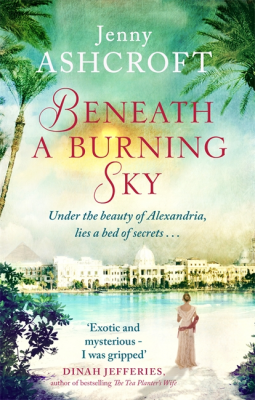
Beneath a Burning Sky by Jenny Ashcroft

Publication Date: June 29th from Sphere

Source: Review Copy

When twenty-two-year-old Olivia is coerced into marriage by the cruel Alistair Sheldon she leaves England for Egypt, his home and the land of her own childhood. Reluctant as she is to go with Alistair, it’s in her new home that she finds happiness in surprising places: she is reunited with her long-estranged sister, Clara, and falls ‘“ impossibly and illicitly ‘“ in love with her husband’s boarder, Captain Edward Bertram.

Then Clara is abducted from one of the busiest streets in the city. Olivia is told it’s thieves after ransom money, but she’s convinced there’s more to it. As she sets out to discover what’s happened to the sister she’s only just begun to know, she falls deeper into the shadowy underworld of Alexandria, putting her own life, and her chance at a future with Edward, the only man she’s ever loved, at risk. Because, determined as Olivia is to find Clara, there are others who will stop at nothing to conceal what’s become of her . . .

Beneath a Burning Sky is a novel of secrets, betrayal and, above all else, love. Set against the heat and intrigue of colonial Alexandria, this beautiful and heart-wrenching story will take your breath away.

My Thoughts:

I have mixed feelings about Beneath a Burning Sky by Jenny Ashcroft. I liked the historical setting – Alexandria at the end of the 19th century when Egypt was under British rule. It is a complex book but it is not so much historical fiction but more of a romantic story. Overall I enjoyed it but thought the book was melodramatic and I was hoping for more historical content.

There is a large cast of characters and although the main character, Olivia is convincingly described, many of the other characters are rather flat stereotypes – Alistair the sadistic older husband, Millicent, the wicked grandmother, and Edward, the ‘good’ character, the handsome, romantic lover.

From the start of the novel there is a lot that is not explained and the action moves swiftly from location to location, switching between different sets of characters. Olivia, trapped in an appalling marriage, is reunited with her older sister Clara from whom she was separated at a very young age after the death of their parents. She has no memories of her parents or her early life in Egypt, but throughout the book has tantalising flashbacks. I would have liked to have discovered what had happened to her parents, but this was only hinted at. I also wondered why Millicent, the wicked grandmother, had hated Olivia’s mother so much. And I was not convinced about the plausibility of Olivia’s forced marriage to Alistair.

But this is not the main mystery – that concerns Clara, because shortly after Olivia arrives, Clara disappears. The police investigation is completely useless, mainly because the chief of police is corrupt. What follows is Olivia’s frantic search for Clara with multiple twists as various secrets and passions begin to surface.

An added complication is the story of Nailah, an Egyptian woman, and her family. This shows the contrast between the ruling British class and the local people and the conditions they experienced and I think Jenny Ashcroft’s portrayal is the best part of her book. But I floundered to understand Nailah’s role in the novel and it was only towards the end that that became clear.

It is easy reading, and I was keen to know what had happened to Clara and why she disappeared. But for me it was too long with too many episodes that I sometimes found confusing. However, other people enjoyed it more than I did -there are plenty of 5 and 4 star reviews both on Amazon and Goodreads.

With thanks to NetGalley and Sphere, the publisher for a review copy.

  • Paperback: 432 pages
  • Publisher: Sphere (29 Jun. 2017)
  • Language: English
  • ISBN-10: 0751565032
  • ISBN-13: 978-0751565034
  • My Rating: 3˜…

This is the second book for my 10 Books of Summer Challenge.

Past Encounters by Davina Blake

Past EncountersBlurb (Goodreads)

From the moment Rhoda Middleton opens one of her husband’s letters and finds it is from another woman, she is convinced he is having an affair. But when Rhoda tracks her down, she discovers the mysterious woman is not his lover after all, but the wife of his best friend, Archie Foster.

There is only one problem – Rhoda has never even heard of Archie Foster.

Devastated by this betrayal of trust, Rhoda tries to find out how and why her husband, Peter, has kept this friendship hidden for so long. Her search leads her back to 1945, but as she gradually uncovers Peter’s wartime secrets she must wrestle with painful memories of her own. For if they are ever to understand each other, Rhoda too must escape the ghosts of the past. Taking us on a journey from the atmospheric filming of Brief Encounter, to the extraordinary Great March of prisoners of war through snow-bound Germany, this is a novel of friendship, hope, and how in the end, it is the small things that enable love to survive.

I finished reading Past Encounters by Davina Blake a week ago, but the story is still fresh in my mind. In essence it is a story of a marriage that has drifted, so that Rhoda and Peter no longer talk to each other about the things that matter in their lives. And they both have secrets from each other – big secrets! Their inability to talk about their wartime experiences has isolated them both emotionally and psychologically.

Rhoda and Peter were engaged to be married as war broke out and the story follows their lives, alternating between the novel’s present day of 1955 and the war years of the 1940s. I loved the historical detail, in particular the details of Peter’s experiences as a prisoner of war. Davina Blake explains in the Acknowledgements that his experiences are fictional but based on real-life ordeals of prisoners of war taken from their memoirs. She has included a bibliography of further reading including these memoirs. The account of the prisoners’ march through Germany towards the end of the war is especially moving. I don’t think I have read any war-time stories quite like this one.

Equally as fascinating are Rhoda’s war-time experiences at home and her involvement with the filming of David Lean’s 1945 film Brief Encounter at the refreshment room in the Carnforth Railway station where she was working. Davina Blake used to be a set and costume designer for theatre and BBC TV and was inspired to write Past Encounters as she lives near Carnforth station where she has often kept out of the cold in the refreshment room whilst waiting for a train.

Past Encounters is a thought provoking book about love, loyalty, betrayal and forgiveness, full of tension with well-drawn characters and a great sense of time and place, whether in Germany or Britain.

Davina Blake also writes historical fiction set in the 17th century under the pen name Deborah Swift.

  • Paperback, 442 pages
  • Published June 30th 2014 by CreateSpace
  • ISBN 1499568258 (ISBN13: 9781499568257)
  • My Rating: 4.5*

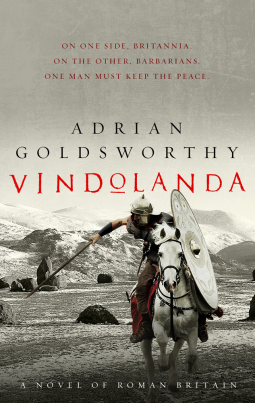
Vindolanda by Adrian Goldsworthy

AD 98: The bustling army base at Vindolanda lies on the northern frontier of Britannia and the entire Roman world. In twenty years’ time, the Emperor Hadrian will build his famous wall, but for now defences are weak, as tribes rebel against Roman rule, and local druids preach the fiery destruction of the invaders.

Flavius Ferox is a Briton and a Roman centurion, given the task of keeping the peace on this wild frontier. But it will take more than just courage to survive life in Roman Britain…

I was quickly drawn into Vindolanda by Adrian Goldsworthy, a novel set in northern frontier of Britain in 98 AD. It’s full of historical detail. Whilst some characters are based on real people about whom little is known apart from their names, most of the characters are fictional, including the main character, centurion Flavius Ferox.  He is based at a small fort called Syracuse (a fictional fort) near the garrison of Vindolanda (modern Chesterholm). Vindolanda is south of Hadrian’s Wall and predates its construction.

The story begins with the arrival of Vindex, the head of the native scouts and a minor son of a chieftain of the Brigantes tribe, who announces that there is a force of at least sixty barbarians in the area planning an attack on the road to Coria (modern day Corbridge). He needs Ferox’s help in hunting these marauders. This is just the start of a series of skirmishes, ambushes and full scale battles. There is at least one traitor in the Roman army informing the tribes of the army’s movements and Ferox is charged with finding out who it is.

I enjoyed reading Vindolanda and the insight it gives into the early period of British history. Adrian Goldsworthy’s Historical Note at the end of the book is excellent, explaining just what is fictional and what is fact in his novel. After Boudicca’s defeat in AD 60 there was little resistance to the Romans in southern Britain, but it was different in northern Britain where there were frequent outbursts of violence, raids and warfare.

There are sections in the Historical Note about the Roman army describing its structure and tactics, on the period before the construction of Hadrian’s Wall, on tribes and druids. The most interesting section for me is the one on Vindolanda and the Writing Tablets found there. These are wooden tablets written in ink on thin sheets of wood. Hundreds of them have survived, most are mundane containing details of daily life, letters, accounts and give an idea about the food they ate and of the social life of the commanders and their families. Among them are details about the commanding officer around AD 98, the Prefect Flavius Cerialis and his wife, Sulpicia Lepidina, both of whom are major characters in the novel.

Vindolanda is a most enjoyable and informative book. I have just one criticism of it, which is purely personal because my eyes always glaze over during battle scenes (both in books and on screen) and in this book there is just too much detail about the battles for me interrupting the storyline, even though the scenes are graphic and fast-paced.

My thanks for the advance review copy I received courtesy of NetGalley and the publishers, Head of Zeus.

  • Hardcover
  • Expected publication: June 1st 2017 by Head of Zeus
  • ISBN13 9781784974688
  • Source: Review copy
  • My rating: 4*

The Author 

Adrian Goldsworthy has a doctorate from Oxford University. His first book, THE ROMAN ARMY AT WAR was recognised by John Keegan as an exceptionally impressive work, original in treatment and impressive in style. He has gone on to write several other books, including THE FALL OF THE WEST, CAESAR, IN THE NAME OF ROME, CANNAE and ROMAN WARFARE, which have sold more than a quarter of a million copies and been translated into more than a dozen languages. A full-time author, he regularly contributes to TV documentaries on Roman themes.

For more information see his website.

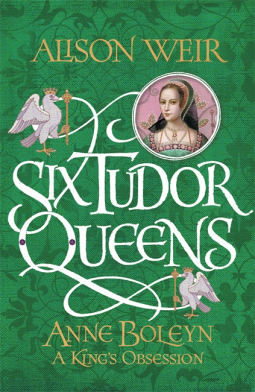
Six Tudor Queens: Anne Boleyn: A King’s Obsession by Alison Weir

Anne Boleyn: A King’s Obsession is Alison Weir’s second book in her series of novels about Henry VIII’s Queens and is due to be published on 18 May 2017.

Just like her first book on Katherine of Aragon this is fictional biography at its most straight forward, written in an uncomplicated style. It is a long and detailed story told from Anne Boleyn’s point of view following her life from when she was eleven up to her execution in 1536.

Mainly I think because I didn’t know much about it before I really enjoyed the first part of the book detailing Anne’s time at the court of the Archduchess Margaret, Regent of the Netherlands, then at the French court where she served Mary Tudor (Henry VIII’s sister) and then she was transferred to the household of Queen Claude, the wife of François I. Anne became proficient in French, and accomplished in the art of pleasing, and witty, flirtatious conversation.

She also learnt from the Archduchess how a woman could rule, and about the ‘New Learning’, that is the texts of ancient Greece and Rome that had been recently discovered. She learnt from Erasmus about the corruption within the Church and she had access to the Archduchess’ library, where she found books written by Christine de Pizan, who had enlightened views on women’s education. The Archduchess encouraged her to show that women were just as capable as men, so that men would admire women for their courage, character and intellect and not just their beauty.

I’m much more familiar with the rest of her life story. As Alison Weir acknowledges in her author’s note in some ways Anne Boleyn is unknowable, we do not have ‘a wealth of her letters’ to get an insight into her inner thoughts and much of the material we do have comes from a hostile source, the Imperial ambassador, Eustache Chapuys. In writing this novel she has tried to reconcile conflicting views of her and I think she has succeeded, portraying her as a flawed and human character. Anne was ambitious and in her early years she had the example of the Archduchess Margaret who  introduced her to ideas questioning the traditional ideas about women.

Alison Weir has kept closely to the historical record, although taking ‘occasional minor liberties’ and ‘modernising the language in places to make the context clearer. Some quotes have been taken out of context or put in the mouths of others’. And the scenes between Anne and Leonardo da Vinci are imaginary (much to my disappointment).

Perhaps it is because she kept closely to the records that the period when Henry was pursuing Anne is described at great length, whilst attempting to end his marriage to Katherine. I found it increasingly tedious to keep reading about how Anne left the court and went to Hever Castle, her parents’ home, then returned to court and then went back to her parents, etc, etc.

Overall, I enjoyed this book, but it is too long and in places very pedestrian and flat. At times it is a bit like reading chick-lit, for example as Mary Boleyn describes how Henry raped her and later as Henry complains to Anne that he has not ‘bedded with a woman in years’, looking at her with ‘anguish and longing in his eyes.’ He comes across as a weak character, truly obsessed with Anne but his passion soon cooled after their marriage when she failed to produce a male heir. And Anne is portrayed as a complex, intelligent woman but obsessed with her ambition for the power that came with being queen.

  • Format: Kindle Edition
  • File Size: 2923 KB
  • Print Length: 544 pages
  • Publisher: Headline Review (18 May 2017)
  • My rating: 3.5*

My thanks to the publishers via NetGalley for a review copy.