Books Read in January 2025

I read 4 books in January, half the number I used to read. My reading has slowed down considerably over the last 2 years and I no longer write in much detail about them. But this year I’m hoping to get back to something more like normal and I’m aiming to write at least a paragraph or more about each of the books I’ve read each month.
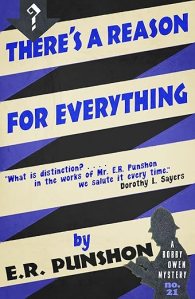
There’s a Reason for Everything (my review) by E R Punshon 4* – I began this book in December and finished reading it in early January. It was first published in 1945 and I read the e-book published by Dean Street Press. It’s the 21st in the Bobby Owen mystery series, in which Bobby has recently been promoted from Inspector to Deputy Chief Constable of Wychshire, a complicated novel with murders, a missing painting allegedly by Vermeer, dodgy fine art dealers and an abandoned country mansion called Nonpareil.

I was perplexed for quite some time until I began to see what was behind the bewildering confusion in Punshon’s narrative. I think this is a cleverly constructed plot, with ingenious puzzles to piece together before all the answers are revealed. I was quite pleased to find out at the end that I’d worked out one of the clues correctly.

Sense and Sensibility by Jane Austen 5* – It’s about the three Dashwood sisters and their widowed mother as they leave their family estate at Norland Park after their father’s death when their half-brother John inherited the estate. This year is the 250th anniversary of Jane Austen’s birth, so this is an ideal time to reread some of her books and I’m joining Brona at This Reading Life in her Austen 2025 project to reread her books, along with the Classics Club’s Sync Read (or readalong).

I read the annotated edition, edited by David M Shapard that gives Explanations of historical context, Citations from Austen’s life, letters, and other writings, Definitions and clarifications, Literary comments and analysis, Multiple maps of England and London, An introduction, bibliography, and detailed chronology of events and More than 100 informative illustrations.

I’ll write more about this book in a later post.

Signal Moon by Kate Quinn 5* – a short story. I’m not a big fan of short stories, often finding them too short and wanting to know more. But this one is good and it fascinated me. It’s sci-fi involving a type of time-travelling, a mix of historical fiction, links to the code breakers at Bletchley Park and WW2. I loved it. It is, of course, impossible, set in two time periods, 1943 during World War 2 and 2023, but I didn’t have to work hard to believe in it. Kate Quinn’s narrative just drew me in. In 1943, Lily Baines is a Wren working for a “Y” station, picking up signals from German intelligence that were then sent to Bletchley Park for translation. Then she picks up a signal apparently from 2023 – it’s a cry for help from Matt Jackson a young US officer. It’s about an American ship that is taking heavy fire in the North Atlantic. Together Lily and Matt have to work out how to help each other: Matt to convince her that the war she’s fighting can still be won, and Lily to help him stave off the war to come.

Kate Quinn wrote this story to feature the information about the Y stations that she had discovered whilst researching Bletchley Park and hadn’t included in The Rose Code.

Keir Starmer: the Biography by Tom Baldwin 3.5* A Times Book of the Year; A Telegraph Book of the Year; A Daily Mail Book of the Year; A Waterstones Book of the Year

Dsecription from Amazon:

This authoritative – but not authorised – biography by Tom Baldwin provides answers by drawing deeply on many hours of interviews with Prime Minister himself, as well as unprecedented access to members of his family, his oldest friends and closest colleagues.Together, they tell an unexpectedly intimate story filled with feelings of grief and love that has driven him on more than any rigid ideology or loyalty to a particular faction.

The book tracks Starmer’s emergence from a troubled small town background and rebellious youth, through a storied legal career as a human rights barrister and the country’s chief prosecutor, to becoming an MP relatively late in life.Baldwin provides a vivid and compelling account of how this untypical politician then rose to be leader of his party in succession to Jeremy Corbyn, then transformed it with a ruthless rapidity that has enraged opponents from the left just as much as it has bewildered those on the right.

Above all, this is a book that should be read by anyone who wants to understand how someone who has too often been underestimated or dismissed as dull, now intends to change Britain.

My thoughts

This book was published in February 2024, five months before the General Election. I decided to watch the televised debates between him and Rishi Sunak, the then Prime Minister, and thought Starmer looked uncomfortable in most of them. All I knew about him was that he was the former Director of Public Prosecutions, and, as he often said in interviews, that growing up he lived in a pebble-dashed semi , that his ‘dad was a toolmaker‘ and his ‘mother was a nurse.’ So I hoped that Baldwin’s book would tell me more. Baldwin writes:

Starmer is a private man who has chosen to place himself in the white light of public scrutiny, while showing a determination that is itself exceptional to maintain a semblance of normality … often appearing uncomfortable at being a politician at all. (page xi)

He also describes him as ‘someone who is both extraordinary and very ordinary‘ (page xii). The biography is divided into five parts :

each of which begins by sketching a moment since he became a politician when this tension is most apparent. All of them also include descriptions of sometimes traumatic episodes that have wrenched him back to real life and away from the febrile – often fake – world of Westminster politics. (page xii).

In the first three parts he covers Starmer’s childhood and schooldays, his time as a student at Leeds University, where he was awarded a first-class law degree, and then at St Edmund Hall at Oxford University where he gained a postgraduate Bachelor of Civil Law degree. He then worked as a trainee barrister in London, eventually transitioning from a human rights lawyer into the country’s chief prosecutor. The fourth part describes how he became an MP, a member of the shadow cabinet and Leader of the Labour Party. The fifth part examines the leadership, before assessing what kind of prime minister he would make.

One friend said:

He’ll just turn up at the pub and be a totally normal and genuinely good bloke. But his public persona is very different, I almost don’t recognise him when I see him on TV.

And another said:

There is this enormous gap between Keir the human being and Keir the politician. At Jonny [Cooper]’s funeral, I saw the real one letting himself go – in the best way – to share his grief with his friends. But, when I watched him on TV at the party conference, he had seemed to be almost a different person, holding back and distant, almost wooden compared to the generous, humorous and empathetic man I’ve known for twenty years. (page 323)

It seems to me that he is a conscientious person who believes in working hard and playing hard. He is resilient and driven. He believes in fairness and social justice, putting the country before the party, a serious, clever man, who wants to get things done and change the country for the better.
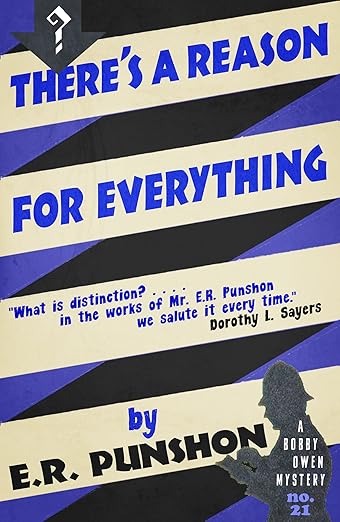

There’s a Reason for Everything by E R Punshon

There’s a Reason for Everything by E R Punshon is the third book I’ve read for Dean Street Press December, hosted by Liz at Adventures in Reading, Running and Working from Home. I’d never read anything by him before, or even heard of him, but it was one of the books Dean Street Press was giving away free in November 2021, so I was lucky to receive it. It’s the 21st in the Bobby Owen mystery series, first published in September 1945, and Bobby has recently been promoted from Inspector to Deputy Chief Constable of Wychshire.

The first thing to say is that I enjoyed it and the second thing is that it is a complicated novel with murders, a missing painting allegedly by Vermeer, dodgy fine art dealers and an abandoned country mansion, Nonpareil, once the home of the Tallebois family, and known as a haunted house.

Description from Amazon:

With a slow gesture of one lifted hand, Bobby pointed. There, in a space between the prostrate stag and posturing goddess, was a human leg, a twisted, motionless leg in a strained, unnatural position.

Bobby Owen, now Deputy Chief Constable of Wychshire, finds himself taking part in a ghost hunt at legendary haunted mansion Nonpareil. What he discovers is the very real corpse of a paranormal investigator. It seems that among the phantoms there are fakes – but will that end up including a priceless painting by Vermeer?

Nonpareil, where much of the action tales place, dominates the book. It is enormous, with many rooms, now boarded up and in darkness, connected by a

far-stretching labyrinth of corridors and of rooms, room upon room, one opening from another, all in gloom alleviated by the spare daylight that here and there struggled through chinks and cracks in the boarded windows. (page 83)

The silence is intense in the all-pervading gloom, with great shadows where a man could lurk unseen and in its east and west wings space enough to hide an army. The picture gallery, a long, lofty, narrow room, with windows on one side and niches between the windows where shrouded statues stand, is darker even than anywhere else in the house. A sense of danger, spookiness and foreboding pervades the book and it has a great sense of place.

The characters are just as mysterious, apart from the police, of course. Are they who they say they are? I was perplexed for quite some time until I began to see what was behind the bewildering confusion in Punshon’s narrative. I think this is a cleverly constructed plot, with ingenious puzzles to piece together before all the answers are revealed. I was quite pleased to find out at the end that I’d worked out one of the clues correctly.

I’ll certainly look for more of Punshon’s books to read. There are 35 Bobby Owen mysteries, 1 Inspector Carter mystery and 4 novels.

About the author from Dean Street Press:

E.R. Punshon was born in London in 1872.

At the age of fourteen he started life in an office. His employers soon informed him that he would never make a really satisfactory clerk, and he, agreeing, spent the next few years wandering about Canada and the United States, endeavouring without great success to earn a living in any occupation that offered. Returning home by way of working a passage on a cattle boat, he began to write. He contributed to many magazines and periodicals, wrote plays, and published nearly fifty novels, among which his detective stories proved the most popular and enduring.

He died in 1956.

Who Pays the Piper? by Patricia Wentworth

Dean Street Press| 2016| 255 pages| e-book|3.5* rounded up to 4*

This month, Liz at Adventures in Reading, Running and Working from Home is hosting another Dean Street Press December. After my disappointment reading The Red Lacquer Case by Patricia Wentworth I decided to see if Who Pays the Piper? was any better. And I’m delighted to say that it is. It was originally published in 1940, so 16 years later than The Red Lacquer Case. It’s the 2nd book in the Inspector Ernest Lamb Mysteries. This new edition published by Dean Street Press features an introduction by crime fiction historian Curtis Evans.

Description from Dean Street Press:

Lucas Dale, new owner of King’s Bourne, was flirting with danger when he showed his priceless collection of pearls to the guests assembled in his period salon. But when, under threat, he forced lovely Susan Lenox to break her engagement and consent to marry him, he started a train of events that inevitably led to murder, shattering the quiet of the English village. Bill Carrick, Susan’s former fiancé, is the primary suspect, but as Inspector Ernest Lamb and Detective Frank Abbott soon discover, Dale’s questionable past offered motives of revenge and greed to darken the mystery. Motives which would lead another victim into the path of murder…

It’s a murder mystery, so that may explain why I prefer this one to The Red Lacquer Case, as I do enjoy crime fiction more than stories about enemy agents and unconvincing kidnappers that left me feeling exasperated. Who Pays the Piper? is complicated, with many twists and turns, convincing characters and plenty of suspects with plausible motives, along with red herrings – very much like some of Agatha Christie’s plots.

The title is part of the saying ‘He who pays the piper calls the tune’ meaning that the person who provides the money for something decides what will be done, or has a right to decide what will be done. The ‘piper’ in the title is Lucas Dale, who in the opening pages declares that he always gets what he wants. And having bought Bourne House from Mrs O’Hara what he wants is Susan Lennox, her niece. He forces her to agree to marry him and break her engagement with Bill Carrick, which in turn makes him a prime suspect when Lucas is found dead, shot through the back of his head. Bill had been overheard threatening to kill him. 

But he is not the only suspect and it is down to Inspector Ernest Lamb and Sergeant Frank Abbott (who also appear in some of the Miss Silver books) to investigate the case. They discover Dale’s questionable past includes others with a motive to kill him. There is his ex-wife wife, Cora de Lisle and Vincent Bell, his American business partner who both wanted money from Dale. I thoroughly enjoyed trying to unravel it all, even though when the murderer was revealed I was rather surprised.

The Red Lacquer Case by Patricia Wentworth

Dean Street Press| 2016| 224 pages| e-book|2*

This month, Liz at Adventures in Reading, Running and Working from Home is hosting another Dean Street Press December. I decided to read The Red Lacquer Case by Patricia Wentworth for this event. It was originally published in 1924. This new edition published by Dean Street Press features an introduction by crime fiction historian Curtis Evans.

Description from Amazon:

There was a hand pressed against the window, a large hand that looked unnaturally white, the blood driven from it by the pressure of a man’s weight. The light showed the pale fingers—and the still paler palm crossed by a dark, jagged scar.

Young Sally Meredith is distracted from her jam recipes by a visit from uncle Fritzi, who is accompanied by a mysterious red lacquer case containing a deadly secret. A band of unscrupulous international agents are close behind, and when the eccentric uncle disappears into the night the lacquer case is stolen. But Sally is now the only person who knows how to open the case – she is kidnapped, her life in terrible danger.

Meanwhile Bill Armitage, formerly Sally’s fiancé and still in love with her, begins with the aid of Scotland Yard to search for her. The ending of this clever detective story is, unexpected and piquantly, in high contrast to the preceding terrors.

Previously I’ve read two books by Patricia Wentworth, The Girl in the Cellar, the last of her Miss Silver books, which I didn’t think was very convincing, and The Brading Collection, the 17th Miss Silver book,which I thought was much better. So, I wasn’t sure what to expect from The Red Lacquer Case: A Golden Age Mystery. It’s a romance/spy thriller, very much in the same vein as Agatha Christie’s first Thomas and Tuppence novel, The Secret Adversary, a spy/detective story that is fast and furious with Tommy and Tuppence landing themselves in all sorts of dangerous situations.

In The Red Lacquer Case, Sally, a former suffragette, finds herself in danger when her uncle Fritzi shows her how to open the red lacquer case, a cigar case, in which he has placed his formula for a deadly gas that he thinks enemy agents are determined to get from him. The case has a pattern of raised roses and fishes with goggling eyes. Her tells her

You touch here and here, pressing, and, with the other hand, touching this flower on one side and this on the other, you pull.

But, he tells her, if you try to open it without knowing the correct sequence it will release enough acid to destroy the formula inside.

Over night the case is stolen, thus setting in motion a sequence of events that sees Sally being kidnapped and in terrible danger as the kidnappers try to get her to open the case. Sally is plucky and feisty, able to withstand whatever they try, but she is also naive. Meanwhile Bill Armitage, formerly Sally’s fiance and still in love with her, begins with the aid of Scotland Yard to search for her. At this point the narrative becomes very repetitive and irritating and my interest flagged to the point where I couldn’t wait for the book to end. Sadly, after many twists and turns, the ending, in one final twist, was just irritating and unbelievable. It left me feeling exasperated. I think this book began well, setting up an interesting mystery, but then became tedious reading, and ended, I thought, in such a disappointing way.

I have one more book by Patricia Wentworth to read, Who Pays the Piper? and I’m hoping it will be better than this one.

Hemlock Bay by Martin Edwards

Head of Zeus — an Aries Book| 12 September 2024 | 372 pages|e-book | Review copy| 4*

Description from Amazon UK:

Basil Palmer has decided to murder a man called Louis Carson. There’s only one he doesn’t know anything about his intended victim, not who he is or where he lives.

Basil learns that Carson owns Hemlock Bay, a resort for the wealthy and privileged. Knowing that his plan will only work if he covers his tracks, he invents a false identity and, posing as Dr Seamus Doyle, journeys to the coast plotting murder along the way.

Meanwhile Rachel Savernake buys an intriguing painting of a place called Hemlock Bay, one that she cannot get out of her head. Macabre and strange, the image shows a shape that seems to represent a dead body lying on the beach.

Convinced that there is something sinister lurking amongst the glamour of the bay, Rachel books a cottage there – where she meets a mysterious doctor called Seamus Doyle…

My thoughts:

This is the 5th Rachel Savernack book, written in the style of the golden age of crime. I loved the first two books in the series but somehow managed to miss the next two. I had high expectations for Hemlock Bay and certainly wasn’t disappointed as I thoroughly enjoyed it.

Like the other two Rachel Savernack books this is also a complex mystery, with several strands and plenty of twists and misdirections. It begins with a Prologue. It is July 1930 as an unnamed couple in a basement room in Temple, London hear a newspaper vendor announce the death of Sir Arthur Conan Doyle. They are discussing death, ending as the man lifts a revolver and squeezes the trigger. Then in January 1931 Basil Palmer makes a New Year resolution – to murder a man he has never met, Louis Carson. But he doesn’t know where he lives, nor what he looks like. This sets in motion a sequence of events, involving numerous people, all with their own agendas, all gathered together in Hemlock Bay.

Hemlock Bay is a seaside resort on the north-west coast of Lancashire. It was originally just ‘a small bay with a splendid beach, flanked by a stretch of sheer cliffs on one side and a tiny secluded cove on the other side of the steep headland‘ and on ‘a treacherous outcrop of rock was an old lighthouse‘. J M W Turner had visited the Bay on a sketching trip and said it was ‘as pretty as Paradise‘. In the past, ships were often wrecked on the shore and contraband was smuggled through a maze of underground passages. But after the end of the First World War it had been developed into a small and select seaside resort. Pleasure Grounds had been built on Hemlock Head, with provision for dancing and all sorts of amusements, known as Paradise, adopting Turner’s description. Jackson, a speculator, and his wife had bought the resort and then opened a new venture, the Hemlock Sun and Air Garden, a nudist club.

Rachel Savernack is intrigued by a surrealist painting of Hemlock Bay depicting a body stretched out below the lighthouse. She and Jacob Flint go to Hemlock Bay, where among others, she meets Virginia Penrhos, the woman who painted the picture, a reclusive doctor named Seamus Doyle, a man named Louis Carson and Basil Palmer under an assumed name. It’s a well plotted novel with interesting characters in a beautiful setting.

Martin Edwards’ Author’s Note at the end of the book is interesting, explaining that although Hemlock Bay is a fictional place it is based on Heysham in Lancashire, overlooking Morecombe Bay (where I enjoyed several holidays as a child). The information in the Heritage Centre in Heysham helped him with the description of Paradise. And the ‘Cluefinder’ at the back of the book listing hints and clues is most enlightening. But I resisted the temptation to read it before I read the book. It is a baffling and most enjoyable murder mystery.

My thanks to NetGalley and Head of Zeus — Aries Fiction, the publishers for the ARC.

Book Beginnings & The Friday 56: Death in the Tunnel by Miles Burton

Every Friday Book Beginnings on Friday is hosted by Gillion at Rose City Reader where you can share the first sentence (or so) of the book you are reading. You can also share from a book you want to highlight just because it caught your fancy.

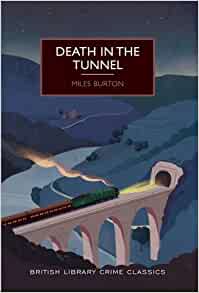
This week I’m featuring one of the books I’m currently reading – Death in the Tunnel by Miles Burton, a Golden Age murder mystery. Miles Burton is one of the pen names of Cecil John Street, who also wrote under the names John Rhode and Cecil Waye. He was a prolific author who produced four detective novels a year for thirty-seven years!

The Book Begins:

The 5.0 pm train from Cannon Street runs fast as far as Stourford, where it is due at 6.07. On Thursday, November 14th, it was, as usual, fairly full, but not uncomfortably so.

A fairly dull opening paragraph to a very complicated murder mystery that is keeping me turning the pages as fast as I can and at the same time trying to take in all the detail.

Also every Friday there is The Friday 56, hosted by Freda at Freda’s Voice. *Grab a book, any book. *Turn to Page 56 or 56% on your  ereader . If you have to improvise, that is okay. *Find a snippet, short and sweet, but no spoilers!

The alternative to suicide can only be murder. I should naturally like to know who may be said to benefit by Sir Wilfred’s death?

Summary:

On a dark November evening, Sir Wilfred Saxonby is travelling alone in the 5 o’clock train from Cannon Street, in a locked compartment. The train slows and stops inside a tunnel; and by the time it emerges again minutes later, Sir Wilfred has been shot dead, his heart pierced by a single bullet.

Suicide seems to be the answer, even though no motive can be found. Inspector Arnold of Scotland Yard thinks again when learns that a mysterious red light in the tunnel caused the train to slow down.

Finding himself stumped by the puzzle, Arnold consults his friend Desmond Merrion, a wealthy amateur expert in criminology. Merrion quickly comes up with an ‘essential brainwave’ and helps to establish how Sir Wilfred met his end, but although it seems that the dead man fell victim to a complex conspiracy, the investigators are puzzled about the conspirators’ motives as well as their identities. Can there be a connection with Sir Wilfred’s seemingly troubled family life, his highly successful business, or his high-handed and unforgiving personality? And what is the significance of the wallet found on the corpse, and the bank notes that it contained? 

~~~

What have you been reading lately?