My Friday Post: All the Light We Cannot See

Book Beginnings Button

Every Friday Book Beginnings on Friday is hosted by Gillion at Rose City Reader where you can share the first sentence (or so) of the book you are reading, along with your initial thoughts about the sentence, impressions of the book, or anything else the opener inspires.
18143977

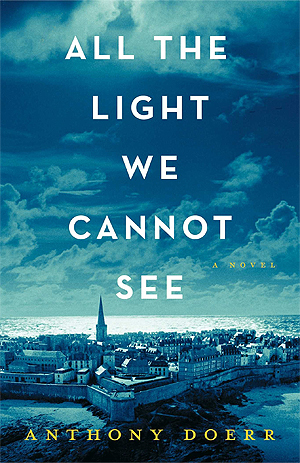
This morning I began reading All the Light We Cannot See by Anthony Doerr (one of the TBRs on my Kindle) and already I think I’m going to like it very much.

It begins:

Zero

7 August 1944

Leaflets

At dusk they pour from the sky. They blow across the ramparts, turn cartwheels over rooftops, flutter into the ravines between houses. Entire streets swirl with them, flashing white against the cobbles. Urgent message to the inhabitants of this town, they say. Depart immediately to open country.

A dramatic opening, immediately alerting me to the danger that is to come.

Also every Friday there is The Friday 56, hosted by Freda at Freda’s Voice.

Friday 56

These are the rules:

  1. Grab a book, any book.
  2. Turn to page 56, or 56% on your eReader.
  3. Find any sentence (or a few, just don’t spoil it) that grabs you.
  4. Post it.
  5. Add the URL to your post in the link on Freda’s most recent Friday 56 post.

Page 56:

All day Marie-Laure lies on her stomach and reads. Logic, reason, pure science: these Aronnax insists, are the proper ways to pursue a mystery. Not fables and fairy tales.

Synopsis:

A beautiful, stunningly ambitious novel about a blind French girl and a German boy whose paths collide in occupied France as both try to survive the devastation of World War II

Marie-Laure has been blind since the age of six. Her father builds a perfect miniature of their Paris neighbourhood so she can memorize it by touch and navigate her way home. But when the Nazis invade, father and daughter flee with a dangerous secret.

Werner is a German orphan, destined to labour in the same mine that claimed his father’s life, until he discovers a knack for engineering. His talent wins him a place at a brutal military academy, but his way out of obscurity is built on suffering.

At the same time, far away in a walled city by the sea, an old man discovers new worlds without ever setting foot outside his home. But all around him, impending danger closes in.

Doerr’s combination of soaring imagination and meticulous observation is electric. As Europe is engulfed by war and lives collide unpredictably, ‘˜All The Light We Cannot See’ is a captivating and devastating elegy for innocence.

My Friday Post: The Eagle of the Ninth

Book Beginnings Button

Every Friday Book Beginnings on Friday is hosted by Gillion at Rose City Reader where you can share the first sentence (or so) of the book you are reading, along with your initial thoughts about the sentence, impressions of the book, or anything else the opener inspires.

The Eagle of the Ninth

This year I’m hoping to read more from my own shelves than last year so I’ve been looking at some of the books that I’ve had for years. The Eagle of the Ninth by Rosemary Sutcliff is one of my TBRs – I bought it in a library book sale, not sure when that was, over 10 years ago, I should think. Today I got it down off the shelf and began reading:

From the Fosseway westward to Isca Dumnoniorum the road was simply a British trackway, broadened and roughly metalled, strengthened by corduroys of logs in the softest places, but otherwise unchanged from its old estate, as it wound among the hills, thrusting further and further into the wilderness.

Also every Friday there is The Friday 56, hosted by Freda at Freda’s Voice.

Friday 56

These are the rules:

  1. Grab a book, any book.
  2. Turn to page 56, or 56% on your eReader.
  3. Find any sentence (or a few, just don’t spoil it) that grabs you.
  4. Post it.
  5. Add the URL to your post in the link on Freda’s most recent Friday 56 post.

Page 56:

A great gust of wind swooped against the house like a wild thing striving to batter its way in; the lamplight jumped and fluttered, sending shadows racing across the chequered board – and the ghost of last year were once more a year away. Marcus looked up, and said, as much for the sake of shutting out his own thoughts as for anything else, ‘I wonder what possessed you to settle here in Britain, Uncle Acquila, when you could have gone home?’

Blurb from the back cover:

The Ninth Legion marched into the mists of northern Britain. And they were never seen again. Four thousand men disappeared and the eagle standard was lost.

Marcus has to find out what happened to his father, who led the Ninth Legion. So he sets out into the unknown, on a quest so hazardous that no one expects him to return …

This is the first of Sutcliff’s series of novels about Roman Britain. The film, The Eagle (2011) is adapted from her book. I read some of her books when I was a child and loved them. I’m hoping this one will be as good.

My Friday Post: Rather Be the Devil

Every Friday Book Beginnings on Friday is hosted by Gillion at Rose City Reader where you can share the first sentence (or so) of the book you are reading, along with your initial thoughts about the sentence, impressions of the book, or anything else the opener inspires.

Ian Rankin’s latest book was published yesterday and it arrived in the post as I’d pre-ordered it back in March. It’s Rather Be the Devil, the 21st Rebus book.  I immediately started reading it.

Rather Be the Devil (Inspector Rebus, #21)

It begins:

Rebus placed his knife and Fork on the empty plate, then leaned back in his chair, studying the other diners in the restaurant.

‘Someone was murdered here, you know,’ he announced.

Blurb

Some cases never leave you.

For John Rebus, forty years may have passed, but the death of beautiful, promiscuous Maria Turquand still preys on his mind. Murdered in her hotel room on the night a famous rock star and his entourage were staying there, Maria’s killer has never been found.

Meanwhile, the dark heart of Edinburgh remains up for grabs. A young pretender, Darryl Christie, may have staked his claim, but a vicious attack leaves him weakened and vulnerable, and an inquiry into a major money laundering scheme threatens his position. Has old-time crime boss Big Ger Cafferty really given up the ghost, or is he biding his time until Edinburgh is once more ripe for the picking?

In a tale of twisted power, deep-rooted corruption and bitter rivalries, Rather Be the Devil showcases Rankin and Rebus at their unstoppable best.

Also every Friday there is The Friday 56, hosted by Freda at Freda’s Voice.

Friday 56

These are the rules:

  1. Grab a book, any book.
  2. Turn to page 56, or 56% on your eReader.
  3. Find any sentence (or a few, just don’t spoil it) that grabs you.
  4. Post it.
  5. Add the URL to your post in the link on Freda’s most recent Friday 56 post.

Page 56:

‘So what’s this all about?’ Chatham enquired.

‘It’s just a feeling I got, right back at the start of the original investigation. The feeling we were missing something, not seeing something.’

I see that even in retirement Rebus just can’t stop being a detective!

My Friday Post: Sunshine on Scotland Street

Book Beginnings ButtonEvery Friday Book Beginnings on Friday is hosted by Gillion at Rose City
Reader
 where you can share the first sentence (or so) of the book you are reading, along with your initial thoughts about the sentence, impressions of the book, or anything else the opener inspires.

I’ve just started reading Sunshine on Scotland Street by Alexander McCall Smith, one of his 44 Scotland Street novels.

It begins:

Even if she had not been an anthropologist, Domenica Macdonald would have understood the very particular significance of weddings. Anthropologists – and sociologists too, perhaps even more so – often tell us what we already know, or what we expect to hear, or what we are not surprised to learn. And so we all know, as did Domenica, that weddings are far more than marriage ceremonies; we know that they are occasions for family stock-taking and catharsis; that they furnish opportunities for naked displays of emotion and unscheduled tears; that they are a stage for sartorial and social ostentation; that they are far from the simple public exchange of vows they appear to be.

Also every Friday there is The Friday 56, hosted by Freda at Freda’s Voice.

Friday 56

These are the rules:

  1. Grab a book, any book.
  2. Turn to page 56, or 56% on your eReader.
  3. Find any sentence (or a few, just don’t spoil it) that grabs you.
  4. Post it.
  5. Add the URL to your post in the link on Freda’s most recent Friday 56 post.

Page 56:

He looked at his watch. That brief encounter with the two girls on Queen’s Street had taken place about twenty minutes previously. That gave him forty minutes to have a necessary cup of coffee, unpack his clothes and products, and have a quick shower before the girls arrived – if they arrived. They had laughed when he had shouted out the invitation, but it had been, he thought, a laugh of delight rather than a dismissive laugh.

The 44 Scotland Street books form a serial novel about the residents of 44 Scotland Street, a fictitious building in a real street in the author’s home town of Edinburgh. It first appeared in daily episodes in the Scotsman newspaper in 2004 and I read a few of them online some years ago.

I felt in the mood for something light and not about murder, psychologically disturbed characters, or full of doom and gloom and this seems to be just that – ‘a joyous, charming portrait of city life and human foibles‘ according to the Sunday Express (quoted on the back cover).

My Friday Post: The Scent of Death

Book Beginnings ButtonEvery Friday Book Beginnings on Friday is hosted by Gillion at Rose City
Reader
 where you can share the first sentence (or so) of the book you are reading, along with your initial thoughts about the sentence, impressions of the book, or anything else the opener inspires.

This week’s book is a library book I’m thinking of reading. It’s The Scent of Death by Andrew Taylor. I borrowed it because I’ve enjoyed some of his other books. It begins:

This is the story of a woman and a city. I saw the city first, glimpsing it from afar as it shimmered like the new Jerusalem in the light of the setting sun.

Synopsis:

August, 1778. British-controlled Manhattan is a melting pot of soldiers, traitors and refugees, surrounded by rebel forces as the American War of Independence rages on. Into this simmering tension sails Edward Savill, a London clerk tasked with assessing the claims of loyalists who have lost out during the war.

Savill lodges with the ageing Judge Wintour, his ailing wife, and their enigmatic daughter-in-law Arabella. However, as Savill soon learns, what the Wintours have lost in wealth, they have gained in secrets.

The murder of a gentleman in the slums pulls Savill into the city’s underbelly. But when life is so cheap, why does one death matter? Because making a nation is a lucrative business, and some people cannot afford to miss out, whatever the price’¦

Also every Friday there is The Friday 56, hosted by Freda at Freda’s Voice.Friday 56

These are the rules:

  1. Grab a book, any book.
  2. Turn to page 56, or 56% on your eReader.
  3. Find any sentence (or a few, just don’t spoil it) that grabs you.
  4. Post it.
  5. Add the URL to your post in the link on Freda’s most recent Friday 56 post.

Page 56:

You’re a thief, a damned pickpocket. There were two empty purses in your bundle. And those shoes you had on your feet – well they tell their own story don’t they?

I like the promise of this book – historical crime fiction set during the American War of Independence, a war about which I know only the briefest of details.

My Friday Post

Book Beginnings ButtonEvery Friday Book Beginnings on Friday is hosted by Gillion at Rose City Reader where you can share the first sentence (or so) of the book you are reading, along with your initial thoughts about the sentence, impressions of the book, or anything else the opener inspires.

This week’s book is Leaving Everything Most Loved by Jacqueline Winspear, the 10th Maisie Dobbs novel. It begins:

Prologue – London, July 1933

Edith Billings – Mrs Edith Billings, that is, proprietor of Billings’ Bakery – watched as the dark woman walked past the shop window, her black head with its oiled ebony hair appearing to bob up and down between the top shelf of cottage loaves and the middle shelf of fancy cakes as she made her way along with a confidence to her step.

Blurb:

London, 1933. Some two months after an Indian woman, Usha Pramal, is found murdered in a South London canal, her brother turns to Maisie Dobbs to find the truth about her death. Not only has Scotland Yard made no arrests, but evidence indicates they failed to conduct a full and thorough investigation. Before her death, Usha was staying at an ayah’s hostel, a refuge for Indian women whose British employers had turned them out. As Maisie learns, Usha was different from the hostel’s other lodgers. But with this discovery comes new danger – soon another Indian woman who was close to Usha is found murdered before she can speak out. As Maisie is pulled deeper into an unfamiliar yet alluring subculture, her investigation becomes clouded by the unfinished business of a previous case. And at the same time her lover, James Compton, gives her an ultimatum she cannot ignore …

Friday 56Also every Friday there is The Friday 56, hosted by Freda at Freda’s Voice.

These are the rules:

  1. Grab a book, any book.
  2. Turn to page 56, or 56% on your eReader.
  3. Find any sentence (or a few, just don’t spoil it) that grabs you.
  4. Post it.
  5. Add the URL to your post in the link on Freda’s most recent Friday 56 post.

Page 56:

Maisie felt her skin prickle when she read the more common name for the Camberwell Beauty: the Mourning Cloak. It was not a clue, not an element of great import of her investigation, but there was something in the picture before her that touched her heart. That something beautiful was so bold, yet at once so fragile.

I’ve read a few of the Maisie Dobbs books and like them. I’ve read just the first chapter of this book so far and it promises to be as good as the others. I don’t know the significance of the Camberwell Beauty butterfly but I know it under that name – not as the Mourning Cloak. It’s a rare butterfly here in the UK.