First Chapter First Paragraph: The Toymakers by Robert Dinsdale

Every Tuesday First Chapter, First Paragraph/Intros is hosted by Vicky of I’d Rather Be at the Beach sharing the first paragraph or two of a book she’s reading or plans to read soon.

This week I’m featuring a book that I’ve just started to read, The Toymakers by Robert Dinsdale, to be published on 8th February 2018. It promises to be A dark enchanting, spectacularly imaginative novel.
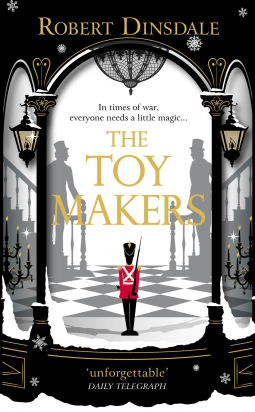
It begins:

PAPA JACK’S EMPORIUM, LONDON 1917

The Emporium opens with the first frost of winter. It is the same every year. Across the city, when children wake to see ferns of white stretched across their windows, or walk to school to hear ice crackling underfoot, the whispers begin: the Emporium is open! Christmas is coming and the goose is getting fat …

If, at a certain hour on a certain winter night, you too had been wandering the warren between New Bond Street and Avery row, you might have seen it for yourself. One moment there would be darkness, only the silence of shops shuttered up and closed for business. The next, the rippling snowflakes would part to reveal a mews you had not noticed before – and, along that mews, a storefront garlanded in lights. Those lights might be but pinpricks of white, no different to the snowflakes, but still they would draw you eyes. Lights like these captivate and refract the darkness. Lights like these can bewitch the most cynical of souls.

Blurb:

Do you remember when you believed in magic?

It is 1917, and while war wages across Europe, in the heart of London, there is a place of hope and enchantment.

The Emporium sells toys that capture the imagination of children and adults alike: patchwork dogs that seem alive, toy boxes that are bigger on the inside, soldiers that can fight battles of their own. Into this family business comes young Cathy Wray, running away from a shameful past. The Emporium takes her in, makes her one of its own.

But Cathy is about to discover that the Emporium has secrets of its own…

∼ ∼ 

This has me bewitched already.

What do you think – would you read on?
First Chapter First Paragraph: The Midnight Line by Lee Child

eca8f-fistchapEvery Tuesday Diane at Bibliophile by the Sea hosts First Chapter First Paragraph Tuesday Intros to share the first paragraph sometimes two, of a book that she’s reading or is planning to read soon.

Last week I featured one of my Christmas presents, so I thought I’d follow that with another one of my Christmas presents, The Midnight Line by Lee Child.

The Midnight Line (Jack Reacher, #22)


It begins:

Jack Reacher and Michelle Chang spent three days in Milwaukee. On the fourth morning she was gone. Reacher came back to the room with coffee and found a note on his pillow. He had seen such notes before. They all said the same thing. Either directly or indirectly. Chang’s note was indirect. And more elegant than most. Not in terms of presentation. It was a  ballpoint scrawl on motel notepaper gone wavy with damp. But elegant in terms of expression. She had used a simile, to explain and flatter and apologize all at once. She had written, You’re like New York City. I love to visit, but I could never live there.

Blurb:

Jack Reacher takes an aimless stroll past a pawn shop in a small Midwestern town. In the window he sees a West Point class ring from 2005. It’s tiny. It’s a woman cadet’s graduation present to herself. Why would she give it up? Reacher’s a West Pointer too, and he knows what she went through to get it.

Reacher tracks the ring back to its owner, step by step, down a criminal trail leading west. Like Big Foot come out of the forest, he arrives in the deserted wilds of Wyoming. All he wants is to find the woman. If she’s OK, he’ll walk away. If she’s not … he’ll stop at nothing.

He’s still shaken by the recent horrors of Make Me, and now The Midnight Line sees him set on a raw and elemental quest for simple justice. Best advice: don’t get in his way.

∼ ∼ 

Lee Child is a new-to-me author, but by no means a new author and this is the 22nd Jack Reacher thriller. The thing that strikes me about this opening paragraph is the straight forward style of writing and the short sentences, almost staccato, which makes me think this will be a fast-paced book. When I wrote about it in my Christmas Books post I was encouraged by some of the comments about his books, so I’m looking forward to reading it very soon.

What do you think – would you read on?

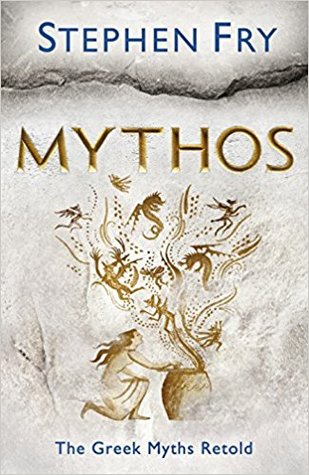
First Chapter First Paragraph: Mythos by Stephen Fry

Happy New Year to One and All –  Let’s hope it’s a good one!

eca8f-fistchap

Every Tuesday Diane at Bibliophile by the Sea hosts First Chapter First Paragraph Tuesday Intros to share the first paragraph sometimes two, of a book that she’s reading or is planning to read soon.

This week’s opening is from Mythos: the Greek Myths Retold by Stephen Fry, one of my Christmas presents.

Mythos: A Retelling of the Myths of Ancient Greece

It begins:

These days the origin of the universe is explained by proposing a Big Bang, a single event that instantly brought into being all the matter from which everything and everyone are made.

The ancient Greeks had a different idea. They said that it all started not with a bang, but with CHAOS.

Was Chaos a god – a divine being – or simply a state of nothingness? Or was Chaos, just as we would use the term today, a kind of terrible mess, like a teenager’s bedroom only worse.

Think of Chaos perhaps as a kind of grand cosmic yawn. As in yawning chasm or a yawning void.

Blurb:

No one loves and quarrels, desires and deceives as boldly and brilliantly as Greek gods and goddesses. They are like us, only more so – their actions and adventures scrawled across the heavens above.

From the birth of the universe to the creation of humankind, Stephen Fry – who fell in love with these stories as a child – retells these myths for our tragic, comic, fateful age. Witness Athena born from the cracking open of Zeus’s great head and follow Persephone down into the dark realm of Hades. Experience the terrible and endless fate of Prometheus after his betrayal of Zeus and shiver as Pandora opens her jar of evil torments.

The Greek gods are the best and worst of us, and in Stephen Fry’s hands they tell us who we are. Mythos – smart, funny, and above all great fun – is the retelling we deserve by a man who has been entertaining the nation for over four decades.

∼ ∼ 

I was delighted to receive this as a Christmas present. I loved Greek myths when I was a child and want to know more. In his Foreword Fry writes that you don’t need to know anything to read this book – but I’m looking forward to reading about the ones I do know as well as others I don’t.

What do you think – would you read on?

First Chapter First Paragraph: The Earth Hums in B Flat

eca8f-fistchapEvery Tuesday Diane at Bibliophile by the Sea hosts First Chapter First Paragraph Tuesday Intros to share the first paragraph sometimes two, of a book that she’s reading or is planning to read soon.

This week’s opening is from The Earth Hums in B Flat by Mari Strachan.

The Earth Hums in B Flat

It begins:

I fly in my sleep every night. When I was little I could fly without being asleep; now I can’t even though I practise and practise. And after what I saw last night I want more than ever to fly wide-awake. Mam always says: I want never gets. Is that true?

Blurb (from the back cover):

Young Gwenni Morgan has a gift. She can fly in her sleep. She’s also fond of strawberry whip, detective stories and asking difficult questions. When a neighbour mysteriously vanishes, she resolves to uncover the secret of his disappearance and return him to his children. She truthfully records what she sees and hears: but are her deductions correct? What is the real truth? And what will be the consequences – for Gwenni, her family and her community – of finding it out?

Gwenni Morgan is an unforgettable creation, and this portrait of life in a small Welsh town on the brink of change in the 1950s is enthralling, moving and utterly real. Mari Strachan’s debut is a magical novel that will transport you to another time and place.

I like the idea of being able to fly.

What do you think – would you read on?

First Chapter First Paragraph: A Lovely Way to Burn

eca8f-fistchapEvery Tuesday Diane at Bibliophile by the Sea hosts First Chapter First Paragraph Tuesday Intros to share the first paragraph sometimes two, of a book that she’s reading or is planning to read soon.

This week’s opening is from A Lovely Way to Burn by Louise Welsh.

A Lovely Way to Burn (Plague Times, #1)


It begins with a Prologue:

London witnessed three shootings that summer, by men who were part of the Establishment. The first  was the Right Honourable Terry Blackwell, Tory MP for Hove who, instead of going to his consistency as planned, sat in a deck chair on the balcony of his Thames-side apartment on sweltering Saturday in June and shot dead six holidaymakers.

Blurb:

It doesn’t look like murder in a city full of death.

A pandemic called ‘The Sweats’ is sweeping the globe. London is a city in crisis. Hospitals begin to fill with the dead and dying, but Stevie Flint is convinced that the sudden death of her boyfriend Dr Simon Sharkey was not from natural causes. As roads out of London become gridlocked with people fleeing infection, Stevie’s search for Simon’s killers takes her in the opposite direction, into the depths of the dying city and a race with death.

A Lovely Way to Burn is the first outbreak in the Plague Times trilogy. Chilling, tense and completely compelling, it’s Louise Welsh writing at the height of her powers.

I’ve borrowed this book from the library as I’ve read and enjoyed other books by Louise Welsh and I’m hoping it’ll be just as hypnotically compulsive reading as her other books.

What do you think – would you read on?

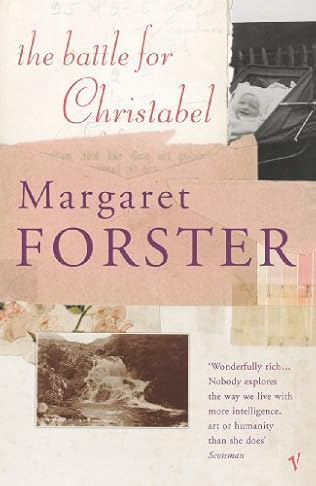
First Chapter First Paragraph: the Battle for Christabel

eca8f-fistchapEvery Tuesday Diane at Bibliophile by the Sea hosts First Chapter First Paragraph Tuesday Intros to share the first paragraph sometimes two, of a book that she’s reading or is planning to read soon.

This week’s opening is from The Battle for Christabel by Margaret Forster.

book cover of The Battle for Christabel

It begins:

Today I lost the battle for Christabel. I lost the whole war (this is a war story, make no mistake). There is nothing to salvage from it, no medals, no trophies, but my God the scars, the wounds, the shell shock … If I were a man, and had this  been a man’s war, I would have been invalided out, flown from the war zone, heavily sedated, and when the plane had landed and I was put into the ambulance waiting on the tarmac, people would have wept at the pity of it and the waste of a fine young man’s life.

From the Guardian:

Forster has the essential capacity to see everyone’s point of view, whether it is the social workers who resent the upper-middle class assumptions of Christobel’s grandmother, Isobel’s lover who believes she should adopt the child, or Christabel’s foster-mother Betty … in that territory of dread and reconciliation which is the family, Forster reigns supreme.

Margaret Forster wrote 25 novels and 14 biographies, about social history, memoir, and journalism. I’ve read and enjoyed quite a few of them – they’re often about family life and  women and their role in society. This one looks quite challenging, I think.

What do you think – would you read on?