First Chapter, First Paragraph: The Silver Pigs

Every Tuesday Diane at Bibliophile by the Sea hosts First Chapter First Paragraph Tuesday Intros, where you can share the first paragraph, or a few, of a book you are reading or thinking about reading soon.

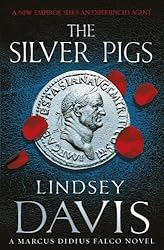
This week I’m featuring The Silver Pigs by Lindsay Davis, a book that I started reading last night. Whilst this is a new-to-me series, The Silver Pigs was first published in 1989 and there are now 20 books in the series. Lindsey Davis also writes the Favia Alba Mystery series. She has won many literary awards, and was honorary president of the Classical Association from 1997 to 1998.
It begins:

When the girl came rushing up the steps, I decided she was wearing far too many clothes.

It was late summer. Rome frizzled like a pancake on a griddleplate. People unlaced their shoes but had to keep them on; not even an elephant could cross the street unshod. People flopped on stools in shadowed doorways, bare knees apart, naked to the waist – and in the backstreets of Aventine Sector where I lived, that was just the women.

This is historical crime fiction, the first of the Marcus Didius Falco novels. Set in Rome in 70AD, Vespasian is the new Roman emperor and Falco is a private informer, or private eye. In this first book he and his partner Helena Justina rescue a young girl in trouble. He is then catapulted into a dangerous game involving stolen imperial ingots, a dark political plot and, most hazardous of all, a senator’s daughter connected to the traitors Falco has sworn to expose.

My copy has an introduction by Lindsey Davis in which she tells of how she began to write historical fiction, setting a typical private eye figure in Rome two thousand years ago. It has maps and a Dramatis Personae.

And I do like the cover.


First Chapter, First Paragraph

First chapterEvery Tuesday Diane at Bibliophile by the Sea hosts First Chapter First Paragraph Tuesday Intros, where you can share the first paragraph, or a few, of a book you are reading or thinking about reading soon.

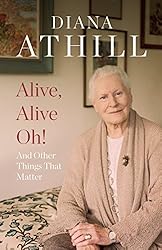
One of the books I’ll be reading soon is Alive, Alive Oh! And Other Things That Matter by Diana Athill OBE. From what I’ve read so far it promises to be very interesting. Born in 1917 Diana Athill helped Andre Deutsch establish his publishing company and worked as a literary editor for many years. She is also a novelist and has published several memoirs.

Alive, Alive Oh! And Other Things That Matter begins:

‘Sometimes I sits and thinks and sometimes I just sits’: I have forgotten who it is who is supposed to have said that, but it is a good description of a state quite often observed in a retirement home, and considered pitiable. Disconcertingly, I recently realized that I myself (not very often, just now and then) might say those very words if somebody asked me what I was doing. It is not a welcome thought, but less dreadful than it might be because I now know from experience that the state is not necessarily pitiable at all. It is even pleasant – or it can be. That probably depends on the nature of the person sitting. To me it has been, because the thinking turns out to be about events in the past which were enjoyable, and when the mind relaxes itself it is those same events which float in and out of it.

Blurb:

What matters in the end? In the final years of life, which memories stand out? Writing from her retirement home in Highgate, London, as she approaches her 100th year, Diana Athill reflects on what it is like to be in her nineties, and on the moments in her life which have risen to the surface and sustain her in her later years.

She recalls in sparkling detail the exact layout of the garden of her childhood, a vast and beautiful park attached to a large house, and writes with humour, clarity and honesty about her experiences of the First and Second World Wars, and her trips to Europe as a young woman. In the remarkable title chapter, Athill describes her pregnancy at the age of forty-three, losing the baby and almost losing her life, and her gratitude on discovering that she had survived.

With vivid memories of the past mingled with candid, wise and often very funny reflections on the experience of being very old, Alive, Alive Oh! reminds us of the joy and richness to be found at every stage of life.

Teaser Tuesday newTeaser Tuesday is a weekly bookish meme, hosted by MizB of Books and a Beat. ! Just do the following:

‘¢ Grab your current read
‘¢ Open to a random page
‘¢ Share two (2) ‘teaser’sentences from somewhere on that page

My teaser is from page 29:

It annoys me when someone describes this country in the late 1940s and 1950s as being dreary, an opinion usually based on the continuation of rationing for some years after the war’s end. People who see it like that can’t have lived through the war. Those of us still alive who did so see it differently.

It’s a short book – just 168 pages – but she seems to have packed so much into it.

First Chapter, First Paragraph: Runaway

First chapterEvery Tuesday Diane at Bibliophile by the Sea hosts First Chapter First Paragraph Tuesday Intros, where you can share the first paragraph, or a few, of a book you are reading or thinking about reading soon.

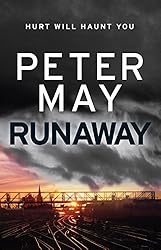
Runaway by Peter May is one of the books I’m thinking of reading this month. I’ve read some of his other books, the Lewis Trilogy and Entry Island and thoroughly enjoyed them, real page-turners. So I’m hoping that Runaway will be just as good.

It begins with a Prologue:

London

He wakes in a cold sweat from a dream pervaded by darkness and blood. And after a lifetime of being someone else in another land, he wonders who he is now. This man, who, he knows, is fading all too soon. A life squandered for a love lost. A life that seems to have passed in the blink of an eye.

and moves on to Chapter One in 2015:

Glasgow

Jack stepped down from the bus almost at the end of Battlefield Road and raised his head towards the darkening sky with a sense of foreboding. He took in the brooding silhouette of the smoke-stained Victoria Infirmary that climbed the hill above the field of battle where Mary, Queen of Scots, was once defeated by James VI, and felt as if someone had just walked over his grave.

Now, reading this, I am keen to read on. Flicking through the book I can see that it alternates between 1965 and 2015.

The back cover reveals that in 1965, five teenage friends fled Glasgow for London to pursue their dream of musical stardom. Yet before year’s end three returned, and returned damaged. In 2015, a brutal murder forces those three men, now in their sixties, to journey back to London and finally confront the dark truth they have run from for five decades.

 What do you think?

Would you keep reading?

First Chapter, First Paragraph: Dictator

First chapterEvery Tuesday Diane at Bibliophile by the Sea hosts First Chapter First Paragraph Tuesday Intros, where you can share the first paragraph, or a few, of a book you are reading or thinking about reading soon. I’m currently reading Dictator by Robert Harris, the third in his Cicero trilogy.

Dictator

It begins:

I remember the cries of Caesar’s war-horns chasing us over the darkened fields of Latium – their yearning, keening howls, like animals on heat – and how when they stopped there was only the slither of our shoes on the icy road and the urgent panting of our breath.

It was not enough for the immortal gods that Cicero should be spat at and reviled by his fellow citizens; not enough that in the middle of the night he be driven from the hearths and altars of his family and ancestors; not enough even that as we fled from Rome on foot he should look back and see his house in flames. To all these torments they deemed it necessary to add one further refinement: that he should be forced to hear his enemy’s army striking camp on the Field of Mars.

Blurb:

‘˜Laws are silent in times of war.’
Cicero

There was a time when Cicero held Caesar’s life in the palm of his hand. But now Caesar is the dominant figure and Cicero’s life is in ruins. Exiled, separated from his wife and children, his possessions confiscated, his life constantly in danger, Cicero is tormented by the knowledge that he has sacrificed power for the sake of his principles.

His comeback requires wit, skill and courage ‘“ and for a brief and glorious period, the legendary orator is once more the supreme senator in Rome. But politics is never static and no statesman, however cunning, can safeguard against the ambition and corruption of others.

Riveting and tumultuous, DICTATOR encompasses some of the most epic events in human history yet is also an intimate portrait of a brilliant, flawed, frequently fearful yet ultimately brave man ‘“ a hero for his time and for ours. This is an unforgettable tour de force from a master storyteller.

————————————————

I read in The Guardian that this last part of the trilogy marks the culmination of 12 years work. The trilogy as a whole has transported me back into the first century BC when Rome was engulfed in intrigue, conspiracies and civil war as the Roman Republic began to collapse and move into dictatorship and empire.  I’m loving the whole experience. Just as when I was reading the first two books, Imperium and Lustrum, I can’t wait to get back to it each time I have to stop reading.

First Chapter, First Paragraph: The Ghosts of Altona

First chapterEvery Tuesday Diane at Bibliophile by the Sea hosts First Chapter First Paragraph Tuesday Intros, where you can share the first paragraph, or a few, of a book you are reading or thinking about reading soon.

I started reading The Ghosts of Altona by Craig Russell yesterday.

It begins:

The sky that day, he would later remember, had been the colour of pewter. When he thought back on it, that was what he would remember, the lack of colour in the sky, the lack of colour in everything. And he hadn’t noticed at the time.

Winter had been half-hearted that day.

‘So why, exactly, are we talking to this guy more than any other neighbours?’ asked Anna Wolff as she and Fabel got out of the unmarked police BMW. ‘Schalthoff has no record … never been so much as a suspect for anything and has no dodgy connections that we can find. I just don’t get why you get a vibe from him. What is it – some kind of hunch?

This book won the 2015 Bloody Scotland Crime Novel of the Year. It’s the first book by Craig Russell’s that I’ve noticed. How could I have missed the others? This is his seventh Jan Fabel book!

Blurb:

Jan Fabel is a changed man. Head of the Polizei Hamburg’s Murder Commission, Fabel has dealt with the dead for nearly two decades, but when a routine enquiry becomes a life-threatening – and life-altering – experience, he finds himself on much closer terms with death than ever before.

Fabel’s first case at the Murder Commission comes back to haunt him: Monika Krone’s body is found at last, fifteen years after she went missing. Monika – ethereally beautiful, intelligent, cruel – was the centre of a group of students obsessed with the gothic. Fabel re-opens the case. What happened that night, when Monika left a party and disappeared into thin air?

Meanwhile, Hamburg’s most dangerous serial rapist has escaped from high-security prison. Fabel is convinced he had outside help, but from whom? His suspicions that the escape is connected to the discovery of Monika’s body seem to lead to nothing when there are no sightings of the fugitive, but little can he imagine the real purpose for which this monster has been unleashed.

When men involved with Monika start turning up dead, the crime scenes full of gothic symbolism, Fabel realizes he is looking for a killer with both a hunger for vengeance and a terrifying taste for the macabre. A true gothic demon is stalking the streets of Hamburg…

I’m enjoying what I’ve read so far. What do you think – have you read any of Craig Russell’s books? Would you read on?

My Tuesday Post: After the Fire

First chapterEvery Tuesday Diane at Bibliophile by the Sea hosts First Chapter First Paragraph Tuesday Intros, where you can share the first paragraph, or a few, of a book you are reading or thinking about reading soon.

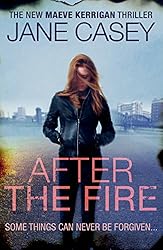
The book I’ve chosen this week is After the Fire by Jane Casey.  I read this in June and have not got round to writing about it yet.

It begins:

There were 224 residents of Murchison House on the Maudling Estate in north London, and on a cold grey late November day  not one of them was expecting to die. Some were hoping to die. some were waiting to die. but no one actually expected to die that day.

This is the sixth book in the Maeve Kerrigan series. It stands well on it’s own, although there are references to past events and storylines that appear in the earlier books.

The Maudling Estate and some of the minor characters featured in the 5th book, The Kill.

Blurb:
After a fire rips through a North London tower block, two bodies are found locked in an 11th floor flat. But it’s the third victim that ensures the presence of detective Maeve Kerrigan and the murder squad. It appears that controversial MP Geoff Armstrong, trapped by the fire, chose to jump to his death rather than wait for rescue. But what was such a right wing politician doing in the deprived, culturally diverse Maudling Estate?
As Maeve and her senior colleague, Derwent, pick through the wreckage, they uncover the secret world of the 11th floor, where everyone seems to have something to hide’¦

Would you read on? I did and thoroughly enjoyed this book.

Teaser Tuesday is a weekly bookish meme, hosted by MizB of A Daily Rhythm. Anyone can play along! Just do the following:

‘¢ Grab your current read
‘¢ Open to a random page
‘¢ Share two (2) ‘teaser’sentences from somewhere on that page

Here’s a teaser from 32% on my Kindle (rather more than 2 sentences!):

I felt the familiar rush, the moment a shape began to emerge from the darkness that surrounded the case. A pattern. A connection. A witness and a suspect.

A killer with a face and a name.

Maybe.