Two Short Reviews: Coffin Road by Peter May and The Wonder by Emma Donoghue

Two more short reviews as I try to catch up on the books I’ve been reading. Both are excellent books, each one with a great sense of location and descriptive writing bringing the scenes and characters vividly to life.

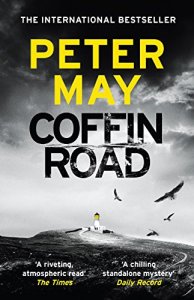
First, Coffin Road by Peter May, is a standalone novel, set on the Isle of Harris in the Outer Hebrides. I read it because I loved his Lewis trilogy. There are 3 strands to the story. There’s a mystery surrounding a man, washed up during a storm on a deserted beach on the Isle of Harris. He is wearing a life jacket, is battered and bruised – and has no idea who he is or where he is. The only clue to why he is living on Harris is a folded map of a path named the Coffin Road and following the route marked on the map he finds some hidden beehives that are familiar to him. In the second strand DS George Gunn investigates the murder of a bludgeoned corpse discovered on a remote rock twenty miles to west of the Outer Hebrides. And thirdly, a teenage girl in Edinburgh is desperate to discover the truth about her scientist father’s suicide.

It is fast-paced, almost impossible to put down, and full of intrigue and mystery. Each strand of the story kept me guessing, wondering what the connections between them were. It’s tense with the sense that time is running out for all the characters and I wasn’t sure whether any of them were reliable narrators or were who they appeared to be.

In addition the bees have a major role in the story. All the facts about the bees slot seamlessly into the story and I learned quite a lot about bees that I didn’t know before, especially their role in climate change.

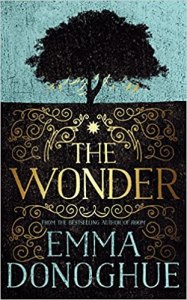
The Wonder is a very strange story. It’s uncomfortable reading, but I felt I just had to read it. And although it moves at a slow pace I read it quickly in large chunks. It is tense, full of atmosphere and just like Coffin Road, I found it almost impossible to put it down, such is the power of Emma Donoghue’s storytelling.

The plot is simple: it is set in a small village in the Irish Midlands in the 1850s. Eleven-year-old Anna O’Donnell stops eating, but remains miraculously alive and well. A nurse, Lib Wright, trained in the Crimea by Florence Nightingale, and a nun, Sister Michael are hired by a committee of influential locals to spend two weeks observing her to make sure she is not being fed secretly.

Lib observes Anna in scrupulous detail, noting Anna’s symptoms. At first she seems a healthy little girl but as the two weeks go by she develops worrying symptoms – downy cheeks, scaly skin, blue fingertips, and swollen lower limbs and hands. Lib begins to realise that it is not just a question of how Anna is managing to exist without food, but also why. What is motivating Anna to persist in saying she is not hungry and doesn’t need to eat? The answer seems to lie in her religious beliefs, and maybe religious hysteria is playing a part as well as the clash between medical science and faith. But is there more to it? Lib wonders about the family’s relationships and the effect of Anna’s brother’s death just a few months before Anna stopped eating.

As Donoghue explains in her author’s note The Wonder is an invented story, inspired by almost fifty cases of so-called Fasting Girls in the British Isles, Western Europe and North America between the 16th and 20th centuries. A film of the book is available on Netflix, but I don’t think I could bear to watch it.

Book Beginnings & The Friday 56: Bel Canto by Ann Patchett

Every Friday Book Beginnings on Friday is hosted by Gillion at Rose City Reader where you can share the first sentence (or so) of the book you are reading. You can also share from a book you want to highlight just because it caught your fancy.

Today I’m featuring one of my TBRs books Bel Canto by Ann Patchett, a book I bought four years ago and promptly forgot about it. Earlier this year I thoroughly enjoyed reading State of Wonder and then remembered that I hadn’t read Bel Canto. I’ve just started reading it.

My Book Beginning:

When the lights went off the accompanist kissed her.

Also every Friday there is The Friday 56, hosted by Freda at Freda’s Voice, where you grab a book and turn to page 56 (or 56% of an eBook), find one or more interesting sentences (no spoilers), and post them.

Page 56:

The crowd on the floor pulsed with needs. Some had to go to the bathroom again. There were murmurings about medications. People wanted to stand up, to be fed, to have a drink of water to wash the taste from their mouths.Their restlessness emboldened them, but there was this as well: eighteen hours had passed and still no one was dead.

Synopsis:

Somewhere in South America, at the home of the country’s vice president, a lavish birthday party is being held in honour of the powerful businessman Mr. Hosokawa. Roxane Coss, opera’s most revered soprano, has mesmerised the international guests with her singing.

It is a perfect evening – until a band of gun-wielding terrorists takes the entire party hostage. But what begins as a panicked, life-threatening scenario slowly evolves into something quite different, a moment of great beauty, as terrorists and hostages forge unexpected bonds and people from different continents become compatriots, intimate friends, and lovers.

What do you think? Would you read it?

The Island by Victoria Hislop: A Short Post

I have been struggling to write posts recently. I haven’t been able to settle down to writing after finishing a book, either because I’m too eager to read the next book, or like Heavenali I’ve been so distracted and mithered by other things going on in my life, mostly minor that shouldn’t really bother me, but do, that I am finding it hard to concentrate on writing.

So, that is why I haven’t written about a number of books I read earlier this year. Some of them are books that qualify for the Wanderlust Bingo CardThe Island by Victoria Hislop, The Fellowship of the Ring by J R R Tolkien, The Night of the Mi’raj by Zoë Ferraris and Coffin Road by Peter May. These aren’t the only books I’ve read that need to write about, but it’s a start.

The first one I’m writing about is The Island by Victoria Hislop, her debut novel and one of my TBRs. It’s been on my bookshelves for years and I did start reading it soon after buying it, but I didn’t get very far and put it back on my bookshelves. Since then I’ve read three other books by Victoria Hislop and enjoyed them so I decided to try it again, especially as it fills the Island Square (set in Greece) on the Wanderlust Bingo card. I began reading it in August, when I took it away with me, visiting family, but didn’t find much time to read it and had to set it to one side. After I returned home I went on to read other books until October when I picked it up once more.

It is historical fiction set in Plaka on the island of Crete and in Spinalonga, a tiny, deserted island just off the coast of Plaka. I wasn’t very sure I would like it when I read the first chapter about Alexis Fielding longing to find out about her mother’s past. Sofia had never told her anything about it and all that Alexis knew was that Sofia had grown up in Plaka, a small Cretan village before moving to London. She gave Alexis a letter to take to an old friend, Fotini, promising that through her she will learn more. And once Fotini entered the story I was hooked as she told what had happened to Sophia’s grandmother, Eleni and her daughters, Anna and Maria after Eleni caught leprosy and was sent to live on Spinalonga.

Beginning before the Second World War the story moved between Plaka and Spinalonga and I loved all the details of Elena’s life on Spinalonga, but then when the narrative moved on to describing her daughters’ lives I began to lose interest. Instead of a fascinating historical novel about leprosy it changed into a historical romance, which I didn’t enjoy as much as the earlier part of the book. Overall, I think it’s too long and drawn out, and the ending is a bit too neat. So I’m giving this book 4*, combining 5* for Eleni’s story and 2-5* for both the beginning and the ending.

I’m hoping to write similar short posts for the other three books.

Maigret’s Memoirs by Georges Simenon Translated by Howard Curtis

Week 2 in Novellas in November is Novellas in translation and a Maigret book is an obvious choice for me. But Maigret’s Memoirs is not your usual Maigret mystery. This a memoir written by Simenon writing as his fictional character, Maigret.

Penguin Classics| 2016| 160 pages| My Own Copy| 4*

I can still see Simenon coming into my office the next day, pleased with himself, displaying even more self-confidence, if possible, than before, but nevertheless with a touch of anxiety in his eyes.’

Maigret sets the record straight and tells the story of his own life, giving a rare glimpse into the mind of the great inspector – and the writer who would immortalise him.

‘One of the greatest writers of the twentieth century . . . Simenon was unequalled at making us look inside, though the ability was masked by his brilliance at absorbing us obsessively in his stories’ Guardian

‘A supreme writer . . . unforgettable vividness’ Independent

The original French version of Maigret’s MemoirsLes Mémoires de Maigret, was first published in 1950. An English translation was later published in Great Britain in 1963. It is unlike any of the other Maigret novels. It’s a fictional autobiography by Georges Simenon writing as Maigret, beginning in 1927 or 1928 when Maigret and Simenon, calling himself Georges Sim, first ‘met’. I don’t recommend reading if you haven’t read some of the Maigret mysteries.

I enjoyed it – it’s a quick entertaining read as Maigret looks back to his first ‘meeting’ with Sim. He fills in some of the background of his early life and talks about his father and how he first met his wife, Louise. Simenon had written 34 Maigret novels before this one and Maigret took this opportunity to correct some of Simenon’s inaccuracies. I recognised some of the books – I’ve read 11 of his first 34 books.

One of the things that irritated Maigret the most was Simenon’s habit of mixing up dates, of putting at the beginning of his career investigations that had taken place later and vice versa. He’d kept press cuttings that his wife had collected and he had thought of using them to make a chronology of the main cases in which he’d been involved. And he also considered some details his wife had noted – concerning their apartment on Boulevard Richard Lenoir, pointing out that in several books Simenon had them living on Place des Vosges without explaining why. There were also times when he retired Maigret even though he was still several years away from retirement. Madame Maigret was also bothered by inaccuracies concerning other characters in the books and by Simenon’s description of a bottle of sloe gin that was always on the dresser in their apartment – that was in actual fact not sloe gin but raspberry liqueur given to them every year by her sister-in-law from Alsace.

Simenon drops facts and information piecemeal in his Maigret books and one thing I particularly like in Maigret’s Memoirs is that it is all about Maigret, but I did miss not having a mystery to solve.

Lord of the Flies by William Golding: a Mini Review of a Short Classic

The first weekly theme for Novellas in November is short classics and I read Lord of the Flies, William Golding’s 1954 novel about a group of boys stranded on a desert island. It was his first novel and it certainly packs a punch. It was described as ‘A post-apocalyptic, dystopian survivor-fantasy … [A novel] for all time … A cult classic.’ Guardian. It’s a quick read of just 183 pages.

What are we? Humans? Or animals? Or savages? What’s grown-ups going to think? Going off-hunting pigs-letting fires out-and now!

A plane crashes on a desert island. The only survivors are a group of schoolboys. By day, they explore the dazzling beaches, gorging fruit, seeking shelter, and ripping off their uniforms to swim in the lagoon. At night, in the darkness of the jungle, they are haunted by nightmares of a primitive beast. Orphaned by society, they must forge their own; but it isn’t long before their innocent games devolve into a murderous hunt …

I thought I’d read this book years ago. But as soon as I began reading I realised I hadn’t read it – it’s one of those books you think you’ve read because you know the basic outline of what happens.

It is frighteningly believable. What at first seemed to the boys as a great adventure – stranded on a desert island, leaving them free to play all day without any annoying interference from adults, soon descended into a sinister nightmare scenario. They elected a leader, Ralph who initially made friends with Jack, the leader of a group of choirboys. But soon the two fell out as Jack, disappointed at not being chosen as leader, tried to take over – and a battle for power followed.

Ralph wanted to make sure they were seen if a ship passed the island and organised the boys to keep a fire going as a smoke signal. But when one of the younger boys thought he saw a beast in the jungle panic set in. Jack made himself the leader of the hunters, promising to hunt and kill the beast band the boys let the fire go out as they joined the hunt. Things got completely out of hand ending in chaos. It is absolutely gripping and very dark, showing the savage side of human nature.

Throwback Thursday: They Came to Baghdad by Agatha Christie

Today I’m linking up with Davida @ The Chocolate Lady’s Book Review Blog for Throwback Thursday. It takes place on the Thursday before the first Saturday of every month (i.e., the Thursday before the monthly #6Degrees post). The idea is to highlight one of your previously published book reviews and then link back to Davida’s blog.

They Came to Baghdad by Agatha Christie is a standalone spy thriller. I first reviewed it on November 4, 2011.

My review begins:

I made copious notes as I read Agatha Christie’s They Came to Baghdad because it’s such a complex plot and there seemed to be so many significant events and people that I wanted to clarify what was happening. This is not one of Agatha Christie’s detective novels – no Miss Marple or Hercule Poirot,-  just Victoria Jones, a short-hand typist, a courageous girl with a ‘natural leaning towards adventure’ and a tendency to tell lies. Set in 1950 this is a story about international espionage and conspiracy. The heads of the ‘great powers‘ are secretly meeting in Baghdad, where if it all goes wrong ‘the balloon will go up with a vengeance.’ And an underground criminal organisation is out to make sure it does go wrong, aiming at ‘total war – total destruction. And then – the new Heaven and the new Earth.’

Click here to read my full review

The next ThrowbackThursday post is scheduled for December 1, 2022.