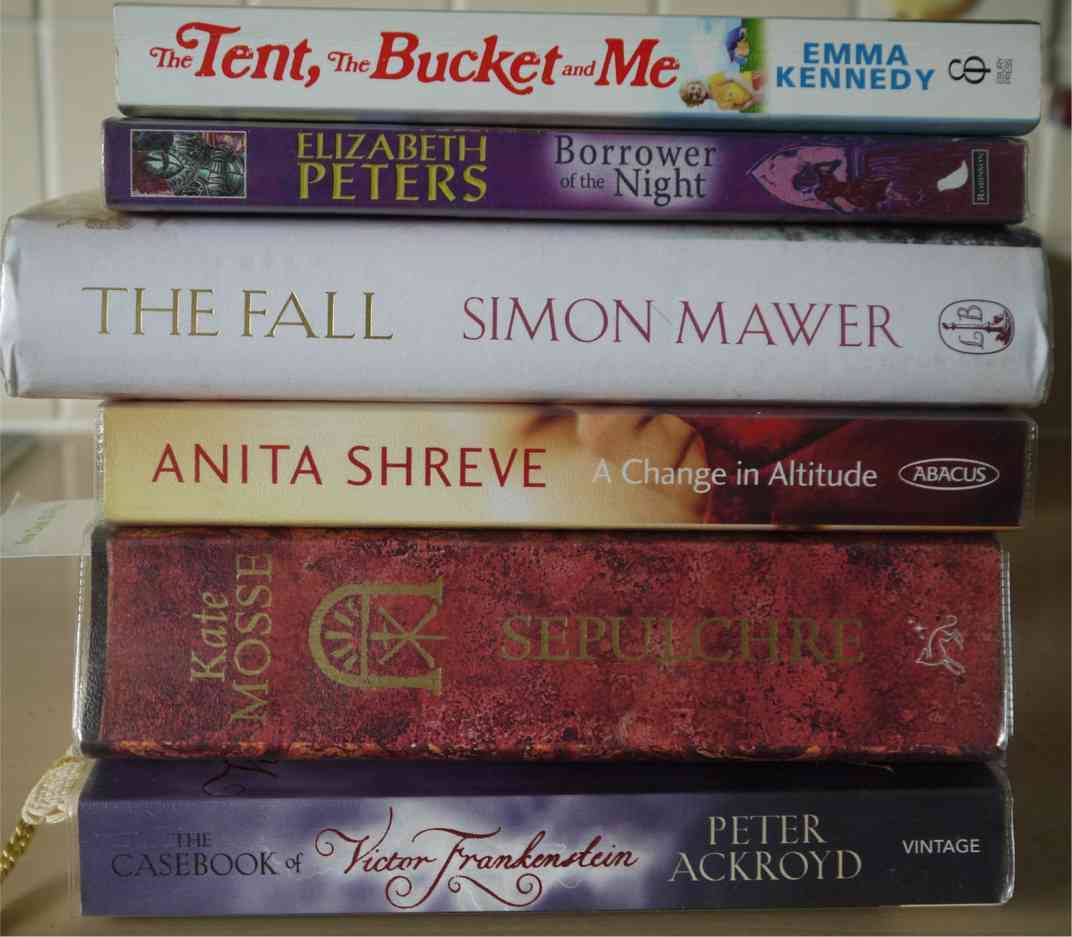
Birthday Books

These are the books I had for my birthday.

The Rough Guide to Crime Fiction is a reference book that I can just dip into. The rest are all books I’d love to read immediately. If you click on the photo you’ll see from the enlarged view showing the creasing on the spine that I’ve already started to read the Creative Writing book. I’m always fascinated by this type of how-to book and already have a few. I saw this at one of the airport bookshops on our recent trip to Stuttgart (see Flickr for some photos) and thought it looked interesting – I’m much better at reading books like this than actually writing anything.

I’ve also read the first few pages of Peter Ackroyd’s Dickens. I’ve read several of Dickens’s books and am currently reading The Mystery of Edwin Drood, so I want to know more about him. This biography begins with his death and the reactions to his death, not only in Britain but also in America.

I’ve read Martin Edwards earlier Lake District Mysteries – they’re excellent. I couldn’t resist reading the startling opening of this latest one, The Serpent Pool:

The books were burning.

Pages crackled and bindings split. The fire snarled and spat like a wild creature freed from captivity to feast on calfskin, linen and cloth. Paper blackened and curled, the words disappeared. Poetry and prose, devoured by flames. (page 7)

This grabs my attention and makes me want to read on immediately.

But there are also the other books I can’t wait to get to:

  •  Susan Hill’s latest Simon Serrailler novel The Shadows in the Street, because I’ve all the others and found them all compelling reading.  This is the fifth one.
  • The Sunday Philosophy Club by Alexander McCall Smith, the first Isabel Dalhousie book. I’ve read and loved some of the later ones.
  • The Year of the Flood by Margaret Atwood. I’ve read good reports of this book. Margaret Atwood is one of my favourite authors and this book promises to be just as good as her others.

As usual I wish I could read all of them at once!

Portrait of an Unknown Woman by Vanora Bennett: Book Review

I didn’t write about Portrait of an Unknown Woman by Vanora Bennett as soon as I’d finished reading it, which is a pity because I only made a few notes whilst reading and now my memory of it is fading fast. It took me some time to get really involved in the story, which is a mixture of fiction and history. I liked the historical elements very much. The fictional side mixed in quite well but I found some of it a bit too sentimental and somewhat contrived.

It’s the story of Sir Thomas More’s fall from Henry VIII’s favour and that of his adopted daughter Meg Giggs and her love for two men – John Clements, the family’s former tutor, and the painter, Hans Holbein. Bennett puts forward a theory about John Clements’ true identity drawn from an analysis and an interpretation of two paintings by Hans Holbein of the More family and also his painting, The Ambassadors. I was fascinated by this and the detail in the paintings, enhanced by the inclusion in the book of a reproduction of the plan for Holbein’s first portrait of the More Family painted in 1527 -28 and a colour reproduction of  a second portrait of the family attributed to Holbein, even though it is signed ‘Rowlandas Lockey’.

I liked the way Bennett portrayed different aspects of Sir Thomas More’s character; in his early life he was a humanist and friend of Erasmus, later a courtier and Henry VIII’s Catholic chancellor, who persecuted Protestant heretics. This contrasts with his family life, where he is relaxed, generous and gentle and Meg cannot reconcile her knowledge of him as a father with his cruel and fanatical persecution of the heretics.

It combines a love story, art history and historical fiction providing an insight into the Tudor period at a time of great social and religious change.

The Gourmet by Muriel Barbery: Book Review

I found The Gourmet an interesting book, maybe an appetiser, or an amuse-bouche, for Muriel Barbery’s later book The Elegance of the Hedgehog (which I haven’t read). It offers tantalising glimpses of food that Pierre Arthens, France’s celebrated food critic recalls as he lies dying, trying to remember the most delicious food he ever tasted. He thinks the flavour of this elusive food is

the first and ultimate truth of my entire life, and that it holds the key to a heart that I have since silenced. I know that it is a flavour from childhood or adolescence, an orginal, marvellous dish that predates my vocation as a critic, before I had any pretension to expound on the pleasure of eating. A forgotten flavour, lodged in my deepest self, and which has surfaced in the twilight of my life as the only truth ever told – or realised. (pages 12-13)

As he remembers back to his childhood his life and character are also revealed through impressions and memories of him from his wife, son and other relations and acquaintances. These are in short chapters building up a picture of Pierre’s character and contrasting with his own thoughts and memories. They are interspersed with Pierre’s florid, over-blown, pretentious ruminations on food, including fish, meat, vegetables, bread, mayonnaise, ice cream and sorbet, none of which provides that elusive taste he is seeking.

I wished the short chapters from his family and friends had been longer and his own shorter – I wanted to know more about the other characters. I know from the extract from The Elegance of the Hedgehog that there is more about Renee, the concierge of the apartement building where Pierre lies dying in that book, so I will read that at some time. I liked the changes in writing style between the characters and Pierre.

All in all, it’s a delightful description of food, mouth-watering, rich and sumptuous, but somehow lacking in substance. By the end it was losing impetus as I began to wonder what it could possibly be that had been tantalising him so much and that was so important to him. The ending was really inevitable and rather sad.

My copy was kindly sent to me from the publishers, Gallic Books.

Teaser Tuesday: The Gourmet by Muriel Barbery

Teaser Tuesdays is a weekly bookish meme, hosted by MizB of Should Be Reading.

Share a couple or more sentences from the book you’re currently reading. You also need to share the title of the book that you’re getting your “teaser” from … that way people can have some great book recommendations if they like the teaser you’ve given!

This week I’ve been reading The Gourmet by Muriel Barbery. It’s a slim book, packed with richness – sumptuous, and full to over-flowing with words and images. It is verbose, florid and sensational – meaning that is celebrates all the sensations experienced relating to food.

Here is a description of one of my favourite foods:

… crimson in its taut silken finery, undulating with the occasional more tender hollow, with a cheerfulness about it like a plumpish woman in her party dress hoping to compensate for the inconvenience of her extra pounds by means of a disarming chubbiness that evokes an irresistible desire to bite into her flesh.

… my teeth tore into the flesh to splatter the tongue with the rich, warm and bountiful juice, whose essential generosity is masked by the chill of a refrigerator, or the affront of vinegar, or the false nobility of oil.

The raw tomato, devoured in the garden when freshly picked, is a horn of abundance of simple sensations, a radiating rush in one’s mouth that brings with it every pleasure. The resistance of the skin – slightly taut, just enough; the luscious yield of the tissues, their seed-filled liqueur oozing to the corners of one’s lips, and that one wipes away without any fear of staining one’s fingers, this plump little globe, unleashing a flood of nature inside us: a tomato, an adventure. (from pages 44-5)

The Body on the Beach by Simon Brett: Book Review

The Body on the Beach is the first in Simon Brett’s Fethering Mysteries. It’s an easy read, a ‘cozy mystery’, set in a fictitious village on the south coast of England. Not a typical village as it has a large residential conurbation, but at its heart is the High Street, with its flint-faced cottages, dating back to the early 18th century. Radiating out from the High Street are a number of new developments, Victorian and Edwardian houses, bungalows, post-war council houses and a large private estate of huge houses backing on to the sea.

Carole Seddon has taken early retirement from her career at the Home Office to live there and as the book opens she is confronted by a new neighbour, Jude, who with her informality and casual approach to life breaks all the accepted local conventions. Carole views her with slight distaste. But when Carole is also confronted by the the discovery of a dead body on the beach, that has disappeared by the time the police go to investigate, she gradually accepts Jude’s help. Together they set about solving the mystery, which gets more complicated with the discovery of the body of a local lad.

This is an entertaining whodunnit which I liked well enough. It wasn’t too difficult to work out the identity of the first body and the culprit. I liked the contrast between Carole and Jude – Carole, set in her ways, reserved and conventional and the flamboyant, casual Jude. Despite her informality Jude reveals very little about her life and relationships, despite Carole’sefforts to get to know more about her.  I also liked the way Brett so convincingly describes the relationships between the different groups of Fethering’s residents.

There are 11 books in the Fethering series.  I’ve already read the fourth –  Murder in the Museum, so there are plenty more to read, the latest one being The Shooting in the Shop. The full list is in Wikipedia and Simon Brett also has a website.

Agatha Christie Reading Challenge: My Progress

The Agatha Christie Reading Challenge is an open-ended challenge to read all of Agatha Christie’s books and short stories, run by Kerrie at Mysteries in Paradise. I first read some of Christie’s books when I was a teenager and hadn’t read any for years until I borrowed a copy of The Crooked House from my local library three years ago. This reminded me of how much I had enjoyed her books and set me off reading them again. Over the years I must have read a good number of them but had never kept any records of what I read at the time.

So when I saw that Kerrie was running this challenge I decided to join in. It’s one of the best challenges out, for me at least, because all you have to do is read Agatha Christie’s books at your own pace and link to the Agatha Christie Carnival once a month. There’s no pressure to meet any deadlines – if you haven’t read any Christie books for the Carnival that’s OK and you just carry on reading when you like.

I’m not even trying to read them in the order they were published, even though Kerrie and some others are, because I’m reading books I already own or books that I find in librarys and/or bookshops. So far I’ve read 17 and 2 collections of her short stories – I’ve listed them on a separate page.

My latest find is 4.50 from Paddington, which I received from Juxtabook as part of my prize in her recent competition. Catherine described this book as a ‘rather aged paperback’ and it is, but then it is 50 years old, published in 1960 for just 2/6 (in old money). It may be old and faded, but because it was published soon after Agatha Christie wrote it, it has a contemporary feel about it. I’ve watched so many TV and film versions, with different actors playing the part of Miss Marple, some more successfully than others that it’s interesting to see this book. I’m not sure who the woman on the front cover is meant to portray – surely not Miss Marple?

And this is the back cover – really that’s all the blurb you need to capture your interest.

This will be my next Agatha Christie book to read.