Book Beginnings: The Bell

I love starting a book. There’s such potential to find a book that really satisfies the imagination, that draws you into its world and also makes you think. It’s even better when you can start a book you’ve read before, knowing that you enjoyed it but not remembering all the details and have it unfold before you still with the power to enchant. Such a book is The Bell by Iris Murdoch.

I first read it in the early 199os (I think), so my memory of it is only of the outline story – a new bell is to be installed at an Abbey, which triggers the discovery of the old bell and then tragedy strikes. I also remember that it was peopled by some interesting characters, but I couldn’t have told you who they are.

Here is the opening paragraph:

Dora Greenfield left her husband because she was afraid of him. She decided six months later to return to him for the same reason. The absent Paul, haunting her with letters and telephone bells and imagined footsteps on the stairs had begun to be the greater torment. Dora suffered from guilt, and with guilt came fear. She decided at last that the persecution of his presence was to be preferred to the persecution of his absence. (page 7)

Now, that’s not a good marriage, but it is a great opening to this story of a lay community at Imber Court, a beautiful house outside Imber Abbey, the home of an enclosed order of nuns. Paul is a guest at Imber Court studying some 14th century manuscripts which belong to the Abbey. You know straight away that Dora and Paul’s marriage is a disaster area, that Paul is a man to be feared and that Dora is a mass of contradictions, a complex character – will she be able to stand living with Paul? My immediate reaction was that she is making a big mistake.

So far I’ve read about a quarter of the book and it’s just as good as I remember. Iris Murdoch’s writing is so good, full of description so that you can see the people and places as though you were there and also full of insights into the characters thoughts and feelings. There is an impending sense of evil  and menace, for below the peaceful surface stress and tension abound.

Book Beginnings is hosted by Katy at A Few More Pages, where you can leave a link to your own post on the opening lines of a book you’re currently reading.

New to BooksPlease

New in today is Patronage by Maria Edgeworth, thanks to the publishers Sort of Books.

Maria Edgeworth (1768 – 1849) was a contemporary of Jane Austen, publishing novels at the same time – Patronage was published just 5 months before Mansfield Park in 1814. It will be a while before I read this book, which is to be published on 6 July 2011, because there are already quite a few in my reading queue. But it does look interesting, described as

… one of the most eagerly anticipated novels of Jane Austen’s day. It sold out within hours of publication.

… an adventurous soap opera about the trials and fortunes of two neighbouring families in Regency England, both of which had sons and daughters setting out in the world. … a bright and mischievous critique of the way young men gained careers and young women gained husbands. (from the back cover)

I might just have to bump it up the list.

I also received newbooks magazine a few days ago. This has all sorts of book news, interviews  and articles, plus lots of reviews and extracts from six novels – you can choose one for just the cost of p&p. This issue the free books are:

  • Tony & Susan by Austin Wright, his fourth and overlooked novel, originally published in 1993, about a divorced couple. Tony asks Susan to read the manuscript of his first novel.
  • The Particular Sadness of Lemon Cake by Aimee Bender, about the link between food and our emotions.
  • Outside the Ordinary World by Dori Ostermiller, in which Sylvia finds herself following in her mother’s footsteps into an affair she feels powerless to resist.
  • Drums on the Night Air: a Woman’s Flight from Africa’s Heart of Darkness by Veronica Cecil, set in the Congo in the early 1960s as civil war breaks out.
  • Collusion by Stuart Neville, a crime novel featuring DI Jack Lennon caught up in a web of official secrets and lies as he tries to find the whereabouts of his daughter.
  • The Collaborator by Margaret Leroy, in which Vivienne decides to escape from Guernsey to England in June 1940, as the German invasion is threatened, but stays and finds herself in danger.

Tony & Susan looks interesting, as does Drums on the Night Air, but I think I’m going to get The Collaborator.

Crime Fiction Alphabet: V is for Val McDermid

Until now I’ve steered clear of reading any of Val McDermid‘s books and the reason is that I can’t stand to watch the violence and torture scenes in TV series such as Wire in the Blood. But recently I’ve been thinking that maybe I wasn’t being fair to judge a writer’s work on films based on the books. So I decided to check out a Val Mcdermid book from the library to see for myself.

There are many to choose from but I picked the shortest one, thinking if I didn’t like it I wouldn’t waste much time reading it.

Cleanskin is one of the Quick Reads series, aimed at “adults who’ve stopped reading or find reading tough, and for regular readers who want a short, fast read.” 

Summary (adapted from the back cover where Jack Farrell is erroneously called Jack Farlowe!):

When career criminal, Jack Farrell’s body is found washed-up on a Suffolk shore, it looks to the police like a clear-cut case. Broken-hearted at his daughter’s death, he has drowned himself – good riddance and one less crime to solve, according to CID. Then again, maybe not. For, one by one, Farrell’s enemies are being killed. And the horrific manner of their deaths makes drowning look like a day at the beach!

My thoughts:

Val McDermid’s style in this long short story is clear, straight-forward and chatty. The narrator is DCI Andy Martin. He’s the world expert on Jack Farrell, a criminal known as a ‘cleanskin‘ because he had no criminal record:

Farrell’s crew ran just about every dirty racket you could think of: drugs, guns, hookers, porn. You name it they were into it. They bought and sold human lives like they were bargains on eBay. (page 2)

Martin identifies Farrell’s body from the vivid tattoos still visible on his battered and bloated body. Being a novella the action is fast paced, the characters are briefly sketched and although I had worked out some of the mystery, the final dénouement came as a surprise. And there is a certain amount of  graphic description of the gruesome methods of killing and torture, so I’m still not sure about reading any of Val McDermid’s other books.

Can anyone recommend where I should start – bearing in mind that I am squeamish?

Cleanskin:

  • Paperback: 128 pages
  • Publisher: HarperCollins; World Book Day edition edition (18 May 2006)
  • Language English
  • ISBN-10: 0007216726
  • ISBN-13: 978-0007216727
  • Source: Borrowed from the library

A Crime Fiction Alphabet post – for more posts featuring the letter V see Kerrie’s blog.

Abandoned Books Meme

This meme was started by Mrs. B at The Literary Stew. She was reading Nancy Pearl’s Book Lust when this passage set her off thinking about abandoning books:

“..your mood has a lot to do with whether or not you will like a book. I always leave open the option of going back to a book that I haven’t liked (especially if someone I respect has recommended it to me) sometime later. I’ve begun many books, put them down unfinished, then returned a month or two, or years, later and ended up loving them. This happened with Mathew Kneale’s English Passengers, John Crowley’s Little Big, and Andrea Barrett’s The Voyage of the Narwhal.”

Here are my answers to her questions.

1. What would cause you to stop reading a book ?

I never used to give up on reading books, but now I have few qualms about it. I start a book and if it doesn’t appeal within 50 or so pages I put it down. I give up if it becomes a chore to read it, or if the writing is bad, if it irritates me or makes me squirm. Sometimes it may just be that I’m not in the right mood at the time for that book, or it may be that another book is grabbing my attention.


2. Name a book or books you’ve abandoned in the past that you ended up loving later on.

Wolf Hall by Hilary Mantel immediately springs to mind. When I first started I groaned because it’s written in the first person, which often grates with me. It’s also very big and heavy. When I went back to it I soon forgot about the irritating first person and became entranced. I loved it.


3. Name a book you’ve abandoned in the past that you hope to finish someday.

There are several I could name. The first one I thought of is Cloud Atlas by David Mitchell, followed closely by Italo Calvino’s If on a Winter’s Night a Traveller, which has an excellent beginning  but as I read on all the stops and starts became disjointed. I’d borrowed the book from the library and had renewed it a few times so eventually I gave up and returned it.

I’ve started Cloud Atlas at least three times and found it interesting at first and then confused by the changes in the narrative. These are both books with novels-within-novels. I have nothing against such books – I loved the Blind Assassin by Margaret Atwood, another book that uses this technique – but both Cloud Atlas and If on a Winter’s Night are maybe taking it a step too far for me. I’d like to think I will read them both but I doubt it.

Another book I’m much more likely to start again is The Voyage Out by Virginia Woolf. This is her first book published in 1915. It’s about a young woman aboard the Euphrosyne, bound for South America, travelling with her aunt and uncle, a coming-of -age novel. One of my favourite books is Mrs Dalloway and Clarissa Dalloway makes her first appearance in The Voyage Out.  I can’t remember now why I stopped reading this book. It may just have been simply that other books took precedence at the time, but it’s one I definitely want to read.


Reading Notes

Notes on The Weather in the Streets by Rosamond Lehmann and Small Island by Andrea Levy

My face-to-face book group is introducing me to some books I would never read by my own choice. Last month’s book was The Weather in the Streets.

I was looking forward to reading it as I don’t often read romantic fiction. However, I was disappointed. It’s about Olivia, separated from her own husband and having an affair with Rollo Spencer. At times I just wanted to shake Olivia and tell her to open her eyes to reality. It’s set in the 1930s, that inter-war period that seems so glittering, full of bright young things going to lots of parties, lots of socialising and being part of the in-crowd. Olivia is really just on the fringes looking in, whereas Rollo is one of the aristocracy – it’s painfully obvious that he is not going to leave his wife and marry Olivia.

Although it is a beautifully written book, rich in description, giving insight into the characters’ thoughts as well as their actions, I didn’t like the plot and felt little empathy with the characters. I can imagine how shocking it must have seemed when it was first published in 1936 when divorce and abortion were taboo. I found it mildly depressing.

I didn’t fare any better with Small Island by Andrea Levy, which won the Whitbread Book of the Year and the Orange Prize for Fiction. I had high expectations of this book as I had thoroughly enjoyed The Long Song. Small Island tells the story of two couples, Hortense and Gilbert from Jamaica and Queenie and Bernard from England and the interactions of their lives in 1948 and earlier. It’s narrated by each of the four characters, covering a number of issues, predominantly racism and prejudice, war and love.

As with The Weather in the Streets I didn’t like the characters very much; although they mostly come across as rounded personalities, at times they seemed like stereotypes. For me the book was too long and I lost interest several times. For such a long book I thought the ending was rushed, as though Levy had suddenly thought she’d better draw it to a close.

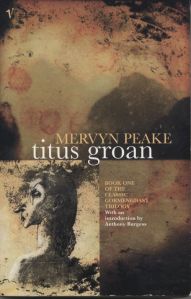
Gormenghast – Titus Groan by Mervyn Peake

This week is the start of the Gormenghast Read-Along:

Titus Groan: The Hall of the Bright Carvings ‘“ Near and Far (p15 ‘“ p136 in my edition, Vintage 1998)

I was a bit concerned that re-reading this book would spoil my memory of it. I needn’t have been, I’m finding it just as entrancing, whisking me off to the strange world that is Gormenghast.

Gormenghast, that massing of stone, the castle, surrounded by an ‘epidemic‘ of mean dwellings swarming round its walls, with its ‘irregular roofs‘, ‘time-eaten buttresses, of broken and lofty turrets’, and the enormous Tower of Flints:

This tower, patched unevenly with black ivy, arose like a mutilated finger from the fists of knuckled masonry and pointed blasphemously at heaven. At night the owls made of it an echoing threat; by day it stood voiceless and cast its long shadow. (page 15)

These first few chapters set the scene and introduce the characters, all eccentric, grotesque even and above all – strange. The castle is filled with excitement at the birth of an heir to Gormenghast, although not everyone welcomes it with delight. Indeed, Mr Flay, Lord Gormenghast’s personal servant, calls it a ‘Challenge to Change!‘ and he doesn’t want ‘Change!‘ And neither does Fuchsia, Titus’s older sister, and on hearing of his birth she refused to believe it. She’s a girl of

about fifteen with long, rather wild black hair. She was gauche in movement and in a sense, ugly of face, but with how small a twist might she not suddenly have become beautiful. Her sullen mouth was rich and full – her eyes smouldered. (page 51)

The descriptions are very visual, with a strong expression of colour and solidity and there is an emphasis on the importance of ritual and tradition.

List of characters so far (in order of appearance):

  • the craftsmen who created the Bright Carvings, the forgotten people living outside the Castle.
  • Mr Rottcodd, the curator of the Bright Carvings.
  • Mr Flay, the thin, bony and taciturn servant of Sepulchrave, Earl of Gormenghast.
  • the Grey Scrubbers, a company of 18 men who clean the kitchen, deaf slablike men.
  • Abiatha Swelter, the fat, drunken slob who is the head chef – Flay and Swelter dislike each other intensely.
  • Steerpike, a kitchen boy whose aim is to escape from the kitchen, loathing Swelter.
  • Doctor Prunesquallor with a high pitched voice and an alarming laugh.
  • Fuchsia, Lord Sepulchrave’s daughter.
  • Countess of Sepulchrave, Gertrude, dark red hair, huge, surrounded by birds and white cats.
  • Nannie Slagg, a little ancient woman, nurse for Titus and before that Fuchsia.
  • Titus, newly born baby with extraordinary violet eyes.
  • Lord Sepulchrave, bound by tradition, long olive coloured face, a melancholy man.
  • Sourdust, the librarian, knotted beard very lined face as though made of brown paper.
  • Keda, a woman from the Dwellings of the Bright Carvers, Titus’s wet-nurse.
  • Lady Cora and Lady Clarice, Sepulchrave’s sisters, resentful of Gertrude, wanting what she has that they think should be theirs- power.

Normally I like a book to move along swiftly – this one doesn’t, but I’m perfectly happy reading it slowly, enjoying the scenes it conjures up in my mind.