First Chapter First Paragraph Tuesday Intros

First chapterEvery Tuesday Diane at Bibliophile by the Sea hosts First Chapter First Paragraph Tuesday Intros, to share the first paragraph or (a few) of a book she is reading or thinking about reading soon.

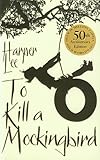
This week I’m featuring a book that I’ve known about for many years, but have never read until now. It is To Kill a Mockingbird by Harper Lee and although I haven’t finished it yet it’s promising to be one of the best books I’ve read for a long time. Although she had written some long short stories before this was her first novel (and only novel!) and published in 1960 it became an immediate best seller.

It begins:

When he was nearly thirteen my brother Jem got his arm badly broken at the elbow. When it healed, and Jem’s fears of never being able to play football were assuaged, he was seldom self-conscious about his injury. His left arm was somewhat shorter than his right ; when he stood or walked the back of his hand was at right-angles to his body, his thumb parallel to his thigh. He couldn’t have cared less, so long as he could pass and punt.

When enough years had gone by to enable us to look back on them, we sometimes discussed the events leading to his accident. I maintain that the Ewells started it all, but Jem, who was four years my senior, said it began the summer Dill came to us, when Dill first gave us the idea of making Boo Radley come out.

I’m not writing any more about it right now – not until I’ve finished it (less than 100 pages from the end) – except that it has captured my imagination completely and given me plenty to think about!

Tamburlaine Must Die by Louise Welsh

It was a treat to read Tamburlaine Must Die, a short book that I read in a day. I can’t remember when I last read a book in a day!

Sometimes novellas, such as this is with just 140 pages, can seem lacking, needing more depth of character or plot, leaving me feeling that it should really have been a full length novel, or an even shorter story. But Tamburlaine Must Die has an immediacy, that drew me in to the late Elizabethan world.

I wrote about the opening paragraph and synopsis on Tuesday and almost immediately after I began to read the book. Written in the first person and set in May 1593, it’s a tense, dramatic story of the last days of Christopher Marlowe, playwright, poet and spy. Accused of heresy and atheism, his death is a mystery, although conjecture and rumours abound. Louise Welsh has used several sources in writing this novella, but as she writes in the Author’s Note:

History has bequeathed us a tantalising framework of facts – the Elizabethans were as prolific as the Stasi when it came to official documents. Yet the facts can’t tell us the full tale and historian’s theories on Marlowe’s death are ultimately well informed, meticulously researched speculation.

We know that Marlowe dies in a house in Deptford. We know the date of his death and the three men present. We know the nature of the wound that killed him. Everything else is educated guesswork, or in this author’s case, a fiction.

Tamburlaine Must Die conveys the claustrophobic atmosphere of danger surrounding Marlowe; who can he trust, and who is behind the pseudonym of ‘Tamburlaine’, who posted a libellous handbill referencing Marlowe’s plays? He is very aware that death is just around the corner:

A dagger can find its way into a belly or a back before the victim spies it. I thought I felt the prickle of surveillance on my shoulders. And though I knew it was most likely the effect of my own blood running faster in my veins, I made my way from the crush of people, trying to keep note of who was around me, checking  if any faces lingered in the thinning crowd. (page 31)

As well as Marlowe, Louise Welsh throws in Dr Dee and Thomas Walsingham, Marlowe’s patron and refers to Walter Raleigh too. In such a brief book she has managed to convey the political and the seedy underworld of the Elizabethan period, the dishonesty and love of intrigue, the dangers of the plague and the threat of war. Has much changed since then, I wonder.

The Drowning by Camilla Lackberg: Book Notes

You can’t like every book you read and if I find I’m not enjoying a book I stop reading it. But it’s not always so straight forward because a book can begin well and hook you into the story, get your attention then begin to irritate because it takes so long to get there, and you read on. Then when you get to the end you heave a sigh of relief that you have finished it. It was just about OK.

The Drowning by Camilla Lackberg is such a book. It began well – I wrote about the opening paragraphs in this post. They made me want to read on but I had some reservations because of the blurb on the back cover €“ €˜Expert at mixing scenes of domestic cosiness with blood-curdling horror’. Well, there is a lot of domestic cosiness and not really any blood-curdling horror. There are a few nasty scenes, but nothing that made me want to skim read, nothing in fact that I couldn’t read.

Synopsis from the back cover:

Christian Thydell’s dream has come true: his debut novel, The Mermaid, is published to rave reviews. So why is he as distant and unhappy as ever? When crime writer Erica Falck, who discovered Christian’s talents, learns he has been receiving anonymous threats, she investigates not just the messages but also the author’s mysterious past€¦

Meanwhile, one of Christian’s closest friends is missing. Erica’s husband, Detective Patrik Hedström, has his worst suspicions confirmed as the mind-games aimed at Christian and those around him become a disturbing reality.

But, with the victims themselves concealing evidence, the investigation is going nowhere. Is their silence driven by fear or guilt? And what is the secret they would rather die to protect than live to see revealed?

My view:

  • This is the sixth book in Camilla Lackberg’s  Fjällbacka series, so maybe I should have begun with the first book. However, I didn’t feel that I’d jumped into a series without understanding how the characters interacted, or that there were back stories that I should know, so I think it does work as a stand-alone book.
  • It’s written from several perspectives and has a second narrative interspersed with the main one. It’s not clear at first how these are related but it soon becomes apparent.
  • None of the characters came alive for me, apart from Erica  and Patrik and there was little I could visualise from the description of the location – it’s in Sweden, it’s cold and there is snow on the ground.
  • It’s unevenly paced, disjointed with snippets of information being passed between the characters and not shared with the reader, presumably to increase the suspense and tension, which it didn’t achieve for me. As a page-turner it just didn’t work, and I sighed mentally each time it came up.
  • The  description in places reminded me of an exercise I did on a training course in which you had to describe in detail how to make a cup of tea – decide to make a cup, pick up the kettle, take it to the tap etc. I am exaggerating, but you get the picture.
  • It’s predictable – I knew quite early on who the culprit was. That doesn’t necessarily mean it spoils a book, but in this instance it did because I kept on thinking, it’s … I couldn’t see why Erica and the police couldn’t see it either.
  • The ending was so irritating – a cliff hanger, aimed at getting you to read the next book??

I doubt I’ll read any of the other books in the series.

First Chapter First Paragraph Tuesday Intros

Every Tuesday Diane at  Bibliophile by the Sea hosts First Chapter First Paragraph Tuesday Intros, sharing the first paragraph or (a few) of a book she’s reading or thinking about reading soon.

Today I’m in the mood for reading short fiction and picked this book off my to-be-read shelves. It’s Tamburlaine Must Die by Louise Welsh, set in 1593 it tells the story of playwright, Christopher Marlowe’s last days, weaving together fact and fiction. It’s only 140 pages.

It begins:

I have four candles and one evening in which to write this account. Tomorrow I will lodge these papers with my last true friend. If I survive the day, they will light our pipes. But should I not return, he has instructions to secrete this chronicle where it will lie undiscovered for a long span, in the hope that when these pages are found, the age will be different and my words may be judged by honest eyes.

When I read the first four words I immediately thought of the Ronnie Barker and Ronnie Corbett sketch from years ago in the Two RonniesThe Four Candles. I don’t suppose that is the response Louise Welsh would have expected, but there it is, that’s what came to my mind. But this is not a comedy as this summary from Amazon reveals:

London, 1593. A city on edge. Under threat from plague and war, strangers are unwelcome, suspicion is wholesale, severed heads grin from the spikes on Tower Bridge. Playwright, poet and spy, Christopher Marlowe walks the city’s mean streets with just three days to find the murderous Tamburlaine, a killer escaped from the pages of his most violent play. Tamburlaine Must Die is the searing adventure of a man who dares to defy both God and the state and whose murder remains a taunting mystery to the present day.

What do you think? Would you keep reading?

Falling Angels by Tracy Chevalier

I really enjoyed reading Falling Angels by Tracy Chevalier. It’s been sitting unread for several years on the to-be read shelves and I’ve been meaning to read it for ages after reading her earlier book, Girl with a Pearl Earring. I should have got round to it sooner.

It begins:

I woke this morning with a stranger in my bed. The head of blond hair beside me was decidedly not my husband’s. I did not know whether to be shocked or amused.

Well, I thought, here’s a novel way to begin the new century.

It is 1901, the day after Queen Victoria’s death and the ‘I’ in this opening is Kitty Coleman, one of several narrators in this novel set in Edwardian England.

Synopsis from Tracy Chevalier’s website:

Two families visit neighboring graves in a fashionable London cemetery. One is decorated with a sentimental angel, the other an elaborate urn. The Waterhouses revere the late Queen and cling to Victorian traditions; the Colemans look forward to a more modern society. To their mutual distaste, the families are inextricably linked when their daughters become friends behind the tombstones. And worse, befriend the gravedigger’s son.

As the girls grow up and the new century finds its feet, as cars replace horses and electricity outshines gas lighting, Britain emerges from the shadows of oppressive Victorian values to a golden Edwardian summer. It is then that the beautiful, frustrated Mrs Coleman makes a bid for greater personal freedom, with disastrous consequences, and the lives of the Colemans and the Waterhouses are changed forever.

A poignant tale of two families brought reluctantly together, Falling Angels is an intimate story of childhood friendships, sexual awakening and human frailty. Yet its epic sweep takes in the changing of a nation, the fight for women’s suffrage and the questioning of steadfast beliefs.

My view:

This book covers the years from 1901 – 1908 when the world was on the cusp of change just before the outbreak of the First World War, and I found myself wondering what my grandmothers, who would have been much the same age as Kitty Coleman and Gertrude Waterhouse, had thought about it all. What would they have thought about the suffragettes for example? I suspect it would have been similar to one of the characters, Jenny Whitby, the Colemans’ maid servant, as they too were domestic servants. Jenny is horrified when she listens to the suffragettes, whilst she served them with scones at Kitty Coleman’s ‘At Home’:

What I heard made me want to spit. They talked about helping women but it turns out they are choosy about who exactly gets the help. They ain’t fighting for my vote – only for women who own property or went to university. (pages 227 – 228)

Maybe my great aunt who never married and became a matron at a public school would have had more sympathy and agreed with the suffragettes that all women would not get the vote all at once and they had to start somewhere. These are the early years of the suffragette movement culminating in the book in June 1908 with the Women’s March in Hyde Park to demand Votes for Women.

The change between Victorian and Edwardian England was a gradual one, as attitudes to life and death were transformed and the middle-class Colemans and the Waterhouses reflect these changing attitudes with the Colemans looking forward to the modern era, whilst the Waterhouses still value the Victorian traditions. I was interested in the discussion about cremation/burial, with Kitty favouring cremation  in opposition to her mother-in-law as they visited the columbarium (a place for keeping cinerary remains, ie ashes) that had recently been opened at the cemetery. Their discussion with Mr Jackson, the superintendent of the cemetery was a theological one in which he ends the discussion of how God could reunite the body and soul if the body has been burnt by saying:

Surely there is no difference between the decomposed remains of a buried body and the ashes of a burned one. … I would simply say that God is capable of all things, and nothing we do with our remains will stop Him if he wishes to reunite our souls with our bodies. (pages 37 – 38)

I liked the multiple first person narrator structure of the book, giving an all round view of events and the characters’ views and thoughts. It was easy to distinguish between them all, the two daughters, Maude Coleman and Lavinia Waterhouse in particular are very well depicted. The setting too is so well described that I could imagine myself wandering round the cemetery with all its gothic symbology, and see the suffragettes’ march with their banners ‘Deeds not Words’ and hear their cries of ‘Votes for Women’.

It’s an easy to read book that still manages to contain depth both of characterisation and of themes – family relationships, in particular that of mother and daughter, attitudes towards death and mourning, the change in social codes, the perils of being an unmarried mother and the beginnings of the women’s movement. I was fascinated by it!

This page on Tracy Chevalier’s website lists her books – I have one more of hers – The Lady and the Unicorn, I mustn’t wait too long before I read it!

Although I didn’t read this to take part in any challenges I realise that it fits in with several I’ve signed up to do – the Mount TBR Challenge, the Historical Fiction Reading Challenge and the What’s in a Name Challenge (in the category of book with the word ‘down’ or an equivalent in the title).

Wondrous Words

wondrous2Wondrous Words Wednesday is a weekly meme run by Kathy at Bermuda Onion’s Weblog where you can share new words that you’ve encountered or spotlight words you love.

These are some words from Barnaby Rudge by Charles Dickens:

Usquebaugh – ‘what does my noble captain drink – is it brandy, rum, usquebaugh?’

This is obviously a drink of some sort, but I didn’t know what. Usquebaugh is Gaelic meaning “Water of Life”, phonetically it became “usky” and then “whisky” in English.

Flip – ‘every man … put down his sixpence for a can of flip, which grateful beverage was brewed with all dispatch, and set down in the midst of them on the brick floor; both that it might simmer and stew before the fire, and that its fragrant steam, rising up among them, and mixing with the wreaths of vapour from their pipes, might shroud them in a delicious atmosphere of their own and shut out all the world.’

Another intoxicating drink, I thought. Flip is eggnog, a drink of eggs and hot beer or spirits. I was interested to see it came in a can! Canning food was invented by a French chef in 1795 to preserve military food for Napoleon’s army. Barnaby Rudge, although written in 1839-41 when sealed cans similar to those we use now would have been in use, is set in 1775 and 1780 so Dickens was probably using the word to mean a container for holding liquid – or it’s an anachronism?

Poussetting – ‘Joe Willet rode leisurely along in his desponding mood, picturing the locksmith’s daughter going down long country dances, and poussetting dreadfully with bold strangers – which was almost too much to bear ...’

Poussette is simply a figure in country dancing when the couples hold hands and move up or down the set changing places with the next couple. And by the way Joe describes it he was thinking the locksmith’s daughter was being too familiar with strangers.