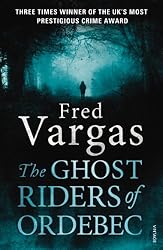
The Ghost Riders of Ordebec by Fred Vargas

I really enjoyed The Ghost Riders of Ordebec. It’s full of  eccentric and quirky characters, an intriguing mystery beginning with the death of an old woman, killed with breadcrumbs, then a car is burnt out with someone inside, and a pigeon is found with its legs tied together so it can’t fly.

But the main mystery Commissaire* Adamsberg has to solve is the strange tale a woman from Ordebec, a little village in Normandy, presents to him.

Blurb:

‘People will die,’ says the panic-stricken woman outside police headquarters.

She refuses to speak to anyone besides Commissaire Adamsberg. Her daughter has seen a vision: ghostly horsemen who target the most nefarious characters in Normandy. Since the middle ages there have been stories of murderers, rapists, those with serious crimes on their conscience, meeting a grisly end following a visitation by the riders.

Soon after the young woman’s vision a notoriously vicious and cruel man disappears. Although the case is far outside his jurisdiction, Adamsberg agrees to investigate the strange happenings in a village terrorised by wild rumours and ancient feuds.

My thoughts:

This is the 8th book in Fred Vargas’ series of Commissaire Adamsberg books. I’ve previously read two, so I’ve a bit of catching up to do. But although there are obviously events that I don’t know about (the appearance of a son, aged 28, that he hadn’t known about, for one thing) this doesn’t detract from the story. I loved all the strange characters – not just the odd people living in Ordebec, but also Adamsberg’s fellow police officers whom he describes as:

 … a hypersomniac who goes to sleep without warning, a zoologist whose speciality is fish, freshwater fish in particular, a woman with bulimia who keeps disappearing in search of food, an old heron who knows a lot of myths and legends, a walking encyclopaedia who drinks white wine non-stop — and the rest to match. (page 67)

And I also loved the medieval myths and legends forming the basis of the plot: the ghostly army that gallops along the Chemin de Bonneval, led by the terrifying Lord Hellequin.

Adamsberg is a thinker ‘ but a vague thinker ‘ he works mainly on intuition, and in this book his intuition and deductive reasoning have to work overtime. I was thoroughly immersed in this book, enjoying the humour as well as the mystery, intrigued to see how the crimes came together and how the pigeon was rescued. It’s original, and maybe not altogether plausible, but most definitely a treat to read.

Fred Vargas is the pseudonym of the French historian, archaeologist and writer Frédérique Audoin-Rouzeau.

*Commissaire is roughly the equivalent of a British Superintendent. His colleagues’ ranks in descending order are commandant, lieutenant and brigadier.
Agatha Christie Reading Challenge Update

agatha_christie_rcIt’s been a while since I’ve written about where I’m up to in reading my way through Agatha Christie’s crime fiction novels and short stories.  In fact it’s been months since I last read an Agatha Christie book!

The list of the books I’ve already read is on this page. I still have many of the short stories to read but just four novels!!

I’m aiming to read these four remaining novels by the end of this year:

  1. The Murder at the Vicarage – (Miss Marple)
  2. Death Comes as the End
  3. Sparkling Cyanide (Colonel Race)
  4. Destination Unknown

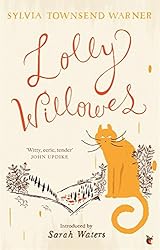
Lolly Willowes by Sylvia Townsend Warner

Lolly Willowes has been on my radar for a few years now and I’ve seen a few other bloggers have been reading it recently – Cath for one at Read Warbler.

From the back cover:

After the death of her adored father, Laura ‘Lolly’ Willowes settles into her role of the ‘indispensable’ maiden aunt of the family, wholly dependent, an unpaid nanny and housekeeper. Two decades pass; the children are grown, and Lolly unexpectedly moves to a village, alone. Here, happy and unfettered, she revels in a new existence, nagged only by the sense of a secret she has yet to discover.

And here is what I thought about it.

Published in 1926, Lolly Willowes is Sylvia Townsend Warner’s first novel. In the Introduction to this edition by Sarah Waters she states that it was an instant hit  with readers and critics and I can see why. On the surface it’s a gentle fantasy, but it’s not at all whimsical, and Sylvia Townsend Warner’s writing is beautiful, lovely lyrical descriptions of both town and country. It’s a book of two parts – the first about Lolly’s existence with her brother’s family in London, where she becomes increasingly disquiet and finds her self indulging in day dreaming about being

‘in the country, at dusk, and alone, and strangely at peace. … Her mind was groping after something that eluded her experience, a something that was shadowy and menacing, yet in some way congenial, a something that lurked in waste places, that was hinted at by the sound of water gurgling through deep channels and by the voices of birds of ill-omen. (page 67)

There’s a bit of a spoiler in this next paragraph.

The second part about her life in the little village of Great Mop, in the Chilterns in the Buckinghamshire countryside is in direct contrast, as she gradually regains the peaceful happy existence she had had growing up. But Great Mop is not just a sleepy backwater because as Laura discovers there are unusual forces at large and she finds herself with her neighbours at a night-time gathering dancing in a continual flux. Her life is changed forever as she meets Satan, who turns out to have a happy relationship with his servants and she enters into a new independence.

So this is a somewhat magical, mystical book and underlying the text is the changing position of women in society in the 1920s,  especially single women financially dependent on their male relatives, who previously were expected to remain within the family looking after elderly relatives, or as in Lolly’s case helping with looking after the children and the running of the household.  In moving away from her family Lolly asserts her independence and enjoys her single life as part of the village community.

So, it’s a book I really enjoyed, for its content, the characters and setting and last but not least Sylvia Townsend Warner’s style of writing. She went on to write more books and poetry, including these novels:

Lolly Willowes (1926)
Mr Fortune’s Maggot (1927)
The True Heart (1929)
This Our Brother (1930)
Summer Will Show (1936)
After the Death of Don Juan (1939)
The Corner That Held Them (1948)
The Barnards of Loseby (1954)
The Flint Anchor (1954)
The Cat’s Cradle (1960)

A Pale View of Hills by Kazuo Ishiguro

This is the cover of my copy of the book

A rather strange book; its ambiguous content left me wondering just what had happened and how to interpret it.

On the surface this is simply the story of a widow, Etsuko living in Britain, as she reminisces about her past life in Japan shortly after the war, living at the edge of the wasteland of Nagasaki. She is haunted by the past and by the suicide of her daughter, Keiko, who was never happy living in Britain. Her younger daughter, Niki, visits her and it is during this visit that Etsuko remembers a friendship she had had briefly with a mysterious woman, Saicho, once wealthy but now reduced to poverty, and her little daughter, Mariko.  Saicho often leaves Mariko to fend for herself, seemingly unconcerned about what she does and where she is, which troubles Etsuko, who is expecting her first daughter who I assume is Keiko.

There are parallels between Saicho and Etsuko. Just as Saicho is hoping to leave Japan with Frank, her American friend, so Etsuko (without her Japanese husband, Jiro; what happened to him is not explained) left Japan to live in Britain with her British husband. Their daughters are disturbed characters, unhappy, solitary and distant from their mothers.

As I read I began to wonder about Etsuko, especially when she says:

Memory, I realize, can be an unreliable thing; often it is heavily coloured by the circumstances in which one remembers, and no doubt this applies to certain of the recollections I have gathered here. (page 156)

To say much more would reveal too much of the story, but when I came to a sentence where the pronoun changes I was even more unsure just what was meant and what actually happened. This is a book I need to re-read in the light of its ambiguity.

However the events play out this is a beautifully written book, describing the countryside around and in Nagasaki after the Second World War, referring to life before the war, and how not only the landscape but also the people and traditions were altered in the aftermath of the atomic bomb. There is an awful lot packed within its 183 pages. It’s a fascinating story of loss, grief, guilt and shame.

A Pale View of Hills is Kazuo Ishiguro’s first novel. It won the 1982 Winifred Holtby Memorial Prize.

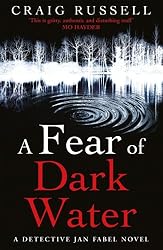
A Fear of Dark Water by Craig Russell

Once more I’m trying to catch up writing about the books I’ve read recently so this is just a short post about A Fear of Dark Water by Craig Russell. It’s the sixth book in the series featuring Jan Fabel, the head of Hamburg’s Murder Commission, but it’s only the second one that I’ve read (I previously read the seventh book, The Ghosts of Altona). Craig Russell has now joined my list of favourite authors and I think Fabel now equals Rebus as one of my favourite police detectives.

In A Fear of Dark Water a massive storm hits Hamburg, flooding the city, just as a major environmental summit is about to start.  A serial rapist and murderer is still at large in the city and when the flood waters recede a headless torso is found washed up. Initially it’s thought to be another victim of the killer, who had dumped his victims’ bodies in waterways around the city.

But there’s more to it than that as Fabel’s investigations dig up a secret environmental organisation/cult called ‘Pharos’, that demands its members hand over all their wealth to it, and with an aggressive and hostile approach to criticism. Fabel is drawn into the high-tech world of cyberspace, particularly the Virtual Dimension site, where people create personalities who only exist in cybre-space and who only interact through the internet – a world unfamiliar to Fabel, who denies he is technophobic, insisting he is a traditionalist.

This is a fast paced and complex, multi-layered crime novel that I thoroughly enjoyed and that kept me guessing right to the end.

The Author

Born in Fife, Craig Russell served for several years as a police officer in Scotland, before becoming an advertising copywriter and later creative director. His Fabel novels were inspired by his long-standing interest in the language, culture and people of Germany.

In addition to his Jan Fabel books Craig Russell also writes the Lennox thrillers set in 1950s Glasgow and I hope to get round to reading those too.

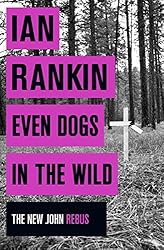
Even Dogs in the Wild by Ian Rankin

In Ian Rankin’s previous book Saints of the Shadow Bible Rebus was back on the police force, the rules on retirement age having changed. Now, two years later in Even Dogs In the Wild Rebus is on his second retirement – well almost. It seems they can’t do without him and when someone takes a potshot at retired gangster, Big Ger Cafferty DI Siobhan Clarke suggests they ask him to act in a ‘consultative capacity’ albeit not as a cop and with no warrant card or real powers and with no pay. Cafferty refuses to let the police in to talk to him – he’ll only speak to Rebus. That suits Rebus as he’s bored with being retired, each day the same as the one before.

It seems this is connected to the killing of David Menzies Lord Minton, a former Lord Advocate, who had been found beaten around the head and throttled. He had received a note: I’M GOING TO KILL YOU FOR WHAT YOU DID – as had Cafferty.

A second strand of the story concerns the warfare between two gangs, one from Glasgow, headed by Joe Stark, who have arrived in Edinburgh looking for a guy called Hamish Wright and whatever it is he has stolen from them, and the other from Edinburgh, headed up by Darrell Christie, Cafferty’s successor. DI Malcolm Fox, no longer in Professional Standards, is seconded to the team of undercover cops from Glasgow, surveilling Stark and his men.

And so a complicated scenario unfolds, with more deaths, and so many twists and turns that my mind was in a whirl as I tried to sort out all the characters. After a dramatic scene set in woods in the Fife countryside some years earlier, the story gathered pace and tension as the various elements came together. Who is the murderer, what connection does Cafferty have with Lord Minton, how does the gang warfare fit into the murders, who is the mole in the Glasgow gang, and what happened years ago in Acorn House, an assessment centre for children in care,  a sort of remand home?

It was intriguing to see Rebus and Cafferty working together, although never fully confiding in each other. They have had a complex relationship in the past, aggressive and hostile and yet at times they have worked together before.  Rankin, as usual, successfully combines all the elements of the crime mystery with the personal lives of the main characters and at the same time highlighting various current political and social issues, such as the involvement of public figures in child abuse cases and the effect this has on the individuals concerned and their families.

The title comes from The Associates song of the same name, released in 1982:

Even dogs in the wild
Could do better than this
Even dogs in the wild
Will care for
Whatever means most to them

It’s also interesting to look back over the Rebus books which I began reading eight years ago (to the month!). They cover his life as a detective beginning with Knots and Crosses, first published in 1987. Rebus, ex-army, SAS was then a Detective  Sergeant, aged 42. He was divorced and smoked and drank too much.  By the time of Even Dogs in the Wild in some respects he hasn’t changed much – still a loner, still drinking and smoking, but so much has happened that he has changed, both in his personal and professional life. I’ve read all the books, but I’ve not written about all of them and some of my posts are quite short. At one time I began summarising the books, listing the characters and crimes, but I didn’t get very far – maybe I’ll finish it one day.

I like the series as a whole and think this latest book stands well with the best of them.  The first Rebus book I read was Set in Darkness, the 11th book in the series. It was obvious that this featured characters that had been in the earlier books but I didn’t find it difficult to follow who was who and their relationships. Even so I decided I needed to start at the beginning and read them in sequence. And I think, for me at least, that works best, in order to fully understand the background and how the characters interacted and evolved.

Has Rebus had his day? He tells Fox

‘It feels like the end of a long song though – men like Cafferty and Joe Stark … and me too, come to that … we’re on our last legs. Our way of thinking seems … I don’t know.’

‘Last century?’

‘Aye, maybe.’ (p 243)

We’ll see. One nice touch throughout the book is the little dog, Brillo who seems to have adopted Rebus – but will Rebus settle for walks in the country with Brillo, and being a granddad?