My Week in Books: 10 February 2016

This Week in Books is a weekly round-up hosted by Lypsyy Lost & Found, about what I’ve been reading Now, Then & Next.

IMG_1384-0

A similar meme,  WWW Wednesday is run by Taking on a World of Words.

Currently I’m reading two books:

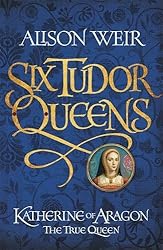
Six Tudor Queens: Katherine of Aragon, the True Queen by Alison Weir, a proof copy – expected publication 5 May 2016. This is the first novel of the Six Tudor Queens series.
Blurb:

A Spanish princess. Raised to be modest, obedient and devout. Destined to be an English Queen. Six weeks from home across treacherous seas, everything is different: the language, the food, the weather. And for her there is no comfort in any of it. At sixteen years-old, Catalina is alone among strangers. She misses her mother. She mourns her lost brother. She cannot trust even those assigned to her protection.

Acclaimed, bestselling historian Alison Weir has based her enthralling account of Henry VIII’s first wife on extensive research and new theories. She reveals a strong, spirited woman determined to fight for her rights and the rightful place of her daughter. A woman who believed that to be the wife of a King was her destiny.

History tells us how she died. This captivating novel shows us how she lived.

I’m also reading SPQR: a History of Ancient Rome by Mary Beard, the Kindle edition.

Blurb:

Ancient Rome matters. Its history of empire, conquest, cruelty and excess is something against which we still judge ourselves. Its myths and stories – from Romulus and Remus to the Rape of Lucretia – still strike a chord with us. And its debates about citizenship, security and the rights of the individual still influence our own debates on civil liberty today. 

SPQR is a new look at Roman history from one of the world’s foremost classicists. It explores not only how Rome grew from an insignificant village in central Italy to a power that controlled territory from Spain to Syria, but also how the Romans thought about themselves and their achievements, and why they are still important to us.

Covering 1,000 years of history, and casting fresh light on the basics of Roman culture from slavery to running water, as well as exploring democracy, migration, religious controversy, social mobility and exploitation in the larger context of the empire, this is a definitive history of ancient Rome.

SPQR is the Romans’ own abbreviation for their state: Senatus Populusque Romanus, ‘the Senate and People of Rome’.

I’ve recently finished Too Soon a Death by Janet O’Kane, crime fiction set in the Scottish Borders.
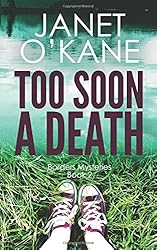
You can read my thoughts on this book in my previous post.

And next I’ll be reading Slade House by David Mitchell, or at least I think I’ll be reading this next. When the time comes I could fancy something completely different.
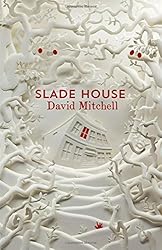
Blurb:

Born out of the short story David Mitchell published on Twitter in 2014 and inhabiting the same universe as his latest bestselling novel The Bone Clocks, this is the perfect book to curl up with on a dark and stormy night.

Turn down Slade Alley – narrow, dank and easy to miss, even when you’re looking for it. Find the small black iron door set into the right-hand wall. No handle, no keyhole, but at your touch it swings open. Enter the sunlit garden of an old house that doesn’t quite make sense; too grand for the shabby neighbourhood, too large for the space it occupies.

A stranger greets you by name and invites you inside. At first, you won’t want to leave. Later, you’ll find that you can’t.

This unnerving, taut and intricately woven tale by one of our most original and bewitching writers begins in 1979 and reaches its turbulent conclusion around Hallowe’en, 2015. Because every nine years, on the last Saturday of October, a ‘guest’ is summoned to Slade House. But why has that person been chosen, by whom and for what purpose? The answers lie waiting in the long attic, at the top of the stairs…

What have you been reading this week and what have got in mind to read next?

Too Soon a Death by Janet O’Kane

Janet O’Kane’s second book Too Soon a Death follows on from No Stranger to Death, set in a fictional village in the Scottish Borders and continues the story of Doctor Zoe Moreland, a widow and one of the doctors at the local health centre. A boy’s body is discovered on the banks of the River Tweed, near the Chain Bridge, linking Scotland and England and Zoe is asked to help identify the body because he had a note in his clothing giving the health centre’s address and phone number – but he was not one of their patients.

Zoe is not without her own problems. I think this book reads well as a stand alone book, but it certainly helps to have read the previous book, which explains her current condition. At the beginning of Too Soon a Death she is still recovering from a vicious attack (details in No Stranger to Death) and is heavily pregnant.

As the events unfold, she receives anonymous phone calls and is followed by someone in a blue car, who at one point almost runs her down. Added to that her best friend Kate Mackenzie, a deaf genealogist, is having problems both with her ex-husband and a client, with disastrous results. Can Zoe trust a new acquaintance, the vet Patrick Dunin – she wonders who it is that keeps phoning him claiming his attention? A large, vicious looking dog attacks Zoe’s own dog and is savaging sheep. Where has he come from? And that is not all – Zoe has secrets in her own past that are finally revealed in this book.

In some respects Too Soon a Murder has a Midsomer Murders atmosphere, and a general ‘cosy’ feel, but it is not without violence. Its main focus, however, is on Zoe, how she is coping with her pregnancy, her plans for Keeper’s Cottage, which she has bought from Kate’s brother and her hopes to become a partner in the health centre. The crimes are investigated by DCI Erskine Mathers and Sergeant Trent, with Zoe’s assistance, although there are things she can’t tell the police because of patient confidentiality. It has a great sense of location (this may be helped because I know the area a little bit, living a few miles away on the English side of the Border), and the characters are well grounded and believable people, even the minor characters such as Margaret Howie, the practice receptionist, comes across as a character in her own right.

My thanks to Janet O’Kane for providing me with a copy to read and review. I’m looking forward to reading her third book, which she is currently writing.

Reading challenges: My first book for the Read Scotland Challenge –  a book set in Scotland.

First Chapter, First Paragraph: Runaway

First chapterEvery Tuesday Diane at Bibliophile by the Sea hosts First Chapter First Paragraph Tuesday Intros, where you can share the first paragraph, or a few, of a book you are reading or thinking about reading soon.

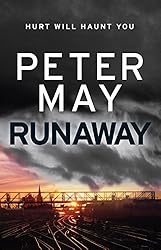
Runaway by Peter May is one of the books I’m thinking of reading this month. I’ve read some of his other books, the Lewis Trilogy and Entry Island and thoroughly enjoyed them, real page-turners. So I’m hoping that Runaway will be just as good.

It begins with a Prologue:

London

He wakes in a cold sweat from a dream pervaded by darkness and blood. And after a lifetime of being someone else in another land, he wonders who he is now. This man, who, he knows, is fading all too soon. A life squandered for a love lost. A life that seems to have passed in the blink of an eye.

and moves on to Chapter One in 2015:

Glasgow

Jack stepped down from the bus almost at the end of Battlefield Road and raised his head towards the darkening sky with a sense of foreboding. He took in the brooding silhouette of the smoke-stained Victoria Infirmary that climbed the hill above the field of battle where Mary, Queen of Scots, was once defeated by James VI, and felt as if someone had just walked over his grave.

Now, reading this, I am keen to read on. Flicking through the book I can see that it alternates between 1965 and 2015.

The back cover reveals that in 1965, five teenage friends fled Glasgow for London to pursue their dream of musical stardom. Yet before year’s end three returned, and returned damaged. In 2015, a brutal murder forces those three men, now in their sixties, to journey back to London and finally confront the dark truth they have run from for five decades.

 What do you think?

Would you keep reading?

First Chapter, First Paragraph: Dictator

First chapterEvery Tuesday Diane at Bibliophile by the Sea hosts First Chapter First Paragraph Tuesday Intros, where you can share the first paragraph, or a few, of a book you are reading or thinking about reading soon. I’m currently reading Dictator by Robert Harris, the third in his Cicero trilogy.

Dictator

It begins:

I remember the cries of Caesar’s war-horns chasing us over the darkened fields of Latium – their yearning, keening howls, like animals on heat – and how when they stopped there was only the slither of our shoes on the icy road and the urgent panting of our breath.

It was not enough for the immortal gods that Cicero should be spat at and reviled by his fellow citizens; not enough that in the middle of the night he be driven from the hearths and altars of his family and ancestors; not enough even that as we fled from Rome on foot he should look back and see his house in flames. To all these torments they deemed it necessary to add one further refinement: that he should be forced to hear his enemy’s army striking camp on the Field of Mars.

Blurb:

‘˜Laws are silent in times of war.’
Cicero

There was a time when Cicero held Caesar’s life in the palm of his hand. But now Caesar is the dominant figure and Cicero’s life is in ruins. Exiled, separated from his wife and children, his possessions confiscated, his life constantly in danger, Cicero is tormented by the knowledge that he has sacrificed power for the sake of his principles.

His comeback requires wit, skill and courage ‘“ and for a brief and glorious period, the legendary orator is once more the supreme senator in Rome. But politics is never static and no statesman, however cunning, can safeguard against the ambition and corruption of others.

Riveting and tumultuous, DICTATOR encompasses some of the most epic events in human history yet is also an intimate portrait of a brilliant, flawed, frequently fearful yet ultimately brave man ‘“ a hero for his time and for ours. This is an unforgettable tour de force from a master storyteller.

————————————————

I read in The Guardian that this last part of the trilogy marks the culmination of 12 years work. The trilogy as a whole has transported me back into the first century BC when Rome was engulfed in intrigue, conspiracies and civil war as the Roman Republic began to collapse and move into dictatorship and empire.  I’m loving the whole experience. Just as when I was reading the first two books, Imperium and Lustrum, I can’t wait to get back to it each time I have to stop reading.

Stacking the Shelves: 23 January 2016

STSmall

Stacking The Shelves is all about sharing the books you are adding to your shelves. This means you can include ‘˜real’ and ‘˜virtual’ books (ie physical and ebooks) you’ve bought, books you’ve borrowed from friends or the library, review books, and gifts.

Last night I finished reading Lustrum by Robert Harris, the second in his Cicero Trilogy (the first is Imperium). It ends as Cicero goes into exile and so this morning I had to buy the third book, Dictator, which covers the last fifteen years of his life.

Dictator

There was a time when Cicero held Caesar’s life in the palm of his hand. But now Caesar is the dominant figure and Cicero’s life is in ruins. Exiled, separated from his wife and children…

I’ve also borrowed these books from the library. My summaries are adapted from the blurbs.

Library bks Jan 2016

From top to bottom they are

  • Blue Genes by Val McDermid – I was put off reading her books several years ago when I just couldn’t stomach watching the violence and torture scenes in the TV series of The Wire. This sounds a bit different as it is a Kate Brannigan mystery, set in Manchester. The back cover reveals that Kate is having a bad week – her boyfriend has died, her plan to capture a team of fraudsters is in disarray and a neo-punk band wants her to find out who’s trashing their flyposters. It delves into the world of medical experimentation – I’m hoping it won’t be too gory!
  • Hunting Season by Andrea Camilleri – I’ve read a few of his Inspector Montalbano mysteries, but this is historical crime fiction set in Vigàta in Sicily in 1880, when a young man arrives in town and opens a pharmacy – then death arrives an the town and its most noble family will never be the same again …
  • Grace and Mary by Melvyn Bragg – he is one of my favourite authors. This novel is about memory and the slow fading of the mind as John visits his mother in a nursing home and finds that most of all she is longing for her mother, Grace, the mother she barely knew. Reaching from the late 19th century to the present, this becomes a deeply moving, reflective elegy on three generations linked by a chain of love, loss, and courage.
  • No Man’s Nightingale by Ruth Rendell, another favourite author. This is the 24th Inspector Wexford novel. The woman vicar of St Peter’s Church may not be popular among the community of Kingsmarkham. But it still comes as a profound shock when she is found strangled in her vicarage. Inspector Wexford is retired, but he retains a relish for solving mysteries especially when they are as close to home as this one is.

Sparkling Cyanide by Agatha Christie

Sparkling cyanideAC

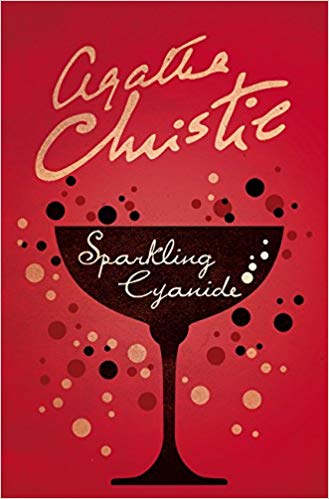
Sparkling Cyanide (published as Remembered Death in America) was first published in 1945. It is a novel in which a crime is investigated a year after it was committed.

Rosemary, the wife of wealthy George Barton dies suddenly at her birthday party at a West End Restaurant, the Luxembourg, after drinking a glass of champagne laced with cyanide. Rosemary had been in a depressed and unhappy state of mind after having a bout of influenza.The official verdict was that she had committed suicide but a year on George, having received anonymous letters stating her death wasn’t suicide, is convinced that she was murdered. He arranges another party, this time for Iris, Rosemary’s younger sister, inviting the same guests, hoping to identify the murderer. But his plan goes awry, as after drinking a toast to Rosemary’s remembrance the party ends with yet another death.

Rosemary was a wealthy heiress in her own right and after her death her inheritance had passed to Iris. George had invited Colonel Race* to both parties, but he had been absent both times. He had known George since his boyhood but had only once met Rosemary, who he thought of as ‘a singularly lovely nit-wit – but certainly not a melancholic type‘. He helps Chief Inspector Kemp of Scotland Yard to investigate both deaths. As well as Iris and George the guests at the party were Ruth Lessing, George’s efficient secretary, and Rosemary’s friends, Anthony Browne, a man with a dubious past and a politician Stephen Farraday and his wife Sandra.

In a series of flashbacks Agatha Christie highlights each person and their relationships with Rosemary and it appears that each one, including George and Iris had a motive for killing her. I was convinced quite early on that one particular character had to be the murderer, but reading further on I began to have doubts, switching from one person to another. As it turned out I was right about my first suspect – Agatha Christie was expert at writing things that could be taken two ways. If I was right about the ‘who’ I couldn’t work out the ‘how’, particularly for the second death, but knew that where everyone sat at the round table was significant. When that was revealed I thought it was difficult to believe, which is why I don’t place it among her best books – but it’s still a very enjoyable read. And it was popular with the public achieving sales of thirty thousand in the first year of publication.

*Colonel Race – first appeared in The Man in the Brown Suit, also in Cards on the Table and Death on the Nile. His appearance in Sparkling Cyanide was his last. He was an agent working for the British Secret Service, often sent on difficult or sensitive missions. In this book he is over sixty, described as ‘a tall, erect, military figure with sunburnt face, closely cropped iron-grey hair, and shrewd dark eyes‘.

Reading Challenges: Mount TBR Reading Challenge and Vintage Mystery Cover Scavenger Hunt for the Golden Age in the category of ‘Bottle/Glass for drinking’.