 This week in the Crime Fiction Alphabet meme hosted by Kerrie at Mysteries in Paradise we’re up to the letter Q. My contribution is:
Quintin Jardine. I found his books in my local library – the one in Scotland, which is most appropriate as Quintin Jardine is Scottish. He was born in Motherwell, Lanarkshire and has homes in both Gullane, East Lothian and Trattoria La Clota, L’Escala, Spain. He has been a journalist, government information officer, political spin-doctor and media relations consultant before becoming a crime fiction writer with two series of detective novels – the Bob Skinner novels set in Edinburgh where Skinner is a Deputy Chief Constable and the Oz Blackstone mysteries, in which Oz is a movie actor trying to forget that he was ever a “private inquiry agent”.
For more biographical details and list of books see his website.
Fallen Gods is the 13th in the Bob Skinner books. It’s set in both Scotland and America. 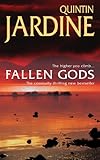 The beginning of this book is quite confusing, which is down to me and not the author as I’ve jumped into the Bob Skinner books mid-stream as it were. It’s confusing because at the beginning of the book it appears that Bob is dead, ‘dropping in his tracks’ at his wife’s parents’ funeral. Sarah, his wife, says
His heart stopped, just like that. Makes you think, doesn’t it. There is no Superman; there is no Planet Krypton. Not even the great Deputy Chief Constable Bob Skinner was invulnerable. (page 6)
I had to double check. I’d read the blurb before I started to read Fallen Gods and that stated that Bob’s career is ‘hanging by a thread’; that his brother’s body has been found in the detritus of a flood – a brother whose existence he has kept a secret for many years; and that a valuable painting was burnt in the Royal Scottish Academy in Edinburgh. Whilst he and his team are investigating these events, his wife, Sarah is left in America with their children, recovering from the death of her parents. She finds comfort in the arms of an old college lover and then is faced with ‘a seemingly inevitable murder conviction’.
So how could Bob Skinner be dead? All was revealed as I read on and what a tangled web Quintin Jardine has woven (as Sir Walter Scott would say).
So, I have found another detective series to read. This is a complex book, with believable characters and it switches seemlessly between the crimes in Scotland and America with ease. I was never unsure where I was or who I was with and there are a lot of characters to get your head round. It kept me guessing throughout as to the culprits and is really more about the characters and their personal lives than about the crimes.
I enjoyed this book and will be reading more of Bob Skinner in the future – there are 19 in total so far.

 n and Paris. The mystery begins with Oscar Wilde finding the naked body of Billy Wood, a 16 year old boy in the candle-lit room in a small terraced house in Westminster, close to the Houses of Parliament. Billy’s throat has been cut and he is laid out as though on a funeral bier, surrounded by candles, with the smell of incense still in the air. It’s a combination of fiction and fact, with both real and imaginary characters. Wilde with the help of his friends Arthur Conan Doyle and Robert Sherard sets out to solve the crime. Sherard (the great grandson of William Wordsworth) who wrote poems, novels, biographies (including five of Oscar Wilde) and social studies is the narrator.
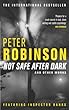 Peter Robinson’s introduction is interesting for me in that he explains how he writes and compares writing a novel to writing short stories. He’s used to thinking in terms of the novel, with it’s ‘broad canvas’ and finds it hard to ‘work in miniature’. Short stories don’t come easily to him.
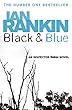 It’s a real page-turner and very complicated. I’m reading it quickly because I want to know what happens next and to see how Rebus gets himself of the terrible mess he is in – suspected by his superiors of being a killer(!) and of corruption back in his early days as a detective, along with Lawson Geddes, his boss at the time. He’s being investigated by a TV company and also by the police themselves in an internal enquiry and all the time he’s spiralling downhill under alcohol and cigarettes. I’m thinking that when I get to the end I may go back to the beginning and read it again more slowly to appreciate the detail.
 This contrasts so well with the other book I’m reading –


 And there is a fair amount of violence in this dark book, starting with the discovery of a brutally tortured body in Mary King’s Close, an ancient Edinburgh street now buried beneath the High Street. It’s August in Edinburgh during the Festival.
 BooksPlease