They Came to Baghdad by Agatha Christie: a Book Review

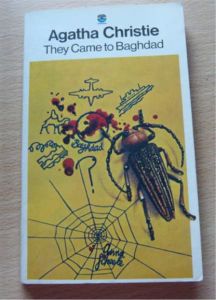
They came to Baghdad

I made copious notes as I read Agatha Christie’s They Came to Baghdad because it’s such a complex plot and there seemed to be so many significant events and people that I wanted to clarify what was happening. This is not one of Agatha Christie’s detective novels – no Miss Marple or Hercule Poirot,-  just Victoria Jones, a short-hand typist, a courageous girl with a ‘natural leaning towards adventure’ and a tendency to tell lies. Set in 1950 this is a story about international espionage and conspiracy. The heads of the ‘great powers‘ are secretly meeting in Baghdad, where if it all goes wrong ‘the balloon will go up with a vengeance.’ And an underground criminal organisation is out to make sure it does go wrong, aiming at ‘total war – total destruction. And then – the new Heaven and the new Earth.’

Victoria gets involved after one meeting with a young man, Edward, who is going out to Baghdad the following day to join an archaeological dig. She thinks he’s an incredibly good-looking man and considering herself an excellent judge of character is immediately attracted to him. As she has just been fired from her job, impulsively she decides to follow him to Baghdad, claiming to be the niece of Dr Pauncefoot Jones, Richard’s boss .

At the same time a British secret agent, Carmichael, is trying to get to Baghdad with important information, and is his life is in great danger. Will he get there? Anna Scheele, a mysterious character is also on her way to Baghdad and there are hints that she is at the centre of things. Just who is she and what side is she on?

Alongside the mystery, Agatha Christie’s descriptions of the locations, local people and of the archaeological dig are superb, no doubt taken from her experience of her own visits to Baghdad and Iraq. I enjoyed it for its entertaining plot, the authenticity of the background and its great characters, in particular I grew very fond of the amazing Victoria Jones.

  • First published in 1951 by William Collins & Co Ltd
  • My copy a secondhand paperback Fontana Books, 1980
  • My Rating: 4/5

R.I.P. VI Challenge Completed

Carl’s R.I.P. VI  challenge ended on 31 October and I’m pleased that I completed Peril the First, which was :

Read four books, any length, that you feel fit (my very broad definitions) of R.I.P. literature. It could be Stephen King or Sir Arthur Conan Doyle, Ian Fleming or Edgar Allan Poe’¦or anyone in between.

I read the following books (linked to my reviews):

These are all books that were on my to-be-read list. I think Blood Harvest has to be my favourite of the four and I thoroughly enjoyed it – a dark, scary book, disturbing, and completely gripping.  I was particularly pleased that I finally read The Turn of the Screw as I first started to read it some years ago. It’s an ideal book for the RIP Challenge. Thanks go to Carl for hosting.

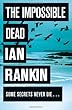
The Impossible Dead by Ian Rankin: a Book Review

The Impossible Dead, Ian Rankin’s second book featuring Inspector Malcolm Fox is very readable, with a nicely complicated plot, and good characterisation. Fox is still in the Complaints, now officially called Professional Ethics and Standards, but it soon becomes apparent that really he wants to be in CID. I’m not sure what to make of Fox. He’s:

… diligent and scrupulous, never a shirker. He had put in the hours, been commended for his error-free paperwork and ability to lead a team: no egos and no heroes. He hadn’t been unhappy. He had learned much and kept out of trouble. If a problem  arose, he either dealt with it or ensured it was moved elsewhere. (page 105)

And yet, he’s another loner, working best on his own, not letting on to his boss what he is working on, disregarding procedure and getting involved in cases outside his remit. He doesn’t drink because he’s an alcoholic, his marriage failed and his relationship with his sister leaves a lot to be desired (although it does improve in this book). Fox’s family life intrudes into his work and gives insight into his background and his relationship with his father and sister. He’s a complex character and I began to think that maybe he’s turning into Rebus.

Detective Constable Paul Carter has been found guilty of misconduct and Fox and his team are called to investigate whether his colleagues have covered up for him. When Paul’s uncle, Alan, a retired policeman, is found dead Fox is convinced it was murder and not suicide and begins his own independent investigations, despite being told it’s a CID case. He oversteps his remit too by investigating a cold case. When his investigations reveal links back to 1985, a time of turmoil when Scottish militants were intent on a split between Scotland and the rest of the UK, he discovers new evidence concerning the unsolved murder of one of the activists at that time.

In the second half of the book the pace and tension increase as Fox delves deeper and puts his own life in danger. I found it quite easy to see who the culprits were because their identity was signalled, but nevertheless it was a satisfying conclusion to the book.

  • Hardcover: 384 pages
  • Publisher: Orion (13 Oct 2011)
  • Language English
  • ISBN-10: 0752889532
  • ISBN-13: 978-0752889535
  • Source: I bought it
  • My Rating 3.5/5

Library Loot/Teaser Tuesday

It’s been a while since I wrote a Library Loot post and as I went to the library today I thought I’d combine it with a Teaser Tuesday post.

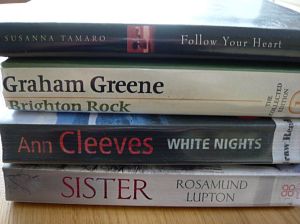
I’ve dipped into each book. From top to bottom they are:

Follow Your Heart by Susanna Tamaro, translated from the Italian by Avril Bardoni. I fancied reading something different from my usual type of book – this book won the Premio Donna Citta di Roma in 1994. From the book jacket – ‘it reflects on feelings and passions and how failure to communicate leads to futility, misunderstanding and tragedy – a meditation on existence.’ An old woman writes to her granddaughter:

As I have wandered aimlessly through the empty house these last few months, the misunderstandings and bad temper that marred our years together have vanished. The memories surrounding me now are of you as a child – a vulnerable, bewildered little creature. (page 3)

Brighton Rock by Graham Greene. A book I’ve known of for so many years and never read. I had no idea that it is a detective story! I love the way it begins:

Hale knew, before he had been in Brighton three hours, that they meant to murder him. With his inky fingers and his bitten nails, his manner cynical and nervous, anybody could tell he didn’t belong – belong to the early summer sun, the cool Whitsun wind of the sea, the holiday crowd. (page 1)

I can just see the scene!

White Nights by Anne Cleeves. I’ve been looking out for this book, the second in her Shetland Quartet, ever since I enjoyed reading the first one – Raven Black. Shetland detective Jimmy Perez investigates what seems at first to be a straightforward suicide. This is my teaser:

‘I don’t know my name’, he said flatly. No drama now. ‘I can’t remember it. I don’t know my name and I don’t remember why I’m here.’ (page 16)

Sister by Rosamund Lupton. More crime fiction, a psychological thriller. I’d read about this book on a blog (sorry, can’t remember which one – it may have been more than one blog) and thought it sounded good. Beatrice’s younger sister Tess is missing. She refuses to give up looking for her and  is determined to discover the truth about Tess and what has happened to her.

For a moment, amongst the crowd, I saw you. I’ve since found out it’s common for people separated from someone they love to keep seeing that loved one among strangers; something to do with recognition units in our brain being too heated and too easily triggered. This cruel trick of the mind lasted only a few moments, but was long enough to feel with physical force how much I needed you. (page 26)

I have high hopes of all four books.

Crime Fiction on a Euro Pass: Turkey

The last stop on Kerrie’s Crime Fiction on a Euro Pass is Turkey. The challenge has been to write posts linked to the country of the week. This time I’ve focused on the British author:

Barbara Nadel

Born in the East End of London, Barbara Nadel trained as an actress before becoming a writer. Now writing full-time, she has previously worked as a public relations officer for the National Schizophrenia Fellowship’s Good Companion Service and as a mental health advocate for the mentally disordered in a psychiatric hospital. She has also worked with sexually abused teenagers and taught psychology in schools and colleges, and is currently the patron of a charity that cares for those in emotional and mental distress.

She has been a regular visitor to Turkey for more than twenty years.http://en.wikipedia.org/wiki/Barbara_Nadel

Her Turkish crime novels feature Inspector Cetin Ikmen. The list below is from Fantastic Fiction

1. Belshazzar’s Daughter (1999)
2. A Chemical Prison (2000)
aka The Ottoman Cage
3. Arabesk (2001)
4. Deep Waters (2002)
5. Harem (2003)
6. Petrified (2004)
7. Deadly Web (2005)
8. Dance With Death (2006)
9. A Passion for Killing (2007)
10. Pretty Dead Things (2008)
11. River of the Dead (2009)
12. Death by Design (2010)
13. A Noble Killing (2011)
14. Dead of Night (2012)

Barbara Nadel  writes for the International Crime Authors Reality Check, where you can also read an interview with her. 

The Impossible Dead by Ian Rankin: an Introduction

I’d forgotten I’d pre-ordered Ian Rankin’s latest book The Impossible Dead, so it was a nice surprise yesterday when it was delivered. I don’t often buy a hardback book so that’s an additional pleasure, even if at nearly 400 pages it is quite heavy.

It is, of course, the follow-up book to The Complaints, starring D I Malcolm Fox and his team investigating other cops. I thoroughly enjoyed The Complaints and am hoping this will be as good if not even better.

From the back cover:

Asked to take on a simple case of police abuse, Malcolm Fox suddenly finds himself digging up a macabre death from the eighties. Little does he know that the answers he finds in that dark period of Scottish history will lead him to the highest echelons of power …

Now officially called Professional  Ethics and Standards (you only need to add Team to the title to get the acronym PESTS!) they still call themselves The Complaints at least among themselves and other cops are never happy to see them or cooperate either.

I’m off to start reading!