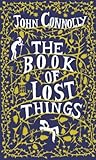
The Book of Lost Things by John Connolly

I like fantasy, so when I came across The Book of Lost Things, a modern version of traditional fairy tales that has glowing reviews from various sources, I was keen to read it. Fairy tales are full of bad things happening to people, wicked stepmothers, evil witches, wolves and trolls, fantasy characters, damsels in distress and magic and enchantments, but in the end good overcomes evil and they live happily ever after.

The Book of Lost Things begins at the start of World War Two, with David, a boy of twelve, who is mourning the death of his mother, resenting his father’s new wife, Rose and his new baby brother, George. Alone in his bedroom he hears the books on the shelves murmuring and whispering in the darkness, and his fantasy world becomes peopled with the characters from his books and he dreams of the Crooked Man, waiting for him out in the woods beyond the house.

One night his dreams and nightmares become reality as he sees through a fissure in his room into another realm beyond. He falls unconscious and coming to he hears his mother calling out him to save her, saying she is not dead but trapped in a strange place. He climbs out of his window and then as a bomber crashes in the garden David escapes through the sunken garden into a different world, a world peopled by the characters from the stories he has been reading. Told that the king has a ‘Book of Lost Things’ that will help him find the way back to his own world, he is met with the most terrible and gruesome opposition.

As well as stomach churning and excruciatingly toe-curling grisly detail there are some very dark episodes in this book with an element of moralising within the story from a number of ‘father figures’ David meets, for example the Woodsman and the knight Roland who tells him that life is filled with threats and dangers.

It is indeed filled with danger but the book becomes a sequence of ‘this happened and then that happened’, of showing rather than telling. The writing is flat; there is no sense of suspense, David is attacked and goes on to fight battle after battle as the characters helping him are killed off. There are his battles against the Loups, wolves who dress like men. He has to answer a riddle to choose the right bridge to cross a chasm thronged with harpies. He meets seven dwarves  dominated by an obese Snow White, her face caked with white make-up (this story is quite funny actually with its references to communism). He comes across a peasant village terrorised by a monstrous loathsome worm which gives birth in mid-battle. He eventually finds the castle of thorns where his mother may be imprisoned, and then finally the great castle of the ancient and now dying king, the guardian of the ‘book of lost things’. And behind it all is the sinister and evil Crooked Man.

I quite liked the concept of this book, it promised much, but I didn’t like its gruesomeness, the torture chambers, the animal and human experimentations, the sexual innuendos, nor did I like the ending, which I thought was weak. These details didn’t leave me with a chill down my spine, but just feeling rather sick.

Still, it seems an appropriate book to include in the Once Upon a Time Challenge, which ended yesterday and certainly for the Mount To Be Read Challenge as it has sat unread on my shelves for 7 years. Maybe fairy stories are no longer magical for me, this one wasn’t.

I can almost hear the rest of my books muttering, well thank goodness that one’s on its way out of the house.
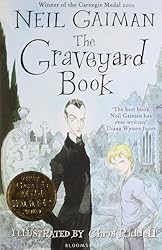
The Graveyard Book by Neil Gaiman

Neil Gaiman is one of those authors I keep reading about on other book blogs and I’ve been meaning to check out one of his books for ages just to see for myself. I didn’t think his books were probably the sort I’d like as I rarely read children’s or Young Adult books. Then recently I saw The Graveyard Book on display in my local library, my eye was caught by the cover, and I was curious enough to find out what makes Gaiman such a popular author, encouraged by the blurb from Diana Wynne Jones declaring: ‘The best book Neil Gaiman has ever written.’

When I began reading I wondered if is this book really is for children – it’s so scary:

There was a hand in the darkness, and it held a knife. The knife had a handle of polished black bone, and a blade finer and sharper than any razor. If it sliced you, you might not even know you had been cut, not immediately.

The knife had done almost everything it was brought to that house to do, and both the blade and the handle were wet. (page 3)

The Graveyard Book won the Newbery Medal and the Booktrust Teenage Book Prize 2009, and was nominated for both the 2010 Carnegie Award and the Kate Greenaway Award.

Intrigued I read on and I was soon hooked into the story of the baby who escapes a murderer (the man Jack) intent on killing his entire family, and who stumbles into the local disused graveyard where he is rescued by ghosts. Think of The Jungle Book but with ghosts looking after the baby rather than animals – and Neil Gaiman acknowledges his debt to Rudyard Kipling’s book. And like The Jungle Book, The Graveyard Book is episodic. The baby, named by the ghosts, Nobody Owens, or Bod for short, grows up looked after by his adoptive parents Master and Mistress Owens who had been dead for a few hundred years and numerous other occupants of the graveyard.

I was fascinated by this fantasy, coming of age novel. Bod is given the Freedom of the Graveyard and educated by the ghosts, learning all sorts of strange and wonderful things, such as the ability to fade from sight. Silas, who is neither dead nor alive appoints himself as his guardian, helped by Miss Lupescu, who is not what she first appears to be. He is only safe if he doesn’t leave the graveyard and of course as he grows up that is what he really longs to do.

It’s creepy, but never gory. There are ghouls as well as ghosts, ancient ghosts predating Christianity, a particularly scary pre-historic tomb guarded by the slithering Sleer awaiting the return of the ‘Master’ and a young witch, Liza buried in the unconsecrated section of the graveyard. Needless to say, Bod has many adventures before his past catches up with him.

Apart from the fantastic characters, all of which I could easily believe to be ‘real’, the graveyard itself is so well described that I had no difficulty imagining what it looked like, so I wasn’t surprised to see in the Acknowledgements that Audrey Niffennegger had shown Gaiman around Highgate Cemetery West.  I like all the details of the epigraphs on the headstones – in particular Mother Slaughter’s headstone. It is so ‘cracked, worn and weathered that all it now said was: LAUGH – which had puzzled the local historians for over a hundred years.

The Graveyard Book is ultimately about life and death, love and friendship, loyalty and the fight between good and evil. There is humour, sadness and suspense. Above all it is about growing up and the excitement and expectations that Bod has about life:

Bod said, ‘I want to see life. I want to hold it in my hands. I want to leave a footprint on the sand of a desert island. I want to play football with people. I want’, he said, and then he paused and he thought. ‘I want everything.’ (page 286)

It is an ideal book for Carl’s Once Upon A Time VIII challenge (my 4th book). I’ll certainly read more of Neil Gaiman’s books.

Books read in April

April was a good reading month – I finished reading 9 books, bringing my total for the year so far to 35:

  1. The Last Enchantment (Arthurian Saga 3) by Mary Stewart
  2. The Potter’s Hand by A N Wilson
  3. The Bell Jar by Sylvia Plath (a re-read for book group)
  4. St Bartholomew’s Man by Mary Delorme
  5. The Nine Tailors by Dorothy L Sayers (to be reviewed)
  6. The Cabinetmaker by Alan Jones
  7. Black Dogs by Ian McEwan
  8. Tantalus by Jane Jazz
  9. Burial of Ghosts by Ann Cleeves (to be reviewed)

They were all good reads, although I wouldn’t have re-read The Bell Jar if it hadn’t been my book group’s choice. I can’t say that I enjoyed that one, it is so depressing, but it is well written. All bar the first one are either library books or books I’ve acquired this year – a reaction, I suppose to finishing three months of reading only books I’ve owned before 1 January 2014!

It’s been difficult this month deciding which book to choose as my Best Book of the Month as they’ve all been enjoyable in different ways.

With so many good books by both established and new authors to choose from, after much thought, my all-round Best Book of the Month for April is The Potter’s Hand by A N Wilson, a remarkable novel about the Wedgwood family, their lives, loves, work, illnesses, depressions, addictions and deaths. I found it fascinating throughout, whether it was set in America during the fight for independence, or in England in Wedgwood’s factories, or his grand new house Etruria Hall, or travelling through England on the new canals.

And I should also flag up Tantalus by Jane Jazz, a love story with a difference, set in the Yorkshire moors and Tuscany. There is so much in this book that I loved €“ the characters, the story, the charged emotions and longing, the setting and the art.

Reading Challenges progress up to 30 April (for details of these challenges see my Challenges page):

  • Mount TBR Reading Challenge €“ 24 of my own unread books. My target is 48.
  • Read Scotland Challenge €“ 6 books. My target 13+.
  • What’s in a Name 7 €“ I’ve completed 5 of the 6 sections – just  a ‘book with a school subject in the title’ to read.
  • Historical Fiction Challenge €“ 6 books. My target is 25 books.
  • Colour Coded Challenge €“ 3 books. The target is to read 9 books in the different colour categories.
  • The Agatha Christie Reading Challenge €“ 2 books. This is an open-ended challenge to read all her books. So far I have read 57.
  • My Kind of Mystery Challenge €“ 10 books. My target is 31+.
  • Once Upon a Time VIII challenge – 2 books, both read this month – The Last Enchantment and Tantalus, both excellent fantasy novels.

Tantalus by Jane Westwell

Tantalus: the sculptor's story by [Westwell, Jane]

I came across Jane Westwell’s novel, Tantalus, originally published under her pen name Jane Jazz, when she made a comment on one of my posts. It’s a love story set in the Yorkshire moors and marble mountains of Tuscany. The opening paragraph drew me in:

Journal of Thomas Hope: 30 June 1967

You were just 17, and I was now 70 years old. Your hair shone like burnished copper and you sparkled with youth, while I faded into the winter of my life.


Tantalus is a love story with a difference. The lovers are separated not by barriers of race, class or creed, but by something much more devastating  – by time. They can see and can talk to each other  but can never touch. Theirs is an impossible love as each is trapped in their own time and space.

It’s a moving story, written beautifully. Once I started reading I didn’t want to stop. It begins with Tom’s diary entry after he came out of his house as Sylvia was walking past. Sylvia then takes over the narrative, telling Emily their story:

I need to start at the beginning – the real beginning I mean, not this brief encounter on the footpath when your mum and I were just teenagers.

I need to ask you to undo the top few buttons of reality, and I need to fast forward eight years to that night of blind terror – the night I first saw the eyes in the wall.

How could I stop reading after that opening! And I had no trouble at all in undoing my buttons of reality.

Fast forward from 1967 to 1975 as Sylvia moves into an old house, the house she has known about and dreamed of living in since her childhood, Birchwood House. Sylvia had polio as a child and consequently has a withered leg. She is a painter, fascinated by a marble statue of a lady by the lake in the local park. She had thought of this lady as her secret friend ever since her mother pointed out that the statue had a damaged leg like hers – the statue is even called ‘Sylvia‘.

Birchwood House is a large Victorian semi-detached house, joined back to back with Oakwood House. Her life changes after she moved into Birchwood and sees through the wall of her studio into Oakwood and the eyes of the young sculptor, Tom who lived there 50 years earlier. I wondered if Tom was a ghost, or a figment of Sylvia’s imagination, the result of her loneliness? But I became increasingly sure that he was a reality as Sylvia centred her life and work on Tom and somehow they were able to communicate over a gap in time.

There is so much in this book that I loved – the characters, the story, the charged emotions and longing, the setting (in Yorkshire and Tuscany), and the art – the paintings and the sculpture. And one of the things that came as a complete surprise was the mention of Edmund Blair Leighton and his painting The Accolade. Tom describes it to Sylvia:

It portrays a maiden queen, with glorious autumn tresses, conferring the order of knighthood on a worthy squire. I was captivated by her loveliness, but never saw her like till now. You, my lady, are the living embodiment of his vision of beauty, and I the humble knight who kneels before you. (Loc 937)

I love this painting and have a tapestry of it hanging in the hall.

The Accolade P1090454

As I read on I began to hope that Tom and Sylvia would meet in real time, but this is not a slushy romance. It is such a poignant story, full of emotion and very moving, which I found completely absorbing. There is so much more I could write, but not without giving away too much of the plot.

This is Jane Jazz’s debut novel and I do hope that she will write another book.

I read Tantalus on my Kindle:

  • Format: Kindle Edition
  • File Size: 3632 KB
  • Print Length: 316 pages
  • Simultaneous Device Usage: Unlimited
  • Sold by: Amazon
  • Language: English
  • ASIN: B00I9E6ANU

Tantalus is a perfect title for the novel as according to Greek myth Tantalus was famous for eternal punishment by being made to stand in a pool of water beneath a fruit tree with low branches, with the fruit ever eluding his grasp, and the water always receding before he could take a drink.

For more information about Jane Jazz and her novel go to her website: Tantalus.

And after I’d finished reading Tantalus I realised that it a perfect fit for Carl’s Once Upon a Time Challenge.