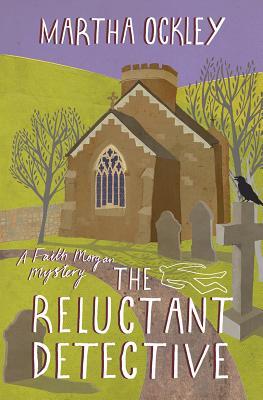
The Reluctant Detective by Martha Ockley

17742272I had little idea what to expect from Martha Ockley’s first Faith Morgan mysteryThe Reluctant Detective as I hadn’t come across the author before and all I had to go on was the description on LibraryThing’s Early Reviewers page last month:

‘Former cop Faith Morgan may have quit the world of crime, but crime has not let her go. Now a priest in the Church of England, she is assigned to the improbably named village of Little Worthy, and within an hour of her arrival she witnesses the sudden, shocking death of a fellow priest. To her distress, the detective assigned to the case is Ben, her former partner and former boyfriend.

As she meets her parishioners she learns some surprising details about her apparently well-loved predecessor, and starts to suspect a motive for his death. The cop may have donned a clerical collar, but the questions keep coming. How will she reconcile her present calling with her past instincts? Is she in danger herself? What should she do about Ben?’

I thought a detective who  was a priest and who used to be a policewoman sounded interesting. So, I am very pleased that The Reluctant Detective turned out to be a good read. Faith Morgan is a well-rounded character; she’s very likeable, observant, compassionate and the sort of person that people feel comfortable talking to – a bit like a young Miss Marple. Indeed, the book has an Agatha Christie feel to it – set in an apparently idyllic country village, with interesting and somewhat quirky characters and although there is one rather gruesome death, it’s not a gory thriller. In short it’s the type of murder mystery that I like, with plenty of complications that kept me guessing about the identity of the murderer for most of the book.

The church and village location are convincing. The parish church of St John is an old building dating from Saxon times, with a tower and church bells, set in the English countryside:

Faith avoided the main approach and followed a gravel path around the back of the church. A creamy cloud of ivory clematis cascaded over a grey stone wall. Beyond a solitary pony raised its chestnut head to gaze mournfully at her from a field of weeds. Some way off squatted a group of ramshackle farm buildings. (page 9)

Faith’s ex – Detective Inspector Ben Shorter, reluctantly allows Faith to contribute to the search for the murderer and the chemistry between the two of them is clearly evident even though he can’t understand why she left the police force for the church. Indeed, Faith herself wonders if she has done the right thing, cutting herself off from her old life and her old self as she realises that she likes investigating, and analyzing people, their expressions and body language and working out what makes them tick. But these are assets for a priest as well as for a police officer. And as for death:

It struck Faith how death is always startling, facing us with the greatest mystery: how the particular and the individual can vanish from this world so completely in a moment. (page 17)

The back cover reveals that Martha Ockley lives in the North East of England and has close links with the church, having grown up as the daughter of a minister. She is a full-time writer of both fiction and non-fiction. I was curious about Martha Ockley and wondered why she had given ‘special thanks to Rebecca Jenkins’ on the title page, so I searched online and discovered that ‘Martha Ockley’ is actually a pseudonym of Rebecca Jenkins, the daughter of the Rev David Jenkins, formerly the Bishop of Durham.

Thanks to LibraryThing and Lion Fiction/Kregel Publications for providing a copy for review. Based on my reading of The Reluctant Detective I shall certainly seek out more books by Martha Ockley/Rebecca Jenkins. There are two more Faith Morgan books:

  • The Advent of Murder
  • A Saintly Killing (to be published in October 2014)

And writing as Rebecca Jenkins:

The R F Jarrett books (the Regency Detective)

  • The Duke’s Agent (1997)
  • Death of a Radical (2010)

also Non Fiction:

  • Free to Believe (David Jenkins and Rebecca Jenkins (1991)
  • Fanny Kemble: a reluctant celebrity (2005)
  • The First London Olympics 1908 (2008)
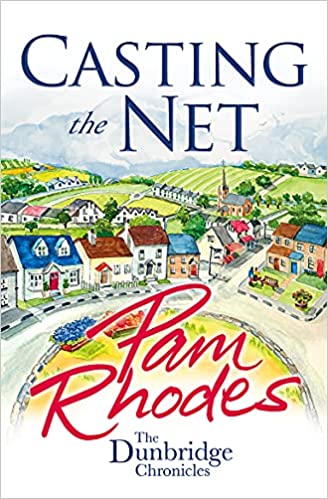
Casting the Net by Pam Rhodes

Blurb:

Heart-warming English comedy of manners, featuring the trials and tribulations of newly ordained minister, Neil FisherIn part two of the Dunbridge Chronicles, Neil Fisher returns from ordination inspired by his sense of ministry, but determined to distance himself from the two ladies in his life. This is not altogether well received, and a wide segment of the congregation of St Stephen’s, Dunbridge–including the music group–points Neil to the error of his ways.

Meanwhile Neil’s close friend Colin and his wife Jeannie are delighted by the birth of a daughter, but is all well with the baby? Neil’s mother Iris continues to meddle, to his irritation. Churchwarden Peter has said a relieved farewell to his flighty wife Glenda–or has he? Dunbridge is not as peaceful as it seems. 

My thoughts:

I liked this light easy-to-read book that deals with serious issues from the Christian perspective. Life in Dunbridge is far from peaceful and the Neil, the curate has many crises to face, not the least being his vicar’s loss of faith. It’s full of interesting characters, painting a picture of life in a small town.

  • Publisher ‏ : ‎ Lion Fiction; 1st New edition (21 Feb. 2014)
  • Language ‏ : ‎ English
  • Paperback ‏ : ‎ 256 pages
  • ISBN-10 ‏ : ‎ 1782640622
  • ISBN-13 ‏ : ‎ 978-1782640622
  • My Rating: 3*

Gillespie and I by Jane Harris: a Book Review

Gillespie and I by Jane Harris is a cleverly told story, narrated by Harriet Baxter, alternating between events in 1888-90 (in Glasgow) and those in 1933 (in London). In 1888 Harriet moved to Glasgow where she got to know the painter, Ned Gillespie and his family. At first I liked Harriet but as I read on I became increasingly doubtful about her character, even though she comes across as an honest, reliable person. But, as she relates what her life is like in 1933 my impression of her began to change.

All is well at first but than a tragedy occurs which forms the major part of the book. It’s signalled in advance, when Harriet refers to the ‘horrible events’ that lay in the future. To say any more would be too much of a spoiler.

The setting of the book in Glasgow of the late 19th century is well described, helped by plans in the front of the book. The characters are also convincing, even some of the minor ones and her portrayal of Ned’s disturbed daughter, Sybil is quite chilling. This is a very detailed book, both about the place, artists and, through the account of a trial, the Scottish legal system of that period. It’s a book that lingered in my mind after I finished reading and if it wasn’t so long I’d like to re-read it in the light of what I now know.

  • Hardcover: 528 pages
  • Publisher: Faber and Faber (5 May 2011)
  • Language English
  • ISBN-10: 0571275168
  • ISBN-13: 978-0571275168
  • Source:an uncorrected proof from the publishers (via LibraryThing Early Reviewers)
  • My rating 3.5/5

I haven’t read Jane Harris first book, The Observations, although I’ve owned it for a while. It’s probably time I read that one too.

More Books

Two books were in my postbox yesterday. I’m very lucky because after deciding not to buy any more books until I’ve read 6 of my unread books these two are gifts, so I don’t have to count them, and I’m very grateful for them too.

The first is Out of Africa by Karen Blixen, which I won from Gaskella’s blog. The back cover says that it is ‘the story of a remarkable and unconventional woman, and of a way of life that has vanished for ever.’ Karen arrived in Kenya in 1914 to manage a coffee plantation and spent the happiest years of her life on the farm. I love the cover of this book.

The other is Gillespie and I by Jane Harris, an uncorrected proof, which I won on LibraryThing’s Early Reviewers Programme. This is a big book. It sounded so good from the publishers’ information – I just hope it lives up to my expectations.

As she sits in her Bloomsbury home, with her two birds for company, elderly Harriet Baxter sets out to relate the story of her acquaintance, nearly four decades previously, with Ned Gillespie, a talented artist who never achieved the fame she maintains he deserved. Back in 1888, the young, art-loving, Harriet arrives in Glasgow at the time of the International Exhibition. After a chance encounter she befriends the Gillespie family and soon becomes a fixture in all of their lives. But when tragedy strikes – leading to a notorious criminal trial – the promise and certainties of this world all too rapidly disorientate into mystery and deception. Featuring a memorable cast of characters, infused with atmosphere and period detail, and shot through with wicked humour, Gillespie and I is a tour de force from one of the emerging names of British fiction.

I love the cover of this one too.

Now I just need a few more hours in the day – I want to start reading these straight away. Actually I couldn’t resist and I have read the opening pages! They’re both looking good, but I have The Weather in the Streets by Rosamond Lehmann to read first.

Whatever You Love by Louise Doughty: Book Review

Whatever You Love, set in a coastal English town is, as it says in the blurb, an ‘astonishing and emotionally-charged novel’, about Laura whose nine-year old daughter, Betty has been killed by a hit and run driver.  Laura tells her story alternating between events before Betty’s death – how she met and married David, Betty’s father, their subsequent divorce after his affair with Chloe – and after Betty’s death. Laura’s grief is palpable, which makes this a harrowing book to read. It is also startling and shocking in parts.

The ‘after’ chapters are written in the first person narrative, which I’m never completely happy about, but it works quite well in this book, and it does add some clarity to the sequence of events. I think I endured rather than enjoyed this book; ‘enjoy’ is not the right word to described reading it, but it is well written, and the characters, for the most part are well drawn. There is an emphasis on relationships, not only between Laura and David but also between Laura and Chloe, David’s new wife, between Laura and the Sally, whose daughter Willow was also killed in the accident, and between the local people and the immigrant community. As Laura, fraught with grief, tracks down the driver of the car she spirals more and more out of control. 

I found the ending of the book inconclusive and there are some questions left hanging.  It seemed to me a book of two halves – the first dwelling on Laura’s grief and her inability to cope, with the second concentrating on her instability. Just how reliable was Laura, a woman who was pushed to the edge of sanity? Overall, I was impressed by the writing and will look for more by Louise Doughty.

My copy was sent to me by the publishers, Faber and Faber via Library Thing’s Early Reviewers’ Programme.

The Holly-Tree Inn by Charles Dickens

The Holly-Tree Inn by Charles Dickens and others is a lovely little book, both to hold and to read. It’s a Hesperus Press publication, smooth paper and a softback cover with flaps you can use as bookmarks. I received my copy via Library Thing Early Reviewers Programme. I enjoyed reading it.

This was originally published in 1855, being the Christmas number of Dickens’s periodical Household Words. It was so popular that it was then adapted for the stage. It’s a collection of short stories by Dickens, Wilkie Collins, William Howitt, Adelaide Anne Procter and Harriet Parr, around the theme of travellers and  inns. I liked Collins’s and Howlitt’s stories the most.

It begins with a story by Dickens, The Guest in which a gentleman on his way to Liverpool is snowed in at the Holly-Tree Inn in Yorkshire. To keep himself entertained he reminisces about inns he has visited, giving glimpses into travel and inns in the 19th century. Having exhausted his own memories, this story ends with the idea of asking the inmates of the inn for their own stories.

So, the next stories are from:

The Ostler by Wilkie Collins. In this the landlord tell’s the ostler’s tale of his dread of his wife after dreaming that she is about to murder him, a tale of impending doom:

His eyes opened owards the left hand side of the bed, and there stood – The woman of the dream again? – No! His wife; the living reality, with the dream spectre’s face – in the dream-spectre’s attitude; the fair arm up – the knife clasped in the delicate, white hand. (page 53)

The Boots by Charles Dickens – according to Melisa Klimaszewski’s Introduction this tale was such a favourite that Dickens included it in his later public readings. It’s not quite to my taste, a sentimental tale about two young children determined to elope, staying at the Holly- Tree inn:

Boots could assure me that it was better than a picter (sic) and equal to a play, to see them babies with their long bright curling hair, their sparkling eyes, and their beautiful light tread, a rambling in the garden, deep in love.

The Landlord by William Howitt. An entertaining tale of the landlord’s brother who emigrated to Australia in order to better himself. But when they get there they wished they’d stayed in England. It seems they arrived just at the wrong time. Howitt, himself had travelled to Australia in search of gold and his experience is reflected in his tale. 

The Barmaid by Adelaide Anne Procter – a sad story told in verse by the landlord’s niece of Maurice and his love for ‘the loveliest little damsel his eyes had ever seen.’  Not the most challenging of tales.

The Poor Pensioner by Harriet Parr. Hester lives at the inn on ‘broken victuals’, now a poor demented creature refusing to believe that her son was guilty of murder. She waits in vain for his sentence to be reversed. This tale reveals how her wild and wilful ways as a young woman led her to seek for change and excitement with disastrous results. 

The Bill by Charles Dickens. This story completes the cycle. A week has gone by, the Guest’s route is now clear of snow and he can leave.He then discovers that his enforced stay at the inn has changed his life!

Reading this book has made a welcome break in reading modern fiction and has made me keen to read more of Dickens’s and Collins’s books.  I knew nothing about the other authors but fortunately there is a short section at the end with biographical notes about the contributors.