The Adventures of Maud West, Lady Detective by Susannah Stepleton

Narrative Non-Fiction 4*
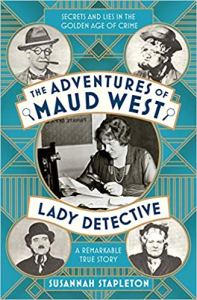
Adventures of Maud West

The Adventures of Maud West, Lady Detective, by Susannah Stapleton and published by Picador, is subtitled ‘Secrets and Lies in the Golden Age of Crime‘. With a title like that I thought it sounded just the sort of book I would like – and I did.

It is so intriguing – was Maud West really who she said she was? Susannah Stapleton discovered that she really did exist and was indeed a private investigator with her own detective agency, based in London in the early part of the twentieth century, from 1905 onwards.  The book gives plenty of extracts from Maud West’s own accounts of her investigations under Golden Age crime fiction titles such as The Lady Vanishes, The Body in the Library, and They Do It With Mirrors, for example. But these accounts had me wondering just what was the truth and what was fiction. They are so incredible! Maud was truly an amazing person – a master of disguise, equally able to pass herself off as a man, or a fortune teller, or a parlour maid, and skilled with a revolver, able to face down blackmailers. There are photographs of Maud – at work in her office and in a number of disguises. And it was not just in Britain – she worked all over the place including  New York, Cape Town, Brazil, and Jakarta. 

But what makes the book so good, and what kept me glued to the pages are the details of how Susannah Stapleton went about her research, included within the main narrative of her book. I haven’t come across this before – usually  an author lists the sources used at the end – and there is just such a list (a very long and comprehensive list) at the end of this book.  I was more intrigued by Stapleton’s own methods of research into finding out about Maud than I was by Maud herself.

 I also loved all the details of the changing society in which Maud lived – the role of women in the struggle for equality, details of the living and working conditions and of the crimes that real life private detectives investigated – divorces, missing persons, adultery and theft.

It more than lived up to my expectations, but I am still wondering did she really do what she said she did? Whatever the truth she was a complex woman and a very private one at that.

Many thanks to the publishers, Picador, for my review copy via NetGalley.

Katharina: Fortitude by Margaret Skea

Historical fiction at its best

‘We are none of us perfect, and a streak of stubbornness is what is needed in dealing with a household such as yours, Kat… and with Martin.’ 

Katharina fortitude

Sanderling Books|23 July 2019|print length 446 pages|e-book review copy|5*

My thoughts:

I loved this book; beautifully written and meticulously researched Katharina: Fortitude by Margaret Skea it presents a vivid portrait of Katharina von Bora from the beginning of her married  life with Martin Luther in 1525 to her death in 1552. It is the conclusion to Katharina: Deliverance, which covered the early years of her life from 1505 up to her wedding to Luther.

They both work well as standalone novels but I think reading both gives a fully rounded picture of her life. Margaret Skea is a skilful storyteller and seamlessly blends historical fact into her fiction. She is an award winning author both for her short stories and her historical novels – and Katharina: Deliverance was Runner-up in the Historical Novel Society Novel Award 2018.

Just as in Katharina: Deliverance, I was transported back in time and place to Reformation Germany, and in particular to Wittenberg in Saxony, experiencing the social, cultural and political situation. It’s also an intensely personal novel and I feel I really came to know Katharina and Martin very well. They lived through turbulent times, suffering outbreaks of plague, political and religious conflict as well as coping with the death of two of their children. Their marriage, initially one of convenience, opposed by some of his friends and fellow reformers, eventually became full of their love for each other and Martin came to value Katharina’s candid opinions and the support she gave him.

I felt immense admiration for Katharina, for her strength of character, resilience and courageous spirit. She gave birth to six children, whilst looking after Martin, who was often ill and suffered from depression. And in addition she also managed the daily life of the Lutherhaus in Wittenberg, often under financial difficulties because of Martin’s generosity towards others. She catered for the students and all the visitors and boarders, as well as working in the garden, with its vegetable beds and herb garden, the brewhouse, stable and piggery. Luther continued to be involved in religious controversy, whilst lecturing students, and holding his Table Talk sessions discussing a variety of topics ranging from theology and politics to diseases and their remedies.  He also translated the Bible into German, composed hymns, catechisms and treatises. 

I have often written in my reviews that I am not a fan of novels written in the present tense, but I had no issues with it in either of these books about Katharina and I think it fits the story perfectly. I was totally immersed in the story, enhanced by the richly descriptive writing, which made it compulsively readable for me.

In her Author’s Note Margaret Skea states that her book, based on a research trip in Saxony, ‘is a work of fiction, and though based on extensive research, the Katharina depicted here is my own interpretation’. There is a list of the main characters, a glossary of German terms and a map showing Saxony and Surroundings to help with the locations. It is a remarkable story, full of drama, centred on Katharina, a strong and courageous woman who never gave up no matter the difficulties that life with Luther brought her. I loved it.

With many thanks to Margaret Skea for sending me an advance review copy.


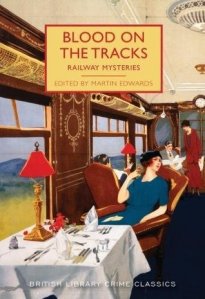
Blood on the Tracks: Railway Mysteries edited by Martin Edwards (British Library Crime Classics)

I’ve said before that I’m not a big fan of short stories, often finding them disappointing. So I’m glad to say that I enjoyed this anthology edited by Martin Edwards: Blood on the Tracks: Railway Mysteries. Some stories, of course, are better than others.

Blood on the tracks

There are fifteen railway themed stories in the collection and an introduction on classic railway mysteries by Martin Edwards. He has also prefaced each story with a brief biographical note, which I found useful as some of the authors were new to me. I read the collection slowly over a few months, which I find is the best way to approach a short story collection.

Train travel provides several scenarios for a mystery – the restriction of space on trains, with or without a corridor, means that there are a limited number of suspects and they can also provide an ideal place for a ‘locked room’ crime or an ‘impossible crime’ story. This collection also includes a couple of crimes with a supernatural element.

The mysteries are presented in roughly chronological order from 1898 up to  the 1950s. The ones I enjoyed the most are by R Austin Freeman, Roy Vickers, Dorothy L Sayers, F Tennyson Jesse and Freeman Crofts Willis.

  1. The Man with the Watches by Arthur Conan Doyle featuring an un-named sleuth, ‘a well-known criminal investigator’, about a man shot through his heart on the London to Manchester train. He had no ticket on him but had six valuable gold watches in his possession. This was first published in The Strand Magazine in 1898.
  2. The Mystery of Felwyn Tunnel by L T Meade and Robert Eustace. This was also first published in 1898 in which a signalman is found dead at the mouth of the tunnel. When another man dies in in the same place it looks as though something very strange is the cause of their deaths.
  3. How He Cut His Stick by Matthias McDonnell Bodkin. In this story Lady Detective Dora Myrl investigates the theft of £5,000 in gold and notes from a locked railway carriage.
  4. The Mysterious Death on the Underground Railway (1901) by Baroness Orczy, featuring the Old Man in the Corner, an ‘armchair detective’ as he sits in a teashop and tells journalist Polly Burton the solution to the murder of a young woman on the Underground, whilst he fiddles with a piece of string.
  5. The Affair of the Corridor Express by Victor L Whitechurch featuring the railway detective Thorpe Hazell. He investigates the kidnapping of the son of a millionaire.
  6. The Case of Oscar Brodski by R Austin Freeman, an ‘inverted’ detective story, in which the reader knows everything, whereas the detective knows nothing and it all hinges on the significance of trivial details, including fragments of glass, biscuit crumbs, a piece of string and threads of fabric.
  7. The Eighth Lamp by Roy Vickers – an underground mystery about switching off the station lamps after the last train had gone down the line, with a rather spooky supernatural ending.
  8. The Knight’s Cross Signal Problem by Ernest Bramah, in a steam engine crashes into a light train, killing twenty seven people and injuring forty plus. The cause of the accident is a mix up with the signals. I think this is one of the less successful stories for me.
  9. The Unsolved Puzzle of the Man with No Face (1928) by Dorothy L Sayers (a Lord Peter Wimsey story), . The body of a man is found on a lonely beach, his face slashed, and with no means of identification. Wimsey’s discussion of the crime with his fellow passengers as they travel into London, helps D I Winterbottom to solve the mystery – a most intriguing story.
  10. The Railway Carriage by F Tennyson Jesse (1931) – this is possibly my favourite story in the collection. It’s a supernatural mystery in which Solange Fontaine, a female sleuth with a ‘feeling for evil’ features meets two passengers on a train. Both the elderly woman, dressed in shabby black and the insignificant-looking man in a grey felt hat seem to be locked in their own thoughts and she feels very ill at ease. Then the train crashes. An excellent story.
  11. Mystery of the Slip-Coach by Sapper (1933), the creator of ‘Bulldog’ Drummond – an example of an ‘impossible crime’ in which the clue of a raw egg supplies the solution to the murder – I wasn’t convinced by this story.
  12. The Level Crossing by Freeman Crofts Willis ( 1933) in which a man is found dead, lying near an unmanned railway crossing. A mystery that shows the effects of unforeseen circumstances even on a well planned murder.
  13. The Adventure of the First-class Carriage by Ronald Knox (1947) a Sherlock Holmes pastiche with an ‘impossible crime’ scenario.
  14. Murder on the 7.16 by Michael Innes, a John Appleby mystery in which he investigates a murder in a railway carriage on trestles, not on wheels, as it is part of a film set.
  15. The Coulman Handicap by Michael Gilbert (1950s). I found this rather confusing as the police follow a woman passing on stolen goods as she uses the Underground to give them the slip. I think this is possibly the one story in the collection that failed to hold my interest.

My thanks to the publishers for my review copy via NetGalley.

  • Paperback: 358 pages
  • Publisher: Poisoned Pen Press (3 July 2018) in association with the British Library
  • Language: English
  • ISBN-10: 1464209693
  • ISBN-13: 978-1464209697
  • My rating: 3*

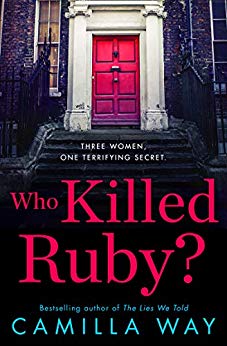
Who Killed Ruby? by Camilla Way

Who killed Ruby

Harper Collins|30 May 2019|403 pages|Review e-book copy|3.5*

Ruby was murdered 32 years ago but her death still affects her family – Stella her mother, Vivienne her younger sister, and Cleo, Vivienne’s 13 year old daughter. Who Killed Ruby?  begins in a house in Peckham, London where the three of them are in shock, as a man lies dead on the kitchen floor. Whilst they wait for the police to arrive, Vivienne asks what they should tell them and Stella replies that they will tell them it is the man who murdered Ruby. This rather begs the question – is it?

The novel then rewinds two months describing the events that led up to that first scene and also reveals the events that led up to Ruby’s murder. It’s a complex tale told mainly from Vivienne’s point of view. She was just a child of eight when the murder happened and it was largely her testimony that convicted Jack Delaney, Ruby’s boyfriend. She had been alone in the house when she found her sister’s pregnant body splayed out on her bedroom floor. Jack has always protested his innocence and now he has been released from prison. But Vivienne is vague about the details of the murder, having blocked out her memories of what had happened and what she had seen. Plagued by nightmares ever since Ruby was killed, she is now terrified that Jack will come looking for her, wanting revenge.

The second viewpoint is Cleo’s. She is excited about the messages she’s exchanging online with Daniel, who she met on a gaming site. He tells her he is 14 and lives in Leeds. She lies to Vivienne about it and says that she is texting her friend Layla. Gradually Vivienne begins to remember what happened the day that Ruby died, but when Cleo disappears she becomes frantic, certain that Jack has taken her.

It is a tense and emotional mystery that kept me guessing to the very end. My suspicions about Cleo turned out to be partly correct, but as for who killed Ruby I was thrown off track by all the different characters who could be the culprit and I just couldn’t decide who I thought it could be. When the identity of the killer was revealed I was so surprised as it was someone I’d not even considered. I wasn’t convinced by some of the characters and thought they were too obviously there to confuse the reader. But overall I did enjoy the book. And I liked the emphasis on family relationships – particularly on the mother/daughter relationships.

Many thanks to the publishers, Harper Collins, for my review copy via NetGalley.
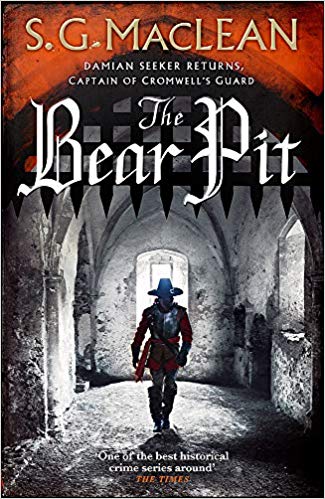
The Bear Pit by S G MacLean

Bear Pit

Quercus/ 11 July 2019/Paperback/ 416 pages/ Review copy/ 5*

S G MacLean is one of my favourite authors of historical fiction, so I was delighted to read her latest book, The Bear Pit.  It is the fourth book in her Damien Seeker series, set during the Interregnum under Oliver Cromwell, the Lord Protector. I’ve read the previous three books. Reading them takes me back to England in the 17th century, a time and a place full of danger and unrest, teeming with spies, exiles and assassins. Whilst I  was happy to read them as standalones, I think it would help to follow the progression of events if they are read in order.

This one begins in September 1656 as three men are waiting for Oliver Cromwell to emerge from Westminster Abbey on his way to the State Opening of Parliament in Parliament House. Their plan to assassinate Cromwell had been in preparation in Cologne and Bruges for a year and a half, but that day it was thwarted. However, they will not give up.

Damian Seeker, Captain of Cromwell’s Guard, works for John Thurloe, Cromwell’s Chief Secretary and spy master, in charge of the security of the regime, running a virtual secret service. Thurloe is floundering under all the reports from the Continent about plots against Cromwell’s life and to reinstate Charles Stuart as King. He tells Seeker until they have corroboration of the rumours they don’t have the time or capability to look into the matter. Not wanting to go against Thurloe’s orders, Seeker decides to take part in a raid on an illegal gaming house which ends with the discovery of the body of an elderly man chained to the wall by his neck and half eaten, obviously ravaged by a bear. But bear baiting had been banned and all the bears had been shot recently – or so it was claimed. Where had the bear come from and why was the man killed? And what connection, if any, does the murder have to the plots to kill Cromwell?

Like all good historical fiction The Bear Pit blends historical fact and fiction. There was indeed a plot to assassinate Cromwell in the autumn and winter of 1656 as described in the novel, whereas the mystery of the man killed by a bear and the subsequent search for the bear’s whereabouts are fictional. 

Some of the things I enjoy in this book are the return of characters from the earlier books -Sir Thomas Faithly, Lawrence Ingoldby, Manon, Marie Ellingworth, to mention just a few, and the glimpses we see of other historical figures – such as John Evelyn, a young Samuel Pepys, the poet Andrew Marvell as well as John Milton and one of my favourite historical figures when I was at school – Prince Rupert of the Rhine. I was fascinated by the details of The Cabinet of Curiosities, assembled by John Tradescant and his son, in Tradescant’s Garden in South Lambeth. In her Author’s Note S G MacLean states that these were indeed, very much in existence and were open for business as well as being a public attraction. The remains of the collection are held in Oxford’s Ashmolean Museum. 

S G MacLean is a wonderful storyteller and her books are full of authentic detail skilfully interwoven in the stories without holding up the action. The Bear Pit is a fast-paced book, full of action and danger and wonderful characters, especially in the figure of Damien Seeker. He is the hero of the book – strong, dedicated to his work, indefatigable in his search of the truth and loyal to his friends and colleagues. The atmospheric setting complements the plot – the streets of London in winter, the cold, fog and damp and in particular Bankside in Southwark and the eerie atmospheric wastes of Lambeth Marsh. I was completely absorbed in the book. I found it compelling reading both the murder mystery and the assassination plot gripped me and I raced through it, eager to find out what happened. I was absolutely incredulous at the ending though, but it does give me hope that there may be fifth Damian Seeker novel.

Many thanks to the publishers, Quercus, for my review copy via NetGalley.

First Chapter First Paragraph: Who Killed Ruby? by Camilla Way

Every Tuesday First Chapter, First Paragraph/Intros is hosted by Vicky of I’d Rather Be at the Beach sharing the first paragraph or two of a book she’s reading or plans to read soon.

This week I’m featuring Who Killed Ruby? by Camilla Way, a book I hope to read very soon.

Who killed Ruby

They stand there, the three of them, looking at the dead man, his blood creeping slowly across the floor. Despite the savagery of his death the room is very still, almost peaceful after the violence that led to this.

Soon the police will come. They will charge into this nice expensive kitchen in this rather lovely London townhouse with their boots, their batons, their loud authority, and will want to know what happened, whom to hold responsible.

It’s Vivienne who speaks first. ‘What will we do?’ she asks, her teeth chattering with shock. ‘What will we tell them?’

The seconds slip by slowly until her mother at last replies. ‘We will tell them that this is the man who murdered Ruby,’ she says.

Blurb 

If you passed it on the street, you’d see an ordinary London townhouse.

You might wonder about the people who live there, assume they’re just like you.

But inside a family is trapped in a nightmare. In the kitchen, a man lies dead on the blood-soaked floor. Soon the police will come, and they’ll want answers.

Perhaps they’ll believe the family’s version of events – that this man is a murderer who deserved to die.

But would that be the truth?

~~~

I haven’t read any of Camilla way’s books, but I’m hoping this one will be good.

If you’ve read it I’d love to know what you thought of it. If you haven’t, does it tempt you too?