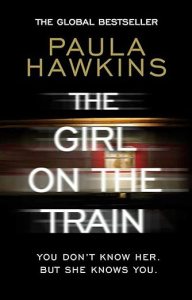
The Girl on the Train by Paula Hawkins

The Girl on the Train by Paula Hawkins has won a lot of awards and is a very popular book. It has good reviews, Stephen King for example describes it as a “Really great suspense novel. Kept me up most of the night. The alcoholic narrator is dead perfect.”

I thought it sounded good, so I decided to read it. But it didn’t live up to the hype for me. I wasn’t enthralled.

It began well with Rachel on the train each morning looking out at the houses on the road where she used to live before she was divorced. As the train stops at the same signal each day she enviously watches a young couple who are living the perfect life, or so she imagines. Then something happens that shocks her and everything changes and she begins to get involved in their lives, with disastrous results.

But I couldn’t easily distinguish between the three main characters, Rachel, Anna and Megan. Each one is an unreliable narrator and not very likeable. I had to keep referring to the chapter headings and dates to remind myself who was who and what happened when. I didn’t find it chilling or thrilling and any suspense rapidly disappeared with the repetition of Rachel being drunk, then being sorry, but unable to stop drinking. Then there are all the phone calls, text messages and emails that she sends when she is drunk. She has blackouts and can’t remember what happened, or what she said. Added to that she dreams and is unable to distinguish between them and reality. Overall it’s dreary and depressing.

So after a good start, the narrative lost impetus and dragged on to its conclusion, which by comparison seemed rushed, with a twist right at the end that took me by surprise. I suppose it is a ‘page-turner’ as I did want to know what what going to happen, but it left me feeling unsatisfied, irritated and rather out of sorts.

I’ve seen this book compared to Gone Girl, another book I have sitting waiting to be read. Now, I’m wondering if I’ll find that one disappointing as well. Do let me know your views on both or either of these books.

Reading challenges: Bev’s Mount TBR Reading Challenge 2016, 20 Books of Summer 2016 and although I didn’t find this book particularly perilous, Carl’s RIP XI (Readers Imbibing Peril), because plenty of other people have.
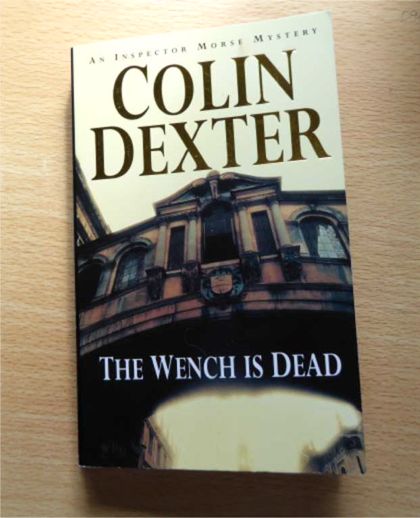
The Wench is Dead by Colin Dexter

An Inspector Morse book, The Wench is Dead is the 8th in the series, first published in 1989. This is a bit different from the other Morse books in that it is historical crime fiction – no current cases are investigated.

The wench is dead


Morse is in hospital being treated for a perforated ulcer. Whilst recovering he is given a book called Murder on the Oxford Canal by the wife of a recently deceased patient at the hospital. It’s an account of the investigation and trial that followed the death of Joanna Franks in 1859. She had been found at Duke’s Cut on the Oxford Canal. As he reads, Morse becomes convinced that the two boatmen hanged for her murder and a third man who had been transported to Australia were innocent.

Dexter based his book on an account of a Victorian murder in 1839, that of 37-year-old Christina Collins as she travelled the Trent and Mersey Canal atRugeley, Staffordshire, on the Staffordshire Knot en route to London. It reminded me of Josephine Tey’s novel, The Daughter of Time in which Inspector Alan Grant, also recovering in hospital, investigates the murder of the Princes in the Tower.

Morse enlists the help of Sergeant Lewis as well as that of Christine Greenaway, the beautiful daughter of one of the other patients. She works as a librarian at the Bodleian Library. So he is able to study original source material as well as the account in the published book. Morse finds it an absorbing puzzle, like a tricky cryptic crossword, and the more he read and thought about it the more questions came to his mind. He was not satisfied that the conclusions drawn at the trial about the forensic and pathological evidence were right. He felt uneasy about reported conversations between the various people involved:

… all of it was wrong somehow. Wrong if they were guilty. It was if some inexperienced playwright had been given a murder-plot, and then had proceeded to write page after page of inappropriate, misleading and occasionally contradictory dialogue. (page 133)

I thought it was ingenious and compelling reading, very well constructed and very clever. By the time he leaves the hospital Morse is convinced that he has solved the mystery. It’s a tale of  intrigue, lust and deception, with more than a few twists and turns.

Reading Challenges: Mount TBR Reading Challenge, 20 Books of Summer 2016 , Vintage Cover Silver Age Scavenger Hunt: in the category of a Building (not a house) – the front cover of my copy shows the Hertford Bridge, popularly known as the Bridge of Sighs, which joins two parts of Hertford College over New College Lane in Oxford.

My Friday Post: The Scent of Death

Book Beginnings ButtonEvery Friday Book Beginnings on Friday is hosted by Gillion at Rose City
Reader
 where you can share the first sentence (or so) of the book you are reading, along with your initial thoughts about the sentence, impressions of the book, or anything else the opener inspires.

This week’s book is a library book I’m thinking of reading. It’s The Scent of Death by Andrew Taylor. I borrowed it because I’ve enjoyed some of his other books. It begins:

This is the story of a woman and a city. I saw the city first, glimpsing it from afar as it shimmered like the new Jerusalem in the light of the setting sun.

Synopsis:

August, 1778. British-controlled Manhattan is a melting pot of soldiers, traitors and refugees, surrounded by rebel forces as the American War of Independence rages on. Into this simmering tension sails Edward Savill, a London clerk tasked with assessing the claims of loyalists who have lost out during the war.

Savill lodges with the ageing Judge Wintour, his ailing wife, and their enigmatic daughter-in-law Arabella. However, as Savill soon learns, what the Wintours have lost in wealth, they have gained in secrets.

The murder of a gentleman in the slums pulls Savill into the city’s underbelly. But when life is so cheap, why does one death matter? Because making a nation is a lucrative business, and some people cannot afford to miss out, whatever the price’¦

Also every Friday there is The Friday 56, hosted by Freda at Freda’s Voice.Friday 56

These are the rules:

  1. Grab a book, any book.
  2. Turn to page 56, or 56% on your eReader.
  3. Find any sentence (or a few, just don’t spoil it) that grabs you.
  4. Post it.
  5. Add the URL to your post in the link on Freda’s most recent Friday 56 post.

Page 56:

You’re a thief, a damned pickpocket. There were two empty purses in your bundle. And those shoes you had on your feet – well they tell their own story don’t they?

I like the promise of this book – historical crime fiction set during the American War of Independence, a war about which I know only the briefest of details.

Books Read in August 2016

I read 6 books this August, three of them TBR books, and all are fiction, a mix of crime fiction, historical fiction and epic fantasy novels. One book is a library book and one a review copy. (The links are to my  posts on the books.)

  • The Sunne in Splendour by Sharon Penman (TBR), a fascinating novel about the Wars of the Roses and Richard III from his childhood to his death at Bosworth Field in 1485 and one of the best historical novels that I’ve read.
  • The Woman Who Walked into the Sea by Mark Douglas Hume (LB), the second The Sea Detective novel, set in an imaginary coastal village of Poltown in the north of Scotland, the story revolves around the main character,Violet who had been abandoned as a new-born baby.  It had been assumed that her mother, Megan had committed suicide, although her body had never been found.  Cal McGill helps Violet find out what really happened.
  • The Girl in the Cellar by Patricia Wentworth, a Miss Silver Mystery first published in 1961. It begins well as the main character finds herself in the dark in a cellar, not knowing who she is or how she got there. Overall, I thought the book was odd and not very convincing. There are too many coincidences, improbabilities, and loose ends.
  • The Plague Charmer by Karen Maitland, a review copy from Lovereading due to  be published in October. This is another unputdownable book by Karen Maitland, set in Porlock Weir in 1361, bringing the medieval world to life in all its brutality and hardship. I thoroughly enjoyed it. My full review will follow later this month.
  • A Game of Thrones (A Song of Ice and Fire,1) by George R R Martin (TBR), an epic fantasy novel  set in a grim and violent world full of tragedy, betrayals and battles; a tale of good versus evil in which family, duty, and honour are in conflict. It’s complex and multifaceted, and full of stories and legends and wonderful characters. I loved it.
  • The Mysterious Mr Quin (Agatha Christie'¦The Mysterious Mr Quin by Agatha Christie (TBR) – I finished this collection of short stories yesterday. It’s one of her earliest books, first published in 1930, not at all like her Poirot or Miss Marple books, and I enjoyed it very much. It’s beautifully written. I’ll write about it in more detail soon.

It’s impossible to decide which is my favourite this month between books in different genres. I loved The Sunne in Splendour, The Game of Thrones and The Mysterious Mr Quin in almost equal measure, each book taking me to completely different worlds and times.

Missing, Presumed by Susie Steiner: Paperback Publication

I first posted this review of Missing, Presumed by Susie Steiner last December prior to its publication in hardback. I loved this gripping and intense crime thriller and it’s out in paperback today!

I was a bit doubtful that I would like Missing, Presumed by Susie Steiner as it’s written in the present tense, which I usually find irritating. But I needn’t have been concerned because it wasn’t long before I’d completely forgotten the tense and I was totally immersed in the story. And I loved it.

Missing, Presumed is crime fiction, investigating the disappearance of Edith Hind, a beautiful Cambridge post-grad.  Her boyfriend, Will Carter had returned to their flat to find the front door open, coats in disarray and a spatter of blood on the kitchen floor. It’s told from different characters’ viewpoint, each one individually distinct, beginning with DS Manon Bradshaw on the Major Incident Team (her name means ‘˜bitter’ in Hebrew, but I thought it was Welsh), a lonely disillusioned single woman approaching forty, who overcomes her insomnia by listening to the low murmurings of police reports on her radio.

Edith’s mother, Miriam, Lady Hind, is distraught, wondering if somehow this is fault, her daughter the centre of a drama. Sir Ian Hind, a successful doctor, physician to the Royal Family and a friend of the Home Secretary adds to the pressure the police are under to find Edith. Edith’s friend, Helena comes under suspicion and known offenders are interviewed, but after the first 72 hours she is still missing. The team’s urgency is cooling  as the possibility that Edith is still alive diminishes. Then a dog walker finds a body in the Ouse, near Ely; is it Edith? The search for the killer is intensified.

This has all the ingredients of a successful crime novel for me. My only criticism of the book is that I didn’t think the final section, ‘˜One Year Later‘˜ in which the ends are tied up , was necessary. But apart from that I found it gripping and intense. I was intrigued by the multi-layered plot, and thought the characters were fully rounded, believable people, explored with psychological depth ‘“ in particular Manon Bradshaw stands out. And, best of all, it is beautifully written.

The Author

Susie Steiner began her writing career as a news reporter first on local papers, then on the Evening Standard, the Daily Telegraph and The Times. In 2001 she joined The Guardian, where she worked as a commissioning editor on Weekend Magazine for 11 years. For more information see her website, susiesteiner.co.uk.

Missing, Presumed is Susie Steiner’s second book ‘“ her first is Homecoming.

First Chapter, First Paragraph:

First chapterEvery Tuesday Diane at Bibliophile by the Sea hosts First Chapter First Paragraph Tuesday Intros to share the first paragraph sometimes two, of a book that she’s reading or planning to read soon.

The Wench is Dead by Colin Dexter is one of those books I’ve been meaning to read for some time and it’s one of my 20 Books of Summer. It’s an Inspector Morse book.

It begins:

Intermittently, on the Tuesday, he felt sick. Frequently, on the Wednesday, he was sick. In the Thursday, he felt sick frequently, but was actually sick only intermittently. With difficulty, early on the Friday morning – drained, listless, and infinitely weary – he found the energy to drag himself from his bed to the telephone, and seek to apologise to his superiors at Kidlington Police HQ for what was going to be an odds-on non-appearance at the office that late November day.

Blurb:

That night he dreamed in Technicolor. He saw the ochre-skinned, scantily clad siren in her black, arrowed stockings. And in Morse’s muddled computer of a mind, that siren took the name of one Joanna Franks . . .

The body of Joanna Franks was found at Duke’s Cut on the Oxford Canal at about 5.30 a.m. on Wednesday, 22nd June 1859.

At around 10.15 a.m. on a Saturday morning in 1989 the body of Chief Inspector Morse – though very much alive – was removed to Oxford’s John Radcliffe Hospital. Treatment for a perforated ulcer was later pronounced successful.

As Morse begins his recovery he comes across an account of the investigation and the trial that followed Joanna Franks’ death . . . and becomes convinced that the two men hanged for her murder were innocent . . .

What do you think? Would you keep reading? I’m predisposed to like this book, because I loved the Morse TV series and also because I’m a fan of cold case investigations – especially one this old.