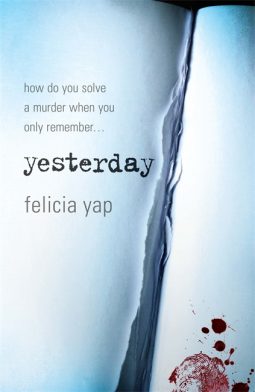
There are two types of people in the world. Those who can only remember yesterday, and those who can also recall the day before.
You have just one lifeline to the past: your diary. Each night, you write down the things that matter. Each morning, your diary tells you where you were, who you loved and what you did.
Today, the police are at your door. They say that the body of your husband’s mistress has been found in the River Cam. They think your husband killed her two days ago.
Can you trust the police? Can you trust your husband? Can you trust yourself?
My thoughts:
The nature of memory always fascinates me. Just how much can we rely on our memories – what is real and reliable, how well can we really remember what happened, how much do we bury in our subconscious? In Yesterday by Felicia Yap she has created a world where memory for everyone over the age of eighteen is limited for 70% of people to just one day (the Monos) whilst the rest (the Duos) have two days of memory. Each day everyone has to write down their actions, thoughts and feelings in their iDiaries and then memorise the ‘facts’. But are these ‘facts’ reliable?
This is a murder story, told through extracts from iDiaries and the perspectives of four people, that of the victim, Sophie, Claire a Mono, married for twenty years to Mark, a novelist and prospective MP who is a Duo, and DCI Hans Richardson, who is racing against time to find the murderer.
I found it rather confusing at first, getting my head around the fact that everyone has such a short-term memory. Just how reliable are the four narrators, are they even who they say they are and do they write the truth in their iDiaries? I think it is an interesting book but I did have to suspend my disbelief, especially towards the end of the book, which I found farcical and rather annoying. It was one twist too far for me. And I couldn’t really get over the fact of how much time you would have to spend writing everything down and then learning what you had done and thought each day.
I’m following the example of my blogging friend, Cath at Read Warbler, by writing a ‘catch up’ post as I am behind with writing reviews. That’s what going away for two weeks and then having an awful cold afterwards does for you!
So here are three crime fiction books, all very enjoyable 4 star books, that I read earlier this year:
A Dedicated Man by Peter Robinson, the second novel in Peter Robinson’s Inspector Banks series, first published in 1988, and my 17th book for Bev’s Mount TBR 2017 challenge. I’ve been reading these books totally out of order and have gone back to the first ones to fill in the gaps in my reading.
Banks is now more settled in Yorkshire after the events described in the first book, Gallows View. I was struck as I read the books how unlike the TV version of Banks they are. Banks, himself, is nothing like Stephen Tompkinson (who plays his role). Robinson’s Banks is ‘a small dark man, in appearance rather like the old Celtic strain of Welshman, and his physique certainly didn’t give away his profession.‘
The ‘dedicated man‘ is local historian, Harry Steadman, who was found half-buried under a dry-stone wall near the village of Helmthorpe, Swainsdale. It seems that nobody would have wanted to kill such a good man, but as Banks investigates his background several suspects emerge. Sally Lunn, a young teenager knows more than is good for her and sets out to beat the police in finding the culprit.
Banks is a dogged and determined police officer, also a ‘dedicated man‘ and he concentrates on Steadman’s past; after leaving Cambridge where he got a first in history, he’d taught at Leeds University where he’d developed an interest in industrial archaeology. After his father died he’d inherited a considerable fortune and left his job to concentrate on his own interests. He’d married, Emma, a plain-looking woman who Banks first mistook for the cleaning lady.
Other characters include Jack Barker, a crime fiction writer, Penny Cartwright, a folk singer and Michael Ramsden, a close friend who worked in publishing. I thought Barker’s comment about his editor was interesting – that he could spend two days working on a fine description and find his editor wants him to cut it out because it slows the action. I wondered if that was Robinson’s own experience because he does include passages of description that do slow down the action. But I like his style, which is a good balance of description and fast -paced action.
Completely different in style is my next book, also detective fiction. It’s The Hanged Man of Saint-Pholien by Georges Simenon, translated by Linda Coverdale. This is the third book in the new series of Maigret novels in new translations, published by Penguin, originally written in 1930. In this short book (144 pages) Maigret observed a shabby man, travelling on a train from Holland to Bremen, carrying a small suitcase. He replaced the man’s suitcase with another exactly like it and followed him when he left the train, only to watch him through a keyhole in hotel bedroom, place a revolver in his mouth and press the trigger. Maigret is disturbed by the thought that he had both witnessed the tragedy and been the cause of it. Wonderfully mysterious and obscure I was baffled for most of the book, as Maigret uncovers a crime from ten years earlier, revolving around the macabre drawings of hanged men of all types. A recurrent theme was the steeple of a church – the same church, that of Saint-Pholien in Liège.
A note at the beginning of the book reveals that the book was drawn from Simenon’s experiences in Liège, when he was ‘involved with a literary set, comprised of poets and young artists. A member of the group, Joseph Jean Kleine, was found hanging from the doorway of the church of Saint-Pholien during this period, a tragedy that left its mark on Simenon.
Moving forward to 2016 my final book is Present Tense by W H S McIntyre, a criminal defence lawyer. It’s the 7th book in his Best Defence series, featuring criminal lawyer Robbie Munro. Munro is based in Linlithgow and deals mainly with Scottish Legal Aid cases.
Billy Paris, ex-military, leaves a cardboard box with Robbie and asks him to look after it for him, without telling him what it contained, but assuring him it wasn’t guns, knives or drugs. That’s OK until two men in black suits, one a detective inspector and the other from the Ministry of Defence, ask him for the box and want to know where they can find Billy.
It’s a legal drama, a tense and complicated mystery, combined with details of Robbie’s personal life. He is a single dad with a daughter, Tina, aged four and a half, living in his dad’s house along with his brother, Malky, an ex-footballer. His dad has promised Tina a Pyxie Girl doll for Christmas, but they’re impossible to get. There’s a lot about parenthood, more specifically fatherhood, and family relationships told with dark humour, all making for an intriguing and absorbing mystery.
I have only recently started reading Val McDermid’s books and after reading one of her stand-alone books, A Place of Execution, I decided to move on to her Karen Pirie books. The first one is The Distant Echo (first published in 2003) in which Karen doesn’t play a major role – only appearing in Part Two as a Detective Constable.
Blurb (Goodreads):
It was a winter morning in 1978, that the body of a young barmaid was discovered in the snow banks of a Scottish cemetery. The only suspects in her brutal murder were the four young men who found her: Alex Gilbey and his three best friends. With no evidence but her blood on their hands, no one was ever charged.
Twenty five years later, the Cold Case file on Rosie Duff has been reopened. For Alex and his friends, the investigation has also opened old wounds, haunting memories-and new fears. For a stranger has emerged from the shadows with his own ideas about justice. And revenge.
When two of Alex’s friends die under suspicious circumstances, Alex knows that he and his innocent family are the next targets. And there’s only way to save them: return to the cold-blooded past and uncover the startling truth about the murder. For there lies the identity of an avenging killer…
My thoughts:
The nightmare began when student, Alex Gilbey found Rosie Duff dying in the snow in the Pictish cemetery in St Andrews. He ran to the nearby housing estate to get help and finding a policeman in his patrol car told him what he had found. By the time they got back to the body, Rosie was dead, despite the efforts of Alex’s friends to keep her alive. He and his three friends were the prime suspects, both the police and Rosie’s thuggish brothers were convinced they were guilty. But DI Barney Maclennan and his team, including DC Burnside, WPC Janice Hogg and PC Jimmy Lawson (the policeman Alex asked for help) were unable to find enough evidence to charge them with the murder.
Nearly half the book concentrates on the crime and the initial investigation, going into detail about each character and the circumstances of the murder, ending dramatically with another death. I felt I knew all the characters but had little idea who had killed Rosie or why. The case lay dormant for 25 years.
In 2003 Jimmy Lawson, now an ACC, is in overall control of the cold cases squad and is keen to enhance his reputation by getting at least one result. He assigns DC Karen Pirie to the Rosemary Duff case and asks her to find the physical evidence, which is missing from the box it’s supposed to be in, before interviewing the original witnesses. A new character comes onto the scene – Graham MacFadyen – with additional evidence that the police were not aware of at the time. The second investigation begins, equally as in depth as the first. The four students, all now with settled careers, are questioned again.
I just couldn’t work out which one of them, if any, was guilty. I couldn’t believe any of them would have murdered Rosie. And then a vague suspicion grew in my mind and I revisited the events immediately after the body was discovered, only to dismiss my idea as fanciful. Val McDermid is so skillful in giving you the clues and then leaving you in suspense (or at least that was my experience). There is a major twist that completely threw me before the dramatic ending when I realised that my initial suspicion was correct after all.
Paperback: 576 pages
Publisher: HarperCollins (4 Mar. 2010)
Language: English
ISBN-10: 0007344651
ISBN-13: 978-000734465
Source: library book
My rating: 5*
I loved this book and hope to read the next three books in the series as soon as possible. They are:
What if your perfect home turned out to be the scene of the perfect crime?
Londoners Jack and Syd moved into the house a year ago. It seemed like their dream home: tons of space, the perfect location, and a friendly owner who wanted a young couple to have it. So when they made a grisly discovery in the attic, Jack and Syd chose to ignore it. That was a mistake. Because someone has just been murdered. Right outside their back door. And now the police are watching them…
Given the title, The House, I anticipated that the main focus would be a house. And it was, at the beginning, which really raised my expectations that this was going to be a suspense-filled creepy book with hints even of the supernatural. Syd found the house advertised on the internet; the owner had suddenly moved to Australia, leaving the house fully furnished and she was immediately smitten by it. Jack wasn’t so sure – he thought it was creepy, full of junk, with an overgrown garden. But they put in a bid and were amazed when they got it a bargain price.
Jack and Syd share the narrative, explaining how they came to buy the house and their feelings as they move in and experience strange, disgusting smells and scary noises in the night. Then Jack found something nasty in the attic, which I thought must be something so evil, because he didn’t want to tell Syd what it was. He began to worry why the owner had wanted him and Syd to have the house. It’s a nightmare scenario.
But then the focus changed and the mystery of the house was absorbed into a very complex story that is difficult to write about without giving away the plot. As I read on and found out more about Jack and Syd it became clear that this book is not really about the house – it’s about their past lives and in particular about Syd’s. I think that if I had known more about that before, I wouldn’t have chosen to read the book. It’s a story about despair, domestic violence, dark secrets and the effects of the past on the present.
Even thought the main issues are not topics that I want to read about, I did find the book compelling and it drew me along. The characters are believable, so much so that I didn’t like some of them; they are not people I’d want to meet. It was not what I expected from the title or synopsis – and there is nothing supernatural about it. Having said that it is well-written in a conversational style that makes each character easily distinguishable, with a well constructed plot.
My thanks to NetGalley and Penguin, the publishers for a review copy.
Every Friday Book Beginnings on Friday is hosted by Gillion at Rose City
Reader where you can share the first sentence (or so) of the book you are reading, along with your initial thoughts about the sentence, impressions of the book, or anything else the opener inspires.
I’ve recently finished reading Gallows View by Peter Robinson, the first Inspector Banks book and have decided to read the series in the order they were written. The second Inspector Banks book is A Dedicated Man.
When the sun rose high enough to clear the slate roofs on the other side of the street, it crept through a chink in Sally Lumb’s curtain and lit on a strand of gold blonde hair that curled over her cheek. She was dreaming.
This opening doesn’t tell me much about the book. If I didn’t know it’s an Inspector Banks book I’d probably not bother reading much further. But reading the blurb encourages me to read on:
Blurb:
Near the village of Helmthorpe, Swainsdale, the body of a well-liked local historian is found half-buried under a dry stone wall. Harry Steadman has been brutally murdered. But who would want to kill such a thoughtful, dedicated man?
Chief Inspector Alan Banks is called in to investigate and soon discovers that disturbing secrets lie behind the apparently bucolic facade. It is clear that young Sally Lumb, locked in her lover’s arms on the night of the murder, knows more than she is letting on. And her knowledge could lead to danger . . .
Turn to page 56, or 56% on your eReader. (If you have to improvise, that’s ok.)
Find any sentence (or a few, just don’t spoil it) that grabs you.
Post it.
Add the URL to your post in the link on Freda’s most recent Friday 56 post.
From Page 56:
‘He was a fine man, good-tempered, even-natured. He had a sharp mind – and a tongue to match when it came to it – but he was a good man; he never hurt a soul, and I can’t think why anyone would want to kill him.’
‘Somebody obviously felt differently,’ Banks said. ‘I hear he inherited a lot of money.’
I’m pleased that page 56 provides information about the man in the title and provides an answer to the question of why anyone would want to kill such a good man. I haven’t read much more of the book so I’m still in the dark about the motive – was the man really killed for his money?
I read The Unquiet Dead by Ausma Zehanat Khan in May. It’s due to be published by No Exit Press on 27 July 2017 (first published December 30th 2014).
Blurb:
One man is dead.
But thousands are his victims.
Can a single murder avenge that of many?
When Christopher Drayton’s body is found at the foot of the Scarborough Bluffs, Detectives Esa Khattak and Rachel Getty are called to investigate his death. But as the secrets of his role in the 1995 Srebrenica Massacre surface, the harrowing significance of the case makes it difficult to remain objective. In a community haunted by the atrocities of war, anyone could be a suspect. And when the victim is a man with far more deaths to his name, could it be that justice has at long last been served?
In this striking debut, Ausma Zehanat Khan has written a compelling and provocative mystery exploring the complexities of identity, loss, and redemption.
The harrowing account of the atrocities of Srebrenica in 1995 and the search for justice forms the basis of this intriguing novel. Extracts from statements and reports from survivors of the massacre head each chapter, giving voice to the ‘unquiet dead‘. These are immensely powerful and drive the novel. Alongside that is the investigation by detectives Esa Khattak and Rachel Getty into the death of Christopher Drayton who fell from the heights of the Scarborough Bluffs. Was it suicide, or an accident? Or was he pushed -and if so, who pushed him and why?
This is Ausma Zehanat Khan‘s debut novel but at times events in the past lives of the characters are referred to without much explanation and I felt I must have missed an earlier novel. For me, the investigation into Drayton’s death is the weaker part of the book. I think Rachel is the most convincing character, with Esa more of a shadowy personality, seemingly easily influenced by the women he meets. The other characters and there are a lot, aren’t particularly well-drawn and some are really just caricatures.
But these criticisms aside I think it is a powerful and thought provoking story that brought home to me the devastating and heart breaking horrors of the Srebrenica massacre of 8,000 Bosnian Muslims.

 Banks is now more settled in Yorkshire after the events described in the first book, Gallows View. I was struck as I read the books how unlike the TV version of Banks they are. Banks, himself, is nothing like Stephen Tompkinson (who plays his role). Robinson’s Banks is ‘a small dark man, in appearance rather like the old Celtic strain of Welshman, and his physique certainly didn’t give away his profession.‘

 Moving forward to 2016 my final book is


 BooksPlease