A – Z of TBRs: G, H and I

I have been neglecting my TBRs this year and have been reading mainly new books and library books.So here is the third instalment of my A – Z of TBRs, a series of posts in which I take a fresh look at some of my TBRs to inspire me to read more of them by the end of the year. These TBRs are all physical books – I’ve not included e-books.

I’m enjoying searching my shelves – finding books I’d forgotten were there (the disadvantage of shelving books behind others).
a-z tbrs ghi P1020304


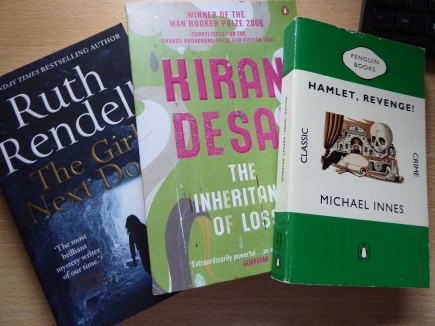
G is for The Girl Next Door by Ruth Rendella book I’ve had for just over a year. When a new house is being built a long buried secret is uncovered – a tin box is found in an earthen tunnel. It contained two skeletal hands, one male and one female.

Their garden was not beautiful. It had no flowering trees, no roses, no perfumed herbs. Tunnels, they called it at first. The word ‘qanat’, an impossible word, was found by Daphne Jones and adopted by the rest of them. It meant, apparently, a subterranean passage for carrying water in some oriental language. They liked it because it started with a q without a u. Their scholteachers had taught them that no word could ever start with a q unless it was followed by u, so Daphne’s idea appealed to them and the tunnels became qanats. In time to come the qanats became their secret garden. (pages 14 -15)

HHamlet, Revenge! by Michael Innes (on my TBR shelves since May 2015). This is a green Vintage Penguin, first published in 1937, and in this edition in 1961, about a murder planned to take place in the middle of a private performance of Hamlet.

It had begun as a family frolic. And now, although it would not be publicly reported, the dramatic critics were coming down as if to an important festival. Professors were coming to shake learned respectable bald heads over a fellow-scholar’s conception of an Elizabethan stage. Aged royalty  was coming to be politely bewildered. Most alarming of all, ‘everybody’ was coming – for the purpose no doubt, of being where ‘everybody’ was. And even if it was a select and serious everybody – a known set before whom a Lord Chancellor might mime without misgiving – it was still a crowd, and its actions were unpredictable. (page 28)

IThe Inheritance of Loss by Kiran Desai, a book I’ve had for just over 10 years! It won the Man Booker Prize in 2006. This is set in India, in a dilapidated mansion high in the Himalayas, the home of three people each dreaming of another time – a retired judge, Sai, his granddaughter and a cook.

In Kalimpong, high in the northeastern Himalayas where they lived – the retired judge and his cook, Sai and Mutt – there was a report of new dissatisfaction in the hills, gathering insurgency, men and guns. It was the Indian Nepalese this time, fed up with being treated like the minority in a place where they were the majority. They wanted their own country, or at least their own state, in which to manage their own affairs. Here, where India blurred into Bhutan and Sikkim, and the army did pull-ups and push-ups, maintaining the tanks with khaki paint in case the Chinese grew hungry for more territory than Tibet, it had always been a messy map. The papers sounded resigned. A great amount of warring, betraying, bartering had occurred; between Nepal, England, Tibet, India, Sikkim, Bhutan; Darjeeling stolen from here, Kalimpong plucked from there – despite, ah, despite the mist charging down like a dragon, dissolving, undoing, making ridiculous the drawing of border. (page 9)

What do you think? Do you fancy any of them? 

One reason I haven’t read these books yet is that they’re all in such a small font!
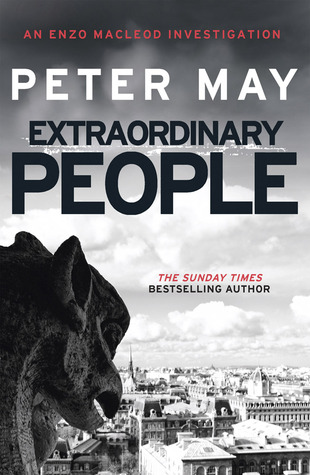
Extraordinary People by Peter May

Extraordinary People (The Enzo Files, #1)

I loved Peter May’s Lewis trilogy and I also enjoyed his standalone book, Entry Island, so I decided to read Extraordinary People, the first in his Enzo Files series when I saw a copy in a secondhand bookshop (along with the second in the series, The Critic). They are both TBR books.

Set in France the action moves between various locations, but is mainly in Paris, as Enzo Macleod tries to solve a cold case mystery, that of the disappearance and presumed death of Jacques Gaillard, an eminent professor, 10 years earlier. Enzo is trained as forensic scientist, who is now a professor of  biology at a university in Toulouse. He has taken a bet that he can solve seven of the most notorious murders, using modern technology. Journalist Roger Raffin had originally researched the Gaillard case and shares his information with Enzo and accompanies him on the search.

It helps that a metal trunk had been found in the catacombs under the Place d’Italie, containing a skull and a number of apparently unconnected items. Enzo succeeds in establishing that it is Gaillard’s skull and using the items in the trunk as clues begins the search for the rest of his skeleton. This takes the form of internet searches, DNA investigations and leaps of intuition, ending up in a dramatic scene back in the Paris catacombs. Enzo’s own life is in danger and that of his elder daughter, Kirsty.

There is quite a lot about Enzo and his family background. He is of Scottish/Italian parents, with a complicated personal life. He has two daughters, by different mothers. Kirsty refuses to have anything to do with him, whereas Sophie who dotes on him, lives with him, whilst Enzo can’t stand her boyfriend.

I had a couple of small issues with this book. It takes the form of a puzzle and a chase to find the culprit, much in the same vein as Dan Brown’s books. I did find it rather implausible that the murderer would have left such specific clues and although Enzo does raise the question of why anyone would do that, it’s never properly answered (to my mind at least).

I also questioned why the French police ordered him to leave the investigation solely to them without using his obvious skills and knowledge (there is a reason for that, which I quickly surmised).

Another little niggle is the way May interspersed the text with French words for some items, but not others – the word séjour is used a lot but other rooms such as ‘bedroom’, ‘hall’ are in English – a minor quibble I know, but each time I read it I wondered why.

But, having said all that I did like the book, it’s very readable and I learned a lot about Paris and its catacombs.

  • My copy: published in GB in 2014 by Quercus Editions Ltd, 420 pages
  • Source: I bought a secondhand paperback copy
  • My rating: 3* (it would have been 4*, but for the leaps of intuition and other small issues I had with this book)

Reading Challenges: my 3rd book for the RIP 2017 challenge and my 20th book for Bev’s Mount TBR 2017.

First Chapter First Paragraph: A Darker Domain

Every Tuesday Diane at Bibliophile by the Sea hosts First Chapter First Paragraph Tuesday Intros to share the first paragraph sometimes two, of a book that she’s reading or planning to read soon.

This week’s first paragraph is from one of the library books I featured in my last post. A Darker Domain by Val McDermid, the second Karen Pirie book.

A Darker Domain (Karen Pirie, #2)


It begins:

Wednesday 23 January 1985; Newton of Wemyss

The voice is soft, like the darkness that encloses them. ‘You ready?’

‘As I’ll ever be.’

‘You’ve told her what to do?’ Words tumbling now, tripping over each other, a single stumble of sounds.

‘Don’t worry. She knows what’s what. She’s under no illusions about who’s going to carry the can if this goes wrong.’ Sharp words, sharp tone. ‘She’s not the one I’m worrying about.’

Blurb (fromAmazon):

Val McDermid, creator of TV’s Wire in the Blood, mixes fact with fiction, dealing with one of the most important and symbolic moments in recent history.

Twenty-five years ago, the daughter of the richest man in Scotland and her baby son were kidnapped and held to ransom. But Catriona Grant ended up dead and little Adam’s fate has remained a mystery ever since. When a new clue is discovered in a deserted Tuscan villa – along with grisly evidence of a recent murder – cold case expert DI Karen Pirie is assigned to follow the trail.

She’s already working a case from the same year. During the Miners’ Strike of 1984, pit worker Mick Prentice vanished. He was presumed to have broken ranks and fled south with other ‘scabs’… but Karen finds that the reported events of that night don’t add up. Where did he really go? And is there a link to the Grant mystery?

The truth is stranger – and far darker – than fiction.

I’ve only recently become a fan of Val McDermid’s books and wish that I’d started reading them years ago.

What do think? Have you read this one or any of her other books? Would you keep on reading?


Library Books

I reserved these books over the last few months and, wouldn’t you know it, they all arrived practically together!

IMG_20170925_190629502[1]

A Darker Domain by Val McDermid. This is the second Karen Pirie book. I’ve borrowed it because I loved the first one, The Distant Echo. In 1984, in Fife, heiress Catriona Maclennan Grant & her baby son are kidnapped. The ransom payoff goes horribly wrong. She is killed while her son disappears without trace. 2008, Tuscany. A jogger stumbles upon dramatic new evidence that re-opens the cold case. For Detective Sergeant Karen Pirie, it’s an opportunity to make her mark.

Conclave by Robert Harris – I’ve thoroughly enjoyed other books by Robert Harris, so I’m keen to read this one about how a new Pope is chosen as the cardinals meet in the Sistine chapel to cast their votes. This is a novel and Harris depicts the cardinals as holy men – but ambitious and rivals to become the most powerful spiritual figure on earth.

The Hidden Life of Trees:What They Feel, How They Communicate – Discoveries from a Secret World by Peter Wohlleben. I read Katrina’s review of this book and immediately thought it sounded an amazing book as I love trees. Wohlleben is a German forester and his book is about his love of trees and why they matter on a global scale. He makes the case that the forest is a social network – I like the idea that they communicate with each other – even if they don’t actually walk and talk like Tolkien’s ents.

Days Without End by Sebastian Barry – I loved his book, The Secret Scripture and am hoping I’ll like this one too. Thomas McNulty and John Coles signed up for the US army in the 1850s and fought in the Indian Wars and then in the American Civil War. The book was awarded the Costa Book Award 2016 and won the 2017 Walter Scott Prize. It was also longlisted for the Man Booker Prize 2017 – not that winning these awards automatically means that I’ll like it and I’m often not keen on books about war.

The Taxidermist’s Daughter by Kate Mosse

The Taxidermist's Daughter

Publication date: September 2015, Orion Books

Source: my own copy

Rating: 3*

The Taxidermist’s Daughter is a difficult book to review without giving away too much detail particularly about the element that almost made me stop reading and because of that I was in two minds what rating to give it. The main thing that I didn’t like is all the detail about taxidermy – and there is a lot of detail. I found its gruesome application in this book absolutely sickening. But I still read on, such is the strength of Kate Mosse’s ghoulish storytelling.

Blurb (from the back cover):

1912. A Sussex churchyard. Villagers gather on the night when the ghosts of those who will not survive the coming year are thought to walk. And in the shadows, a woman lies dead.

As the flood waters rise, Connie Gifford is marooned in a decaying house with her increasingly tormented father. He drinks to escape the past, but an accident has robbed her of her most significant childhood memories. Until the disturbance at the church awakens fragments of those vanished years . . .

Connie Gifford is the taxidermist’s daughter and she has grown up learning the art of taxidermy, taking over from her father who is a hopeless drunk. Her mother had died giving birth to her and there had been an accident when she was twelve (ten years earlier), which had almost completely wiped the first twelve years of her life from her mind.

The book began well, full of atmosphere, set in the Fishbourne Marshes and the tidal estuary in West Sussex (where Kate Mosse grew up), with Gothic overtones and hints of dark and terrible secrets and revenge. There is the mystery of the dead woman who has been garroted – who was she? What, or who haunts Connie’s father? What had happened to Connie when she was twelve, and who was the girl Connie vaguely remembers – older than her, with a love of life and a yellow ribbon in her hair? She experiences strange episodes where she feels herself falling out of time, spinning and flying through the air – episodes full of menace and threat.

But it dragged in the middle, with too many indistinct male characters and even though there is a map showing the layout of Fishbourne in 1912 I had difficulty in following the location of the action, nor could I work out how quickly they seemed to be able to travel between the various houses and Chichester.

It ends dramatically in death and destruction, with all the strands of the story coming together, one dark and stormy night. The waters rise, as the banks of the rivers, streams, the mill pond and the sluice gates break, flooding the whole area. Connie’s memories too come flooding back as the wind and rain join the thundering torrent of the flood water.

After a while though too much was foreshadowed and the story became rather predictable, which lessened the tension. Its gruesomeness however will stay with me for quite a while.

Reading Challenges: Mount TBR 2017 and R.I.P. 2017

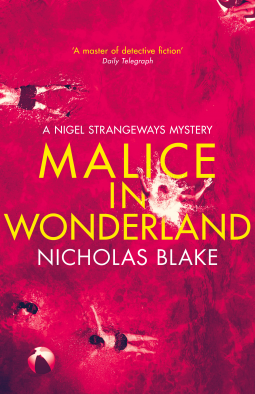
Malice in Wonderland by Nicholas Blake

A Golden Age Mystery

Published: 2017, Ipso Books. First published in 1940, Collins UK (The Crime Club)

Source: Review copy via NetGalley

My rating: 4*

I really enjoyed Malice in Wonderland by Nicholas Blake*. It’s a Golden Age mystery first published in the UK in 1940; in the US as The Summer Camp Mystery, later in 1971 as Malice with Murder; and in 1987, as Murder with Malice.

There are several allusions to Lewis Carroll’s Alice’s Adventures in Wonderland. The train to Wonderland plunges into a tunnel, just as Alice enters Wonderland through a rabbit hole. But in this case Wonderland is a holiday camp, set on a cliff top overlooking the sea. And all is not well in Wonderland as there is a prankster in the camp , the self-styled ‘Mad Hatter’, who is playing nasty and cruel practical jokes on the holiday makers. Swimmers are ducked in the sea and held down, tennis balls are coated in treacle, left with a note that refers to a part of dormouse’s story in Alice in Wonderland. Then the jokes get more dangerous. The camp’s owners are concerned not just for the guests but also for their business as they fear a rival firm with a grudge against the company is trying to ruin them.

There are hundreds of visitors at Wonderland, but the action revolves around a few characters including Paul Perry, a young man who calls himself a scientist, but who is there taking notes for the Mass Observation project, Mr and Mrs Thistlethwaite and their teenage daughter, Sally, Albert Morley, a timid little man, brothers Mortimer and Teddy Wise, the camp’s managers, their secretary Esmeralda Jones and Nigel Strangeways, a private detective.

Like other Golden Age mysteries, Malice in Wonderland presents a puzzle, plenty of suspects, clues planted along the way and a detective who solves the puzzle. It also presents a picture of life just before the Second World War, the social attitudes and in particular the beginnings of the holiday camps. By the 1930s there were several camps, including Warners and Butlins, at seaside locations. Wonderland has dining-halls presenting food cooked by London chefs, a ballroom, bars, an indoor swimming-bath, a concert hall, a gymnasium and numerous playrooms, plus a programme of entertainment with professional hosts and hostesses. It’s described as ‘the biggest, brightest and most ambitious of all the holiday camps that had sprung up over England during the last year or two.’

I loved the setting, the interesting characters, and the fiendishly difficult mystery to solve (I only solved it just before the denouement). And it’s well written with humour and style.

*Nicholas Blake was the pseudonym of Poet Laureate Cecil Day-Lewis (1904 – 1972), one of the leading British poets of the 1930s. He published his first Nigel Strangeways detective novel, A Question of Proof in 1935. Malice in Wonderland is the 6th in the series.

My thanks to the publisher for a digital ARC via NetGalley.

Amazon UK