Agatha Raisin and the Haunted House

I’ve not been around much on my blog this week, time out for looking after grandchildren in Scotland for one thing. I have still been reading, though I didn’t take Wolf Hall away with me as I knew I wouldn’t be able to concentrate much on reading and Wolf Hall deserves that.

I read a much less substantial book – Agatha Raisin and the Haunted House by M C Beaton. I’ve only read one of her books before, Death of a Gossip, which I thought was awful. I decided to give her books another go as I know other people enjoy the Agatha Raisin series. I’m sorry to say that I wasn’t enthralled by this book. It’s number 14 in the series, but I know a bit about the earlier books from an article in newbooks Crime Supplement, so it wasn’t difficult to follow. It’s definitely a ‘cozy’ mystery with three deaths for Agatha to resolve. An old woman reports that her house is haunted and is later found murdered. More deaths follow.

Agatha Raisin is an amateur sleuth and a very amateur one indeed. She blunders around and every now and then lands on something relevant. But this book is all rather silly and Agatha herself is a silly woman. It’s like reading an Enid Blyton book for not so very grown up adolescents, as she goes ga-ga over her new neighbour, Paul a married man, repeatedly changing her clothes and renewing her make-up to  catch his eye. Then there is the haunted house and a secret passage, reminding me of the Famous Five etc. For example she and Paul hide behind a hedge at dead of night keeping watch, stumble around in the garden trying to find the entrance to the secret passage and even worse, Agatha dressed up in a bright red wig and a long droopy tea-dress goes out at two in the morning to push a note through the police station door. I could go on … and  …. on.

So, a second book by M C Beaton hasn’t made me want to read any more.

Library Loot

I hadn’t intended to borrow any more library books for a while, at least until I’ve read at least half of the ones I’ve got out at present. But on Thursday I was watering the hanging basket at the front door and glancing down the road saw a mobile library van. We moved here in December and this was the first time I’d seen it. Needless to say I went across the road to have a look and came away with four books. It comes here every three weeks! So now I have three libraries locally that I can use – I’m spoilt for choice.

One of the books I borrowed is a great source of writers: Myers’ Literary Guide The North East. This includes not just writers born in the North East, which includes the counties of Northumberland, Tyne and Wear, Durham, and Cleveland, but also writers with important links to the area. These include such people as Wordsworth, Shakespeare, Coleridge, Auden and Larkin. This area of Britain boasts the first known writer of English prose – Bede (673 – 735) who was also known as ‘The Father of English History’ – and the first Christian English poet, Caedmon (fl. 670 – 680), a servant at the monastery in Whitby. The only drawback is that it concentrates on historical rather than modern writers.

I also borrowed:

  • Agatha Raisin and the Haunted House by M C Beaton. This was quite opportune because I’d read an article about Agatha in newbooks Crime Fiction Supplement the other day. The victim of the haunting is an old lady nobody likes. Then she is murdered. This looks as if it sits in the Cozy Mystery genre.
  • Indiscretion by Jude Morgan, who was also mentioned in the Supplement, so maybe that’s why one of his books stood out for me. This one is historical fiction set in Regency England.
  • The Cruellest Month: an Inspector Gamache Crime Novel by Louise Perry. I keep seeing her books mentioned on book blogs but haven’t read any of them yet. This is a Canadian whodunit about a seance in an old abandoned house that has gone wrong. Another Cozy Mystery?

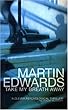
Take My Breath Away by Martin Edwards

Take My Breath Away by Martin Edwards is a legal mystery, featuring Nic Gabriel, a lawyer turned writer, who is investigating the death of his friend Dylan Rees. Nic is transfixed by the sight of Ella, a woman who had apparently died five years earlier, walking up to Dylan at a party and stabbing him. Dylan had already intrigued him with stories about ‘strange and sudden deaths’ and had promised to tell him the details after the party:

This was all Dylan’s fault. Dylan who had seduced him with all that talk about dead lawyers. Dylan the yarn-spinner; the myth-maker, the Celtic bard in an Armani suit. Of course he’d known that Nic could never resist a story about strange and sudden deaths.

The rich man who burned in Paradise. The giant who chopped himself in half. (page 15)

 I kept turning back to this passage in the first chapter as Nic delved into the mystery, and also this one:

There was a connection, Dylan had insisted on the phone, and not just because the dead men were lawyers in the same firm. Forget about suicide or accident. Think murder for pleasure.

‘As for the boy who died of shock’, Dylan said dreamily, ‘the real culprit wasn’t the guilty creature who killed him. Trust me.’ (page 15)

At the same time Roxanne Wake begins her new job with Creed, a firm of lawyers specialising in human rights law. She’s nervous and it’s not just the new job, because she has something to hide, something she’s not told Creed, something terrible. However, someone knows her secret and it seems she’ll go to any lengths to prevent it becoming known. Eventually the two strands of the book coincide in a dramatic conclusion.  There are many twists and turns and it kept me guessing to the end.

Like all good murder mysteries this is a complex book about good and evil, about power and manipulation, about secrets, lies and deception. It’s a stand-alone book, but I hope that some time Martin will write another book about Nic as I’d love to know his back story and what really happened to his parents.

For more details about Martin’s books see his website. He also writes an entertaining blog – Do you Write Under Your Own Name?

More Crime Fiction

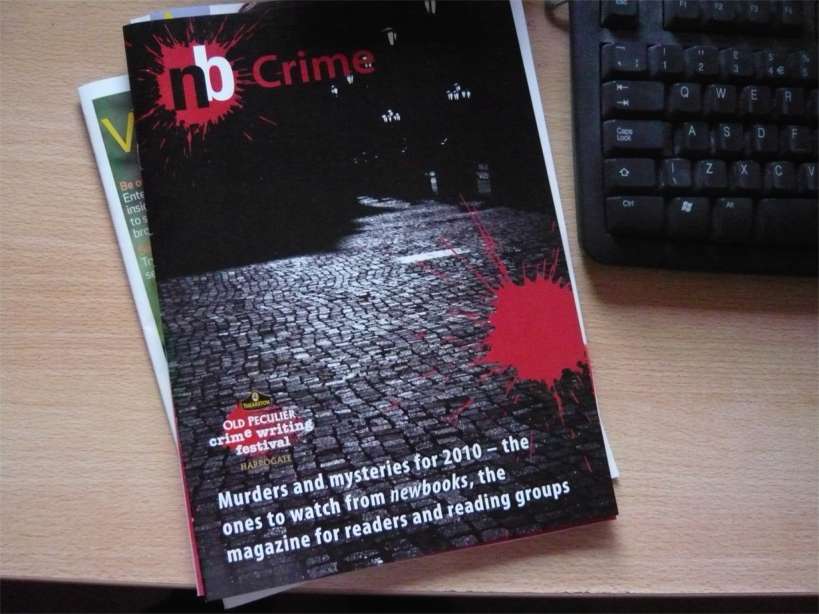
The current issue of newbooks magazine included a Crime Supplement, which I’ve just got round to looking at. This is a really useful source of information on crime fiction for someone like me who has only relatively recently ventured into this genre. In the past my knowledge of crime fiction has been rather limited, although it did expanded rapidly over the last 8 months through taking part in Kerrie’s Crime Fiction Alphabet.

In this supplement a few books caught my eye, all by writers who are new to me, such as:

  • Instruments of Darkness by Imogen Robertson. This is her first novel, described as an eighteenth-century manor house murder mystery. The manor house in question is Thornleigh Hall, the seat of the Earl of Sussex and the murder mystery concerns a dead man found with his throat has cut and the death of Alexander Adams killed in a London music shop.
  • A Time of Mourning by Christobel Kent. This is set in a rainy Florence, a menacing and dark story of the death of  an elderly Jewish architect and the disappearance of a young English art student. As private detective Sandro Cellini investigates the cases the connections between them get increasingly complex.
  • Two more historical whodunnits by Shirley McKay –  Hue and Cry and Fate and Fortune, both set in Edinburgh in the sixteenth century. These are the Hew Cullen Mysteries. In Fate and Fortune Hew is reluctant to follow in his father’s footsteps as a lawyer and ends up in the middle of a long-hidden mystery, an abduction and a brutal murder.
  • No Sorrow to Die by Gillian Galbraith. Another book set in Edinburgh, this one featuring Dectective Sergeant Alice Rice investigating a murder in the course of a burglary that is complicated by the fact that the victim was terminally ill.

There are articles by and about authors such as barrister-turned-author M R Hall, and a “Biography of Agatha Raisin“, M C Beaton’s fictional sleuth. I’ve only read one Agatha Raisin book and wasn’t impressed. Maybe I should give them another chance as apparently they are very popular books – there are plenty of them!

Then there is the programme of  2010 Theakstons Old Peculier Crime Writing Festival in Harrogate 0n 22 – 25 July with a whole host of crime fiction writers, including Ian Rankin, Val McDermid and Joanne Harris. Full details are at www.harrogate-festival.org.uk/crime. I’m not going but I’d love to be there.

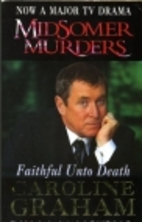
Faithful Unto Death by Caroline Graham


Faithful Unto Death (Misomer Murders -€¦Faithful Unto Death by Caroline Graham is a Midsomer Murder Mystery. I’ve enjoyed watching the TV series over the years. Midsomer is obviously a dangerous place to live with all those murders happening so regularly, but they are not the gory kind – it’s murder of a sanitised nature. Inspector Barnaby is a genial character, although an astute detective, one who is not quite up to date with modern police methods but relies on intuition and thinking.

So I was a bit surprised reading this book that the characters are a bit different, especially Sergeant Troy who is nothing like the TV character. On TV Troy was a bit naive and usually didn’t have much of a clue about solving the murders, but a likeable chap who got on OK with Barnaby. Troy in the book is sharper, meaner, spiteful and inwardly critical of Barnaby. He’s insecure, resentful and sees any creative or intellectual prowess in others as a criticism of his own life.

Set in Fawcett Green, an unspoilt peaceful village the book begins with the disappearance of Simone Hollingsworth, soon followed by her distraught husband’s death, apparently suicide, then the disappearance of their neighbour’s daughter. Barnaby and Troy, with the doubtful assistance of the local policeman Constable Perrot work their way through interviewing the village’s inhabitants and gradually unravel the mystery.

It’s an entertaining and satisfying book, full of detail and clues as to the eventual outcome, which I did work out before the end. The characters stand out as real people, and are described with humour and empathy. I don’t remember seeing this on TV but reading about it online it seems it’s differed from the book, so that’s not too surprising. As in the TV version Barnaby is a patient, tolerant man,  also a bit grumpy and moody, who is trying and failing to lose weight, and who loves music. So many fictional detectives seem to like music and food!

This is the first Midsomer Murder mystery I’ve read and much as I like the TV series I prefer the book version – it has more bite and more substance. I’m taking part in the Cozy Mystery Challenge and although I’m still not too sure about the classification of “cozy” murder mysteries, I think this book can count as one.

Passenger to Frankfurt by Agatha Christie: Book Review

Passenger to Frankfurt 001

Passenger to Frankfurt is unlike any other Agatha Christie book I’ve read. It was first published in 1970, the year she was 80, as her “eightieth” title, although she had written more than that.

It rambles on a lot, has many characters, and at times I wondered what it was all about. I decided that it was best not to think of it as an Agatha Christie crime novel, but rather as a collection of her thoughts about life and the society she had lived through, with a bit of intrigue thrown into the mix.

It begins well, with Sir Stafford Nye, a diplomat on his way back to London, sitting in an airport lounge in Frankfurt. He was thinking that “life and journeys by air were really excessively boring” when he met a dark haired woman whose life was in danger and his own life changed for ever. The woman wanted his passport to get her safely to London, disguised by his dark purply-blue cloak with its scarlet lining and hood.  He agreed.

So far, so good. From then on Sir Stafford is dragged along, somewhat unwillingly at first into a world of espionage, and world-wide organisations dedicated to anarchy and violence, all mixed with strains from Wagner – with the Young Siegfried – and Nazism. It’s a bleak picture of the world with money and the power of money perverting young people world wide, following blindly like the children beguiled by the Pied Piper of Hamelin.

I never really got the impression that many of the characters were real, apart from Sir Stafford his Great-Aunt Matilda and the young lady known as either Daphne Theodofanous, or Mary Ann or Countess Zenata Zerkowski. Great-Aunt Matilda is a very verbose lady who tells him that things are in a very bad mess  and “once people learn to love destruction for its own sake, evil leadership gets its chance.” Cynically she also comments that politicians are not to be trusted:

And one can’t help coming to the conclusion that politicians have a feeling that they have a kind of divine right to tell lies in a good cause. (page 80)

Sir Stafford doesn’t really know who he can trust, or who is playing a double game. It’s his sense of humour that is in the way of his career that makes him useful in discovering what is going on – he’s not a hero-worshipper and can see through humbug. The power some people wield through their personality is vital in enthusing people with their vision but it’s also dangerous:

It’s the magnetic power that a few men have of starting something, of producing and creating a vision. By their personal magnetism perhaps, a tone of voice, perhaps some emanation that comes forth straight from the flesh. …

Such people have power. The great religious teachers had this power, and so has an evil spirit power also. (pages 106 -7)

I find myself rambling as I think and write about this book. It does get rather repetitive with it’s pessimistic emphasis on a

growing organisation of youth everywhere against their mode of government; against their parental customs, against very often the religions in which they have been brought up. There is the insidious cult of permissiveness, there is the increasing cult of violence. Violence not as a means of gaining money but violence for the love of violence. (page 113)

It certainly is not representative of Agatha Christie’s books and not one I’d recommend to anyone who hasn’t read any of her books. Although there is a degree of pessimism and cynicism running through it there is also a strain of humour, a sense that you shouldn’t take it all too seriously and I did enjoy it. Sir Stafford is the best portrayed character and as Agatha Christie has him say:

One cannot go entirely through life taking oneself and other people seriously. (page 43)