Monday Musings is hosted by Should Be Reading.
This week’s question is:
What are you currently reading? Would you recommend it to others? Is it part of a series (if so, which one)? What are you thinking about it? What book(s) would you compare it to, if any?
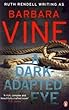 Currently I’m reading A Dark Adapted Eye by Barbara Vine. I think it’s the first one Ruth Rendell wrote under the pseudonym Barbara Vine. I’m still in the opening chapters and working out the relationships between the characters. It’s a psychological crime novel about a family with secrets. The blurb reads:
Brilliantly plotted. Vine is not afraid to walk down the mean streets of the mind and can build up an almost tangile atmosphere of menace and unease. (Daily Telegraph)
It’s not part of a series, although the Vine books are all psychological crime novels and from what I’ve read so far I would certainly recommend it if you like that sort of book.
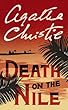 I’m also reading Death on the Nile by Agatha Christie, featuring Hercule Poirot. I haven’t read this before, although I’ve seen the film with Peter Ustinov as Poirot and the TV version starring David Suchet, so as I’m reading it I’m remembering what happens and can visualise the setting in Egypt on the Nile alongside the Pyramids. I like the way Christie sets up so many possible suspects and then reveals how each one couldn’t be the murderer. I think I remember who did it, and how – but I could be wrong. As I like Agatha Christie I’d recommend any of her books, and this one is a classic.
 I have a third book on the go, although at present it’s lagging behind as I’m enjoying the other two books so much. It’s Portrait of an Unknown Woman by Vanora Bennett, historical fiction set in Tudor England (Henry VIII) with Thomas More’s family. That’s not to say that I’m not enjoying this book, but it’s quite slow to get going – or rather I’m slow at reading it, because it is quite detailed and not a lot happens at first.
It covers the same period as Wolf Hall by Hilary Mantel, when Henry VIII wants a divorce from Katherine of Aragon to marry Anne Boleyn, but there is little comparison between these two books apart from that. I suppose I’d compare it to Philippa Gregory’s books. And if you like detailed and well-researched historical fiction, then it is for you.



 The Reivers were romanticised by Sir Walter Scott, who gave them ‘the spit-and -polish treatment’ and a ‘romantic bearing and heroic stature.’ Robson also sheds light on the derivation of words, such as ‘reiver’: a ‘reef” in Old English meant a line, a Shire Reeve was a man who protected boundaries, thus the reiver raided across the Border Line. ‘Blackmail’ has two possible derivations – greenmail was agricultural rent and blackmail was money taken at night, or protection money. Alternatively it could be that it came from the fact that the reivers blacked their armour to ride as shadows in the moonlight (page 49). I prefer the alternative derivation.