Library Loot

It’s been a while since I did a Library Loot post. This is my latest haul from the Mobile Library that called round this morning (as usual click on the photo to enlarge):

I really appreciate the mobile library service, the van stops just along the road from our house and has a varied, if small selection of books. I chose:

  • The Lighthouse by P D James, an Adam Dalgleish mystery, set in an imaginary, remote island off the Cornish coast.  It’s been a few years since I read one of P D James’s books – I hope it won’t disappoint.
  • Have Mercy On Us All by Fred Vargas. I haven’t read any of his books before. According to the blurb on the back cover this is ‘an unusual and eccentric thriller’  and Adamsberg is ‘one of the most fetchingly weird detectives … a bit like Morse, but much more French.’ That’s odd as Morse isn’t a bit French!  I’m not sure I’ll like it, but that’s the beauty of library books – I don’t mind giving up on them. On the other hand, if I buy a book that’s very disappointing.
  • The Scent of the Night by Andrea Camilleri, an Inspector Montalbano Mystery. I’ve read one of his before which I enjoyed, so I have high hopes for this one.

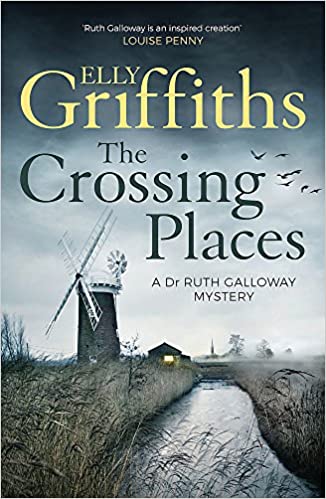
The Crossing Places by Elly Griffiths: Book Review

When I started reading The Crossing Places by Elly Griffiths I nearly didn’t bother carrying on because it’s written in the present tense, but I’m glad I did because I did enjoy it and at times didn’t even notice the tense. This is a debut crime fiction novel, even though it’s not the author’s first book.

Set in Norfolk it’s an interesting mix of investigations into a cold case – the disappearance of Lucy, a five year old girl ten years earlier and a current case of another missing four year old girl. Are they connected and just how does the discovery of a child’s bones from the Iron Age fit in? The police ask Dr Ruth Galloway, who lectures in archaeology at the local university and lives near the finds in a remote cottage at Saltmarsh overlooking the North Sea, to date the bones. She becomes more involved when DI Harry Nelson asks her to look at the anonymous letters the police have received ever since Lucy disappeared – strange letters full of archaeological, biblical and literary references, taunting the police about Lucy’s whereabouts and details of ritual sacrifice.

There’s a satisfying amount of information about Ruth’s earlier life and just enough about the archaeological digs to whet my appetite, plus some whacky characters like Cathbad who lives in a decrepit caravan on the beach. I liked Harry Nelson, a gruff northerner obsessed by Lucy’s disappearance and I became very fond of Ruth, an overweight woman nearing forty who lives on her own with two cats. I found the setting in Norfolk  in winter with its immense skies was very atmospheric – its remoteness, treacherous mud flats, marshlands and driving rain made feel as though I was there. In fact there were parts of the story involving quicksand that reminded me of Wilkie Collins’s The Moonstone, in which Rosanna Spearman drowns in quicksand on the marshes and there is a remarkable similarity between the names of Sergeant Cuff (in The Moonstone) and Sergeant Clough (in The Crossing Places).

The mystery isn’t too difficult to solve and I’d guessed the culprit quite early on in the book, so the ending wasn’t a surprise. I thought there were maybe just one too many coincidences in the connections between the characters, but none of this spoilt the book for me and I’m adding the next Ruth Galloway book, The Janus Stone to my list of books to look out for.

The Mystery of the Blue Train by Agatha Christie: Book Review

Agatha Christie didn’t enjoy writing The Mystery of the Blue Train (first published in 1928). In her autobiography she wrote that it had not been easy writing it and that she had always “hated” it:

To begin with I had no joy in writing, no élan. I had worked out the plot – a conventional plot, partly adapted from one of my other stories. I knew, as one might say, where I was going, but I could not see the scene in my mind’s eye, and the people would not come alive. I was driven on by the desire, indeed the necessity, to write another book and make some money.

That was the moment when I changed from being an amateur to a professional. I assumed the burden of a profession, which is to write even when you don’t want to, don’t much like what you are writing and aren’t writing particularly well. (pages 368-9)
As she was writing this book at the time of her disappearance and divorce from her first husband, Archibald Christie it’s hardly surprising. It may not be her best book, but it’s still a good read. Ruth Kettering, the daughter of millionaire Rufus Van Aldin, is married to Derek, against her father’s advice. Agatha’s views on divorce are clear when Van Aldin tells Ruth she should divorce Derek, who he thinks is no good, rotten through and through and had only married her for her money, saying:

Have you got the grit to admit to all the world that you’ve made a mistake. There’s only one way out of this mess, Ruthie. Cut your losses and start afresh. (page 20)

Later Ruth is found strangled in her compartment in the Paris-Nice train, known as the train bleu, on its arrival in Nice and the fabulous ruby, the Heart of Fire that Van Aldin had given her, has been stolen. Fortunately Hercule Poirot is also travelling on the train and he of course unravels the mystery. There are a number of suspects ranging from Derek and his mistress, the dancer Mirelle, who had both the motive and the opportunity, to Ruth’s lover, the Comte de la Roche, suspected of stealing the jewels.

I liked the reflections on detective novels through a conversation Poirot has with another passenger on the train, Katherine Grey, from St Mary Mead who has inherited money from her employer. She is reading a roman policier when they meet at dinner and Poirot comments that they always sell well. She replies that may be because they give ‘the illusion of living an exciting life’ and that ‘nothing of that kind ever happens to me.‘ From then on however, she is drawn into the mystery along with Poirot, that

 small man, distinctly foreign in appearance, with a rigidly waxed moustache and an egg-shaped head which he carried rather on one side. (page 80)

It may be that Poirot is a bit of a caricature in this book, but the characters are in the main believable and the book certainly has a 1920s feel to it.

Sunday Salon – Crime Fiction

Today I’ve been dipping into The Rough Guide to Crime Fiction by Barry Forshaw, published in 2007. This is an excellent little book giving “a selection of the best in crime writing over the last century or so, organized by subject (or sub-genre)”.  There are succinct book reviews, ‘top five’ lists for writers such as Agatha Christie, notes on screen adaptations and profiles of writers.

I suppose all guides are subjective and not everyone will agree on the selection, but for me this works, with information on writers whose books I know and those I don’t. I could wish it had a section on ‘cozy mysteries’ but it doesn’t!

There are sections on

  • The origins of crime novels, including Edgar Allan Poe, Wilkie Collins and Arthur Conan Doyle
  • The Golden Age, classic mysteries from authors I know, such as Christie, Allingham and Tey and from ones I don’t such as Christianna Brand and Edmund Crispin.
  • Hardboiled and pulp – a hazardous world of carnality and danger, violent and brutal. Not really my cup of tea, but there are some classics here too – Raymond Chandler and The Big Sleep.
  • Private eyes, sleuths and gumshoes – in this section are Kate Atkinson, Michael Connelly and Alexander McCall Smith to name but a few.
  • Cops – police procedurals and mavericks. This includes the maverick cops, those loose canons at daggers drawn with their superiors, like Ian Rankin’s Rebus. It’s a long section covering authors both known and unknown to me – too many to list here, but including Jon Cleary, Colin Dexter and Ed McBain.
  • Professionals – lawyers, doctors, forensics etc. So, John Grisham, Val McDermid and Scott Turow et al feature here.
  • Amateurs – journalists and innocent bystanders. These are books that don’t fit easily into other genres, exploring the human psyche by for example authors as varied as Christopher Brookmyre and G K Chesterton, Dick Francis and Michael Ridpath.
  • All in the Mind – psychological matters. This chapter includes books that ‘foreground the psychology of their characters in extremis’, such as Iain Banks ‘The Wasp Factory’ and Strangers on a Train by Patricia Highsmith.
  • Serial killers – Thomas Harris (Hannibal Lector) and Karen Slaughter (Faithless) – not a genre that I’m comfortable with, one for me to skip over maybe.
  • Criminal protagonists taking the reader into the heads of criminals. I haven’t read any of the books in this section, books like Maura’s Game by Martina Cole and Night and the City by Gerald Kersh.
  • Organized Crime – the world of the godfather and gangs. Another new-to-me genre, more familiar to me from films, such as The Gangs of New York – I didn’t know it was based on Herbert Asbury’s series of books on 19th century crime.
  • Crime and Society – key issues such as class, race and politics, from writers such as P D James in Britain and Michael Crichton in the US.
  • Espionage – John Le Carre, Len Deighton and Ian Fleming to name but a few.
  • Historical crime – one of my favourite genres from Ancient Rome (Lindsay Davis and Steven Saylor), Medieval murder (Michael Jecks) and World War thrillers from Robert Ryan and Robert Harris. Here is one of my favourites – C J Sansom (Shardlake) and new-to me Jane Jakeman who wrote In the Kingdom of the Mists, which appeals to me with the Impressionist painter, Monet at the centre of the mysteries – I must find this one.
  • Crime in Translation – some of these are familiar, like Umberto Eco, Andre Camilleri, and Henning Mankell. No Stieg Larsson, though. It maybe that his books came out too late for this guide, I don’t know.

Snapped in Cornwall by Janie Bolitho

Snapped in Cornwall by Janie Bolitho is a quick, light read in the ‘cozy mystery’ category. I had high hopes that this was going to be a really good book because the start sets the scene so well, but it didn’t quite meet my expectations and tailed off towards the end. Gabrielle Milton has recently moved to Gwithian in Cornwall, whilst Dennis, her husband spends his working week in a London flat. She employs Rose Trevelyan to photograph her house for her personalised Christmas cards. Rose, a photographer and artist is a widow in her forties, still recovering from the death of her husband four years earlier. When Gabrielle invites her to a party for old friends from London and the new people she’s met in Cornwall, even though the anniversary of her husband’s death is approaching Rose decides to go.

Dennis has been having an affair with Maggie. He wants to end the relationship but she doesn’t. The Cornwall house belongs to his wife and he is in danger of losing his job – his life is at a crossroads. He’s not pleased when Maggie turns up at the party. Also at the party are Paul, their son and his fiancee, Anna.  All in all, there’s an uncomfortable atmosphere, made worse as Paul and Anna are in the middle of an argument. Rose retreats into the garden where she finds Gabrielle’s body beneath the bedroom balcony. Why would anyone want to kill her? Was it her husband or his mistress?  Maybe it was her son or his fiancée who thought they would inherit the house, or maybe  it was Eileen Penrose, a local woman who thought her husband was having an affair with Gabrielle.

Rose finds herself drawn into the investigations, which brings her into contact with DI Jack Pearce. Inevitably relationships and secrets in the Milton family and the locals are gradually brought into the open, but the ending was rather predictable and straight forward. Nor was it surprising that Rose and Jack found themselves attracted to each other. Nevertheless the descriptions of Cornwall are good and it was the right book for a quick, easy read.

 This is the first book in Janie Bolitho’s series of mysteries featuring Rose Trevelyan, now published in an omnibus edition as The Cornish Novels.
Revenge Served Cold by Jackie Fullerton

Revenge Served Cold by Jackie Fullerton was kindly sent to me by the publishers, Thomas House Publishing. It’s her second book featuring Anne Marshall, a part-time court reporter and law student. I think it slots into the “cozy mystery” category, with the crime being solved by amateur sleuths rather than the police, who are always one step behind. If  there is a category for “paranormal crime fiction” that applies too. In some respects it reminded me of that TV series – Randall and Hopkirk (Deceased), a remake with Vic Reeves of a 60s TV series about private detectives, one of whom was dead and appearing in a white suit could only be seen by his partner.

Anne’s father died three years earlier, and his ghost appears to her, helping her to solve crimes. She is the only person who can see him, although others can smell his pipe tobacco. The book begins with the death of Professor Elliot Spence, Anne’s law lecturer and her father’s former colleague, when a car apparently driven by Kathy, Elliot’s wife runs him down.

Kathy’s friend Shirley, who works with Anne at the law courts, convinces her of Kathy’s innocence and Anne together with her fellow law students start looking for evidence to prove it. Her father also helps, which really means that you have to suspend your disbelief in following everything that happens. As a ghost he is able to be at police interviews unseen, and report back to Anne thus giving her information she wouldn’t otherwise have and also send text messages on her phone. One thing  that made me pause for thought is that at one point he breathed a sigh – ghosts can’t breathe as far as can tell, but if I can accept his presence in the story I also have to accept that he can breathe and smoke and chat to Anne.

I found this a light and entertaining book and although I found the style stilted in parts, with too many short sentences and repetitive, it moves along at a rapid pace. Even though it was obvious early on who killed Elliot Spence there were enough plot twists and turns to hold my interest in the story to its dramatic ending.