Agatha Christie Reading Challenge Update

The Agatha Christie Reading Challenge is run by Kerrie at Mysteries in Paradise. It’s an open-ended challenge to read all of Agatha Christie’s books. I’m not attempting to read them in order (as Kerrie is doing) but reading them as I find them. So far I have read her Autobiography, 25 of her full length books and 2 of the collections of her short stories:

Progress in publication date order (the links are to my posts on the books):

  1. 1920 The Mysterious Affair At Styles
  2. 1922 The Secret Adversary
  3. 1924 The Man in the Brown Suit
  4. 1926 The Murder of Roger Ackroyd
  5. 1928 The Mystery of the Blue Train
  6. 1929 The Seven Dials Mystery
  7. 1932 Peril At End House
  8. 1934 Why Didn’t They Ask Evans? (Aka The Boomerang Clue)
  9. 1936 The A.B.C. Murders
  10. 1937 Death on the Nile
  11. 1938 Hercule Poirot’s Christmas
  12. 1939 Murder is Easy
  13. 1941 The Body in the Library
  14. 1946 The Hollow
  15. 1949 Crooked House
  16. 1953 A Pocket Full of Rye
  17. 1956 Dead Man’s Folly
  18. 1957 4.50 from Paddington
  19. 1961 The Pale Horse
  20. 1962 The Mirror Crack’d from Side to Side
  21. 1964 A Caribbean Mystery
  22. 1968 By the Pricking of My Thumbs
  23. 1970 Passenger to Frankfurt
  24. 1972 Elephants Can Remember
  25. 1975 Curtain: Poirot’s Last Case (written in the 1940s)

Short Stories:

  1. 1932 The Thirteen Problems
  2. 1933 The Hound of Death

Autobiography/Biography

Agatha Christie: An Autobiography

I own a few more of her books, which I’ll be reading next:

  • Murder on the Orient Express (1934)
  • Dumb Witness (1937)
  • The Moving Finger (1942)
  • Taken at the Flood (1948)
  • They Do It With Mirrors (1952)
  • A Murder is Announced (1950)
  • They Came to Baghdad (1951)
  • The Golden Ball and Other Stories (1971)
  • Nemesis (1971)

I also have:

  • The Complete Parker Pyne: Private Eye,  which brings together the 14 stories featuring Mr Parker Pyne.
  • Miss Marple and Mystery: the Complete Short Stories.

Crime Fiction Alphabet: W is for Dan Waddell

I’m not sure whether  The Blood Detective by Dan Waddell is historical crime fiction or genealogical crime fiction. One thing is certain it is crime fiction and one that I was thoroughly immersed in. If I gave books stars on this blog I would have given it 5 stars, if only the ending wasn’t so graphic. It’s the sort of scene that if I was watching it on TV it would have had me peeping through my fingers or even covering my eyes completely until it was over. There are bits of graphic violence earlier in the book, which I could just about cope with, but the grisly stuff at the end was a step too far for me.

That said it’s a fascinating fast-paced book linking the crimes of the past – the events of 1879 – to a series of murders in the present. DCI Grant Foster enlists the help of genealogist Nigel Barnes to track down the killer who has left cryptic clues carved into his victims’ bodies.

I used to work with archives, much of it helping people track down their family histories and so was very familiar with the sources Nigel uses to discover the original killer. I loved the way Waddell wove this into his story. Nigel Barnes is a convincing character and manages to solve both the modern day murders and the historical ones too, not only through family history but also through working out the topography of London through the years.  I loved that part of the book.

Dan Waddell as well as writing crime novels is the author of Who Do You think You Are?, the accompanying book of the TV series – one of my favourites, so it’s no surprise that The Blood Detective is so good on genealogy. He has his own website and also writes regularly on the Murder is Everywhere blog. His next book featuring Nigel Barnes is Blood Atonement and despite my phobia about graphic violence I’m planning to read that one too.

The Blood Detective

  • Paperback: 416 pages
  • Publisher: Penguin (7 Aug 2008)
  • Language English
  • ISBN-10: 9780141025650
  • ISBN-13: 978-0141025650
  • ASIN: 0141025654
  • Source: library book

The Crime Fiction Alphabet is hosted by Kerrie at Mysteries in Paradise. All you have to do is write a post relating to the letter of the week – either the first letter of the book title or of the author’s first or second name.

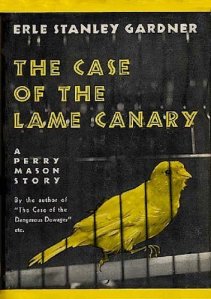
The Case of the Lame Canary by Erle Stanley Gardner

The Case of the Lame Canary was originally published in 1937. My copy is a Penguin green and white reprint of 1961. At that date Erle Stanley Gardner was in his sixties and was one of the world’s best-selling mystery writers. He had given up his career as a lawyer in California in 1935 and had taken a log cabin in the mountains to write his books full-time.

Perry Mason specialises in murder cases so when Rita Swaine arrives at his office with a tale of her sister’s matrimonial problems he isn’t interested. However, he is interested in the caged canary she has carried into his office, because it has a lame foot and he wants to know why it’s lame and why she brought it with her.

Rita tells him a complicated tale, which persuades Perry to represent her sister. Her sister Rosalind is married to Walter Prescott, but is still in love with Jimmy Driscoll, Walter had found out and threatened to kill her and so Rosalind had left and then asked her to get her things and the canary. Walter is later found murdered and the story gets even more complicated, especially as Rita just doesn’t tell Perry the truth. It appears that all three – Rita, Rosalind and Jimmy could have killed Walter.

Perry enlists Paul Drake’s help and together they ferret out yet more information – at times it felt like information overload and no clear way through to discover who killed Walter and why. And yet there is more because towards the end Perry says to his secretary, Della Street

… a solution of any crime which doesn’t account for all of the various factors involved is no solution at all. No, I’ve paid too much attention to the people the district attorney’s office suspect, and not enough to the victim. In the long run, Della, the essence of all successful detective work lies in reconstructing the life of the victim. That gives motivation, and motivation makes murders. (page 185)

There was no way I was able to work it all out, until almost the end and yet all the clues are there just so cleverly concealed within the text – and the lame canary does have a part to play!

Perry Mason acts more as a detective than a lawyer and works independently of the police to protect his clients, but he also has a very human side. Della, is anxious that he has a holiday and has planned a long trip around the world for the two of them. She’s booked their tickets and as the case gets more and more complicated she continues to urge him to start packing his things. In the end they just make it on board and they sail away. The book ends on a romantic scene as the other passengers watch:

… the tall, distinguished man, accompanied by the capable, good-looking young woman, parading around the deck, as though it were a ceremonial march, and, as they walked, whistling Hawaiian Paradise. (page 224)

A satisfying read and one I might read again, if only to see how it was all put together.

New to BooksPlease

New in today is Patronage by Maria Edgeworth, thanks to the publishers Sort of Books.

Maria Edgeworth (1768 – 1849) was a contemporary of Jane Austen, publishing novels at the same time – Patronage was published just 5 months before Mansfield Park in 1814. It will be a while before I read this book, which is to be published on 6 July 2011, because there are already quite a few in my reading queue. But it does look interesting, described as

… one of the most eagerly anticipated novels of Jane Austen’s day. It sold out within hours of publication.

… an adventurous soap opera about the trials and fortunes of two neighbouring families in Regency England, both of which had sons and daughters setting out in the world. … a bright and mischievous critique of the way young men gained careers and young women gained husbands. (from the back cover)

I might just have to bump it up the list.

I also received newbooks magazine a few days ago. This has all sorts of book news, interviews  and articles, plus lots of reviews and extracts from six novels – you can choose one for just the cost of p&p. This issue the free books are:

  • Tony & Susan by Austin Wright, his fourth and overlooked novel, originally published in 1993, about a divorced couple. Tony asks Susan to read the manuscript of his first novel.
  • The Particular Sadness of Lemon Cake by Aimee Bender, about the link between food and our emotions.
  • Outside the Ordinary World by Dori Ostermiller, in which Sylvia finds herself following in her mother’s footsteps into an affair she feels powerless to resist.
  • Drums on the Night Air: a Woman’s Flight from Africa’s Heart of Darkness by Veronica Cecil, set in the Congo in the early 1960s as civil war breaks out.
  • Collusion by Stuart Neville, a crime novel featuring DI Jack Lennon caught up in a web of official secrets and lies as he tries to find the whereabouts of his daughter.
  • The Collaborator by Margaret Leroy, in which Vivienne decides to escape from Guernsey to England in June 1940, as the German invasion is threatened, but stays and finds herself in danger.

Tony & Susan looks interesting, as does Drums on the Night Air, but I think I’m going to get The Collaborator.

Crime Fiction Alphabet: V is for Val McDermid

Until now I’ve steered clear of reading any of Val McDermid‘s books and the reason is that I can’t stand to watch the violence and torture scenes in TV series such as Wire in the Blood. But recently I’ve been thinking that maybe I wasn’t being fair to judge a writer’s work on films based on the books. So I decided to check out a Val Mcdermid book from the library to see for myself.

There are many to choose from but I picked the shortest one, thinking if I didn’t like it I wouldn’t waste much time reading it.

Cleanskin is one of the Quick Reads series, aimed at “adults who’ve stopped reading or find reading tough, and for regular readers who want a short, fast read.” 

Summary (adapted from the back cover where Jack Farrell is erroneously called Jack Farlowe!):

When career criminal, Jack Farrell’s body is found washed-up on a Suffolk shore, it looks to the police like a clear-cut case. Broken-hearted at his daughter’s death, he has drowned himself – good riddance and one less crime to solve, according to CID. Then again, maybe not. For, one by one, Farrell’s enemies are being killed. And the horrific manner of their deaths makes drowning look like a day at the beach!

My thoughts:

Val McDermid’s style in this long short story is clear, straight-forward and chatty. The narrator is DCI Andy Martin. He’s the world expert on Jack Farrell, a criminal known as a ‘cleanskin‘ because he had no criminal record:

Farrell’s crew ran just about every dirty racket you could think of: drugs, guns, hookers, porn. You name it they were into it. They bought and sold human lives like they were bargains on eBay. (page 2)

Martin identifies Farrell’s body from the vivid tattoos still visible on his battered and bloated body. Being a novella the action is fast paced, the characters are briefly sketched and although I had worked out some of the mystery, the final dénouement came as a surprise. And there is a certain amount of  graphic description of the gruesome methods of killing and torture, so I’m still not sure about reading any of Val McDermid’s other books.

Can anyone recommend where I should start – bearing in mind that I am squeamish?

Cleanskin:

  • Paperback: 128 pages
  • Publisher: HarperCollins; World Book Day edition edition (18 May 2006)
  • Language English
  • ISBN-10: 0007216726
  • ISBN-13: 978-0007216727
  • Source: Borrowed from the library

A Crime Fiction Alphabet post – for more posts featuring the letter V see Kerrie’s blog.

Crime Fiction Alphabet: U is for Nicola Upson

This week’s letter in Kerrie’s Crime Fiction Alphabet is letter-u
U.

Nicola Upson has written three novels featuring novelist Josephine Tey (Elizabeth Mackintosh 1896-1952):

  • An Expert in Murder
  • Angel with Two Faces
  • Two for Sorrow

She has also written two books of non-fiction:

  • Mythologies: Sculpture of Helaine Blumenfeld
  • In Good Company: A Snapshot of Theatre and the Arts

I recently read An Expert in Murder, a very detailed and intricate murder mystery. Nicola Upson has a passion for the theatre and it shines through to great advantage in this book, set in the theatrical world of  the 1930s – March, 1934 to be precise, as the final week of Josephine Tey’s play Richard of Bordeaux begins. Josephine is travelling from her home in Inverness to London by steam train when she meets an enthusiastic fan, Elspeth Simmons, who boarded the train at Berwick-upon-Tweed. They chat and Josephine takes a liking to her, feeling protective towards her.

They arrive in London, but then Elspeth is murdered and soon afterwards Bernard Aubrey, the theatre owner is also found dead, poisoned. Detective Inspector Archie Primrose, a friend of Josephine’s investigates. It’s a blend of fact and fiction. I don’t know much about Elizabeth Macintosh and so this representation of her persona as Josephine Tey seemed wholly fictional and actually she is a minor character in the sequence of events and plays little part in discovering the murderer. I think, on the whole, there is too much ‘telling’ and not enough ‘showing’ for my liking.

There is a great amount of family background, back stories and theatrical information that slowed down the action. But I liked the detailed descriptions of people and places and I especially liked the background details of the World War One, that had ended 16 years earlier but still cast its shadow. There are a number of coincidences in the book, but as Josephine tells Archie,

‘Anyway’, she continued wryly, ‘the only people who don’t believe in coincidence are the ones who read detective novels – and policemen. These things happen, Archie, even if we’re not supposed to use them in books. (page 45)

Reading An Expert in Murder made me think about mixing fact and fiction by using real people as characters. I decided that I don’t have a problem with historical fiction so wondered why its use in crime fiction should give me pause for thought. I think maybe it’s a step too far and I would have preferred it if Tey had been wholly a fictional character based on the author in the same way as John Terry, the leading actor in Tey’s play, is a fictionalised version of John Gielgud. Nicola Upson’s Author’s Note at the back of the book is interesting on this point when she explains that Elizabeth Mackintosh

… took a dim view of mixing fact and fiction – but she allowed it if the writer stated where the truth could be found, and if invention did not falsify the general picture. (page 290)

I think she succeeded in this, although, as she then adds

Murder, of course, does rather distort the general picture, but I hope that it won’t entirely eclipse a unique moment of theatrical history and the true beginnings of a remarkable writing career. (page 290)

I think that was a slight stumbling block for me, but I’m glad that it may have advertised Josephine Tey’s work to a wider audience. I haven’t read many of her books, but those I have read are excellent, especially The Daughter of Time.

Since reading An Expert in Murder I am interested in reading more of Nicola Upson’s Tey books and have  Angel with Two Faces lined up to read soon.

  • Paperback: 304 pages
  • Publisher: Faber and Faber; paperback / softback edition (5 Feb 2009)
  • Language English
  • ISBN-10: 0571237711
  • ISBN-13: 978-0571237715
  • Source: I bought the book