Crime Fiction Alphabet: Z is for Zouroudi

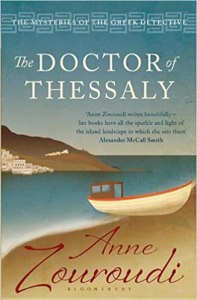
For the last letter of Kerrie’s Crime Fiction Alphabet I’ve chosen The Doctor of Thessaly by Anne Zouroudi. It’s a good book to end this round of the Alphabet, by an author whose books I’ve seen on the bookshelves but have never read before.  I enjoyed it.

Anne Zouroudi was born in England, has lived for some years on the Greek islands and now lives in the Derbyshire Peak District. The Doctor of Thessaly is the third in the series of her Mysteries of the Greek Detective, about Hermes Diaktoros, a mysterious fat man. I was never sure who he worked for, or how he knew of the mystery to solve. Each of the books in the series features one of the Seven Deadly Sins – in this one it is envy, a tale of revenge and retribution.

Set in the little Greek village of Morfi, it begins with Chrissa, a jilted bride weeping on the beach, and then moves on quickly to the discovery of the local doctor, the victim of an attack that has left him horribly scarred and blind. He is the absent bridegroom. Meanwhile Hermes has arrived in the village, waiting to be served at the kafenion:

Adonis, riding by, stared at the man – a big man, perhaps even fat, whose curly, greying hair was a little too long, and whose glasses gave him an air of academia. Beneath a beige trench-coat, he wore a suit without a tie; beside him lay a holdall of green leather. In Eva’s comfortable chair he seemed relaxed, drawing on a freshly lit cigarette, one foot crossed over the other; and it was the stranger’s feet that drew Adonis’s eyes. The fat man was wearing tennis shoes – old fashioned, canvas shoes, pristinely white. (page 9)

Hermes involves himself with the mystery of who attacked the doctor, made more puzzling because the doctor doesn’t want his attacker to be found. At the same time the village is expecting a visit from a government minister, an event that not all the locals want to be successful, and the family of the garage owner is going through some traumatic experiences. Hermes helps out in some unorthodox ways.

Just who is Hermes Diaktoros, I wondered as I read this book? My knowledge of Greek mythology is very rusty, but the clue is in his name, I think – Hermes, the messenger of the gods. He wore shoes with wings, and this Hermes is indeed fleet of foot in his pristine tennis shoes.

There are many things I like about this book, not just the mystery and the references to mythology, but also the characters and the setting which evoke the scenes of a little Greek village so well and the close-knit almost claustrophobic relationship of its inhabitants. And there is a map of the area and a list of characters.

I really must read the other books in the series:

  • The Messenger of Athens
  • The Taint of Midas
  • The Lady of Sorrows
  • The Whispers of Nemesis

Thanks to Kerrie for organising the Crime Fiction Alphabet.

Gently by the Shore by Alan Hunter: Book Review

Gently by the Shore is the second Inspector Gently book by Alan Hunter. George Gently is called in to investigate a murder in Starmouth, a British seaside holiday resort. An unidentified body was found on the beach. The victim was naked, punctured with stab wounds. Gently summarises it:

He had wandered into town, this enigmatical foreigner, he had taken lodgings, he had found a cafe to his taste and a prostitute to his taste; and then he had been, in a short space of time, kidnapped, tortured, murdered and introduced into the sea, his room ransacked and plundered of something of value. There was a ruthlessness about that … it bore the stamp of organization. But there was no other handle. The organization persisted in a strict anonymity. (page 92)

All Gently has to go on is his intuition. This man had been in disguise, no one seemed to know him or why he was in Starmouth. Gently by the Shore was first published in 1956 and reflects that period of time. Gently smokes a pipe and puffs his way through the investigate often in a haze of smoke when questioning suspects who also smoke. The account of a British holiday scene in the fifties brought back memories of childhood holidays (without any murders!) of sunny days on the beach, wet days in amusement arcades on the penny slot machines, the end-of-piers shows, beach cafes, deckchairs, and staying in Guest Houses, where you had bed, breakfast and an evening meal but weren’t expected to stay in your room during the day, the change-over on a Saturday with a mass exodus of one set of holiday makers before the next lot arrived.

It has a very ‘English’ feel about it:

Exceeding Sunday-white lay the Albion Pier under mid-morning sun. Its two square towers, each capped with gold, notched firmly into an azure sky and its peak-roofed pavilion, home of Poppa Pickle’s Pierrots, notched equally firmly into a green-and-amethyst sea. Its gates were closed. They were not open until  half past two. The brightly dressed strollers, each infected in some degree by the prevailing Sundayness, were constrained to the languid buying of ice-cream, the indifferent booking of seats or the bored contemplation of Poppa Pickle’s Pierrots’ pics. They didn’t complain. They knew it was their lot. Being English, one was never at a loss for a moral attitude. (page 145)

The fifties were also the period where the death sentence was still in force and Gently and the main suspect discuss the ethics of killing comparing a hired killer with the hangman. Gently maintains that the death penalty is an ideal – ‘to protect people on their lawful occasions’, and that his duty is to catch the criminal. The case is complicated by the involvement of secret agents, at which point I thought the plot became too contrived, and Gently is faced with solving:

… a planned execution, the details of which have been efficiently erased. (page 189)

But, solve it, he does!

My verdict is that this book doesn’t live up to the promise of the first one, Gently Does It, but I enjoyed the setting, the ethical discussions and the problem-solving aspects.

Crime Fiction Alphabet: Letter Y

My choice for Kerrie’s Crime Fiction Alphabet this week is Margaret Yorke’s Intimate Kill.

Margaret Yorke has written numerous crime fiction novels and is a past chairman of the Crime Writers’ Association (CWA). In 1999 she was awarded the CWA’s Cartier Diamond Dagger Award for her outstanding contribution to the genre.

Intimate Kill was first published in 1985 and I think it’s an excellent example of her work  Margaret Yorke writes in a fluent style, one that draws you into the story effortlessly. Stephen Dawes has been released from prison after serving 10 years of a life sentence for murdering his wife, Marcia. Her body had never been found. Stephen knew he was innocent and believed that she had killed herself, making him out to be the murderer, devastated when he had asked for a divorce. He is determined to find out how she did it.

The book is divided into three parts. Part One deals with Stephen’s search for the truth about Marcia’s death and for his daughter. Stephen’s marriage had not been a happy one and he’d been having an affair with Ruth Watson which resulted in the birth of his daughter, Susannah. Part Two moves back in time eleven years, dealing with the events that led up to Marcia’s disappearance and subsequent events. In Part Three Stephen discovers the truth and nearly loses his own life.

It’s not difficult to work out what actually happened but that doesn’t detract from the pleasure of reading this book. Margaret Yorke is so skilled in characterisation that she has captured the emotions and feelings, as well as the weaknesses and ambitions of all the characters. I believed in all of them. The plot moves swiftly and with a real sense of evil as the tension mounts.

Best Crime Fiction Reads so far this year

Kerrie asks: ‘What are the best crime fiction titles you’ve read in 2011?

So far this year I’ve read 31 crime fiction titles. The following books have my highest ratings:

  1. Exit Lines by Reginald Hill 5/5
  2. Drawing Conclusions by Donna Leon 5/5
  3. Rebus’s Scotland by Ian Rankin 5/5
  4. The Stabbing in the Stables by Simon Brett 4.5/5
  5. Gently Does It by Alan Hunter 4.5/5
  6. Cop Hater by Ed McBain 4.5/5
  7. The Case of the Lame Canary by Erle Stanley Gardner 4.5/5
  8. Intimate Kill by Margaret Yorke 4.5/5 (see review next week)
  9. Wycliffe and the Last Rites by W J Burley 4.5/5
  10. The Silent World of Nicholas Quinn by Colin Dexter 4.5/5
  11. The Art of Drowning by Frances Fyfield 4.5/5

Crime Fiction Alphabet: X

Kerrie’s Crime Fiction Alphabet has now reached, for me at least, the most difficult letter of the alphabet. Last year I wrote about Qiu Xiaolong’s  A Loyal Character Dancer and I had intended to read another of his books for the letter X – Death of a Red Heroine. But time and inclination overtook me and I haven’t read it yet.

So, I was going to pass on this letter until I came across X, Y, Z: a Story Told by a Detective (1883) by Anna Katherine Green, a short mystery free on Kindle. It’s only 97 pages and didn’t take long to read.

I hadn’t heard of Anna Katherine Green (1846 – 1935), but according to Wikipedia she was an American poet and novelist and was one of the first American authors to write detective fiction. She published about 40 novels and her first book, The Leavenworth Case was a bestseller, praised by Wilkie Collins. Looking at Amazon, I think most of her books are available free as e-books.

The narrator, an un-named detective has been assigned to investigate a gang of counterfeiters and being told of a number of suspicious-looking letters addressed to X, Y, Z, Brandon, Mass., discovers a completely different crime. (We’re told at the end that the counterfeiters were discovered but not by the narrator.) After waiting to see who collects these letters the detective follows the trail to the house of the wealthy and secretive Benson family where a fancy dress ball is to take place that evening. When  Mr Benson is found dead it is up to the detective to unmask the guilty person.

It wasn’t difficult to work out who the culprit was. Its greatest attraction for me is that it is an example of crime fiction written before the ‘Golden Age’, a forerunner of detective fiction. It’s written in a somewhat formal and stilted style, and is melodramatic as this extract describing Mr Benson’s death shows:

Mr Benson at once turned the key, but no sooner had he done so than he staggered back. For an instant or two of horror he stood oscillatiing from side to side, then his frame succombed, and the terrified eyes of his children beheld his white head lying low, all movement and appearance of life gone from the form that but a moment before towered so proudly above them.

With a shriek, the daughter threw herself down at his side, and even the cheek of Hartley Benson grew white as he leaned over his father’s already inanimate body.

“He is dead!” came a wild cry from her lips. “See! he does not breathe. Oh! Hartley, what could have happened? Do you think that Joe -”

“Hush!” he exclaimed, with a furtive glance around him.

But it moves swiftly along, with clearly defined characters and a well-described setting and it interested me enough to want to investigate more of Green’s novels.

Agatha Christie Blog Carnival – June edition

The June 2011 edition of the Agatha Christie Blog Carnival has just been posted.
As ever there is plenty of variety: 16 contributors have posted 22 items.

The number of contributors is slowly growing, although not everybody is able to contribute each month. Some are reading Agatha Christie titles in order, while others (like me) are reading books as they locate them.

This month’s contributions range from reviews of books about Christie, reviews of Christie titles, to novel/film comparisons, book covers over the years, and recipes for cakes and drinks mentioned in Christie books. Something for everybody!

Find out more about the Agatha Christie Reading Challenge and the accompanying Blog Carnival here.