Crime Fiction Alphabet 2011: The List

Kerrie’s Crime Fiction Alphabet came to the end last week, which left me wondering what were its highlights for me. Before I began I decided that I would use it to read books from my to-be-read list and in the main that is what I did.

The rules of the meme are that you have to write a blog post about crime fiction related to the letter of the week and your post MUST be related to either the first letter of a book’s title, the first letter of an author’s first name, or the first letter of the author’s surname.

I thought that I would try to stick to the authors’ names (either first or last) rather than the title and in the main that is what I did, with 21 of the letters.The letters A, P, R and S relate both to the authors’ names and to the titles.

Some were books by old favourites, such as Agatha Christie and some by new-to-me authors, such as Anne Zouroudi.

The ones I enjoyed the most (in A – Z order) are:

  • Agatha Christie’s Autobiography reading it was like listening to Agatha Christie talk to me.
  • Colin Dexter – The Silent World of Nicholas QuinnI wanted to start it again as soon as I’d finished it.
  • P D James – The Private Patient – a thoughtful book, with precise descriptions of people and places and yet it is tense and dramatic.
  • Donna Leon – Drawing Conclusions – a book I didn’t want to end!
  • Dan Waddell – The Blood Detective – even though there are parts (not many) that were just a bit too graphic for me.

Here is the complete list:

My thanks go to Kerrie as I have thoroughly enjoyed reading through the Crime Fiction Alphabet and also reading what my fellow bloggers have read too – some of whom wrote about specific topics instead of sticking to the rules :) – I think they are most ingenious! Kerrie has listed a summary of the A- G posts, with the rest of the alphabet coming soon.

Murder on the Orient Express by Agatha Christie

Murder on the Orient Express must be one of Agatha Christie’s most well known books. It was first published in 1934 and it was first filmed in 1974, starring Albert Finney as Hercule Poirot, and most recently in 2010 with David Suchet as Poirot. I’ve seen both films and so knew the plot, but I’d never read the book until now.

Poirot is on the Orient Express, on a three-days journey across Europe. But after midnight the train comes to a halt, stuck in a snowdrift. In the morning the millionaire Simon Ratchett is found dead in his compartment his body stabbed a dozen times and his door locked from the inside. It is obvious from the lack of tracks in the snow that no-one has left the train and by a process of elimination Poirot establishes that one of the passengers in the Athens to Paris coach is the murderer.

Poirot interviews the passengers and the Wagon Lit conductors, none of whom appear to have a motive for killing Ratchett or to have any connection with him or each other. Poirot decides that this

… is a crime very carefully planned and staged. It is a far-sighted, long-headed crime. It is not – how shall I express it? – a Latin crime. It is a crime that shows traces of a cool, resourceful, deliberate brain – I think an Anglo-Saxon brain. (page 193)

Having interviewed all the suspects Poirot draws up a list of questions about things that need explaining. This leads him to speculation and re-interviewing some of the suspects and eventually he arrives at the truth. It’s hard to know whether I would have arrived at the same conclusion if I hadn’t seen the films, but watching the first one it did become obvious before the denouement.

I liked this book enormously. I like the way Agatha Christie divided it into three sections – The Facts, the Evidence and Hercule Poirot Sits Back and Thinks. I liked the characterisation and all the, now so non-pc, comments about nationalities, highlighting class and racial prejudice. I like the problem-solving and ingenuity of the plot.

  • Paperback: 240 pages
  • Publisher: Harper; Masterpiece edition (Reissue) edition (3 Sep 2007)
  • Language English
  • ISBN-10: 0007119313
  • ISBN-13: 978-0007119318
  • Source: Library book because I can’t find my own copy!

Wilful Behaviour by Donna Leon: Book Review

Wilful Behaviour begins with an explosion …

The explosion came at breakfast. Brunetti’s position as a commissario of police, though it made for the possibility of explosion more likely than it would be for the average citizen, did not make the setting any less strange. The location, however, was related to Brunetti’s personal situation as the husband of a woman of incandescent, if inconsistent, views and politics, not to his profession.

‘Why do we bother to read this disgusting piece of garbage?’ Paola exploded, slamming a folded copy of the day’s Gazzettino angrily onto the breakfast table, where it upset the sugar bowl. (page 1)

Wilful Behaviour

  • Paperback: 368 pages
  • Publisher: Arrow; First Thus edition (26 Feb 2009)
  • Language English
  • ISBN-10: 0099536625
  • ISBN-13: 978-0099536628
  • Source: Library Book

Brief Description

When one of his wife Paola’s students comes to visit him, with a strange and vague interest in investigating the possibility of a pardon for a crime committed by her grandfather many years ago, Commissario Brunetti thinks little of it, beyond being intrigued and attracted by the girl’s intelligence and moral seriousness. But when she is found murdered, clearly stabbed to death, Claudia Leonardo is suddenly no longer simply Paola’s student, but Brunetti’s case ‘¦’

My view

I’ve been reading Donna Leon’s Commissario Brunetti’s books set in Venice, completely out of order of their publication. It doesn’t  matter at all to me. Her books are crime fiction, but also discuss various social and cultural issues and Wilful Behaviour is no exception. The effects of the Second World War feature largely in this book, the different attitudes Italians had during the war – secrets of collaboration, resistance fighters, the exploitation of Italian Jews – and the way modern day Italians view the past.

I read the book quickly keen to discover who had killed Claudia and why, following the intricacies of Italian bureaucracy with interest, the planning process for example. The question of honour is also uppermost, with Paola, who had been lecturing her university students ‘on the theme of honour and honourable behaviour and the way it was central to [Edith]Wharton’s three great novels,‘  wondering ‘whether it still had the same meaning for her students; indeed whether it had any meaning for her students.’

Brunetti consults his father-in-law, Count Falier, who with his myriad connections is a source of information on the people and workings of Venice. Through him he learns more about Luca Guzzardi, Claudia’s grandfather who had been convicted of war crimes after the war. Guzzardi was ‘one of the people appointed to decide which pieces of decadent art should be disposed of by galleries and museums.’ And it is these works of art and their current whereabouts that provide the clue to why Claudia was murdered, but don’t point exactly to the culprit.

Wilful Behaviour has an intricate plot, with characters who are fallible and so believable. I like the way Brunetti works, gathering information from various sources including the ever-resourceful Signorina Elettra and the interactions with his family. The ending is not in line with the ideal of justice being seen to be done and Brunetti has to admit to himself that he is ‘helpless to effect any change in the way things would play themselves out.’ It reminds Paola of ‘Jarndyce vs Jarndyce.’

Crime Fiction Alphabet: Z is for Zouroudi

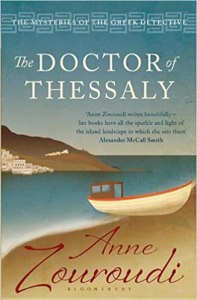
For the last letter of Kerrie’s Crime Fiction Alphabet I’ve chosen The Doctor of Thessaly by Anne Zouroudi. It’s a good book to end this round of the Alphabet, by an author whose books I’ve seen on the bookshelves but have never read before.  I enjoyed it.

Anne Zouroudi was born in England, has lived for some years on the Greek islands and now lives in the Derbyshire Peak District. The Doctor of Thessaly is the third in the series of her Mysteries of the Greek Detective, about Hermes Diaktoros, a mysterious fat man. I was never sure who he worked for, or how he knew of the mystery to solve. Each of the books in the series features one of the Seven Deadly Sins – in this one it is envy, a tale of revenge and retribution.

Set in the little Greek village of Morfi, it begins with Chrissa, a jilted bride weeping on the beach, and then moves on quickly to the discovery of the local doctor, the victim of an attack that has left him horribly scarred and blind. He is the absent bridegroom. Meanwhile Hermes has arrived in the village, waiting to be served at the kafenion:

Adonis, riding by, stared at the man – a big man, perhaps even fat, whose curly, greying hair was a little too long, and whose glasses gave him an air of academia. Beneath a beige trench-coat, he wore a suit without a tie; beside him lay a holdall of green leather. In Eva’s comfortable chair he seemed relaxed, drawing on a freshly lit cigarette, one foot crossed over the other; and it was the stranger’s feet that drew Adonis’s eyes. The fat man was wearing tennis shoes – old fashioned, canvas shoes, pristinely white. (page 9)

Hermes involves himself with the mystery of who attacked the doctor, made more puzzling because the doctor doesn’t want his attacker to be found. At the same time the village is expecting a visit from a government minister, an event that not all the locals want to be successful, and the family of the garage owner is going through some traumatic experiences. Hermes helps out in some unorthodox ways.

Just who is Hermes Diaktoros, I wondered as I read this book? My knowledge of Greek mythology is very rusty, but the clue is in his name, I think – Hermes, the messenger of the gods. He wore shoes with wings, and this Hermes is indeed fleet of foot in his pristine tennis shoes.

There are many things I like about this book, not just the mystery and the references to mythology, but also the characters and the setting which evoke the scenes of a little Greek village so well and the close-knit almost claustrophobic relationship of its inhabitants. And there is a map of the area and a list of characters.

I really must read the other books in the series:

  • The Messenger of Athens
  • The Taint of Midas
  • The Lady of Sorrows
  • The Whispers of Nemesis

Thanks to Kerrie for organising the Crime Fiction Alphabet.

Gently by the Shore by Alan Hunter: Book Review

Gently by the Shore is the second Inspector Gently book by Alan Hunter. George Gently is called in to investigate a murder in Starmouth, a British seaside holiday resort. An unidentified body was found on the beach. The victim was naked, punctured with stab wounds. Gently summarises it:

He had wandered into town, this enigmatical foreigner, he had taken lodgings, he had found a cafe to his taste and a prostitute to his taste; and then he had been, in a short space of time, kidnapped, tortured, murdered and introduced into the sea, his room ransacked and plundered of something of value. There was a ruthlessness about that … it bore the stamp of organization. But there was no other handle. The organization persisted in a strict anonymity. (page 92)

All Gently has to go on is his intuition. This man had been in disguise, no one seemed to know him or why he was in Starmouth. Gently by the Shore was first published in 1956 and reflects that period of time. Gently smokes a pipe and puffs his way through the investigate often in a haze of smoke when questioning suspects who also smoke. The account of a British holiday scene in the fifties brought back memories of childhood holidays (without any murders!) of sunny days on the beach, wet days in amusement arcades on the penny slot machines, the end-of-piers shows, beach cafes, deckchairs, and staying in Guest Houses, where you had bed, breakfast and an evening meal but weren’t expected to stay in your room during the day, the change-over on a Saturday with a mass exodus of one set of holiday makers before the next lot arrived.

It has a very ‘English’ feel about it:

Exceeding Sunday-white lay the Albion Pier under mid-morning sun. Its two square towers, each capped with gold, notched firmly into an azure sky and its peak-roofed pavilion, home of Poppa Pickle’s Pierrots, notched equally firmly into a green-and-amethyst sea. Its gates were closed. They were not open until  half past two. The brightly dressed strollers, each infected in some degree by the prevailing Sundayness, were constrained to the languid buying of ice-cream, the indifferent booking of seats or the bored contemplation of Poppa Pickle’s Pierrots’ pics. They didn’t complain. They knew it was their lot. Being English, one was never at a loss for a moral attitude. (page 145)

The fifties were also the period where the death sentence was still in force and Gently and the main suspect discuss the ethics of killing comparing a hired killer with the hangman. Gently maintains that the death penalty is an ideal – ‘to protect people on their lawful occasions’, and that his duty is to catch the criminal. The case is complicated by the involvement of secret agents, at which point I thought the plot became too contrived, and Gently is faced with solving:

… a planned execution, the details of which have been efficiently erased. (page 189)

But, solve it, he does!

My verdict is that this book doesn’t live up to the promise of the first one, Gently Does It, but I enjoyed the setting, the ethical discussions and the problem-solving aspects.

Crime Fiction Alphabet: Letter Y

My choice for Kerrie’s Crime Fiction Alphabet this week is Margaret Yorke’s Intimate Kill.

Margaret Yorke has written numerous crime fiction novels and is a past chairman of the Crime Writers’ Association (CWA). In 1999 she was awarded the CWA’s Cartier Diamond Dagger Award for her outstanding contribution to the genre.

Intimate Kill was first published in 1985 and I think it’s an excellent example of her work  Margaret Yorke writes in a fluent style, one that draws you into the story effortlessly. Stephen Dawes has been released from prison after serving 10 years of a life sentence for murdering his wife, Marcia. Her body had never been found. Stephen knew he was innocent and believed that she had killed herself, making him out to be the murderer, devastated when he had asked for a divorce. He is determined to find out how she did it.


Intimate KillThe book is divided into three parts. Part One deals with Stephen’s search for the truth about Marcia’s death and for his daughter. Stephen’s marriage had not been a happy one and he’d been having an affair with Ruth Watson which resulted in the birth of his daughter, Susannah. Part Two moves back in time eleven years, dealing with the events that led up to Marcia’s disappearance and subsequent events. In Part Three Stephen discovers the truth and nearly loses his own life.

It’s not difficult to work out what actually happened but that doesn’t detract from the pleasure of reading this book. Margaret Yorke is so skilled in characterisation that she has captured the emotions and feelings, as well as the weaknesses and ambitions of all the characters. I believed in all of them. The plot moves swiftly and with a real sense of evil as the tension mounts.