The Crow Trap by Ann Cleeves

The Crow Trap by Ann Cleeves is the first book in her Vera Stanhope series. I’ve been thinking (and writing) about my difficulties in reading books where I think the detail and description swamp the characters and plot, but I had absolutely no problems with that in The Crow Trap – I think Ann Cleeves has got the balance just right.

It begins with chapters about three of the female characters, Rachael, Anne and Grace all staying at Baikie’s an isolated cottage on the North Pennines whilst they carry out an environmental survey. When Rachael arrives at the cottage she is confronted by the body of her friend Bella Furness, who it appears has committed suicide. I was so drawn in by the character portraits and the vivid descriptions of the setting, that I almost forgot that this is a murder mystery. Then Grace is found dead and the mystery really begins.

There is a full cast of characters, all clearly distinct, and a very intricate and clever plot, with plenty of red herrings subtly masking the important clues. Vera is a great character and even though I do like Brenda Blethyn’s portrayal of her in the TV series, I prefer her as she is in the books –  a woman in her fifties, who looks like a bag lady. Here’s a description of her when she first interviews Rachael and Anne:

She was a large woman – big bones, amply covered, a bulbous nose, man-sized feet. Her legs were bare and she wore leather sandals. Her square toes were covered in mud. Her face was blotched and pitted so Rachael thought she must suffer from some skin complaint or allergy. Over her clothes she wore a transparent plastic mac and she stood there, the rain dripping from it onto the floor, grey hair sleeked dark to her forehead, like a middle-aged tripper caught in a sudden storm on Blackpool prom. (page 230)

And this description too:

Vera was wearing a dress of the sort of material turned into stretch settee covers and advertised in the Sunday papers. (page 406)

The identity of the killer foxed me. I kept changing my mind about who I thought it was and when it was revealed I was surprised, because although I’d worked out the motive, I’d got the circumstances completely wrong!

The My Kind of Mystery theme began on 1 February and this book really is ‘my kind of mystery’. A most satisfying book.

First Chapter First Paragraph

First chapterEvery Tuesday Diane at Bibliophile by the Sea hosts First Chapter First Paragraph Tuesday Intros, where you can share the first paragraph, or a few, of a book you are reading or thinking about reading soon.

Today’s pick is a book that I’m currently reading from my TBR books, Playing With Fire by Peter Robinson, a DCI Banks book (incidentally a new series of DCI Banks started last night on ITV1 – I haven’t watched it yet).

Chapter 1 begins:

‘The barge she sat in, like a burnish’d throne, burn’d on the water,’ Banks whispered. As he spoke, his breath formed plumes of mist in the chill January air.

Detective Inspector Annie Cabot, standing beside him, must have heard because she said, ‘You what? Come again.’

‘A quotation,’ said Banks. ‘From Anthony and Cleopatra.’

‘You don’t usually go around quoting Shakespeare like a copper in a book,’ Annie commented.

Banks and Annie are watching as two narrow boats are burning on a dead-end stretch of the Eastvale canal – inside they find the remains of two dead bodies. Was this an accident or murder?

In the Woods by Tana French

I have had In the Woods by Tana French on loan from the library since last November – fortunately I was able to keep renewing it, until I got round to reading it. It’s Tana French’s debut novel first published in 2007.

When I began reading I thought this was going to be a really great book. It has all the elements I like – a current murder mystery to solve and a cold case from 20 years earlier, well drawn characters and a writing style that contains enough description to visualise the action easily. It’s set in Ireland mainly around an archaeological dig of a site prior to the construction of a motorway. Most of the wood that covered the land had already been cleared, but a small section remains. A little girl’s body is discovered on the site. Is her death connected to the disappearance of two twelve year-olds 20 years earlier? And it just so happens that the detective, Rob Ryan,  investigating the current murder was the third child who was involved in the disappearance – except he came back and has no memory of what had happened.

I was immediately drawn into the book, enjoying the mystery and wondering how long Ryan can keep his identity hidden and whether he will remember what happened. However, as the story progresses, the descriptive passages get longer and more complicated as the characters’ back stories are revealed, in particular the dead girl’s family and other peripheral characters. And whilst I still think this is a good book, it isn’t a great one. I like the psychological elements and the twists and turns, although I think some of them were predictable. I’ve seen criticism about the way the book ends, but I didn’t find that disappointing at all, in fact I think that is the only credible way that it could end. And I liked it well enough to look out for French’s second book – The Likeness.

The Hangman's Song by James Oswald

The Hangman’s Song by James Oswald is the third in his Inspector McLean series set in Edinburgh.

DI McLean, seconded to the Sexual Crimes Unit (SCU) by Acting Superintendent Charles Duguid (nicknamed Dagwood) finds himself working on two separate cases – one for the SCU  investigating a group of prostitutes and the subsequent death of their pimp, Malky Jennings, who was beaten to death – and the second, two suicides, which he and his DC, MacBride consider to be suspicious, and continue to investigate against Duguid’s instructions.

I think you need to have read the first two books in the series to fully understand the background or at least have read their synopses, as I found some elements of this book confusing – a small example being the name of the Acting Superintendent and his nickname, as it is not clear that Duguid and Dagwood are one and the same person. At times both names were used within a few paragraphs, making me think they could be two people.

The Hangman’s Song is a dark, tense book; crime fiction with elements of the supernatural  and parapsychology thrown in. The police force is undergoing great change as it prepares for unification as Police Scotland, adding to McLean’s own difficulties with his colleagues, most of whom dislike him, regarding him as a pain in the arse and a troublemaker. He views them as incompetent, lazy and in some cases corrupt. I did get a bit tired of his constant battle with Duguid, which detracted from the story at times. All is not well in McLean’s private life either. His girlfriend Emma (who was nearly killed in the previous book, The Book of Souls) comes out of a coma, but she has lost most of her memory, regressing to an eight-year old. She moves into McLean’s house to help with her recovery.

It is a complicated book with three storylines to keep in mind, and a large cast of characters, not all of them clearly distinguishable. It’s not a book for the faint-hearted or the squeamish as there are details of some gruesome deaths, murders and beatings that the characters go through. At times I had to read with my imagination turned down – a bit like watching something gory on TV from behind my fingers.

Having said that, it was still a compelling, if disturbing, book (particularly the last chapter) that kept me turning the pages to find out what happened next.

James Oswald runs a 350 acre livestock farm in north-east Fife. In addition to his DI McClean books he has also written a fantasy series, The Ballad of Sir Benfro, set in Wales. I have the first book in the series, Dreamwalker, which I have yet to read.

Thanks to www.lovereading.co.uk for the uncorrected advance proof of this book for review. The published book will be available in February 2014.

Not Dead Enough by Peter James

I read the first Detective Superintendent Roy Grace book, Dead Simple nearly two years ago now and have been meaning to read more of the books, so because I’m now concentrating on reading books I’ve owned before 1 January 2014 I thought it was time to read Not Dead Enough by Peter James. It’s the third Roy Grace book and whilst I don’t think it’s as good as Dead Simple I still enjoyed it – mainly because of the characterisation and the detail James goes into. It’s a long book and I see on Amazon that it’s been criticised for being too long and too detailed, but I liked that. For me it gave added interest and verisimilitude. Some people also criticised it because it has short chapters – to my mind that’s much better than having long chapters!
It’s set in Brighton and begins with the murder of Katie Bishop. The immediate suspect is her husband Brian Bishop, but it appears that he couldn’t be the murderer unless he could have been in two places at once. Then Sophie Harrington is killed. She had been having an affair with Brian thus intensifying the police investigation into his movements and background.

James takes his time setting out the details and the characters, so it’s quite slow to start off, but then the pace picks up, which makes this a quick read as I really wanted to know what happens next. It isn’t difficult to work out who the murderer is, but this didn’t lessen my enjoyment  – and there is just a little twist at the end that I hadn’t foreseen earlier on.

Roy Grace comes across as a real character, concerned about his work and his colleagues, even if he doesn’t get on too well with his boss, ACC Alison Vosper. Grace’s wife, Sandy, had disappeared nine years earlier and he is still wondering what happened to her even though he is now involved with Cleo Morey, the Chief Mortician and he takes a quick trip over to Munich when his friends tell him they had seen her there. This takes his attention away from the murders and he has to defend his visit to Vosper.

This is very much a police procedural, detailing how the detectives go about their work, including Grace’s ideas about whether eye movements indicate whether a person is telling the truth, which I’ve read about before, and what happens when a person is charged and arrested, which I know very little about (only from books and TV – and want to keep it that way)!

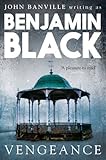
Vengeance by Benjamin Black

The first book I’ve finished this year (I began reading it at the end of last year) is a library book, Vengeance by Benjamin Black. I still have a few library books on loan from last year and I’ll be slotting in them between reading my own unread books.

Vengeance is an interesting book, ostensibly crime fiction, because there are two deaths investigated by Detective Inspector Hackett and his friend, pathologist Doctor Quirke, but it’s more of a character study, with Hackett playing a minor role. It has a slow, steady pace throughout and the mystery is not complex or difficult to solve.

As often happens when I borrow books from the library I have read a book that is one of a series of books – Vengeance is number five in Black’s Quirke Mysteries series (there are currently 6 books in the series). I think it stands well on its own, with enough back story included to keep me happy.

Benjamin Black is a pseudonym used by John Banville (an author whose books I’ve enjoyed before). His Quirke Mysteries are set in Ireland in the 1950s. Vengeance begins with a suicide – Victor Delahaye, a business man who takes his boat out to sea and shoots himself. He had taken his partner’s son, Davy Clancy out to sea with him. The Delahayes and Clancys are interviewed – Mona Delahaye, the dead man’s young and very beautiful wife; James and Jonas Delahaye, his identical twin sons; Marguerite his sister; Jack Clancy, his ambitious, womanizing partner and Sylvia, Jack’s long-suffering wife.

Then there is a second death. Why did Victor kill himself and who is the murderer, wreaking vengeance on the families?

I liked Black’s style of writing – clear and concise, the characters are distinct and the setting is excellent, both in location and time, with the characters wreathed in cigarette smoke, and having to find public telephones for example. At one point a journalist comments on detective stories, comparing them to ‘real life’ investigations:

‘I wanted to be Sherlock Holmes and Poirot and Lord Peter Wimsey all rolled into one. I knew I could be. I knew I’d get all the clues and work out who had done it and at the end would get to point my finger at the culprit …

And then I grew up.’ … ‘ Everything doesn’t get explained,’ he said. … ‘You find a few pieces of the jigsaw puzzle, some of them fit together, some of them you just leave lying on the board, by themselves. That was the point of those detective stories I used to read – there was nothing that didn’t mean something, nothing that wasn’t a clue. It’s not like that in real life,’ (pages 213 -214)

A nice touch, I thought.

I liked this book enough to make me want to read the earlier books in the series:

  1. Christine Falls (2006)
  2. The Silver Swan (2007)
  3. Elegy for April (2010)
  4. A Death in Summer (2011)
  5. Vengeance (2012)
  6. Holy Orders (2013)