The King's Evil by Edward Marston

I’m still reading from my own unread books and turned to The King’s Evil for some historical crime fiction. It’s the first in Edward Marston’s Restoration series, featuring Christopher Redmayne, an architect and Jonathan Bale, a parish constable.

The King’s Evil is set in London in September 1666, just as the Great Fire of London has begun, eventually devastating a large part of the old medieval City of London. I liked Marston’s description of the fire, conjuring up the sights and sounds, the fear and panic it caused and the efforts to stop its spread – although I’m sure they didn’t use ‘dynamite’ to blow up houses to create a fire break. Anyway this anachronism didn’t spoil my enjoyment of this book.

Redmayne, a Royalist – a supporter of the Court and King Charles II – has designed a new house for Sir Ambrose Northcott and Bale is a Puritan who views Charles with great disapproval and is wondering if the fire is a consequence of the corruption in society as a result of the Restoration of the Crown:

England was once more ruled by a Stuart king. A monarchy which Jonathan had been pleased to see ended was now emphatically restored. As a result, London was indeed a wicked city and nobody was better placed to see the extent of its depravity than someone who patrolled the streets in the office of constable. Jonathan was a God-fearing man who always sought guidance from above and he was bound to wonder if the conflagration really was a sign of divine anger. There were Biblical precedents of cities being punished for their corruption. (page 26)

The two men are brought together with the discovery of Sir Ambrose’s dead body in the cellars of his partly built new house. It’s a good story with some interesting characters, including Jesus-Died-To-Save-Me Thorpe and Redmayne’s older brother Henry, elegant, fashionable and a dissipated rake, who had introduced Christopher to Sir Ambrose. But it’s the setting in time and place that interested me most – the period when Christopher Wren was the leading architect in rebuilding London – the bustle and energy of the times and the lingering conflict between Royalists and Parliamentarians.

The mystery of who killed Sir Ambrose moves along swiftly, with a few surprises along the way, as you would expect, but nothing too surprising. Redmayne travels to Sir Ambrose’s country house, Priestfield Place in Shipbourne, Kent and crosses the Chanel to Paris following the trail of the killer. It’s the ending of the book that let it down somewhat for me – it’s all a bit rushed and abrupt, but overall I enjoyed it and will read more in the series.

Edward Marston, who also writes under the name of Keith Miles, is a prolific author. He is a former chairman of the Crime Writers’ Association. He has several series of books, listed on his website and also on Fantastic Fiction.

The King’s Evil fits into several challenges I’m doing – The Mount TBR Reading Challenge, TBR Triple Dog Dare,the Historical Fiction Challenge, My Kind of Mystery Challenge and What’s in a Name (royalty category).
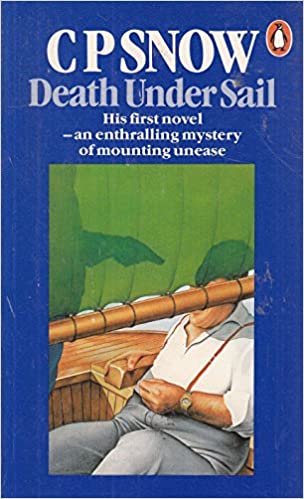
Death Under Sail by C P Snow

I didn’t know that C P Snow had written crime fiction. I’d read some of his books many years ago – the Strangers and Brothers series, in which he had coined the phrase ‘the corridors of power‘. I won Death Under Sail, Snow’s very first novel, in one of Bev’s Mount TBR Checkpoints at My Reader’s Block last year! It was first published in 1932, when Snow was 26 and a research scientist at Cambridge.

This is a classic mystery, a type of ‘country house’ mystery, but set on a wherry (a sailing boat) on the Norfolk Broads, where Roger Mills, a Harley Street specialist, is taking a group of six friends on a sailing holiday. When they find him at the tiller with a smile on his face and a gunshot through his heart, all six fall under suspicion.

The book is narrated by Ian Capel, who is older than the other friends and has joined the party a week later than the others. They are all old friends, with the exception of Tonia, Philip’s new girl friend, who all get on very well together; Avril and Christopher are engaged and William is a young doctor, a colleague of Roger’s. Ian describes them as ‘some of the pleasantest people whom I had ever known‘ – but are they, because one of them must be the murderer?

Ian asks his old friend Finbow, a civil servant home on leave from Hong Kong, to help them discover who did it. Meanwhile the police are also investigating the murder in the form of Detective Sergeant Aloysius Birrell. Finbow and Birrell provide an interesting contrast in the way they work – Finbow looks at the crime from a psychological and philosophical point of view, ruling out suspect after suspect, whereas Birrell looks for facts and evidence – even down to diving into the river himself to look for the missing gun and Roger’s log book. It’s ingenious!

C P Snow (1905 – 1980) was an English novelist and physicist. He was knighted in 1957 and made a life peer in 1964. His last novel, A Coat of Varnish is also crime fiction.

Crucible by S G MacLean

Once again I was transported back to 17th century Scotland with Crucible by S G Maclean, the third of her Alexander Seaton books. I read the first, The Redemption of Alexander Seaton in February 2013 and now a year later I’ve been just as engrossed in Crucible. I think her style of writing suits me perfectly, the characters are just right, credible well-rounded people, the plot moves along swiftly with no unnecessary digressions and it’s just full of atmosphere. I loved it.

It’s set in 1631 in Aberdeen, where Alexander is now a Master at Marischal College. On Midsummer’s eve he stumbles across the body of his friend, Robert Sim, the college librarian, a few feet from the library steps, with his throat cut, blood congealing around the wound. Dr Dun, the college principal asks Alexander to investigate the matter, to look into Robert’s private life, hoping he’ll find nothing to reflect badly on the college.

I found it absolutely compelling reading. Robert had been cataloguing a new acquisition to the library before he was killed and Alexander is convinced that Robert was troubled by what he found there, amongst the books of history, alchemy  and hermetics – the quest for ‘a secret, unifying knowledge, known to the ancients’ since lost to us. There are many twists and turns and another man is killed before he finally arrives at the truth.

This is the third book in the series, but although I haven’t read the second book, I don’t think that matters as I think Crucible stands well on its own. The fourth book in the series is The Devil’s Recruit – the hardback and Kindle versions are available now, whilst the paperback will be available on 14 May. Now I’ve lifted my book buying ban I think I may just have to get the Kindle version soon.

Crucible qualifies for four of the challenges I’m doing this year – the Mount TBR challenge, the Historical Fiction Challenge, My Kind of Mystery Challenge and the Read Scotland Challenge.

Dying in the Wool by Frances Brody

After I finished reading The Grass is Singing (see my previous post) I felt I needed to read something lighter and easier, so I turned to Dying in the Wool by Frances Brody and it turned out to be just the right book – not too taxing on either the brain or the emotions and a rather interesting mystery too.
It’s the first of Frances Brody’s Kate Shackleton Mysteries set in Yorkshire in 1922, with flashbacks to 1916. Bridgestead is a peaceful mill village, until the day in 1916 when mill owner Joshua Braithwaite went missing after apparently trying to commit suicide. Seven years later his daughter, Tabitha, who is getting married, still can’t believe her father is dead and she asks her friend Kate Shackleton to find out what really happened to him.

This is another post World War 1 crime novel, along the lines of Jacqueline Winspear’s Maisie Dobbs and Carola Dunn’s Daisy Dalrymple books, with an independent female amateur detective. Kate is a widow, her husband was missing in action during the war, presumed dead, her father is a police superintendent and she is a keen amateur photographer. On her father’s recommendation she hires Jim Sykes, an ex-policeman to help her. Once they start asking questions things start to happen with disastrous effects.

I liked the characters, Kate and Jim in particular, and the setting is lovely. The novel is well grounded historically in the aftermath of the First World War. I also liked the way the chapter headings were textile related with an explanation of the terms used and relevant to the events described in the chapters – very skilfully done, I thought. And just like woven cloth this mystery has many separate strands that Kate and Jim have to bring together to reveal what had happened in 1916.

This book fits well into several challenges – see the categories listed above.

Other books in the Kate Shackleton series are:

2. A Medal For Murder (2010)
3. Murder in the Afternoon (2011)
4. A Woman Unknown (2012)
5. Murder on a Summer’s Day (2013)
6. Death of an Avid Reader (2014)

Five Little Pigs by Agatha Christie

There are many things I like about Five Little Pigs, a Poirot mystery first published in 1943. I like the plot and the way it’s structured, the characterisation, the dialogue, and Agatha Christie’s fluent style of writing. In addition the solution is convincing and satisfying.

Caroline Crale was convicted of the murder of her husband, Amyas and died in prison. Sixteen years later, her daughter, a child of five at the time of the murder, asks Poirot to clear her mother’s name, convinced that she was innocent.

Poirot checks the police records, talks to the lawyers who conducted the trial and to the five eyewitnesses, persuading them to write down their versions of events. He finds that she had ample motive for the crime, at no time had she protested her innocence, although she contended that he had committed suicide, and all the eyewitnesses thought she was guilty.

Inevitably there are different versions of the events and conflicting views of Caroline’s character, all very clearly set out. So what did actually happen? Was Caroline innocent or guilty?

Poirot, in his usual methodical manner, goes through the sequence of events, and having gathered together all the people involved, using logic and psychology to detect the incongruous he makes his denouement.

The description of Amyas Crale’s house, Alderbury appears to have been modelled on Agatha Christie’s own house, Greenway, complete with a Battery overlooking the river, just as at Greenway. The book was written in 1943, making it 16 years after 1926, the year of her disappearance before her divorce from her first husband, Archie Christie, so I don’t think that it’s a coincidence that Amyas Crale, a womaniser who was proposing to leave his wife for another woman has the same initials as Archie Christie!

I think the nursery rhyme theme of the title and the chapter headings is rather forced, as it doesn’t really throw any light on the mystery. It seems that Agatha Christie was a bit carried away with her ‘crimes of rhymes’, just as Poirot was obsessed with the jingle:

A jingle ran through Poirot’s head. He repressed it. He must not always be thinking of nursery rhymes. It seemed an obsession with him lately. And yet the jingle persisted.

This little pig went to market, this little pig stayed at home…’ (page 33)

This is the first Agatha Christie book I’ve read this year and I’m pleased it was such a good one!

Five Little Pigs is my 8th TBR book I’ve read this year in the Mount TBR Challenge, and the TBR Triple Dog Dare, the 2nd for the My Kind of Mystery Challenge and the 2nd for the What’s in a Name 7 Challenge (in the category, a book with a number written in letters in the title). And last, but by no means least, it’s the 56th Agatha Christie book I’ve read in the Agatha Christie Reading Challenge.

Playing With Fire by Peter Robinson

I wrote about the opening of Playing With Fire in my Tuesday post.  I’ve watched the TV version of DCI Banks, (although I don’t remember this seeing this particular one) but there are changes in the televised versions and to my mind the books are better – but then I always think that.

Synopsis (from the back cover)

In the early hours of a cold January morning, two narrow boats catch fire on the dead-end stretch of the Eastvale canal. When signs of accelerant are found at the scene, DCI Banks and DI Annie Cabbot are summoned. But by the time they arrive, only the smouldering wreckage is left, and human remains have been found on both boats.

The evidence points towards a deliberate attack. But who was the intended victim? Was it Tina, the sixteen-year-old who had been living a drug-fuelled existence with her boyfriend? Or was it Tom, the mysterious, lonely artist?

As Banks makes his enquiries, it appears that a number of people are acting suspiciously: the interfering ‘lock-keeper’, Tina’s cold-hearted step-father, the wily local art dealer, even Tina’s boyfriend . . . Then the arsonist strikes again, and Banks’s powers of investigation are tested to the limit . .

My thoughts

I’ve been reading Peter Robinson’s DCI Banks books totally out of order and as I began this one I thought that I’d read the next book in the series a few years ago. One of the benefits of writing a book blog is that I can look back and see what I thought about a book just after I’d read it, instead of having to rack my brain trying to remember. On checking back (nearly five years ago!) I found that I had indeed read the next book – Strange Affair and had thoroughly enjoyed it.

I liked Playing With Fire too, although maybe not quite as much as Strange Affair. It’s a complicated plot and at times I had to remind myself who the various characters were. I did get a bit fed up with reading about what music Banks is playing but I liked the way his relationship with Annie Cabbot is portrayed and the insights into how his mind works.

I thought I’d spotted who the killer was quite early on and was pleased to see at the end that I was right, although I thought Banks should also have spotted it earlier!