Crime Fiction Alphabet – O is for One Good Turn

letter OWe have reached the letter O in Kerrie’s Crime Fiction Alphabet and my book this week is:

One Good Turn (Jackson Brodie #2)

One Good Turn by Kate Atkinson

This is the second of her Jackson Brodie series. I read Case Histories, the first one, a few years ago and the third one, When Will There be Good News? just over 2 years ago, both of which I thought were excellent. So I had great expectations that this would be equally as good. Maybe it’s me, but I don’t think it is. It is good and I enjoyed it but I thought it was over complicated, especially at the beginning with so many different seemingly unrelated characters being introduced. It’s only near the end that you find out the connections and interactions between them all. And the ending did take me by surprise – a neat twist.

My problem with this book that I’d just get interested in one strand of the story and want to find out what happened next, when the action shifted to another set of characters. There is also too much detail, background information and flashbacks holding up the action for me to say it’s an excellent book.

But it is still a book that I had to finish; I had to find out what happened and work out the puzzle, because it is a puzzle. Like the Russian dolls within dolls (which also feature in this book), there is a thread connecting it all together. Set over four days an awful lot happens changing the characters lives for ever.

It’s summer in Edinburgh at Festival time when people queuing for a lunchtime show witness a road rage incident after Paul Bradley brakes suddenly to avoid hitting a pedestrian. The driver of the Honda behind him attacks his car with a baseball bat and then attacks Paul himself.  The one good turn comes from Martin Canning, the author of the Nina Riley mysteries, who stops the attack by throwing his laptop bag at the Honda driver hitting him on the shoulder.

One of the people in the queue is Jackson Brodie, who doesn’t want to get involved but who nevertheless gives Martin his mobile number and noted the Honda’s registration number. Amongst other witnesses are Gloria, the wife of an unscrupulous property developer, and her friend Pam. I got to like Gloria, a very sympathetically drawn character. Numerous other characters are involved – Jackson’s actress girlfriend, a failing comedian, exploited Eastern European workers for a housecleaning/escort agency called Favours, and Sergeant Louise Monroe and her teenage son, Archie, amongst others.

It’s complicated and full of coincidences, a very cleverly plotted book and as Jackson says:

A coincidence is just an explanation waiting to happen.

One Good Turn is also my entry in Beth’s What’s In a Name Challenge – a book with a number in the title.

  • Paperback: 544 pages
  • Publisher: Black Swan; Reprint edition (22 July 2010)
  • Language English
  • ISBN-10: 0552772445
  • ISBN-13: 978-0552772440

Crime Fiction Alphabet – Letter N

This week we’ve reached the letter N in Kerrie’s Crime Fiction Alphabet. My choice is a medley of ‘N‘s.

  • I had thought I would review Peter James’s Not Dead Enough, and I started it a while back but put it down to read other books. Not because I didn’t like it, but it’s a very long book – 610 pages of very small font, which is difficult for me to read, especially late at night when my eyes get tired quickly. From the back cover:

On the night Brian Bishop murdered his wife he was sixty miles away, asleep in bed at the time. At least that’s the way it looks to Detective Superintendent Roy Grace, who is called to investigate the kinky slaying of beautiful young Brighton socialite, Katie Bishop.

  • Another choice for the letter N that I considered is A Necessary End, an Inspector Banks mystery by Peter Robinson but I haven’t finished that book either. From the back cover:

In the usually peaceful town of Eastvale, a simmering tension has now reached breaking point. An anti-nuclear demonstration has ended in violence, leaving one policeman stabbed to death. Fired by professional outrage, Superintendent ‘Dirty Dick’ Burgess descends with vengeful fury on the inhabitants of ‘Maggie’s Farm’, an isolated house high on the daleside.

  • My third choice is Not the End of the World by Christopher Brookmyre. I started reading this after enjoying Quite Ugly One Morning. The bookmark shows I’m up to page 30. I think I didn’t finish this book because I was expecting it to be set in Scotland like Quite Ugly One Morning and was put off by it being in Los Angeles – silly I know!


  • Then there is Agatha Christie’s Nemesis, which is the last Miss Marple mystery. I only bought it recently and I’m itching to read it soon. Mr Rafiel, an old acquaintance (see A Caribbean Mystery), has died and left Miss Marple instructions for her to investigate a crime after his death.


  • And finally the book I’m currently reading is Janet Neel’s Ticket to Ride, which so far is making very interesting reading. But I don’t want to write much about it before I’ve finished it. Ticket to Ride features Jules Carlisle a newly qualified solicitor. She takes on the case of Mirko Dragunoviç, an illegal immigrant who claims that one of the eight dead bodies, found on the beach west of King’s Lynn, is that of his brother.

Janet Neel is the nom de plume of Baroness Cohen of Pimlico who sits as a Labour peer in the House of Lords. She started out as a solicitor, then went to the Board of Trade and then to Charterhouse Bank. She has written several crime fiction novels. The first, Death’s Bright Angel won the John Creasey Prize and both Death of a Partner and Death Among the Dons were shortlisted for the CWA Gold Dagger.

Crime Fiction Alphabet – Letter M

The Murder of Roger Ackroyd by Agatha Christie is my choice to illustrate the letter M in Kerrie’s Crime Fiction Alphabet.

This is Agatha Christie’s 6th book, published in 1926, one of her best known books and possibly one of the most controversial because of its solution to the mystery. I hadn’t read it before, but I knew a bit about it from reading Agatha Christie’s Autobiography, in which she wrote:

Of course, a lot of people say that The Murder of Roger Ackroyd is cheating; but if they read it carefully they will see that they are wrong. Such little lapses of time as there have to be are nicely concealed in an ambiguous sentence … (page 352)

I won’t write any more about the controversy – no spoilers!

Set in the village of King’s Abbot, the story begins with the death of Mrs Ferrars, a wealthy widow and the local doctor, Dr Sheppard suspects it is suicide. The following evening Roger Ackroyd, a wealthy widower who it was rumoured would marry Mrs Ferrars, is found murdered in his study.

Poirot has retired to King’s Abbot, to grow vegetable marrows, not very successfully. He’s missing Captain Hastings who is living in the Argentine, so when he is asked to investigate the murder he enlists Dr Sheppard, who lives next door with his sister Caroline, to help him and it is Dr Sheppard who narrates the story. Caroline is a most interesting character who takes a great interest in other people and likes to know everything that goes on in the village. She is, possibly, a forerunner of Miss Marple as Agatha Christie wrote in her Autobiography:

I think it is possible that Miss Marple arose from the pleasure I had taken in portraying Dr Sheppard’s sister in The Murder of Roger Ackroyd. She had been my favourite character in the book – an acidulated spinster, full of curiosity, knowing everything, hearing everything: the complete detective service in the home. (page 448)

This has to be one of my favourite Agatha Christie books. It’s full of believable characters, suspects aplenty including Major Blunt, an old friend staying with Ackroyd, Flora, Ackroyd’s niece and her mother, his sister-in-law and poor relation, Geoffrey Raymond, his secretary, Ursula Bourne, a parlourmaid who may not be all she appears and Ralph Paton, Ackroyd’s adopted son who has large gambling debts.

The setting is that of the quintessential English village where Poirot appears as an mysterious foreigner. Dr Sheppard’s first impression of him is that he must be a retired hairdresser because of his immense moustaches. He also doubts his ability to solve the mystery and described his as

… ridiculously full of his own importance. It crossed my mind to wonder whether he was really any good as a detective. Had his reputation been built up on a series of lucky chances? (page 80)

Of course, it hadn’t and Poirot meticulously works through the timing of events, and disposes of all the suspects to find the culprit. It was only towards the end of the book that I began to realise who it had to be.

  • Hardcover: 237 pages
  • Publisher: HarperCollins; Facsimile edition (2011)
  • Language English
  • Source: My own copy, part of an issue of The Agatha Christie Book Collection partwork published by Agatha Christie Limited

Crime Fiction Alphabet – Letter L

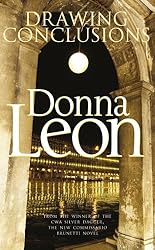
Donna Leon’s Drawing Conclusions is my choice to illustrate the letter L in Kerrie’s Crime Fiction Alphabet.

This is the 20th book in her Commissario Guido Brunetti series. Brunetti is somewhat of a rarity in crime fiction novels – a detective who is happily married with two children. He doesn’t smoke or drink to excess and often goes home for lunch to his beautiful wife Paola.

It’s set in Venice where Donna Leon has lived for many years. I was immediately drawn into this book, with its wonderful sense of locality, believable characters and intricate plot.  Anna Maria Giusti discovers her elderly neighbour Constanza Altavilla lying dead on the floor of her apartment. Apparently she has died from a heart attack but Brunetti, called to the scene because there was blood on the floor, suspects that she may have been attacked as there are bruises on her neck and shoulders. His boss, Vice-Questore Patta wants to close the case but Brunetti decides to make further investigations.

He meets Signora Altavilla’s son and visits the nursing home where she had been helping out. His suspicions are further aroused when the nun in charge of the home is reluctant to answer his questions and by the conversations he has with some of the people she visited. With the help of Inspector Vianello and Signorina Elettra, Patta’s secretary, he discovers a network of deception and lies.

This is a reflective and thoughtful book and I was completely engrossed in it. I haven’t been to Venice, but it came to life as Brunetti walks the streets:

As he walked alongside Rio della Tetta, Brunetti was cheered, as always happened when he walked here, by the sight of the most beautiful paving stones in Venice. Of some colour between pink and ivory, many of the stones were almost two metres long and a metre wide and gave an idea of what it must have been to walk in the city in its glory days. (page 63)

It’s well-paced and there are several unexpected twists that kept me wondering almost to the end what had actually happened to cause Signora Altalvilla’s death. It’s more than crime -fiction as Brunetti ponders on life, the problems of ageing, and the nature of truth and honesty. I didn’t want the book to end – that’s how good it is.

  • Hardcover: 272 pages
  • Publisher: William Heinemann (7 April 2011)
  • ISBN-10: 0434021431
  • ISBN-13: 978-0434021437
  • Source: Review copy

Crime Fiction Alphabet – K is for …

… Karen Maitland

Karen Maitland writes medieval mysteries. She has a doctorate in psycholinguistics and has done all kinds of jobs from cleaner to lecturer, egg packing to dance-drama, before she started writing for a living in 1996. She has travelled and worked in many parts of the world, from the Arctic Circle to Africa, and now lives in the medieval city of Lincoln in England. She is a member of the Crime Writers’ Association, the Historical Novel Society, the Society of Authors and of International Thriller Writers. And she is now one of the Medieval Murderers.

The first book of hers that I read is Company of Liars: a Novel of the Plague, set in the 14th century about a group of nine people travelling to escape from the plague and suspected of concealing the killer of a little girl. It’s a memorable book, with a colourful cast of characters. Although it is a long book (over 550 pages) and there are many other characters than the group of nine I had no difficulty keeping track of who was who. It’s full of suspense and drama and I loved it.

Her second medieval mystery is The Owl Killers: a Novel of the Dark Ages. Again this is set in 14th century England, this time in ‘an isolated village where pagan Owl Masters rule through fear superstition and murder’ (from the back cover). I haven’t finished reading this yet but it’s promising to be equally as good as Company of Liars. Karen Maitland is a wonderful storyteller and her descriptions of the place and period draw me in as though I was actually there.

Her latest book is The Gallows’ Curse, set in the reign of King John (1210). The ‘plot involves people-trafficking, murder and, oh yes… a very feisty dwarf and a eunuch with a hunger for revenge’.

For more crime fiction ‘K‘ entries see Kerrie’s Crime Fiction Alphabet.

Crime Fiction Alphabet – Letter J

I was undecided what to write about for the letter J in Kerrie’s Crime Fiction Alphabet series. I could have chosen P D James’s book The Private Patient, or Peter James’s Not Dead Enough or Jed Rubenfeld’s The Interpretation of Murder, all of which are in my to-be-read piles. But these, inviting though they are, are longish books and I haven’t started any of them yet.

Instead I picked one of the books I’ve borrowed recently from the library by Janie BolithoBetrayed in Cornwall, a quick, easy read. Janie Bolitho was born in Falmouth, Cornwall and her books have a very strong sense of place. She became a full-time writer after being employed as a bookmaker’s clerk, a debt collector, a tour operator’s assistant and a psychiatric nurse. She died of breast cancer in 2002. The first book of hers I read was Snapped in Cornwall, which is the first book in her series of mysteries featuring Rose Trevelyan (see  my review). I think Betrayed In Cornwall (the fourth in the series) is a better book.

Rose is an artist and is holding her first solo exhibition in oil paintings. When her friend Etta Chynoweth doesn’t turn up at the pre-opening private viewing she is concerned and then shocked to discover that Joe, Etta’s son had been found dead at the bottom of a cliff, a packet of heroin near his body. The police think he was involved in drug dealing but Rose and Joe’s family can’t believe that. Rose is convinced that Joe was murdered and that he was set up. Then Joe’s sister, Sarah goes missing. She’d seen Joe with two men on the night he died, near where he died. Did she know too much? Etta has been having an affair with a married man – is he involved and how? Rose has her own ideas and sets about investigating on her own, then everything goes wrong. Add into this mix Rose’s relationship with DI Jack Pearce, a relationship she had broken after a year. Everyone except Rose can see how he still feels about her but she just cannot admit what she feels about him.

I enjoyed this book for what it is, a murder mystery with a ‘cosy’ feel. The characters are quickly drawn, but I still felt they were believable, the writing is fluent, and the Cornish location is superb.