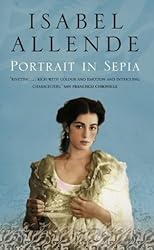
Portrait in Sepia by Isabel Allende

I picked up Portrait in Sepia up in a bookshop four years ago. As I knew nothing about it or the author it joined the other to-be-read books until just recently.

The opening pages of this historical novel grabbed my attention, about Aurora del Valle’s birth in 1880 in San Francisco in the Chinese quarter and referring to family secrets:

I have come to know the details of my birth rather late in life, but it would have been worse not to discover them at all, they could have been lost forever in the cracks and crannies of oblivion. There are so many secrets in my family that I may never have time to unveil them all: truth is short-lived, watered down by torrents of rain. (page 3)

Portrait in Sepia is part of a trilogy, with The House of the Spirits and Daughter of Fortune, and maybe it would have helped if I’d read the other two books, but I thought there was plenty of background history to the characters and I had no problem in following the story and distinguishing the characters.

Summary from the back cover:

After her mother dies in childbirth, Aurora del Valle is raised by her grandmother in San Francisco, but despite growing up in this rich and privileged environment, Aurora is unhappy. Haunted by terrible nightmares and the inexplicable absence of many of her childhood memories, and finding herself alone at the end of a love affair, she decides to travel to Chile to discover what it was, exactly, all those years ago, that had such a devastating effect on her young life. 

Aurora is the narrator and this the story of her family and after giving details of her birth, Aurora goes back to 1862 beginning her story with details about her grandparents. This is not a book you read quickly as there is a lot of detail, a lot of 19th century history of Chile, its mix of nationalities, politics and wars – at first I felt I was drowning in detail, but once I settled into the rhythm of the writing I began to appreciate Allende’s style. It takes you right into the characters, seeing them through Aurora’s eyes – her Chinese grandfather, Tao Chi’en, her uncle Severo and her two grandmothers, Paulina and Eliza, who both play a large role in her life. And there are many other colourful characters and momentous events in this book.

It’s a book about love, loss, identity, betrayal and about family relationships. It’s a portrayal of the strengths and weaknesses of the characters and their struggle to survive. Aurora tells her family’s story through looking at photographs, snapshots in time, through her own disjointed, incomplete and vague memories of her childhood and through conversations with her family members. Whilst she was still very young her two grandmothers decided her future, thinking that time would erase the memory of the traumatic events she had seen, never realising that the scenes would live forever in her nightmares.

Portrait in Sepia explores the nature of memory, how each moment of our lives is so transitory and how the past becomes confused as we try to recapture the moments we’ve lived through. Through photographs we can keep memories alive. As Aurora discovered:

Every instant disappears in a breath and immediately becomes the past; reality is ephemeral and changing, pure longing. With these photographs and pages I keep memories alive; they are my grasp on a truth that is fleeting , but truth none the less; they prove that these events happened and that these people passed through my destiny. Thanks to them I can revive my mother who died at my birth, my stalwart grandmothers, and my wise Chinese grandfather, my poor father, and other links in the long chain of my family, all of mixed and ardent blood. (pages 303-4)

Reading a book like this inevitably leads me on to yet more books, because now I want to read the other two books in the trilogy.

Color Coded Challenge 2015

The Color Coded Challenge is running again next year. Bev has made a change – the colourColour coded may either be named in the title or it may appear as the dominant colour for the cover of the book. For “implies colour” the image implying colour should dominate the cover–for instance a large rainbow, a field of flowers, or the image of a painter.

Here are the rules:

*Read nine books in the following categories. The title shown in italics are my initial choices (mostly on my Kindle) – these could easily change over the course of 2015, especially as I like the idea of using the dominant colour of the cover of the book instead of the title. And these books will also qualify for the Mount TBR Reading Challenge 2015.

1. A book with “Blue” or any shade of Blue (Turquoise, Aquamarine, Navy, etc) in the title/on the cover. Blue Mercy by Orna Ross (Kindle)

2. A book with “Red” or any shade of Red (Scarlet, Crimson, Burgundy etc) in the title/on the cover. The Redbreast by Jo Nesbo (Kindle)

3. A book with “Yellow” or any shade of Yellow (Gold, Lemon, Maize, etc.)in the title/on the cover. The Hare with Amber Eyes by Edmund de Waal

4. A book with “Green” or any shade of Green (Emerald, Lime, Jade, etc) in the title/on the cover. Greenmantle by John Buchan (Kindle)

5. A book with “Brown” or any shade of Brown (Tan, Chocolate, Beige, etc) in the title/on the cover. The Various Flavours of Coffee by Anthony Capella.

6. A book with “Black” or any shade of Black (Jet, Ebony, Charcoal, etc) in the title/on the cover. Black Roses by Jane Thynne (Kindle)

7. A book with “White” or any shade of White (Ivory, Eggshell, Cream, etc) in the title/on the cover. Whitethorn Woods by Maeve Binchy

8. A book with any other colour in the title/on the cover (Purple, Orange, Silver, Pink, Magneta, etc.). Silver Lives by Ann Parker (Kindle)

9. A book with a word that implies colour (Rainbow, Polka-dot, Plaid, Paisley, Stripe, etc.). A Crown of Lights by Phil Rickman (Kindle)

* Any book read from January 1 through December 31, 2015 will count.

*Crossovers with other challenges are fine.

*Everyone who completes all nine categories will be entered in a year-end drawing for a book-related prize package.

Blue Heaven by C J Box

There are lots of things I like about reading e-books, but I’ve found that my Kindle has become a Black Hole – it sucks in books and once they are in there they may never see the light of day again. I don’t even know how many books are lost in there. It’s so easy to download books and just forget they are there. With print books they’re always around sitting on the shelves and even if they are in boxes they take up space and are visible. Not so on an e-reader, the books are invisible.

So it was with Blue Heaven by C J Box – it has sat in my Kindle for nearly three years an unread and indeed a forgotten book. And here is where my liking for reading challenges came into its own, because I was looking for a book with ‘blue’ in its title for Bev’s Color Coded Challenge and up popped Blue Heaven.

I loved it and will certainly look out for more books by C J Box.

The action takes place over four days in North Idaho one spring. It’s a story about two children, Annie and William who decide to go fishing without telling their mother, Monica, and witness a murder in the woods. One of the killers sees them and they run for their lives.

It’s set in a farming community which is changing as people move into the area – specifically retired police officers, about 200 hundred of them, which is where the book title comes from, as according to Fiona Pritzle, the mail lady and local gossip, ‘They call North Idaho ‘Blue Heaven at the LAPD ‘. So when Monica reports her children missing it’s natural for the ex-policemen to volunteer to search for them and as the local sheriff is new to the job, they soon take over the investigation.

Annie and William meanwhile have discovered that not everyone is who they seem to be and it’s not safe even to call home. Until they met Jess Rawlins, an old rancher, a lonely divorcee who is in financial difficulty and struggling to keep his ranch going.

This is really a straightforward story of kids on the run but just to complicate things a little there is a newcomer, Eduardo Villatoro, another retired police officer from California, who arrives in town trying to trace the money stolen from a Santa Anita racetrack several years earlier when a young guard was killed.

It all melds together in a fast paced chase to save Annie and William, the tension maintained until the end. There are several things that kept me gripped as I read Blue Heaven. It’s one of those books that I find myself thinking about when I’m not reading it and keen to get back to it. First of all it’s written in a style that appeals to me – straightforward storytelling, with good descriptions of locality and characters, secondly characters that are both likeable and downright nasty, but not caricatures, and finally the ending was what I hoped, and also dreaded it would be.

  • Format: Kindle Edition
  • File Size: 731 KB
  • Print Length: 353 pages
  • Page Numbers Source ISBN: 0312365705
  • Publisher: Corvus (1 July 2010)
  • Source: I bought it

Challenges: Color Coded Challenge, Mount TBR Challenge and My Kind of Mystery Challenge.

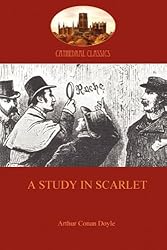
A Study in Scarlet by Sir Arthur Conan Doyle

This is the first Sherlock Holmes and Dr Watson mystery, published in 1887. A Study in Scarlet is a novel in two parts. The first, narrated by Dr John Watson, begins in 1881 with Watson on nine months convalescent leave from the army, having been shot in his shoulder whilst in Afghanistan, followed by an attack of enteric fever. As a result he was weak and emaciated – ‘as thin as a lather and as brown as a nut.‘ He was looking for lodgings when he met a friend who introduced him to an acquaintance who was working in the chemical laboratory at the hospital – Sherlock Holmes, who he described as ‘a little too scientific for my tastes – it approaches to cold-bloodedness. … He appears to have a passion for definite and exact knowledge.’ 
They get on immediately and take a suite of rooms in 221B Baker Street, after Holmes astounded Watson by deducing that Watson had served in Afghanistan. Holmes describes his occupation as a ‘consulting detective‘ solving crimes for both private individuals and the police, using his intuition, observation and the rules of deduction. Tobias Gregson and Lestrade both Scotland Yard detectives regularly ask Holmes for his help.

Very soon they are involved in investigating the murder of Enoch J Drebber, an American found dead in the front room of an empty house at 3 Lauriston Gardens, off the Brixton Road,  with the word “RACHE” scrawled in blood on the wall beside the body.

A Study in Scarlet is a superb story introducing Conan Doyle’s characters – Holmes reminds Watson of

… a pure-blooded well-trained foxhound as it dashes backwards and forwards through the covert, whining in its eagerness, until it comes across the lost scent.

Holmes is his brilliant best, leaving the police officers behind as he discovers the killer. And there then follows a flashback, narrated in the third person, to Part II The Country of the Saints to America in 1847, specifically to a Mormon community, explaining the events that led up to to the murder, where John Ferrier and his adopted daughter Lucy are first rescued from death in the desert and then subjected to the community’s rules, specifically with regard to Lucy’s marriage. At first I just wanted to get back to the murder inquiry and find out how Holmes discovered the murderer’s identity, but soon I was engrossed in the American story. Eventually the two parts come together in Chapter VI as Watson resumes the narrative and  Holmes reveals how he solved the problem by reasoning backwards and from a ‘few very ordinary deductions‘ was able to catch the criminal within three days.

I thoroughly enjoyed this story, written in a straightforward style with enough description to visualise both Victorian London and the American Wild West. I’d watched the TV version A Study in Pink in the Sherlock series, which although very different in some respects is surprisingly faithful to the book in others. I like both versions.

Sir Arthur Conan Doyle was born in Edinburgh in 1859 and died in 1930. He studied medicine at Edinburgh University, becoming the surgeon’s clerk to Professor Joseph Bell said to be the model for Sherlock Holmes’ methods of deduction. He gave up being a doctor with his success as an author and became involved in many causes – including divorce law reform, a channel tunnel, and inflatable life jackets. He was instrumental in the introduction of the Court of Criminal Appeal and was a volunteer physician in the Boer War. Later in life he became a convert to spiritualism.

See Fantastic Fiction for a list of works by Sir Arthur Conan Doyle.

Challenges: Read Scotland 2014, the Colour Coded Challenge, Mount TBR 2014 and My Kind of Mystery.

Two R.I.P. IX Books

So far I’ve read five books that fit into the R.I.P. Challenge categories of Mystery, Suspense, Thriller, Dark Fantasy, Gothic, Horror, or Supernatural. As I’m behind with writing about these books here are just a few notes on two of them:

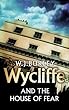
Wycliffe and the House of Fear by W J Burley. Like the other Wycliffe books this is set in Cornwall. Detective Superintendent Wycliffe is on holiday recuperating from an illness when he meets the intriguing Kemp family and visits Kellycoryk, their decaying ancestral home.  The Kemps’ behaviour is odd to say the least and when Roger Kemp’s second wife, Bridget disappears people remember  that his first wife had also disappeared in what had been assumed was a boating accident. Wycliffe is inevitably drawn into the investigation.

I have yet to read a Wycliffe book and be disappointed and this one is no exception. It’s a complex story with sinister undercurrents and good depiction of a dysfunctional family. It kept me guessing almost to the end. This fits into the ‘Mystery’ category.

The next one I read is the short story (just 27 pages), The Yellow Wallpaper by Charlotte Perkins Gilman, which is definitely a suspense story of a young woman slowly but surely losing her mind – or is it a case of a woman suffering from post-natal depression most cruelly treated by her doctor husband? Her husband believes she has just a ‘slight hysterical tendency‘ and prescribes rest and sleep, scoffing at what he considers are her fantasies.

The un-named woman has just had a baby, which she is unable to bear to be near her. She spends most of her time in an attic bedroom, with barred windows and a bed fixed to the floor. The walls are covered in a hideous yellow wallpaper which has been torn off in places. It’s not a beautiful yellow like buttercups but it makes her think of old, foul bad yellow things – and it smells.  The pattern is tortuous and she sees a woman trapped behind the wallpaper as though behind bars, crawling and shaking the pattern attempting to escape. Definitely a creepy and disturbing story!

It reminded me of Marghanita Laski’s The Victorian Chaise-Longue with a similar sense of claustrophobia and helplessness. But The Yellow Wallpaper is much more horrific and by the end I began to question just what was real and what was imagination – it’s psychologically scary!

These two are both books from my to-be-read piles.

Black Dogs by Ian McEwan

Black Dogs 001Black Dogs is one of Ian McEwan’s earlier books (his fifth), first published in 1992. The narrator is Jeremy who lost his parents in a road accident when he was eight and from then on he is fascinated by other people’s parents, particularly his in-laws, Bernard and June Tremaine. When he first met them they were living apart, barely on speaking terms. Starting from a shared belief in communism, they had separated when June turned to God after an encounter with evil in the form of two black dogs. What actually happened doesn’t become clear until the end of the book.

Jeremy is writing a memoir about their lives. The book shifts in time and perspective as he talks to Bernard and June separately. So it moves from Wiltshire, where he visits June in 1987 where she is living in a nursing home, to Berlin with Bernard, when the Wall came down in 1989. Then it moves back in time to 1981 at Majdanek where Jeremy met Jenny, Bernard and June’s daughter, during a visit to the death camp near Lublin in Poland; then to the present day (1989) at the family house at St Maurice de Navacelles in Languedoc in southern France; and finally to 1946 with Bernard and June, newly married on their honeymoon in St Maurice de Navacelles, where June had her encounter with the black dogs.

In 174 short pages the characters come alive, their ideas and meditations are revealed, and the places they inhabit are easily visualised. Black Dogs is a book that gets inside its characters’ minds. It centres around love, loss and longing. The incidents Jeremy describes are open to interpretation – June and Bernard are the extremities, neither seeming to be on the same wave length; Bernard a rationalist and a scientist, June a mystic and believer, seeing the same events through different perspectives. Jeremy is impatient with the difficulty of communication, seeing

an image of parallel mirrors in place of lovers on a bed, throwing back in infinite regression likenesses paling into untruth. (page 90)

The question of the black dogs hangs over the narrative – were they symbolic of evil, or an expression of Churchill’s term for depression, or real creatures? Their impact was immense however you look at it. Black Dogs is a book I really enjoyed reading and thinking about after I finished it.