The Time Machine by H G Wells

This morning the clocks went forward – does that mean we lost an hour? Quite by coincidence yesterday I read The Time Machine – it seems apt!

The Time Traveller has gathered together a group of his friends, who have names such as the Psychologist, the Editor, the Provincial Mayor and so on. First of all he treats them to an explanation of time – of how it is the fourth dimension, ‘with Time as only a kind of Space.’ He then tells them that he intends to explore time in a machine he has invented that transports him back and forth in time.

And to prove it he travels to the future – specifically to the year 802,701 where humanity has evolved into the Eloi, who are pretty little childlike people, strict vegetarians who live above ground and the Morlocks, bleached, obscene nocturnal beings who live underground. Their society is divided between these two – industry being carried out underground by the Morlocks and the Eloi above pursing pleasure and comfort.

On his return he describes his adventures. He was:

 … in an amazing plight. His coat was dusty and dirty and smeared with green down the sleeves; his hair disordered, and as it seemed to me greyer – either with dust or dirt of because its colour had actually faded. His face was ghastly pale; his chin had a brown cut on it – a cut half-healed; his expression was haggard and drawn, as if by intense suffering. … He walked with just such a limp as I have seen in footsore tramps. (page 15)

Whilst describing what happened to him the Time Traveller comments on the society he encountered. At first he thought it was a social paradise, but soon he realised the truth, that the perfection of comfort and security had actually resulted in the weakening of society with no need to struggle for survival or for work. And the truth about the relationship between the Eloi and Morlocks was devastating!

In addition he had soon realised that he had gone into the future particularly ill-equipped – without anything to protect himself, without medicine and without anything to smoke, or even without enough matches! And no camera:

If only I had thought of a Kodak! I could have flashed that glimpse of the Under-world in a second, and examined it at leisure. But, as it was, I stood there with only the weapons and the powers that Nature had endowed me with – hand, feet, and teeth; these, and the four safety matches that still remained to me. (page 69)

I was struck by Wells’s descriptions of the divisions in society between the Haves and the Have-nots and the conditions of the working class as a result of industrialisation in his own time, citing the new electric railways, the Metropolitan Railway in London, the subways and underground workrooms and restaurants:

Even now, does not an East-end worker live in such artificial conditions as practically to be cut off from the natural surface of the earth?

Again, the exclusive tendency of richer people – due, no doubt, to the increasing refinement of their education, and the widening gulf between them and the rude violence of the poor – is leading to the closing, in their interest, of considerable portions of the surface of the land. About London, for instance, perhaps half of the prettier country is shut in against intrusion. (page 62)

So, The Time Machine, which was first published in 1895, is a work of imagination and an early example of science fiction, but it is also a commentary on late 19th century society and a vehicle for H G Well’s views on socialism and industrialisation.

It’s a book I’ve had for a couple of years and so qualifies for the Mount TBR Reading Challenge and after I finished it I realised that it also fits in the ‘Time’ category for the What’s In a Name? Challenge too.
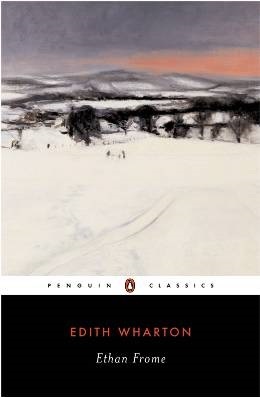
Ethan Frome by Edith Wharton

Ethan FromeWhat a fantastic book. Ethan Frome is a beautifully told tale – a tragedy, signalled right from the beginning of the book, when the unnamed narrator first saw Ethan Frome and was told he had been disfigured and crippled in a ‘smash up’, twenty four years earlier. Life had not been good to him:
Sickness and trouble: that’s what Ethan’s had his plate full up with ever since the very first helping.

I was a bit wary as I began reading Ethan Frome because I’d not long finished reading Doris Lessing’s The Grass is Singing and didn’t want to sink into another bleak and dismal book. I needn’t have worried, even though Ethan Frome is a tragedy there is light to contrast the darkness, and there is love and hope set against repression and misery. It’s another book (like The Grass is Singing) where I hoped the ending would be a happy one, although I knew it couldn’t be. 

It’s a short book (just over 120 pages) and deceptively simple to read, but there is so much packed into it. I enjoyed it very much.  As well as striking and memorable characters the setting is  beautifully described – a ‘mute and melancholy landscape, an incarceration of frozen woe‘, in the isolated village of Starkfield (a fictional New England village). Trapped in an unhappy marriage, Ethan’s life had changed when his father died and he had had to give up his studies to work on the farm. His wife Zeena had always been ill and needing help in the house, which was why her cousin Mattie came to live with them. At first it worked out quite well, but Ethan can’t shrug off a sense of dread, even though he could

… imagine that peace reigned in his house.

There was really even now, no tangible evidence to the contrary; but since the previous night a vague dread had hung on the sky-line. It was formed of Zeena’s obstinate silence, of Mattie’s sudden look of warning, of the memory of just such fleeting imperceptible signs as those which told him, on certain stainless mornings, that before night there would be rain.

His dread was so strong that, man-like, he sought to postpone certainty.

Edith Wharton (1862 – 1937) was an American author. Ethan Frome was first published in 1911 and is in contrast to some of her other books about the New York society of the 1870s to 1920s. It’s a rural tragedy of inevitable suffering and sadness that reminded me of Thomas Hardy’s books.

This book was the Classics Club Spin book for February/March and qualifies in the What’s in a Name 2014 in the Forename/Name category. It’s also a book I’ve owned before 1 January 2014 so is another book for the Mount TBR challenge.

The Thirty-Nine Steps by John Buchan

Way back in 2008 I watched The 39 Steps on TV with Rupert Penry-Jones as Richard Hannay, so inevitably as I read The Thirty-Nine Steps I could see Penry-Jones as Hannay. The dramatisation, however, although there are similarities, is different from John Buchan’s book. There are a number of historical inaccuracies and some artistic licence was used – none of which I was aware of as I watched the film and I thoroughly enjoyed it. It made me want to read the book and it’s taken me until now to get round to it – I’d forgotten most of the details of the film, except for visions of Penry-Jones running away from his pursuers in the Scottish moors, scrambling through the heather.

John Buchan 1936

John Buchan began writing The Thirty-Nine Steps in 1914; it was first published in 1916. He was born in Perth in 1875 and after leaving Oxford University he had a varied career, as well as writing books and articles he was a barrister, a member of Parliament, a soldier and a publisher. He was created Baron Tweedsmuir of Elsefield in 1935 and became the 15th Governor-General of Canada, a position he held until his death in 1940.

Once I began reading The Thirty-Nine Steps I didn’t want to put it down. It’s a fast moving action-story, beginning with an international conspiracy, involving anarchists, financiers and German spies. Richard Hannay, having found Scudder, murdered in his London flat, fears for his life and goes on the run, chased by villains in a series of exciting episodes, culminating in the discovery of the location of the ‘thirty-nine steps’. Hannay is a remarkable character, resourceful, and a master of disguise. As well as fleeing for his life he is searching for Scudder’s notebook, which contains clues to the international conspiracy – Scudder was a spy.

The master villain is also a master of disguise, having the ability to ‘hood his eyes like a hawk‘ :

There was something weird and devilish in those eyes, cold, malignant, unearthly, and most hellishly clever. They fascinated me like the bright eyes of a snake. (page 119)

He can impersonate the British First Sea Lord at a top secret meeting with people who knew the real First Sea Lord very well and is also convincing as the very British gentleman, the plump, bridge-player Percival Appleton.

The Thirty-Nine Steps is to my mind a gem. There are other Hannay books – the Complete series is available on Kindle, The Thirty-Nine Steps, Greenmantle, Mr. Standfast, The Three Hostages, and The Island of Sheep.

And so one book leads on to yet more books!

The Classics Club Spin Result

The Classics ClubLast week I decided to take part in the Classics Club Spin. The rules were €“ list twenty books from your Classics Club list, number them 1 to 20, and the number announced on Monday represents the book you have to read during February and March. The number that has been selected is 20, which means the book I’ll be reading is:

Ethan Frome by Edith Wharton. This is a short novel. I gave up on reading Edith Wharton’s House of Mirth a few years ago, mainly because I thought it was too long winded, so I’m hoping that this much shorter novel will be more to my liking. However, it’s a tragedy and as I’ve just finished reading Doris Lessing’s The Grass is Singing, which is also a tragedy I think I’ll wait a couple of weeks before I start Ethan Frome – too much tragedy is – well, too much all at once.

The Classics Club Spin

The Classics ClubIt’s time for another Classics Spin. To take part in the Spin you:

  • List any twenty books you have left to read from your Classics Club list.
  • Number them from 1 to 20.
  • Next Monday the Classics Club will announce a number.
  • This is the book you need to read during February and March!

Here’s my list chosen by using a random number generator:

  1. North and South by Elizabeth Gaskell
  2. Uncle Tom’s Cabin by Harriet Beecher Stowe
  3. Oliver Twist by Charles Dickens
  4. The Old Wives Tale by Arnold Bennett
  5. Mansfield Park by Jane Austen
  6. The Adventures of Sherlock Holmes by Arthur Conan Doyle
  7. Anne of Green Gables by Lucy Maud Montgomery
  8. Little Dorrit by Charles Dickens
  9. The Man Who Would Be King by Rudyard Kipling
  10. Lord Jim by Joseph Conrad
  11. Parade’s End by Ford Maddox Ford
  12. Lorna Doone: A Romance of Exmoor by R D Blackmore
  13. Notre-Dame of Paris by Victor Hugo
  14. No Name by Wilkie Collins
  15. The Making of a Marchioness by Frances Hodgson Burnett
  16. Where Angels Fear to Tread by E M Forster
  17. Out of Africa by Karen Blixen
  18. Walden by Henry James Thoreau
  19. Moby Dick by Herman Melville
  20. Ethan Frome by Edith Wharton

I don’t really mind which one comes up in this Spin, although there are some I’d prefer over others. What would you chose off this list?

Washington Square by Henry James

When I read  The Turn of the Screw by Henry James I was completely engrossed in the book, even with its long convoluted sentences. It’s a dark and melodramatic story, about good and evil and with hints of sexual relations, reflecting the Victorian society of the time.

So I was expecting to be just as engrossed  with Washington Square – especially as I soon realised that the sentence structure is much simpler. It’s much easier to read, but sadly it just didn’t catch my imagination. I found it rather tedious as Catherine Sloper grew older and older, in conflict with her father over whether she should marry Morris Townsend.

It’s all about will /won’t Catherine and Morris get married. Catherine is an adult, living at home in Washington Square with her father the wealthy Dr Sloper. She has money of her own left to her by her mother. It is her father’s money that she will lose if she marries Morris. At first she is completely obedient to her domineering father and is taken in by the handsome Morris who is clearly after her for her money. I think this description of her sums her up so well and her father’s attitude towards her –

‘She is about as intelligent as the bundle of shawls,’ the Doctor said.’

Spoiler alert – if you don’t want to know how the book ends, don’t read on!

But then she does begin to see through Morris, acknowledges her father’s overbearing manipulation and her aunt’s meddling interference and I began to think this is similar to Jane Austen’s Persuasion, but no, this romance just fizzles out as Morris eventually marries someone else, gets bald and fat and widowed. He returns to see Catherine and she finally rejects his advances. She had forgiven him, but she couldn’t forget the past:

‘I can’t forget – I don’t forget,’ said Catherine. ‘You treated me too badly. I felt it very much; I felt it for years.’ And then she went on, with her wish to show him that he must not come to her in this way, ‘I can’t begin again – I can’t take it up. Everything is dead and buried. It was too serious; it made a great change in my life. I never expected to see you here.’ (page 153)

This was number 10 on my Classics Club Spin list, the number picked as the November/December book – not a success for me.