Agatha Christie Reading Challenge: My Progress

The Agatha Christie Reading Challenge is an open-ended challenge to read all of Agatha Christie’s books and short stories, run by Kerrie at Mysteries in Paradise. I first read some of Christie’s books when I was a teenager and hadn’t read any for years until I borrowed a copy of The Crooked House from my local library three years ago. This reminded me of how much I had enjoyed her books and set me off reading them again. Over the years I must have read a good number of them but had never kept any records of what I read at the time.

So when I saw that Kerrie was running this challenge I decided to join in. It’s one of the best challenges out, for me at least, because all you have to do is read Agatha Christie’s books at your own pace and link to the Agatha Christie Carnival once a month. There’s no pressure to meet any deadlines – if you haven’t read any Christie books for the Carnival that’s OK and you just carry on reading when you like.

I’m not even trying to read them in the order they were published, even though Kerrie and some others are, because I’m reading books I already own or books that I find in librarys and/or bookshops. So far I’ve read 17 and 2 collections of her short stories – I’ve listed them on a separate page.

My latest find is 4.50 from Paddington, which I received from Juxtabook as part of my prize in her recent competition. Catherine described this book as a ‘rather aged paperback’ and it is, but then it is 50 years old, published in 1960 for just 2/6 (in old money). It may be old and faded, but because it was published soon after Agatha Christie wrote it, it has a contemporary feel about it. I’ve watched so many TV and film versions, with different actors playing the part of Miss Marple, some more successfully than others that it’s interesting to see this book. I’m not sure who the woman on the front cover is meant to portray – surely not Miss Marple?
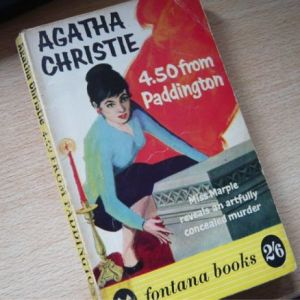
And this is the back cover – really that’s all the blurb you need to capture your interest.

This will be my next Agatha Christie book to read.

Death on the Nile by Agatha Christie: Book Review

Death on the Nile is a pre-Second World War novel, first published in 1937. It shows Agatha Christie’s interest in Egypt and archaeology and also reflects much of the flavour and social nuances of the pre-war period. In it she sets a puzzle to solve –  who shot Linnet Doyle, the wealthy American heiress? Although the novel is set in Egypt, an exotic location, it is essentially a ‘locked room mystery’, as the characters are passengers on the river-steamer SS Karnak, cruising on the Nile. Amongst them is the famous Hercule Poirot, a short man dressed in a white silk suit, a panama hat and carrying a highly ornamental fly whisk with a sham amber handle ‘a funny little man (pages 37 – 38). Linnet is the girl who has everything, good looks and wealth:

A girl with golden hair and straight autocratic features ‘a girl with a lovely shape’ (page 3). She was used to being looked at, being admired, to being the centre of the stage wherever she went. (page 41)

Linnet has recently married Simon Doyle, who was previously engaged to her friend, Jacqueline. This sets in motion a series of events that results in Linnet’s death. When Jacqueline follows them on their trip down the Nile she is the obvious suspect, driven by her jealousy of Linnet. Also on board are an imperious American, Miss Van Schuyler, her niece Cornelia Robson and Miss Bowers, her companion; a novelist Mrs Salome Otterbourne and her daughter, Rosalie; Mrs Allerton and her son, Tim; Linnet’s American solicitor, an excitable Italian archaeologist, a radical English socialist and a young English solicitor.

Poirot is on holiday, but he finds himself discussing the nature of criminals and motives for murder with Mrs Allerton. He says the most frequent motive is money:

that is to say gain in its various ramifications. Then there is revenge, and love, and fear ‘and pure hate, and benefice’. (page 83)

The motive in this case seems straightforward, looking at who gains from Linnet’s death, but this is a complicated plot (when is one of Christie’s books not complicated?) and following on from Linnet’s murder, her maid is also found dead, Linnet’s pearls are missing, several characters are not what them seem and with the arrival of Colonel Race, a member of the British Secret Service, it seems there is also an international murderer and agitator on board. Poirot knew

that Race was a man of unadvertised goings and comings. He was usually to be found in one of the out-posts of Empire where trouble was brewing. (page 120)

It does seem a very unlikely plot, dependent on precise timing, but Poirot works his way through the significant facts and arrives at the truth. He tells Race that

This is a crime that need audacity, swift and faultless execution, courage, indifference to danger and a resourceful, calculating brain. This crime wasn’t safe! It hung on a razor edge, It needed boldness. (page 272)

All in all, an enjoyable puzzle to solve, most of which I’d worked out along with Poirot.

Paris in July

I’m not actually going to Paris this month, but BookBath and Thyme For Tea are hosting a blogging experience to celebrate all things French and Parisian running from the 1st – 31st July this year called “Paris In July“. 
The aim of the month is to celebrate our French experiences through reading, watching, listening to, observing, cooking and eating all things French!
There will be no rules or targets in terms of how much you need to do or complete in order to be a part of Paris In July – just blog about anything French and you can join in. Some ideas for the month might include;
  • Reading a French book – fiction or non-fiction
  • Watching a French movie
  • Listening to French music
  • Cooking French food
  • Experiencing French art, architecture or travel

This should give me the nudge to finish reading Irene Nemirovsky’s Suite Francaise, which I started last year. I’ve read half of it and right now I can’t imagine why I didn’t finish it because I was finding it so good! I’d also like to read The Gourmet by Muriel Barbery.

Although I doubt very much that I’ll be able to read these books this July there are also two other books I’ve been meaning to read for ages – The Hunchback of Notre Dame by Victor Hugo and The Count of Monte Cristo by Alexandre Dumas.

And I must get out my French cookery books too, in particular The Frenchwoman’s Kitchen by Brigitte Tilleray.

Challenges and the All Things Alcott Challenge

At the beginning of the year I decided not to do many challenges this year partly because I want to concentrate on reading books I already own and partly because I find I lose track of where I’m up to with the challenges. I have no problem with the Agatha Christie Reading Challenge as that is ongoing with no deadlines and also the To-Be-Read Challenge fits in well with my aims.

Recently, however, I’ve been attracted by the Cozy Mystery Challenge, the Daphne Du Maurier Challenge and now the All Things Alcott Challenge that Margot has set up. This is a challenge to explore Louisa May Alcott’s world  and her body of work. For all these challenges I intend to read from books I already own and I hope to keep a record of my progress on the Reading Challenges Tab (above).

These are the guidelines for the All Things Alcott Challenge:

  1. Between May 1st and the end of the year (2010), choose one or more Alcott related things to do (see #2). In the spirit of Louisa May Alcott, each participant will set his/her own course in this challenge. You choose one or as many Alcott related items as you wish.
  2. You will also determine the contents of your challenge. As long as it is Alcott related, you may choose books, audiobooks, DVDs, movies, TV shows, a play or live theater. Anything by or about Louisa May Alcott is the intention of the challenge.
  3. It’s not necessary to compile a list at the beginning of the challenge.
  4. It’s perfectly okay if this challenge overlaps with other challenges.

Margot is aiming to re-read some of Alcott’s books and I may do that as well, but my main aim is to read Eden’s Outcasts: the Story of Louisa May Alcott and Her Father by John Matteson, which has been on my bookshelves since last year.

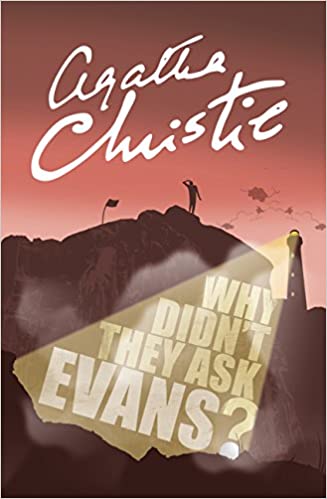
Crime Fiction Alphabet W is for Why Didn’t They Ask Evans?

I’m returning to Agatha Christie to illustrate the letter W in Kerrie’s Crime Fiction Alphabet series, with Why Didn’t They Ask Evans? The copy I read is one of the Collected Works series with the original illustrations by Patrick Couratin and Sylvia Dausset. Why Didn’t They Ask Evans? was first published in 1934.

Why didn't they ask evans

The book begins with Bobby Jones playing golf with Dr Thomas on a golf course on a misty day by the sea. They find a dying man, who had fallen off a cliff. He has no identification on him, just a photo of a young woman that Bobby finds in his pocket. At the inquest Mrs Cayman said it was a photograph of her and that she was the dead man’s sister.

Bobby tells Mr and Mrs Cayman her brother’s last words, which apparently are meaningless and of no importance.Then Bobby is drugged with enough morphia to kill him (he survives) and he realises that the photo in the dead man’s pocket was not Mrs Cayman.  Frankie, (aka Lady Frances Derwent), his aristocratic friend decides that the dead man must have been pushed over the cliff and the killer is determined to kill Bobby too. She and Bobby then set out to discover the dead man’s true identity.

Neither Poirot, nor Miss Marple feature in this book. Bobby and Frankie solve the mystery with a little help from the police in the form of Inspector Williams. The novel as a whole is light-hearted with staged accidents, as Bobby and Frankie, a self-confident and rather bossy young woman relish the adventure of it all, despite being bound and gagged by the villain. There are disguises and subterfuges throughout, drug addicts, an American heiress, a sinister doctor with a questionable sanitorium, suicides and a charming  “ne’er-do-weel”. Bobby says:

You can’t mix up too many different sorts of crimes. (page 59)

But Agatha Christie manages it admirably.

Reading Challenges

 I’ve been thinking about reading challenges and seen that many bloggers are signing up to lots of interesting-looking challenges. I’m always attracted to them and enjoy thinking about the books I could read to complete the challenges … and then I find they become a chore. I find myself thinking “what have I got to read next for a challenge?”, not looking forward with pleasure at the thought of reading the next book. So this year I’m easing off them.

The challenges I am taking part in this year are:

  • Attacking the TBR Tome Challenge. Last year I listed 14 books as my own To-Be-Read Challenge and only read 1 of them, so for 2010 I’ll be taking part in this challenge – the books are shown on my sidebar, in the hope that this will encourage me to read them soon. The idea is to read at least 20 of your tbr books before buying any new books.
  • The Agatha Christie Reading Challenge – this fits in well with my reading as I love AC’s books.
  • Alphabet in Crime Fiction – this is now up to the letter L (which I haven’t done). The letter M next week.