December Prompt – Wrap Up, A Classics Challenge 2012

I’ve completed A Classics Challenge 2012, hosted by Katherine Cox at November’s Autumn. The aim was to read seven works of Classic Literature in 2012, but only three of the seven could be re-reads. I’ve really enjoyed taking part in this because it’s more than just read a book. Katherine’s monthly prompts provided a new way of thinking about the books and the authors. I’ve also enjoyed reading the views of the other participants.

Each month Katherine posted a prompt, which was general enough that no matter which Classic you were reading or how far into it you were, you would be able to answer it.

This is the final Prompt:

Link to your favorite Classic Literature post you’ve written this year, it doesn’t have to be related to this challenge. Just something you’d enjoy sharing.

Make a list of what you read for the challenge, you could compare it to your original list drawn up late 2011 when you were planning what to read, link to the posts you’ve written for the challenge, how many authors you’ve read or any little stat or detail you’d like to share.

My original list:

  • Emma by Jane Austen
  • The Woman in White by Wilkie Collins.
  • Three Men in a Boat by Jerome K Jerome
  • Wives and Daughters by Elizabeth Gaskell.
  • Kidnapped by Robert Louis Stevenson.
  • Our Mutual Friend by Charles Dickens.
  • The Voyage Out by Virginia Woolf.

What I actually read:

I think my favourite prompt was June’s prompt, which was to create a visual tour using quotes from the book you are reading; a series of images that closely represents how you see the scene or description. It doesn’t have to absolutely follow the text but it must reflect the mood. For this I used A Tale of Two Cities, in which I concentrated on London scenes – where Doctor Manette lived in Soho.

Now I look forward to next year and taking part in Katherine’s Turn of the Century Literary Salon.

Mount TBR Reading Challenge 2013

Here’s another Reading Challenge that I can’t ignore, because it’s one that I’ve been doing quietly and slowly on my own, ever since I can remember. It’s Bev’s Mount TBR Reading Challenge 2013.

Bev plans to primarily from her own shelves next year. It might not seem to be a very challenging challenge – to read books you already have on your shelves – but faced with the almost constant temptation to borrow books from the library, buy new books, and download free ones to Kindle, it is! And whilst I can’t promise that I won’t give in to that temptation, I too would like to think that I’ll make great inroads to my ever-growing pile of TBRs.

Challenge Levels

Pike’s Peak: Read 12 books from your TBR pile/s
Mount Blanc: Read 24 books from your TBR pile/s
Mt. Vancouver: Read 36 books from your TBR pile/s
Mt. Ararat: Read 48 books from your TBR piles/s
Mt. Kilimanjaro: Read 60 books from your TBR pile/s
El Toro: Read 75 books from your TBR pile/s
Mt. Everest: Read 100 books from your TBR pile/s
Mount Olympus (Mars): Read 150+ books from your TBR pile/s

And the rules:
*Once you choose your challenge level, you are locked in for at least that many books. If you find that you’re on a mountain-climbing roll and want to tackle a taller mountain, then you are certainly welcome to upgrade.

*Challenge runs from January 1 to December 31, 2013.

This year I’ve read 25 of my TBRs, so next year I’m aiming to increase that by attempting Mount Ararat, that is, to read 48 books from my own bookshelves. I really ‘should’ go for Mount Olympus (Mars) but that is a few steps too far!

Here is my Progress Page

What’s in a Name 6

At this time of year I often think that I won’t take part in any book challenges in the future and I was just thinking that the other day when I saw that Beth Fish Reads had posted about next year’s What’s in a Name challenge, which will run between January 1 and December 31, 2013. As I do like working through my unread books and making lists of what to read next I had to see if it would be easy to fit books to fit the challenge – of course I did! The idea is to read one book in each of the following categories:

1. A book with up or down (or equivalent) in the title: eg Deep Down True, The Girl Below, The Diva Digs up the Dirt

2. A book with something you’d find in your kitchen in the title: Loose Lips Sink Ships, The Knife of Never Letting Go, Breadcrumbs

3. A book with a party or celebration in the title: A Feast for Crows, A Wedding in Haiti, Cocktail Hour under the Tree of Forgetfulness

4. A book with fire (or equivalent) in the title: Burning for Revenge, Fireworks over Toccoa, Catching Fire

5. A book with an emotion in the title: Baltimore Blues, Say You’re Sorry, Dreams of Joy

6. A book with lost or found (or equivalent) in the title: The Book of Lost Fragrances, The World We Found, A Discovery of Witches

  • Books may be any form (audio, print, e-book).
  • Books may overlap other challenges.
  • Books may not overlap categories; you need a different book for each category.
  • Creativity for matching the categories is not only allowed but encouraged.
  • You do not have to make a list of books before hand.
  • You do not have to read through the categories in any particular order.
Here are my choices:
1. A book with up or down (or equivalent) in the title:
  • Ripley Under Water by Patricia Highsmith
  • Rise and Shine by Anna Quindlen

2. A book with something you’d find in your kitchen in the title:

  • Gem Squash Tokoloshe by Rachel Zadok
  • The Various Flavours of Coffee by Anthony Capella
  • The Olive Readers by Christine Aziz
  • Saving Fish from Drowning by Amy Tan
  • The Water Horse by Julia Gregson

3. A book with a party or celebration in the title:

  • Ralph’s Party by Lisa Jewel
  • A Time to Dance, No Time to Weep by Rumer Godden
  • The Birthday Boys by Beryl Bainbridge

4. A book with fire (or equivalent) in the title:

  • Daughters of Fire by Barbara Erskine
  • The Girl who Played with Fire by Stieg Larsson

5. A book with an emotion in the title:

  • Book of Love by Sarah Bower
  • Love in the Time of Cholera by Gabriel Garcia Marquez
  • Sword of Shame by The Medieval Murderers
  • The Pursuit of Happiness by Douglas Kennedy
  • The Soul of Kindness by Elizabeth Taylor
  • The Tenderness of Wolves by Stef Penney

6. A book with lost or found (or equivalent) in the title:

  • The Book of Lost Things by John Connolly
  • The Lost Art of Keeping Secrets by Eva rice
  • The Lost Prophecies by The  Medieval Murderers
  • The Lost Army of Cambyses by Paul Sussman
  • The Inheritance of Loss by Kiran Desai

More than enough!

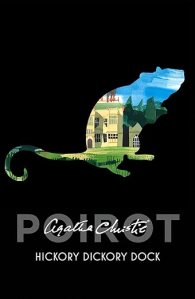
Hickory Dickory Dock by Agatha Christie

Hickory Dickory Dock is a Poirot mystery, first published in 1955. The nursery rhyme title actually bears no relevance to the plot, even though Poirot quotes the rhyme at the end when he hears a clock strike one. The only links I can see are that it’s about the residents of a students’ hostel at 26 Hickory Road and one of the suspects also parodies the rhyme.

Poirot is drawn into the plot through his secretary, Miss Lemon. This is her first appearance as Poirot’s secretary in a full length novel, although she had featured in some of Agatha Christie’s short stories. She had also appeared in Parker Pyne Investigates (1934) when she worked for Mr Parker Pyne. I’m used to Pauline Moran’s portrayal of Miss Lemon, in Agatha Christie’s Poirot TV series – efficient and smart but also attractive. So I was surprised to read this most unflattering description of her as ‘that hideous and efficient woman … she was not a woman at all. She was a machine – the perfect secretary’ , with ‘strong grizzled hair.’ Poirot just cannot believe that she has made three mistakes in one letter and discovers that she is worried about her sister who manages a student hostel where strange things have been happening.

Now this is not the usual setting for an Agatha Christie novel – no quintessential English village, no grand country houses, or quaint cottages, but a crowded London house, owned by Mrs Nicolstis, a Greek and full of a mixed group of young people from a variety of backgrounds and cultures – from America, West Africa and India as well as an assortment from the British Isles. Miss Lemon’s sister, Mrs Hubbard gives Poirot a list of items that have recently gone missing and.invites him to talk to the students about detection and some of his  celebrated criminal cases. At first it all seems to be quite low key, as some of the missing items are rather trivial – lipstick, and a box of chocolates, for example, but others are rather odd – such as one evening shoe, a rucksack, discovered cut up in pieces, and boracic powder. But then one of the students commits suicide – or is it murder? And more deaths follow.

I did enjoy this book, although the plot is somewhat far-fetched, but I liked the characterisation, particularly the way in which Agatha Christie reveals contemporary attitudes (1950s) to race and politics, as the characters’ prejudices come out in their discussions. There are plenty of suspects and red herrings and some interesting reflections on crime and the psychology of behaviour. And I also liked this insight into Miss Lemon’s mind. Poirot has quoted from one of Conan Doyle’s Adventures of Sherlock Holmes and she responds:

‘You mean these Baker Street societies and all that’, said Miss Lemon. ‘Grown men being so silly! But there, that’s men all over. Like the model railways they go on playing with. I can’t say I’ve ever had time to read any of the stories. When I do get time for reading, which isn’t very often, I prefer an improving book.’ (page 9)

It’s just as well we don’t all think like that.

Classics Challenge – September Prompt: Music

Classic Challenge 2012This year I am taking part in a Classics Challenge hosted by Katherine of November’s Autumn. The goal is to read at least seven classics in 2012 and every month Katherine is posting a prompt to help us discuss the books we are reading.

This month’s prompt is to select a piece of…

Music

…that you feel reflects the book. Modern, classical, jazz, anything, it doesn’t have to be from the period of the novel but share what it is about the piece that echoes the novel in someway.

I don’t listen to music when I’m reading because I just don’t hear it when I’m lost in the words and the story. But some books automatically bring music into my head as the book I’m reading this month does. It’s the classic science fiction – The War of the Worlds by H G Wells and the music is Jeff Wayne’s Musical Version of The War of the Worlds, an album that we bought in 1978 – wonderful music and words bringing the book to life. It’s narrated by Richard Burton with songs by David Essex, Julie Covington and Justin Hayward.

The opening words and music are always thrilling, heralding the coming of the Martians to Earth:

No one would have believed, in the last years of the nineteenth century, that human affairs were being watched keenly and closely by intelligences greater than man’s and yet as mortal as his own; that as men busied themselves about their affairs they were scrutinized and studied, perhaps almost as narrowly as a man with a microscope might scrutinize the transient creatures that swarm and multiply in a drop of water. With infinite complacency men went to and fro over this globe about their little affairs, serene in their assurance of their empire over matter.

The clip below is ‘Thunder Child’, the warship that destroys two Martian tripods before being sunk.

Whilst I was looking for the clip to include in my post I discovered that there is a new version of Jeff Wayne’s classic album – Jeff Wayne’s Musical Version of The War of the Worlds, the New Generation, to be released on 12 November, which features Liam Neeson, Gary Barlow, Joss Stone and Ricky Wilson.

Dark Matter: a Ghost Story by Michelle Paver

Dark Matter

My first book for the R.I.P. VII Challenge is a chilling book, very chilling, both in the setting in the High Arctic and in atmosphere. I was glad I wasn’t reading Dark Matter by Michelle Paver in the dead of winter, snowbound and alone, because then it would have been terrifying. The isolation of the long, dark Arctic winter is oppressive and unrelenting.

It’s a ghost story in the form of a diary – that of Jack Miller who in 1937 was part of an expedition to the High Arctic to study its biology, geology and ice dynamics and to carry out a meteorological survey. Jack’s role is as radio operator, transmitting observations three times a day to the Government forecasting system.

From the start Jack is very reluctant to go, put off by the other members of the expedition, four ex-public schoolboys. But he’s stuck in a boring job, after giving up his plans to be a scientist and realises this is the only chance he’ll ever get to change his life. Right from the start things begin to go wrong, but Jack remains enthusiastic. Later when they meet Skipper Eriksson, the part owner and captain of the ship taking them to Gruhuken, a remote uninhabited bay where they’re setting up camp, Jack begins to feel increasingly uneasy. Eriksson is reluctant to take them to Gruhuken, but he doesn’t explain why merely saying he doesn’t think it’s ‘right’ for a camp.

Not long after they have set up camp Jack feels oppressed by the isolation brought on by the thought of the men who had been there before them:

Suddenly, I felt desolate. It’s hard to describe. An oppression. A wild plummeting of the spirits. The romance of trapping peeled away, and what remained was this. Squalor. Loneliness. It’s as if the desperation of those poor men had soaked into the very timber, like the smell of blubber on the Isbjørn. (page 65)

The trappers had left behind a ruined mine, a hut ‘crouched among the boulders  in a blizzard of bones‘ and in front of the hut a ‘bear post’ for luring bears to the trappers’ gun. It all makes Jack’s spirits sink. As the ship is leaving the camp, Jack sees a man standing in front of the cabin by the bear post and is relieved when he leaves. Now the members of the expedition are alone with the huskies and Jack’s unease grows. He is disturbed by the change in the weather, the increasingly shorter days and irritated by the other members, in particular by Algie and his insensitivity and cruelty towards the dogs.

Jack’s unease turns into dread as he realises that Gruhuken may be haunted, but his rational mind explains his feeling as an echo:

An echo from the past. … it’s called ‘place memory’, a well-known idea, been around since the Victorians. If something happens in a place – something intensely emotional or violent – it imprints itself on that place; maybe by altering the atmosphere, like radio waves, or by affecting matter, so that rocks, for example, become in some way charged with what occurred. Then if a receptive person comes along, the place plays back the event, or snatches of it. … What I saw was only an echo. (pages 111-2)

As the darkness descends, Jack is left alone at the camp and his nightmare really begins. The book is well-paced, the tension mounts, and paranoia sets in … or is it real, even the dogs are scared. It really is a page-turner and a good old-fashioned ghost story. The relationships between the characters are well drawn, and especially Jack’s relationship with Isaak, one of the huskies. I was most concerned about Isaak!

Jack describes ‘dark matter‘ of the title, as that part of the universe that cannot be seen or detected, but is there. He finds this idea

‘… unsettling. Or rather, not the idea itself, that’s merely an odd notion about outer space. What I don’t like is the feeling I sometimes get that other things might exist around us, of which we know nothing.’ (pages 94-5)

I don’t like that either. It’s scary.

  • Hardcover: 256 pages
  • Publisher: Orion; First Edition edition (21 Oct 2010)
  • Language: English
  • ISBN-10: 1409123782
  • ISBN-13: 978-1409123781
  • Source: I bought the book
  • My Rating: 4/5