Barnaby Rudge by Charles Dickens

I knew absolutely nothing about Barnaby Rudge: a Tale of the Riots of ‘Eighty before I started to read it. It’s not a book that I’ve seen dramatised. But whilst reading (very slowly) Claire Tomalin’s biography, Charles Dickens A Life I came across the following information. In May 1836, the year that Dickens, then 24, married Catherine Hogarth on 2 April, he agreed he would write a three volume novel, called Gabriel Vardon by November. But by November he was trying to withdraw from the agreement, due to his commitments in writing Pickwick and Sketches by  Boz. He began writing Gabriel Vardon in 1839 and it was only in February 1841 that its serialisation began. By then he had renamed it as Barnaby Rudge.

It’s a murder mystery as well as a historical novel, mainly concerning the events surrounding the Gordon Riots of 1780. The Riots began in protest to the Catholic Relief Act of 1778, which granted Roman Catholics exemption from taking the religious oath when joining the British Armed Forces and granted them a few liberties, previously denied to them. Led by Lord George Gordon the protests quickly turned violent, Parliament was invaded and Newgate prison was burned to the ground. I was rather surprised that Tomalin gave away most of the plot in describing Barnaby Rudge and gave away the identity of the murderer. I don’t intend to do the same as it spoilt the mystery for me.

Barnaby Rudge begins in 1775, five years before the riots as a group of customers in the Maypole Inn in the village of Chigwell, on the borders of Epping Forest and about 112 miles from London, recollect the murder of Reuben Haredale, the owner of The Warren, 22 years earlier to the day. His steward, a Mr Rudge was found months later, stabbed to death.The murderer had never been discovered. Reuben’s brother Geoffrey had lived at The Warren with his niece, Emma ever since.

From then on the book becomes much more complicated with many characters and sub-plots. There is the love story of Emma, a Catholic and Edward Chester, the son of Sir John Chester, a Protestant and opponent of her uncle, who is dead against their marriage. Also crossed in love are Joe Willet, whose father John Willet is the landlord of the Maypole and the captivating Dolly Varden whose father Gabriel Vardon is a locksmith. Barnaby Rudge is a simple young man, living with his mother. His pet raven, Grip goes everywhere with him. He’s a most amazing bird who can mimic voices and seems to have more wits about him than Barnaby. Grip is based on Dickens’s own ravens, one of whom was also called Grip. (Edgar Allen Poe was inspired by Dickens’s portrait to write his poem The Raven).

It’s a long book and in parts loses its impetus, but picks up when Dickens jumps five years forward into the Riots and I was taken aback by his vivid and dramatic descriptions of the violence and horror:

If Bedlam gates had been flung wide open, there would not have issued forth such maniacs as the frenzy of that night had made. … There were men who cast their lighted torches in the air, and suffered them to fall upon their hands and faces, blistering the skin with deep unseemly burns. There were men who rushed up to the fire, and paddled in it with their hands as if in water; and others who were restrained by force from plunging in, to gratify their deadly longing. On the skull of one drunken lad – not twenty, by his looks – who lay upon the ground with a bottle to his mouth, the lead from the roof came streaming down in a shower of liquid fire, white hot; melting his head like wax.

And then there is the attack on Newgate prison, the release of the prisoners and finally the scene as the mob set fire to the prison, scenes that rival the storming of the Bastille in A Tale of Two Cities.

By the end of the novel the murderer is revealed and all the plot strands are completed. There are a number of themes running through the novel – the relationship between fathers and sons, the position of authority, justice and the question of punishment for crime, and religious conflict. Dickens paints a picture of London, the dirt and poverty, the terrible condition of the roads, the perils of footpads and highwaymen which is in contrast to the countryside that still at that period surrounded London making it a cleaner, purer place to live in. There are detailed descriptions of the old inn, the Maypole and Vardon’s house and shop with their individual irregularities and strangeness.

And alongside all this are the characters, the restless innocent that is Barnaby, his over-protective and distracted mother, the melodramatic servant Miggs, the pure evil of Hugh, an idle servant at the Maypole who becomes one of the leaders of the riots, and Mr Dennis, the hangman to name but a few.

It wasn’t such a success as some of Dickens’s other novels but I think that that is not a fair reflection of its qualities. It’s almost a book of two parts and the dramatic second half, to my mind, more than makes up for the slow beginning which I had to read slowly and carefully. The portrayal of Barnaby Rudge is also masterly – a sympathetic but totally unsentimental characterisation of his ‘madness’ and his underlying common sense.

Barnaby Rudge was number 6 in the Classics Club Spin, which is the reason I’ve been reading it this June, rather than later.  I’ve had the book on my Kindle since March 2013, so not as long as some of my to-be-read books, so it also counts towards the Mount TBR Reading Challenge and the Historical Fiction Challenge too. There are numerous editions of Barnaby Rudge and each one gives different page numbers, depending, I suppose on the format and font size. The Kindle edition estimates its length at 845 pages, so it also counts towards the Tea and Books Challenge.
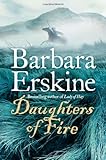
Daughters of Fire by Barbara Erskine

Daughters of Fire is historical time-slip fiction switching between the present day and the first century CE Britannia, a mix of historical fiction, fantasy and romance.  It was with relief that I finished reading it – relief, because although the story of Cartimandua, Queen of the Brigantes tribe is fascinating and that of historian Viv Lloyd Rees is initially interesting, the book is too long, and too wordy.

Daughters of Fire intermingles two stories, that of  Viv and Cartimandua. Viv has published a book on Cartimandua, a book using alternative as well as traditional historical sources – ie using legends, her dreams and visions as well as the writings of Roman historians. She has ‘borrowed’ an ancient cursed brooch from her boss, Professor Hugh Graham, who has criticised her book as fantasy. The rest of her story is their obsession with and struggle to gain control of the brooch.

Cartimandua, back in the first century is beset by enemies on all sides, Romans and  the leaders of the other tribes. It all goes from bad to worse when she betrays Caradoc (Caractacus), the leader of the Catuvellauni tribe, who led the tribes in resisting the Roman invaders and hands him over in chains to the Romans.

For me the essential story was good, but lost impact as it dragged on, drowned in words and by the repetition of the struggles between the characters. Because of this the ending was drained of any impact and suspense for me. I like time-slip stories, the supernatural and the paranormal, so that wasn’t a problem. And I liked the sections explaining Celtic beliefs – their belief in the immortality of the soul, in reincarnations and transmigration of the soul. As one of the characters said:

Remember the world he lived in was an animistic, rainbow world of links and connections which included vast echelons of spirits and gods and ancestors, people dead and people yet to be born, all of whom could be summoned to his aid. (page 258)

In the Author’s Note, Barbara Erskine emphasises that this is above all fiction:

In the absence of written information one has to make do with imagination, dreams and deductive techniques of a dubious nature! … (page 562)

and regarding Cartimandua:

We don’t know her tribe, or if she had children, and although far more is known about her life than that of he much more famous contemporary, Boudicca, she is still an enigma.

So, for all that is historically known about Cartimandua I refer the reader to the Roman historians.

For the truth of her life we must consult archaeology and the oracles.

The rest is silence. (page 562)

A couple of years ago I read Barbara Erskine’s book, The Warrior Princess, another time-slip book, which I also thought was too drawn out and would have been better if the plotting had been tighter. I own one more of her books, which I’ve yet to read – Sands of Time, a collection of short stories, described on the back cover as ‘spine-tingling‘ tales all with ‘a touch of the unexpected … suspense, romance, passion, unexpected echoes of the past.’ I hope, because these are short stories, they will be more succinct than the two books I have read.

This book qualifies for several challenges – Mount To-Be-Read 2013 (it’s been on my shelves for about 4 years), The Historical Fiction Reading ChallengeWhat’s in a Name 6 (in the Fire category) and Once Upon a Time VII (Fantasy).

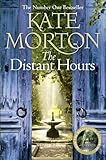
The Distant Hours by Kate Morton

I was hoping that The Distant Hours, Kate Morton’s third book would be as good as the first,The House at Riverton, which I loved. I’ve read her second book The Forgotten Garden, which disappointed me, because it was predictable and I thought it was a re-working of Frances Hodgson Burnett’s book, The Secret Garden. However, I think The Distant Hours is the least satisfying, which is a shame as it promised to be so good at the beginning and the story itself is fascinating …

A dilapidated castle, aristocratic twins, a troubled sister and a series of dark secrets cast a whispery spell … (from the back cover)

It begins with a creepy tale, The True History of the Mud Man, a children’s story written by Raymond Blythe, the owner of the castle. It begins:

Hush – Can you hear him?

The trees can. They are the first to know that he is coming.

Listen! The trees of the deep, dark wood, shivering and jittering their leaves like papery hulls of beaten silver; the sly wind, snaking through their tops, whispering that it will soon begin.

The trees know, for they are old and have seen it all before.

A tale which haunts the book. The dark secrets begin to surface when Edie Burchill’s mother receives a long-lost letter written fifty years earlier from one of the sisters at Milderhust Castle. Edie is intrigued but her mother is reluctant to talk about it and about the time that she was an evacuee at the castle during the war.

The story slips backwards and forwards in time between the 1990s and the Second World War and the characters and the descriptions of the settings are fine – up to a point. But the book moves at a snail’s pace over its 670 pages. There is just too much unnecessary detail, about things on the periphery that never go anywhere. There is so much that it stifles the narrative and the heartaches, betrayals and tragedies become a catalogue of events. I just wasn’t involved. But this is still an enjoyable book, if over long and not as good as her earlier books.

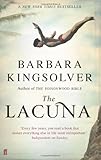
The Lacuna by Barbara Kingsolver

Some years ago I was browsing in a bookshop at Gatwick airport to add to the books I’d brought with me to read on holiday and I bought Barbara Kingsolver’s The Poisonwood Bible. I loved it. I’ve read some of her other books, but none as good as The Poisonwood Bible. When I saw that she had written The Lacuna and it had won the 2010 Orange Prize for Fiction, (actually beating Hilary Mantel’s Wolf Hall!) I bought it, expecting great things. That was two and half years ago and it’s only this year that I’ve read it.
I was disappointed as I don’t think it’s as good as either Wolf Hall or The Poisonwood Bible. There some good parts, but overall I was glad to finish reading it. It’s a long tale (670 pages), moving from Mexico in the 1930s to the McCarthy trials of alleged communists in the USA of the 1940s and 1950s. I thought it began and ended well, with good descriptions and fascinating characters, but I got bored several times in the middle.

It’s the story of Harrison Shepherd, the son of a Mexican mother and an American father and it’s told through his diaries and letters together with genuine newspaper articles, although whether they reported truth or lies is questionable. It begins in Mexico where Harrison’s mother took him to live when she left his father to live with a Mexican businessman, she calls Mr Produce the Cash behind his back. I thought this part came to life with lyrical descriptions of the people and the landscape. But it is only in the second half of the novel that I felt Harrison himself came alive as a character, no longer talking about himself in the third person, ‘the boy’, and referring to himself as ‘I’.

Throughout the book Kingsolver intermingles real characters and events with her fictional ones and I thought that worked well. There are the artists Diego Rivera and his wife Frida Kahlo. Harrison works for Diego, mixing plaster for his huge murals he painted in Mexico City. Whilst working for Rivera, who was a communist he met and subsequently worked for the exiled Bolshevik leader, Lev Trotsky. And it is this connection that eventually lands him in difficulties later on when he had moved to live in the USA and became a novellist writing historical fiction about the Aztecs. He is accused of being a communist and being Un-American.

I found the historical parts very interesting as I knew nothing about Rivera, or his wife, and very little about Trotsky and the McCarthy trials. But eventually I found the level of detail was just too much and the story meandered, losing impetus. Harrison himself comes across as too passive, too accepting of what ever happened to him, a victim of circumstances. Much more interesting is the second narrator, Violet Brown who becomes his secretary and friend, who saved his diaries from being burnt.

There are several instances of lacunas, missing parts and gaps, scattered throughout the book. For example, some of Harrison’s diaries and notebooks go missing. As a boy he loved swimming and diving into a cave, which is only available at certain tides:

Today the cave was gone. Saturday last it was there. Searching the whole rock face below the cliff did not turn it up. Then the tide came higher and waves crashed too hard to keep looking. How could a tunnel open in the rock and then close again? … Leandro says the tides are complicated and the rocks on that side are dangerous, to stay over here in the shallow reef. He wasn’t pleased to hear about the cave. He already knew about it, it is called something already, la lacuna. (page 45)

But although The Lacuna is well written and well researched I felt there was something missing, the personal elements that brought the story to life for me were few and far between; I couldn’t feel involved and just wanted it to end. I persevered because it has had such good reviews and recommendations, but sadly it dragged for me.

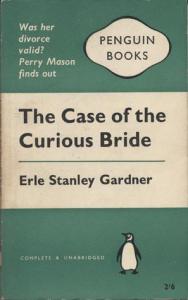
The Case of the Curious Bride by Erle Stanley Gardner

First published in 1935 The Case of the Curious Bride is the 5th Perry Mason book by Erle Stanley Gardner.

Synopsis extracted from the back cover:

An attractive young woman calls at Perry Mason’s office to inquire if a friend can marry again without getting a divorce as her husband had been presumed killed in an air accident seven years previously. Mason sees sinister implications and as a result of his investigations – helped by his secretary Della Street – dramatic developments lead to a court case in which the tables are turned on the police.

My view:

There are plenty of twists and turns in this mystery surrounding Rhoda Montaine, who is accused of murder and it certainly looks as though she is guilty.  I found it very puzzling. I also thought it was unsatisfactory as Perry Mason resorts to trickery, fooling everyone. At times I was at a complete loss to understand what he was doing and why. It all becomes clear at the end, but I found it far-fetched.

  • Paperback: 208 pages
  • Penguin Books 1960 (first published by Cassell 1935)
  • Source: I bought the book
  • My Rating 2/5
  • Challenges: Mount TBR, What’s in a Name 6 (a book with an emotion in the title)

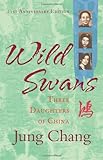
Wild Swans by Jung Chang

It’s taken me a couple of months to read Wild Swans: Three Daughters of China (first published in 1991), Jung Chang’s book about her grandmother, her mother and herself, telling of their lives in China up to and during the years of the violent Cultural Revolution. Her family suffered atrociously, her father and grandmother both dying painful deaths and both her mother and father were imprisoned and tortured.

Needless to say that this is a harrowing book to read, but it’s also an eye-opener (for me at any rate) about what happened in China under Mao.

Jung Chang was born in Yibin, Sichuan Province, China, in 1952. She was briefly a Red Guard at the age of fourteen, and then a peasant, a ‘barefoot doctor’, a steelworker and an electrician. She came to Britain in 1978, and in 1982 became the first person from the People’s Republic of China to receive a doctorate from a British university. Wild Swans  won the 1992 NCR Book Award and the 1993 British Book of the Year. She lives in London.

In Wild Swans she casts light on why and how Mao was able to exercise such paralysing control over the Chinese people. His magnetism and power was so strong and coupled with his immense skill at manipulation and his ability to inspire fear, it proved enough to subdue the spirit of most of the population; not to mention the absolute cruelty, torture and hardships they had to endure.

I wondered how she knew so much about what happened to her mother and grandmother (I don’t know nearly as much about mine) but in the Introduction she explains that when her mother came to visit her in London they talked every day for months. She talked about their eventful lives – her grandmother had been a concubine of a warlord general and her mother had joined the Communist underground at the age of 15. She also recorded sixty hours of her memories.

I wrote a bit about the book in a Book Beginnings post at the end of last November, when I’d just started to read it. It’s a personal story, reflecting the twentieth century history of China. A remarkable book, full of courage and spirit.

  • Paperback: 720 pages
  • Publisher: HarperPress; New edition edition (1 Mar 2012)
  • Language: English
  • ISBN-10: 0007463405
  • ISBN-13: 978-0007463404
  • Source: borrowed from a friend