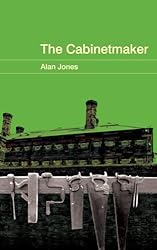
The Cabinetmaker by Alan Jones

When Alan Jones emailed me about reading his book The Cabinetmaker he described it as a gritty crime novel based in Glasgow that tells the story of a local cabinetmaker, Francis Hare, father of a murdered son, and John McDaid, a young detective on the investigation.

He went on to say that it contained some strong language, some sleazy police and a smattering of Glasgow slang, which did make me unsure I wanted to read it. But he also said that it combined Glasgow gang culture, sloppy policing and amateur football with fine furniture making and taking that into account I thought that it probably wouldn’t be your normal run-of-the mill crime fiction.

And I was right – it is different and I did like it, despite some of the language (which actually is no worse than in some other books) and there are no truly gruesome descriptions to put me off. In parts I thought it lost focus somewhat, the crime and justice aspects becoming a bit lost in a wealth of detail about football and furniture making, but apart from that it is a intricately plotted book which had me totally gripped. By the end of the book I realised that there is a purpose to those chapters beyond Alan Jones’s obvious love of football and furniture making. Within them lie the clues to what was really going on in Francis and John’s lives.

The Cabinetmaker follows John McDaid’s life from his first day as a detective up to his retirement in 2008, focussing on one crime – the killing of Patrick Hare, a student by a gang of thugs in Glasglow’s west end. The killers were tried but walked free.  From that point onward the story is of John and Francis and their search for justice.  Patrick’s death was a turning point in their lives and although they become friends through a shared interest in football and cabinet making, under pinning everything is their desire for justice.

There are many characters, including police and villains and at times some of them did begin to blur in my mind, with the exception of Francis, John and Sarah, Patrick’s girl friend, who all stand out as vivid and believable people. There are many twists and turns in the story, before the full truth is revealed. It’s a novel of loss and retribution.

Alan Jones (his pen name) is Scottish, living on the Clyde coast. I see from this interview on Omnimystery News that he is writing another book – I’ll be looking out for it.

The Last Enchantment by Mary Stewart

Magic is the door through which mortal man may sometimes step, to find the gates in the hollow hills, and let himself through into the halls of the other world. (The Last Enchantment, page 121)

I love books that take me away to another time and place – The Last Enchantment (1979) by Mary Stewart is just such a book, magically whisking me back to the time of King Arthur and Merlin. This is not a book to read quickly, but a book to savour both for the story and for Mary Stewart’s descriptive writing.

I’ve been fascinated with the legend of King Arthur from childhood, the tales of the Sword in the Stone, the Knights of the Round Table, the Lady of the Lake, and of Merlin and so on. The Last Enchantment is the third book of the Arthurian Saga, a book of myth and legend and about the conflict between good and evil.

The narrator is Merlin and this book is set after Arthur has become the High King of Brtian, he has drawn the sword, Caliburn (Excaliber) from the stone and he is now plunged into battle against the Saxons , whilst Merlin is in a battle of a different kind, against Arthur’s half-sister, Morgause, the rose-gold witch. Merlin is now getting older and although he is losing his powers, they have not totally deserted him.

In fact this is a story of power, peopled by many richly depicted characters from Bedwyr, Arthur’s companion, who takes the place of Lancelot in this book, to Nimue (Niniane, Vivien), Merlin’s pupil who Merlin initiates into his magic powers. There is the story of Mordred’s birth (his mother Morgause had seduced Arthur), of Guinevere and her rape by King Melwas, and Merlin’s illness and recovery in the wild forest, and his incarceration in the Crystal Cave.

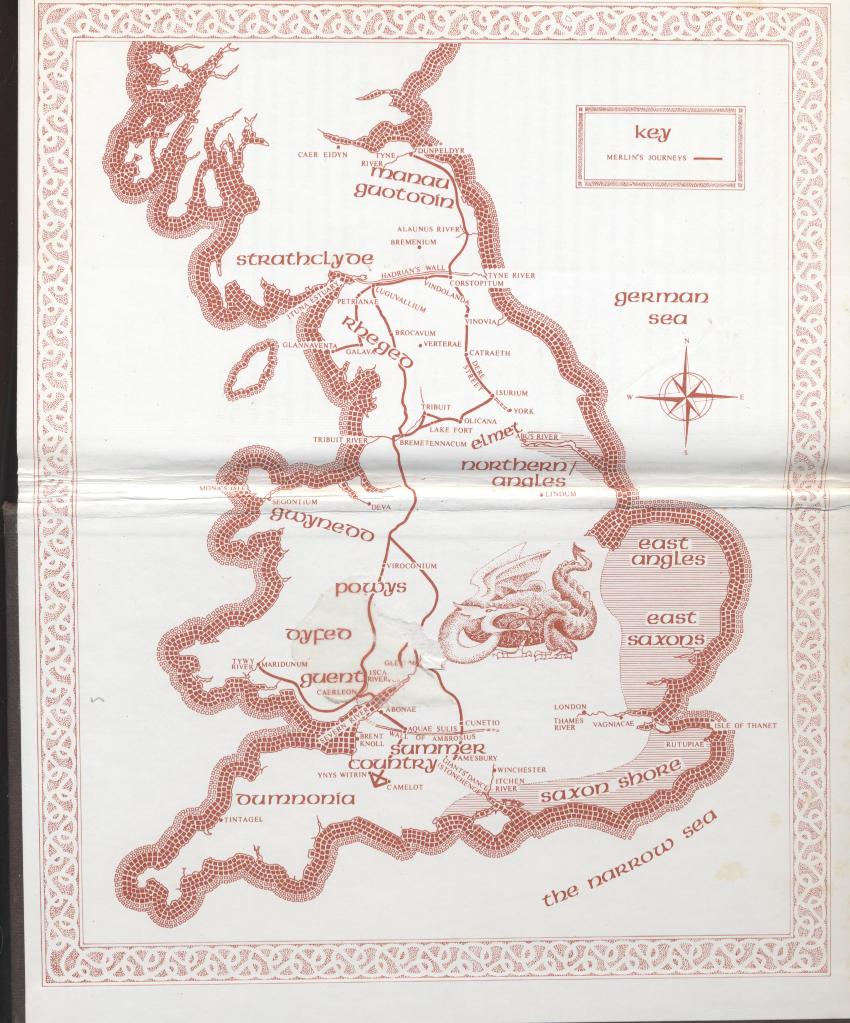
Above all, it is about Merlin and his relationship with Arthur and towards the end of the book with Niniane. As it narrated through Merlin’s eyes the battles that followed Arthur’s acsension are not the main focus of the book. He travels around the country and there is a helpful map on the endpapers of my hardback copy showing the routes he took and the places he visited.

Last Enchantment map 001

(I spent quite some time studying the map and working out what the places are called today.)

Merlin’s travels took him to numerous places including Dunpeldyr in the north-east, possibly on the site of the hill-fort on the present day Traprain Law, not far from Haddington and Dunbar, now in Scotland, then part of Northumbria; Caerleon (now the northern outskirts of Newport in South Wales); Galava (near present day Ambleside in the Lake District; and Vindolanda on the Great Wall of the Emperor Hadrian, where he visits his friend Blaise, to name but a few. It tells of how Merlin built Camelot on the hill then known as Caer Camel (caer is Welsh for fort or castle), a fictional place on a flat topped hill, not far from the sea and the Lake with its Isle of Glass.

Many years ago I read the first two books, The Crystal Cave (1970), about Merlin’s early days and The Hollow Hills (1973), in which Arthur learns who he is and becomes King.  I’d borrowed the books from the library, but never read the third book, so I was really happy when I found it in a library sale a few years ago for just 10p. I can’t think why I’ve not read it until this year, just too many other books clamouring to be read all at once, I expect.

Mary Stewart was born Mary Rainbow in January 1916 in County Durham. She currently lives in Scotland. On Goodreads I found this video of an interview with Mary Stewart in 1992 in which she talks about her writing and another interview with her in 1999, published by the University of Rochester. There are 2 other books following on from the Merlin TrilogyThe Wicked Da(1983), in which Mordred is the main character and The Prince and the Pilgrim (1995).

This historical fantasy is a perfect book not only for the Mount TBR Reading Challenge, but also the Once Upon a Time Challenge, the Historical Fiction Reading Challenge and because Mary Stewart lived in Scotland the Read Scotland 2014 Challenge too.

Mount TBR: March Checkpoint

Mount TBR 2014It’s time for the first quarterly check-in post for Mount TBR. Last year I read 34 of my TBR books and I’m determined to read more than that this year. I’ve made a good start, mainly down to taking part in the TBR Triple Dog Dare, which requires you to read only the books you’ve owned before 1 January 2014, until 31 March (I’ll do a separate post for the Triple Dog Dare.)

Bev asks participants in her Challenge to do two things:

1. Tell us how many miles you’ve made it up your mountain (# of books read).  If you’re really ambitious, you can do some intricate math and figure out how the number of books you’ve read correlates to actual miles up Pike’s Peak, Mt. Ararat, etc. And feel free to tell us about any particularly exciting adventures you’ve had along the way.

As today is the last day of March and I still have nearly 200 pages of one book and over 400 pages of another book to read before I finish them (which I won’t do today) here are my answers.

Mont Blanc (photo from Wikipedia)

I’m very nearly at the top of Mont Blanc (15, 781 ft) with just half a book to finish. I’ve climbed Pikes Peak (14, 115 ft), which means I’ve climbed 29, 896 ft, or just over 5.6 miles, or 23.5 books. This is a vast improvement on this time last year when I’d read just 4 TBRs.

and my answers to two more questions are:

C. Have any of the books you read surprised you–if so, in what way (not as good as anticipated? unexpected ending? Best thing you’ve read ever? etc.)

Cloud Atlas by David Mitchell surprised me in a good way. I’d tried to read it several times before and had given up. It was watching the movie that gave me the incentive to try it again and I’m so glad I did as I was surprised at how good it is.

D. Which book (read so far) has been on your TBR mountain the longest? Was it worth the wait? Or is it possible you should have tackled it back when you first put it on the pile? Or tossed it off the edge without reading it all?

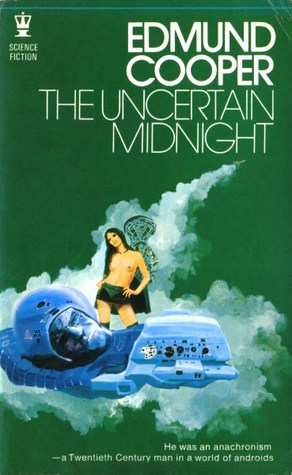
The book that has been on my TBR Mountain the longest is The Uncertain Midnight by Edmund Cooper. I’m not sure exactly how long I’ve had it but it our copy is a 1971 edition, so we’ve probably had it since the early 70s – an amazing 40+ years! It was worth the wait as I enjoyed this 1950s sci-fi book.

The King's Evil by Edward Marston

I’m still reading from my own unread books and turned to The King’s Evil for some historical crime fiction. It’s the first in Edward Marston’s Restoration series, featuring Christopher Redmayne, an architect and Jonathan Bale, a parish constable.
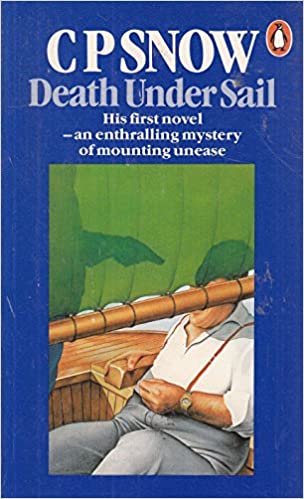
The King’s Evil is set in London in September 1666, just as the Great Fire of London has begun, eventually devastating a large part of the old medieval City of London. I liked Marston’s description of the fire, conjuring up the sights and sounds, the fear and panic it caused and the efforts to stop its spread – although I’m sure they didn’t use ‘dynamite’ to blow up houses to create a fire break. Anyway this anachronism didn’t spoil my enjoyment of this book.

Redmayne, a Royalist – a supporter of the Court and King Charles II – has designed a new house for Sir Ambrose Northcott and Bale is a Puritan who views Charles with great disapproval and is wondering if the fire is a consequence of the corruption in society as a result of the Restoration of the Crown:

England was once more ruled by a Stuart king. A monarchy which Jonathan had been pleased to see ended was now emphatically restored. As a result, London was indeed a wicked city and nobody was better placed to see the extent of its depravity than someone who patrolled the streets in the office of constable. Jonathan was a God-fearing man who always sought guidance from above and he was bound to wonder if the conflagration really was a sign of divine anger. There were Biblical precedents of cities being punished for their corruption. (page 26)

The two men are brought together with the discovery of Sir Ambrose’s dead body in the cellars of his partly built new house. It’s a good story with some interesting characters, including Jesus-Died-To-Save-Me Thorpe and Redmayne’s older brother Henry, elegant, fashionable and a dissipated rake, who had introduced Christopher to Sir Ambrose. But it’s the setting in time and place that interested me most – the period when Christopher Wren was the leading architect in rebuilding London – the bustle and energy of the times and the lingering conflict between Royalists and Parliamentarians.

The mystery of who killed Sir Ambrose moves along swiftly, with a few surprises along the way, as you would expect, but nothing too surprising. Redmayne travels to Sir Ambrose’s country house, Priestfield Place in Shipbourne, Kent and crosses the Chanel to Paris following the trail of the killer. It’s the ending of the book that let it down somewhat for me – it’s all a bit rushed and abrupt, but overall I enjoyed it and will read more in the series.

Edward Marston, who also writes under the name of Keith Miles, is a prolific author. He is a former chairman of the Crime Writers’ Association. He has several series of books, listed on his website and also on Fantastic Fiction.

The King’s Evil fits into several challenges I’m doing – The Mount TBR Reading Challenge, TBR Triple Dog Dare,the Historical Fiction Challenge, My Kind of Mystery Challenge and What’s in a Name (royalty category).

Death Under Sail by C P Snow

I didn’t know that C P Snow had written crime fiction. I’d read some of his books many years ago – the Strangers and Brothers series, in which he had coined the phrase ‘the corridors of power‘. I won Death Under Sail, Snow’s very first novel, in one of Bev’s Mount TBR Checkpoints at My Reader’s Block last year! It was first published in 1932, when Snow was 26 and a research scientist at Cambridge.

This is a classic mystery, a type of ‘country house’ mystery, but set on a wherry (a sailing boat) on the Norfolk Broads, where Roger Mills, a Harley Street specialist, is taking a group of six friends on a sailing holiday. When they find him at the tiller with a smile on his face and a gunshot through his heart, all six fall under suspicion.

The book is narrated by Ian Capel, who is older than the other friends and has joined the party a week later than the others. They are all old friends, with the exception of Tonia, Philip’s new girl friend, who all get on very well together; Avril and Christopher are engaged and William is a young doctor, a colleague of Roger’s. Ian describes them as ‘some of the pleasantest people whom I had ever known‘ – but are they, because one of them must be the murderer?

Ian asks his old friend Finbow, a civil servant home on leave from Hong Kong, to help them discover who did it. Meanwhile the police are also investigating the murder in the form of Detective Sergeant Aloysius Birrell. Finbow and Birrell provide an interesting contrast in the way they work – Finbow looks at the crime from a psychological and philosophical point of view, ruling out suspect after suspect, whereas Birrell looks for facts and evidence – even down to diving into the river himself to look for the missing gun and Roger’s log book. It’s ingenious!

C P Snow (1905 – 1980) was an English novelist and physicist. He was knighted in 1957 and made a life peer in 1964. His last novel, A Coat of Varnish is also crime fiction.

Mini Book Reviews

I’ve got a bit behind with writing about the books I’ve read recently, so to catch up I thought I just write some quick reviews. These books are all from my TBRs, two of them good/ excellent books and the third a bit of a disappointment:

First the good – The Breaker by Minette Walters

From the back cover:

Twelve hours after a woman’s broken body is washed up on a deserted shore, her traumatized three-year-old daughter is discovered twenty miles away wandering the streets of Poole …

But why was Kate killed and her daughter, a witness, allowed to live? And why weren’t they together? More curiously, why had Kate willingly boarded a boat when she had a terror of drowning at sea?

Police suspicion centres on both a young actor, whose sailing boat is moored just yards from where the toddler is found, and the murdered woman’s husband. Was he really in Liverpool the night she died? And why does their daughter scream in terror every time he tries to pick her up … ?

This kept me guessing all the way through and I kept changing my mind about who the murderer was, so I liked this book. It moves between the third person narrative and copies of reports and faxes etc that form part of the police investigation. There are lots of clues, twist and turns and plenty of red herrings. A satisfying book. I’d like to read more of Minette Walters’s books.

Then the excellent – Purple Hibiscus by Chimamanda Ngozi Adichie.

From the back cover:

Fifteen-year-old Kambili lives in fear of her father, a charismatic yet violent Catholic patriarch who, although generous and well-respected in the community, is repressive and fanatically religious at home. Escape and the discovery of a new way of life come when Nigeria is shaken by a military coup, forcing Kambili and her brother to live in their aunt’s home, a noisy place full of laughter. The visit will lift the silence from her world and, in time, unlock a terrible, bruising secret at the heart of her family life.
This is a fabulous book, one of the best I’ve read this year and it’s even more amazing that this was Adichie’s first book. I read her second book Half of a Yellow Sun a few years ago and was completely taken with that book too. It’s beautifully written – Kambili’s father and aunt are such rounded characters, in other hands they could have just been caricatures. At times I struggled to read the physical abuse scenes, they were so vivid.

And finally, the disappointment – Her Fearful Symmetry by Audrey Niffenegger. 

From the back cover:

When Elspeth Noblin dies, she leaves her beautiful flat overlooking Highgate Cemetery to her twin nieces, Julia and Valentina Poole, on the condition that their mother is never allowed to cross the threshold.  But until the solicitor’s letter falls through the door of their suburban American home, neither Julia or Valentina knew their aunt existed. The twins hope that in London their own, separate lives can finally begin but they have no idea that they have been summoned into a tangle of fraying lives, from the obsessive-compulsive crossword setter who lives above them to their aunt’s mysterious and elusive lover who lives below them and works in the cemetery itself.

As the twins unravel the secrets of their aunt, who doesn’t seem quite ready to leave her flat, even after death, Niffenegger weaves together a delicious and deadly ghost story about love, loss and identity.

I’d found The Time Traveler’s Wife disappointing and irritating and at first I thought Her Fearful Symmetry was going to be better. It started off well and I liked all the information about Highgate Cemetery, but actually overall this book was disappointing too. I thought it was all rather predictable – I easily guessed the secrets and whilst the ghost elements are interesting at first I found it all became a bit dull and unconvincing. However, the chapters on Martin, the obsessive-compulsive are much more interesting and brought the book a bit more to life. The decision Valentina made was so ridiculous I just couldn’t suspend my disbelief.