Cause of Death by Patricia Cornwell

Cause for Death is the seventh book in the Dr Kay Scarpetta murder mystery series. It’s a secondhand copy that had been on my TBR shelves for several years and I think I must have started to read it before as the opening chapter seemed very familiar.

It begins well enough when a reported is found dead in the Elizabeth River in Virginia on New Year’s Eve.

From the back cover:

New Year’s Eve and the final murder scene of Virginia’s bloodiest year takes Scarpetta thirty feet below the Elizabeth River’s icy surface. A diver, Ted Eddings, is dead, an investigative reporter who was a favourite at the Medical Examiner’s office. Was Eddings probing the frigid depths of the Inactive Shipyard for a story, or simply diving for sunken trinkets? And why did Scarpetta receive a phone call from someone reporting the death before the police were notified?

The case envelops Scarpetta, her niece Lucy, and police captain Pete Marino in a world where both cutting-edge technology and old-fashioned detective work are critical offensive weapons. Together they follow the trail of death to a well of violence as dark and forbidding as water that swirled over Ted Eddings.

However, although the murder investigation was interesting I wasn’t all interested in the terrorist/FBI/religious fanatics scenes that followed.  I don’t think I’ll bother reading any more of these books.
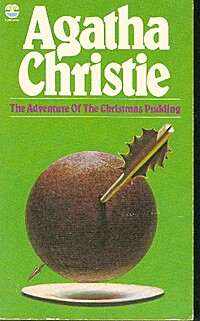
The Adventure of the Christmas Pudding by Agatha Christie

It seemed the right time of year to read The Adventure of the Christmas Pudding and a Selection of Entrées by Agatha Christie. It’s a collection of six short stories but only the first one, the title story, has any Christmas connection.
As Agatha Christie explained in her Foreword this story was an ‘indulgence‘, recalling the Christmases of her youth, spent at Abney Hall:

The Christmas fare was of gargantuan proportions. I was a skinny child, appearing delicate, but actually of robust health and perpetually hungry! The boys of the family and I used to vie with each other as to who could eat the most on Christmas Day. Oyster Soup and Turbot went down without undue zest, but then came Roast Turkey, Boiled Turkey and an enormous Sirloin of Beef. The boys and I had two helpings of all three! We then had Plum Pudding, Mince-Pies, Trifle and every kind of dessert. During the afternoon we ate chocolates solidly. We neither felt, nor were sick! How lovely to be eleven years old and greedy!

But I don’t think this story reflects her own Christmas experience apart from the setting, that is, for this is a collection of crime fiction! Poirot is invited to spend ‘a good old-fashioned Christmas in the English countryside’ in a 14th century English manor house, a prospect that fills him with apprehension, only agreeing to go when he hears there is oil-fired central heating in the house. There is of course a reason for inviting him – for a discreet investigation into the theft of a priceless ruby stolen from a Far Eastern prince. The Christmas Pudding in question is a ‘large football of a pudding, a piece of holly stuck in it and glorious flames of blue and red rising round it’. For a short story this is really complicated with several twists for Poirot to work through.

Four of the other stories feature Poirot, with the last one, Greenshaw’s Folly being a Miss Marple mystery, which I read last year in Miss Marple and Mystery.  Greenshaw’s Folly is a house, an architectural monstrosity, visited by Raymond West (Miss Marple’s nephew) and Horace Bindler, a literary critic. Later, Miss Greenshaw having drawn up a new will, is found murdered.

The remaining four stories concern the murder of a man found a Spanish chest (The Mystery of the Spanish Chest), a widow who is convinced her nephew had not killed her husband despite all the evidence against him (The Under Dog), a man who has inexplicable changed his eating habits is found dead (Four and Twenty Blackbirds), and a man who has the same dream night after night that he shoots himself is found dead (The Dream).

I enjoyed reading these stories. They are of varying length and are all cleverly done, if a little predictable.

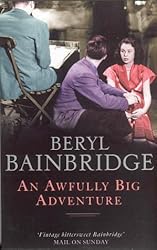
An Awfully Big Adventure by Beryl Bainbridge

It’s trite to say that Beryl Bainbridge’s An Awfully Big Adventure is ‘awfully good’ – but it is!
First published in 1989 and shortlisted for the Booker Prize, this is set in 1950, as a Liverpool repertory theatre company are rehearsing its Christmas production of Peter Pan. The story centres around Stella, a teenager and an aspiring actress who has been taken on as the assistant stage manager.

It’s semi-autobiographical based on Beryl Bainbridge’s own experience as an assistant stage manager in a Liverpool theatre. On the face of it this is a straight forward story of the theatre company but underneath it’s packed with emotion, pathos and drama. And it’s firmly grounded in a grim post-war 1950s England, food rationing still in operation and bombed buildings still in ruins overgrown with weeds.

Stella lives with her Uncle Vernon and Aunt Lily, who run a boarding house. To a large extent Stella escapes real life, living in the world of her own imagination. Her mother is not on the scene, but Stella secretly phones her from a public phone box to talk about her life – her mother just says ‘the usual things’ to her. She’s an innocent, naive and impressionable, she’s troubled and confused, wanting to grow up quickly. She’s ready to fall in love and becomes obsessed by Meredith Potter, the company director, not realising he is simply not interested in her.

After playing a cameo role in Caesar and Cleopatra in the next production, Peter Pan, she ‘manages’ Tinkerbell, shining a torch and ringing a little handbell. The title is taken from Peter Pan, the play about the boy who never grew up, whose attitude to death was ‘To die will be an awfully big adventure.’ Bainbridge’s use of Peter Pan emphasises the themes of reality versus imagination, the loss of childhood innocence, and the quest for love. Stella, whose mother had abandoned her, is most upset by the scene in the play where Peter tells Wendy how his mother had forgotten him when he tried to go back home – the windows were barred and another little boy was in his bed. It’s her mother’s apparent lack of love for Stella that is perhaps the initial cause of what eventually happens.

Love in its various guises is a prominent theme running through the book. When Meredith asks her what she thinks J.B. Priestley’s play Dangerous Corner is about, she says: €˜Love. People loving people who love somebody else.’ And, indeed, An Awfully Big Adventure is about people who are in love with somebody else and they all have secrets to hide.

I was a bit confused by the opening chapter and it was only when I reached the end that I understood it, when the truth that had been hinted at became obvious. It really is an awfully good book.

Color Coded Challenge 2014 – Completed

Color Coded Challenge

For a while this year I thought I would not complete this Challenge, hosted by Bev at My Reader’s Block – but I have!

It’s a simple challenge – to read nine books in the following categories – the links are to my posts on the books:

1. A book with ‘Blue’ or any shade of Blue (Turquoise, Aquamarine, Navy, etc) in the title – Blue Heaven by C J Box.

2. A book with ‘Red’ or any shade of Red (Scarlet, Crimson, Burgundy, etc) in the title – A Study in Scarlet by Arthur Conan Doyle.

3. A book with ‘Yellow’ or any shade of Yellow (Gold, Lemon, Maize, etc.)in the title – The Yellow Wallpaper by Charlotte Perkins Gilman.

4. A book with ‘Green’ or any shade of Green (Emerald, Lime, Jade, etc) in the title –  Christmas at Thrush Green by Miss Read.

5. A book with ‘Brown’ or any shade of Brown (Tan, Chocolate, Beige, etc) in the title – Portrait in Sepia by Isabel Allende.

6. A book with ‘Black’ or any shade of Black (Jet, Ebony, Charcoal, etc) in the title – Black Dogs by Ian McEwan.

7. A book with ‘White’ or any shade of White (Ivory, Eggshell, Cream, etc) in the title – Seven White Gates by Malcolm Saville.

8. A book with any other color in the title (Purple, Orange, Silver, Pink, Magneta, etc.) – Purple Hibiscus by Chimamanda Ngozi  Adichie

9. A book with a word that implies color (Rainbow, Polka-dot, Plaid, Paisley, Stripe, etc.) —Dying in the Wool by Frances Brody

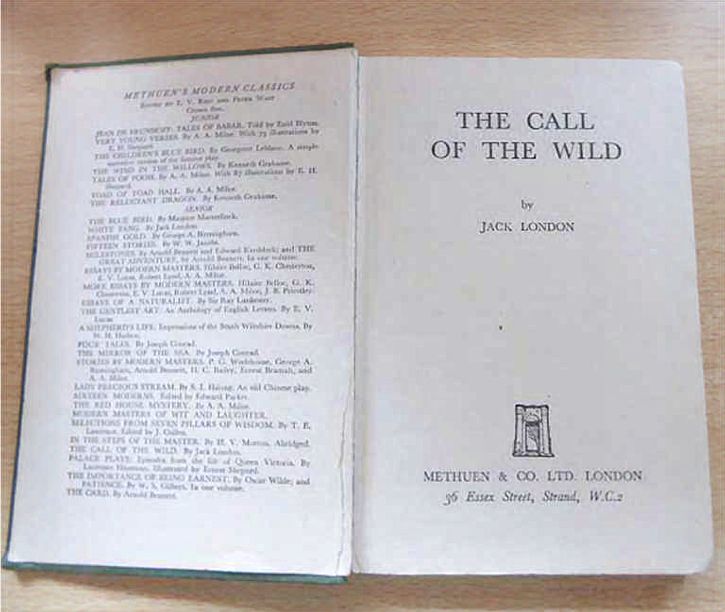
The Call of the Wild by Jack London

The Call of the Wild and White Fang by Jack London are books that I’ve known about as long as I can remember – they were books my parents owned – but I’ve never read them, until now.  So, I was pleased when The Call of the Wild, Jack London’s first book came out as my Classics Club Spin book.  I would have read it one day anyway but the Spin gave me the nudge to read it now. I wasn’t expecting to find it such a beautiful, moving and poignant book, but it is. And it has so much packed into its 106 pages in my little hardback copy.

It begins in 1897 when Buck, a cross between a St Bernard and a Scotch Shepherd (Collie) was stolen from his home in the Santa Clara Valley in California and taken to the Yukon where strong sled dogs were needed during the Klondike Gold Rush. It’s a shock to Buck (what an understatement) as he moves from his pampered life on a California ranch where he had free rein, swimming, hunting and playing to the harsh realities and cruelty of the life of a working dog in the wastes of Alaska, where the ‘law of club and fang‘ predominated. The book is told from Buck’s point of view, but this is no cutesy, sentimental animal story. Buck has to fight for existence and as he learnt by experience, instincts that were long dead came alive in him:

The domesticated generations fell from him. In vague ways he remembered back to the youth of the breed, to the time the wild dogs ranged in packs through the primeval forest and killed their meet as they tracked it down. It was no task for him to learn to fight with cut and slash and the quick wolf snap.

…  And when, on the still cold nights, he pointed his nose at a star and howled long and wolflike, it was his ancestors, dead and dust, pointing nose at star and howling down through the centuries and through him. … the ancient song surged through him and he came into his own again (page 24)

After changing owners several times, each worse than the one before he is eventually saved from death by John Thornton who nurses him back to health and for a while it is the love between man and dog that keeps Buck with him. Eventually however, the call of the wild is too strong!

Apart from the story which kept me turning the pages to find out what happened next it’s the quality of London’s writing, the vivid descriptions and the haunting mystical sense of the wild that captivated me – this passage for example:

There is an ecstasy that marks the summit of life, and beyond which life cannot rise. And such is the paradox of living, this ecstasy comes when one is most alive, and it comes as a complete forgetfulness that one is alive. This ecstasy, this forgetfulness of living, comes to the artist, caught up and out of himself in a sheet of flame; it comes to the soldier, war-mad in a stricken field and refusing quarter; and it came to Buck, leading the pack, sounding the old wolf-cry, straining after the food that was alive and that fled swiftly before him through the moonlight. (pages 37-38)

I’ll be reading White Fang soon.

Christmas at Thrush Green by Miss Read

I was in the library a few days ago and Christmas at Thrush Green caught my eye with its sparkly, snowy front cover. Years ago I read as many of Miss Read’s books that I could find in the library, but I didn’t think I’d read this one. ‘Miss Read’ is a pseudonym for Dora Saint (1913 – 2012) who wrote over 40 books for adults and children.

Christmas at Thrush Green was first published in 2009 and the title page reveals that it was written by Miss Read with Jenny Dereham. In the Acknowledgements at the front of the book Miss Read explained that she and Jenny Dereham, her long-time editor had:

… discussed the initial idea, developed the unfolding story-line and then I left her to put that into words, based on the Thrush Green characters. I am more than happy with the result and hope those people who enjoyed all the other Thrush Green books will enjoy this as much.

So, not exactly by Miss Read, but still an enjoyable book and as it was so many years ago that I read some of the Thrush Green books I can’t compare this with the other books. And I’d read more of her Fairacre books than the Thrush Green ones. It’s comfort reading, nearly 350 pages that kept me entertained, with a few memorable characters amongst its many characters. There are so many characters that I began to get confused, as some of them just melded together in my mind. Each character is introduced with a brief biography and history, which helped me sort out some of them.

Preparations for the Christmas Nativity play are under way when some of the children come down with chicken pox. Ella Bembridge is losing her sight and behaving strangely, Nelly Piggott, the owner of The Fucshia Bush Tea Shop is thrilled at winning an award, there are newcomers to Thrush Green who haven’t settled in and have upset some of the locals. I particularly liked the episodes feating the vicar, Charles Henstock and his wife Dimity, affectionately called ‘Dim’. It’s a nostalgic read about village life at Christmas time – snow, parties, and church services.

As a result of reading this I’ve decided I want to re-read/read more of Miss Read’s books, and have started Village Diary.